Imagine standing on your bathroom scale on a Tuesday morning. You look down. The numbers flicker and then settle on a solid, undeniable 100.0 kg. For many, that three-digit figure feels like a wall. It is an undeniable truth that forces you to confront your health, your energy levels, and your future. This was the exact moment of reckoning for Shiv Seth, a 42-year-old businessman who realized his heart was pounding so loudly at night he couldn’t sleep. He knew he had to change. The journey to lose 30kg is not just about aesthetics. It is a fundamental metabolic recalibration. If you are starting at 100kg, your primary goal is likely reaching a healthier 70kg frame. This transition requires more than a simple diet. It requires a deep understanding of how your body uses energy. This guide will break down the exact science and practical steps needed to make that 30kg drop a reality.
Understanding the 100kg Starting Point
Table of Contents
- 1 Understanding the 100kg Starting Point
- 2 The Mathematics of the 30kg Loss
- 3 Nutrition Frameworks for Massive Weight Loss
- 4 The Science of Cellular Change: mTOR and Insulin
- 5 Exercise Strategies for Joint Protection
- 6 Practical Meal Prep for Fat Loss
- 7 Success Stories: From 100kg to 70kg
- 8 Breaking Through the Weight Loss Plateau
- 9 The Psychological Identity Shift
- 10 Conclusion: Your Roadmap to 70kg
A body weight of 100 kg may place an individual in a higher-weight category or a medically elevated risk range, depending on their height and overall health profile. At this weight, the body is under significant metabolic stress. Excess adipose tissue acts as an active endocrine organ. It releases pro-inflammatory cytokines that contribute to chronic low-grade inflammation. This inflammation is a primary driver for insulin resistance. When your cells stop responding to insulin, your body struggles to manage blood sugar. This often leads to a cycle of fat storage and constant hunger. Research from the National Institutes of Health (NIH) suggests that being at this weight significantly increases the risk for type 2 diabetes and hypertension.
The physical load is equally taxing. Every extra kilogram of body weight puts approximately four kilograms of added pressure on your knee joints. For a 100kg individual, simple tasks like walking or climbing stairs can lead to joint stiffness and fatigue. This is why the journey to 70kg is so transformative. You aren’t just losing fat. You are literally lifting a heavy pack off your skeletal system. The first step is acknowledging where you are without judgment. As clinical experts suggest, obesity is a medical condition, not a personal flaw.
The Mathematics of the 30kg Loss
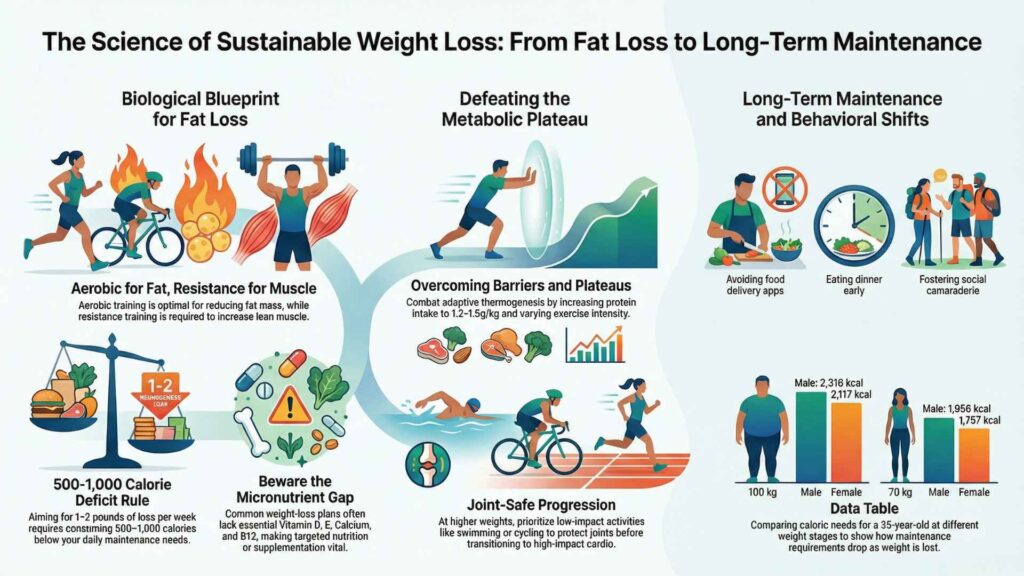
Weight loss is essentially an energy balance equation. However, it is a dynamic one. To move from 100kg to 70kg, you must understand your Total Daily Energy Expenditure (TDEE). Your TDEE is the total number of calories you burn in 24 hours. It consists of your Basal Metabolic Rate (BMR), the thermic effect of food (TEF), and your physical activity. Here is the thing: as you lose weight, your TDEE changes. A 100kg body requires more energy to maintain its vital functions than a 70kg body. This means your calorie needs will decrease as you get smaller.
To calculate your starting point, we use the Mifflin-St Jeor equation. It is the gold standard for accuracy in healthy adults.
Caloric Requirements: 100kg vs. 70kg
The following table compares the energy needs of a 35-year-old male and female at both weights, assuming a height of 175cm and a sedentary lifestyle.
| Weight | Gender | BMR (Basal Metabolic Rate) | TDEE (Sedentary – 1.2x) | Recommended Deficit Intake |
| 100 kg | Male | 1,930 kcal | 2,316 kcal | 1,816 kcal |
| 100 kg | Female | 1,764 kcal | 2,117 kcal | 1,617 kcal |
| 70 kg | Male | 1,630 kcal | 1,956 kcal | 1,456 kcal |
| 70 kg | Female | 1,464 kcal | 1,757 kcal | 1,257 kcal |
What this really means is that a 100kg man can eat 2,316 calories just to stay the same weight. But once he reaches 70kg, that same amount of food would cause him to gain weight. You must recalculate your TDEE every 4 to 6 weeks. If you don’t, you will hit a plateau. To lose 1kg of fat, you need a deficit of roughly 7,700 calories. Spreading this over a week means a daily deficit of 500 to 1,000 calories is ideal for sustainable progress.
Nutrition Frameworks for Massive Weight Loss
When you have 30kg to lose, the “what” you eat is just as important as the “how much.” You need a strategy that preserves your muscle while burning your fat stores. There are three primary models that experts recommend for this journey.
The Balanced Plate Method
The NIH and Harvard Health both advocate for the Plate Method. This approach doesn’t require obsessive calorie counting. Instead, it focuses on volume and nutrition density. You fill half your plate with non-starchy vegetables like broccoli, spinach, or carrots. One quarter is reserved for lean protein, such as chicken breast, fish, or lentils. The final quarter is for whole grains like brown rice or quinoa. This method ensures you get enough fiber to feel full. Fiber is your best friend when reducing from 100kg. It slows digestion and prevents the insulin spikes that lead to fat storage.
Intermittent Fasting for Beginners
Intermittent Fasting (IF) is an eating pattern, not a specific diet. The 16:8 method is the most popular for beginners. You fast for 16 hours and eat during an 8-hour window. For example, you might eat between 12 PM and 8 PM. Let’s break it down: during the fasting window, your insulin levels drop significantly. This allows your body to access stored body fat for energy more easily. Research suggests that IF is particularly effective for long-term success because it is flexible. You can still enjoy your favorite foods as long as you maintain a negative energy balance during your eating window.
The Ketogenic Diet Path
The Ketogenic (Keto) diet is a high-fat, very low-carb approach. It aims to put your body into a state of ketosis. In ketosis, your liver produces ketones from fat to use as fuel instead of glucose. For someone at 100kg, Keto can offer rapid initial weight loss. This is often highly motivating. However, it requires strict adherence to under 50 grams of carbs per day. While it is excellent for short-term fat loss, it can be harder to maintain for the full duration of a 30kg journey.
The Science of Cellular Change: mTOR and Insulin
To understand why some diets work better than others, we have to look at a protein called mTOR. Think of mTOR as your body’s “growth switch.” When you eat processed carbs and high amounts of protein constantly, mTOR is always “on.” This tells your body to store calories and grow tissues, including fat. By incorporating periods of low-calorie intake or fasting, you turn mTOR “down.” This allows your body to perform a “cellular cleanup” called autophagy. This process helps your muscles and brain work better by removing faulty mitochondria.
Insulin management is the other side of the coin. High-carb diets keep insulin levels high. As long as insulin is high, your body cannot burn fat effectively. This is why reducing sugar and refined grains is non-negotiable for anyone moving from 100kg to 70kg. Even small shifts, like drinking more water and avoiding soda, can lower your baseline insulin.

Exercise Strategies for Joint Protection
At 100kg, your joints are vulnerable. High-impact exercises like running can do more harm than good early on. You need a plan that builds strength without causing injury.
Low-Impact Cardio
Swimming is arguably the best exercise for heavy individuals. The buoyancy of water supports your weight, reducing joint stress to almost zero. Water also provides 12 times the resistance of air, meaning you burn more calories per movement. If you don’t have access to a pool, cycling is a fantastic alternative. Whether on a stationary bike or outdoors, cycling is non-weight-bearing. It strengthens your legs and improves heart health without the pounding of the pavement.
Walking: The Accessible Powerhouse
Don’t underestimate the power of a brisk walk. Start with just 10 minutes a day and gradually increase to 30 minutes, 5 days a week. Use the “Talk Test” to check your intensity. You should be able to talk but not sing during your walk. This ensures you are in the fat-burning zone without overexerting your heart.
The Necessity of Strength Training
As you lose 30kg, your body will try to burn muscle for energy along with fat. Muscle tissue is metabolically active; it burns calories even when you are sleeping. By lifting light weights or using resistance bands twice a week, you tell your body to keep its muscle. This prevents the “skinny-fat” look and keeps your metabolism from crashing.
| Exercise | Duration | Calories Burned (approx. for 100kg) | Joint Impact |
| Brisk Walking | 30 mins | 200-250 kcal | Low |
| Swimming Laps | 30 mins | 400-500 kcal | Minimal |
| Stationary Cycling | 30 mins | 300-400 kcal | Low |
| Strength Training | 30 mins | 150-200 kcal | Moderate |
Practical Meal Prep for Fat Loss
One of the biggest hurdles in a 30kg journey is time. If you don’t have a plan, you will default to high-calorie convenience foods. Success requires setting yourself up for the win.
Healthy Meal Prep Ideas
- Overnight Oats: Combine half a cup of rolled oats with Greek yogurt and berries. This fiber-packed breakfast costs less than a dollar and keeps you full until lunch.
- Egg Muffins: Whisk eggs with spinach, peppers, and onions. Bake them in a muffin tin. These are high-protein, grab-and-go snacks that prevent mid-morning hunger.
- Roasted Chickpeas: A crunchy, protein-rich alternative to chips. Simply toss canned chickpeas in olive oil and paprika, then roast until crispy.
- Sheet Pan Chicken: Toss chicken breasts and mixed vegetables (broccoli, carrots) in olive oil. Roast them all at once for a week’s worth of healthy dinners.
For more personalized guidance on creating a meal plan that fits your culture and lifestyle, you can consult experts at(https://dietdekho.com/form/).

Success Stories: From 100kg to 70kg
Success leaves clues. Looking at people who have walked this path provides a blueprint. Azhar Hassan lost 70kg by focusing on discipline and heavy strength training after his father’s passing. His transformation took four years, proving that “slow and steady” is the only way to make it last.
Avery Ryder reached 100kg and felt like he couldn’t recognize himself in photos. He started with a very simple rule: balance. He didn’t eliminate his favorite foods. Instead, he learned to manage portions with intention. A simple habit of drinking 2 to 3 liters of water daily turned out to be the small shift that built real momentum. What this really shows is that meaningful change doesn’t require a drastic reset on day one, just consistent, manageable choices. You need consistency.
Breaking Through the Weight Loss Plateau
Around the 15kg mark, many people notice the scale stops moving. This is the dreaded weight loss plateau. It happens because of adaptive thermogenesis. Your body is a survival machine. When you eat fewer calories for a long time, your body lowers its metabolic rate to conserve energy. Your hunger hormones, like ghrelin, increase, and your “fullness” hormone, leptin, decreases.
To break a plateau, you have to shock the system. Try a “refeed day” where you eat at your maintenance calories for 24 hours. This signals to your brain that you aren’t starving, which can jumpstart your hormones. Alternatively, increase your NEAT (Non-Exercise Activity Thermogenesis). This means more standing, more fidgeting, and more small movements throughout the day.
The Psychological Identity Shift
Losing 30kg is a mental game. When you weigh 100kg, you may identify as “the big person.” As the weight drops to 70kg, your identity will struggle to keep up. This is often called “phantom fat”. You might still feel like you need to take up more space in a room or worry that a chair won’t hold you.
Social dynamics change too. Research shows that people are often “nicer” to individuals after they lose weight. This can be a painful realization. It highlights the weight bias that exists in our society. To stay successful, you must build a support system. Whether it is family, friends, or a professional coach, having someone to talk to about these changes is vital for mental health.
Conclusion: Your Roadmap to 70kg
The journey from 100kg to 70kg is a marathon, not a sprint. It requires a 58% reduction in your risk for chronic disease and a 100% commitment to yourself. Start by calculating your calories, choosing a low-impact exercise you enjoy, and prepping your meals. Remember the words of Shiv Seth: weight loss doesn’t require courage; it requires sheer stubbornness.
If you are ready to stop guessing and start seeing results, take the first step today. Our team of expert dietitians can help you build a sustainable, personalized plan to reach your 70kg goal.
Start your transformation here🙁https://dietdekho.com/form/)

FAQs for Google Snippets
How can I lose 30kg in 6 months? Losing 30kg in 6 months requires a consistent daily caloric deficit of about 1,000 to 1,200 calories. This is achieved through a combination of a high-protein diet, intermittent fasting, and 150-300 minutes of moderate activity per week. While aggressive, it is possible if you prioritize fiber and strength training to keep your metabolism high.
What are the best calories to lose weight for a 100kg person? For most 100kg individuals, a starting daily intake of 1,600 to 1,800 calories provides a safe 1kg per week loss. It is essential to focus on nutrient-dense calories from lean proteins and vegetables rather than “empty” calories from processed sugars and alcohol.
How do I start my 100kg to 70kg weight loss journey? The best way to start is by identifying your triggers and making one small change, such as drinking 3 liters of water daily or walking for 10 minutes after every meal. Focus on a “balanced plate” for lunch and dinner and avoid late-night snacking to naturally reduce your insulin levels.
Is 100kg to 70kg weight loss possible without loose skin? To minimize loose skin, aim for a slow weight loss of 0.5kg to 1kg per week. Incorporating strength training helps fill the space with muscle, while staying hydrated and eating a nutrient-rich diet supports skin elasticity.
BOOK YOUR APPOINTMENT

Abhinav is the Founder of Diet Dekho, helping people manage weight and lifestyle health through simple, practical nutrition and personalized diet plans.