Despite your diligent efforts in the kitchen, are you struggling to shed those excess kilogrammes? A 14 day diet plan for weight loss offers a structured, evidence-based approach to resetting your metabolic rhythm and clearing the path for long-term health. If you are starting an Indian weight loss diet, this fortnight is your chance to reclaim your energy.
If you want to lose weight, a 14-day diet plan that focuses on whole grains, plant proteins, and high-fibre vegetables is a good way to do so. It will help you create a long-term calorie deficit. By replacing refined sugars with Indian staples like millets and pulses, this plan lowers bloating and keeps blood sugar levels steady. It offers a practical way to initiate fat loss without extreme deprivation.
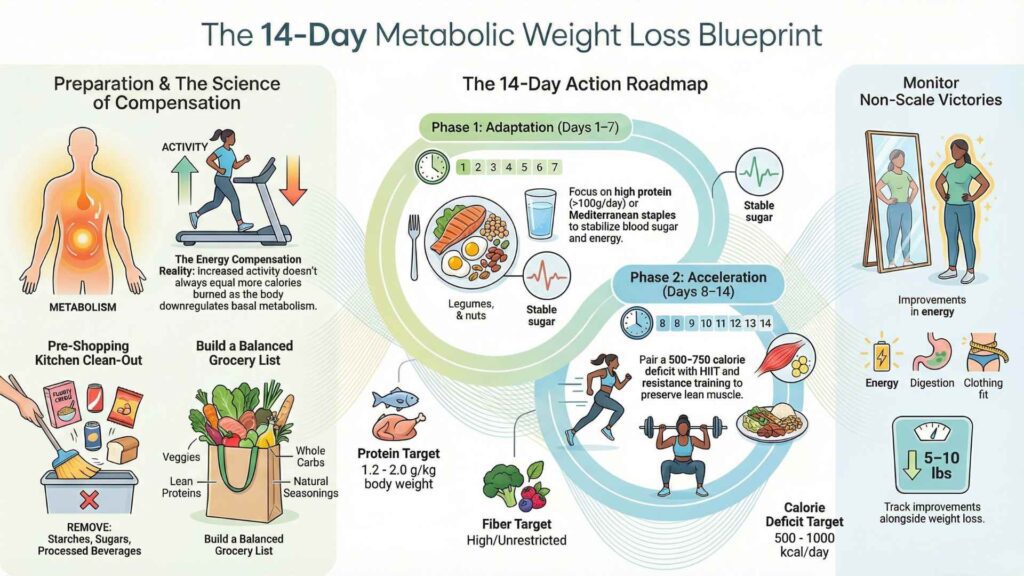
Struggling with Stubborn Weight? A 14-day reset is exactly what your body needs to overcome stubborn weight issues.
Table of Contents
- 1 Struggling with Stubborn Weight? A 14-day reset is exactly what your body needs to overcome stubborn weight issues.
- 2 The 2-Week Reality Check: Setting realistic expectations for healthy weight reduction.
- 3 Common Mistakes in Short-Term Diets: Why “crashing” leads to gaining it all back.
- 4 The Science of Satiety: How protein and fibre work together in an Indian kitchen.
- 5 Phase 1 (Days 1–7): Getting rid of toxins in your routine and fixing your metabolism.
- 6 Phase 2 (Days 8–14): Getting used to things and dealing with cravings in a natural way.
- 7 The Diet Dekho “Swap List”: Indian grains that are high in nutrients instead of refined flour and sugar.
- 8 Hydration and Sleep: The two “hidden” pillars of a successful 14-day plan.
- 9 Don’t Do It Alone: Get your personalised Indian nutrition roadmap from Diet Dekho today.
The prevalence of metabolic disorders in India has reached a critical point. Recent research shows that about 17.40% of young women living in cities like Delhi NCR have Polycystic Ovary Syndrome (PCOS). A lot of these women don’t find out they have a problem until they already have one. Health experts also say that by 2045, 134.3 million people in the US will have diabetes.
The Hidden Epidemic of Metabolic Disorders
I know it’s challenging to stay consistent when your hormones feel out of balance. This could mean that your body is having trouble with insulin resistance, which makes every calorie feel twice as heavy. When making an Indian weight loss diet, you need to think about these changes in hormones. A 14-day reset is like a circuit breaker for your body that helps it get back on track.
Resetting Your Physiological Circuit Breaker
We understand that the human body often adapts to chronic overconsumption by developing leptin resistance. This makes fat loss feel nearly impossible. By sticking to a clean eating plan for two weeks, you can help your body lower systemic inflammation. This 14-day weight loss diet plan is only for a short time, which is good for your mind because it shows you that you can get results without too much stress.
| Metabolic Indicator | Impact of 14-Day Reset | Primary Mechanism |
| Insulin Sensitivity | Improved | Reduction in refined carbohydrate spikes |
| Systemic Inflammation | Reduced | High intake of antioxidants and omega-3s |
| Gut Microbiome | Rebalanced | Diversification of fiber sources (millets/legumes) |
| Water Retention | Decreased | Balancing of sodium-potassium ratio |

The 2-Week Reality Check: Setting realistic expectations for healthy weight reduction.
To put it simply, you cannot undo years of habits in a single week, but you can definitely start the process. While social media often promises dramatic transformations, the laws of thermodynamics and endocrine balance govern fat oxidation. For most people, a safe rate of weight loss is roughly 0.5 to 1 kg/week.
Getting to Know Your Body’s Unique Chemistry
A realistic 14-day diet plan for losing weight aims for a total loss of 1 to 3 kilogrammes. A portion of this weight comes from released water as your body sheds stored glycogen and inflammation. When you follow an Indian weight loss diet, your unique health profile—like a thyroid condition or BP issues—will dictate your specific pace.
Keeping track of small wins
This is what the energy balance equation looks like:
Δ E = Ein – Eout
Δ E is the difference in weight, Ein is the number of calories you eat, and Eout is the total amount of energy you burn. But in women with PCOS, hyperinsulinemia makes the Eout part work less well. 6 Instead of obsessing over the scale, you should track your improved energy levels and better sleep quality.
Common Mistakes in Short-Term Diets: Why “crashing” leads to gaining it all back.
The allure of a “rapid weight loss plan in India” often drives people towards extreme calorie restrictions. This approach, which we call crash dieting, is counterproductive. When your caloric intake drops too low—typically below 1000 calories without a dietitian’s supervision—your body enters “starvation mode”.
The Trap of Processed “Diet” Foods
In this state, your metabolic rate slows down to conserve energy. Your body begins to break down lean muscle tissue rather than fat for fuel. Many seekers of a 14 day diet plan for weight loss also fall into the trap of purchasing “low-fat” or “sugar-free” snacks. Evidence suggests that these products often contain hidden sugar or excessive sodium to compensate for flavour loss.
Why Skipping Meals Backfires
A frequent error in the Indian context is following a diet that is too high in carbohydrates, even “healthy” ones like brown rice. Without adequate protein (15–25% of total calories) and fibre (25–30 g/ day), your satiety levels remain low. Skipping meals, particularly breakfast, can disrupt your metabolism and often leads to excessive late-night eating.
| Common Mistake | Physiological Consequence | Recommended Fix |
| Skipping Breakfast | Metabolism slows; evening overeating occurs | Eat a protein-rich meal within 2 hours of waking |
| Over-exercising | Adrenal fatigue and increased cortisol | Focus on consistent, moderate activity (walking/yoga) |
| Under-eating | Muscle loss and metabolic adaptation | Maintain a moderate deficit (1200-1500 kcal) |
| Dehydration | Thirst mistaken for hunger; poor toxin clearance | Drink 2.5–3 liters of water daily |

The Science of Satiety: How protein and fibre work together in an Indian kitchen.
The success of your 14 day diet plan for weight loss depends on managing your appetite. Satiety is the feeling of being “full,”, and it is regulated by hormones in your digestive tract. In your kitchen, the most powerful tools for satiety are the combination of legumes (pulses) and whole grains.
Mastering the Fibre-First Strategy
Fibre—specifically the soluble kind found in oats, barley, and moong dal—forms a thick gel in your stomach. This gel slows down digestion, so glucose enters your bloodstream gradually. This prevents rapid insulin spikes, which can lead to “energy crashes.” According to the 2024 ICMR-NIN guidelines, half of the cereal you eat should come from whole grains. This is how an effective Indian weight loss diet should work.
Protein: The Natural Way to Suppress Your Appetite
Protein sends strong signals to the parts of your brain that control hunger. Consuming foods like paneer, eggs, or lentils triggers the release of peptide YY (PYY) and GLP-1, which signal fullness. This phenomenon is why adding sprouts to your poha is much more effective for weight loss than eating grains alone.
| Indian Food Combination | Primary Satiety Factor | Scientific Benefit |
| Moong Dal Chilla + Mint Chutney | Fiber + Plant Protein | Stabilizes blood sugar and provides bulk |
| Bajra Roti + Palak Paneer | Complex Carbs + Protein | High iron and calcium; long-term fullness |
| Sprouted Chana Chaat | High Fiber + Raw Enzymes | Improves digestion and prevents mid-day hunger |
| Vegetable Dalia | Soluble Fiber + Micronutrients | Slow-release energy for busy professionals |
Phase 1 (Days 1–7): Getting rid of toxins in your routine and fixing your metabolism.
The first week of your 14 day diet plan for weight loss focuses on systemic detoxification and metabolic priming. This isn’t a “liquid cleanse”. Instead, you are getting rid of things that make you inflamed and getting your natural hunger signals back.
Rituals in the morning help with digestion.
Warm lemon water or jeera (cumin) water first thing in the morning gives your liver the hydration and antioxidants it needs. Thymol is found in cumin, and it helps digestive enzymes work better, which helps you break down nutrients more quickly. In Phase 1, you should also stop using all refined flours (maida) and added sugars.
Stopping the Sugar Cycle
This removal helps lower the amount of insulin in your blood, which lets your body use stored fat for energy. It’s normal to feel a little worn out during the first 48 to 72 hours as your body switches to burning fat. This is what we mean by “metabolic reset”.
| Day 1 | |||
| Meal 1 | Breakfast | Moong dal chilla + mint chutney | 220 kcal |
| Meal 2 | Lunch | 1 roti + lauki sabzi + dal | 350 kcal |
| Meal 3 | Evening | Buttermilk + roasted makhana | 150 lcal |
| Meal 4 | Dinner | Clear vegetable soup + grilled paneer | 280 kcal |
| Day 2 | |||
| Meal 1 | Breakfast | Vegetable oats upma | 250 kcal |
| Meal 2 | Lunch | Brown rice + mixed sprouts curry | 400 kcal |
| Meal 3 | Evening | 1 orange or guava | 80 kcal |
| Meal 4 | Dinner | 1 bajra roti + spinach dal | 270 kcal |
| Day 3 | |||
| Meal 1 | Breakfast | 2 idlis + vegetable-rich sambar | 300 kcal |
| Meal 2 | Lunch | 1 roti + bhindi sabzi + masoor dal | 360 kcal |
| Meal 3 | Evening | Green tea + 1 boiled egg | 80 kcal |
| Meal 4 | Dinner | Tomato rasam + quinoa | 260 kcal |
| Day 3 | |||
| Meal 1 | Breakfast | 2 idlis + vegetable-rich sambar | 300 kcal |
| Meal 2 | Lunch | 1 roti + bhindi sabzi + masoor dal | 360 kcal |
| Meal 3 | Evening | Green tea + 1 boiled egg | 80 kcal |
| Meal 4 | Dinner | Tomato rasam + quinoa | 260 kcal |
| Day 4 | |||
| Meal 1 | Breakfast | 3 egg whites + toast | 220 kcal |
| Meal 2 | Lunch | Grilled chicken or tofu + salad | 350 kcal |
| Meal 3 | Evening | Handful of peanuts | 150 kcal |
| Meal 4 | Dinner | Chicken or vegetable stew + broccoli | 280 kcal |
| Day 5 | |||
| Meal 1 | Breakfast | Vegetable poha + 1 egg | 300 kcal |
| Meal 2 | Lunch | Tofu bhurji + 1 roti + salad | 350 kcal |
| Meal 3 | Evening | Coconut water + fox nuts | 140 kcal |
| Meal 4 | Dinner | Zucchini and bell pepper stir-fry | 200 kcal |
| Day 6 | |||
| Meal 1 | Breakfast | 1 small paratha (no ghee) | 220 kcal |
| Meal 2 | Lunch | Vegetable pulao + cucumber raita | 400 kcal |
| Meal 3 | Evening | Fresh fruit bowl | 120 kcal |
| Meal 4 | Dinner | Tandoori fish or paneer + vegetables | 260 kcal |
| Day 7 | |||
| Meal 1 | Breakfast | Banana and oats smoothie | 300 kcal |
| Meal 2 | Lunch | Millet khichdi + kadhi + salad | 400 kcal |
| Meal 3 | Evening | Herbal tea + sunflower seeds | 120 kcal |
| Meal 4 | Dinner | Clear moong soup + 1 roti | 220 kcal |

Phase 2 (Days 8–14): Getting used to things and dealing with cravings in a natural way.
By the second week of your Indian weight-loss diet, your energy levels should have stabilised. The focus now shifts to introducing variety so you don’t feel deprived. Deprivation is the primary reason most short-term plans fail.
Handling Cravings Without Guilt
I know it’s challenging to ignore cravings, but we can manage them. Cravings are often psychological or triggered by stress. Phase 2 emphasises using “hedonic” but healthy flavours—like amchoor (dried mango powder) or lemon—to satisfy your palate without adding calories.
The Importance of Adrenal Health
You must also manage your cortisol levels. Too much cortisol in your body, which can happen if you don’t get enough sleep, can make it impossible to lose weight, even if you eat well. The best way to keep your hormones in check and burn fat is to get 7 to 8 hours of good sleep every night.
| Day 8 | |||
| Meal 1 | Breakfast | Ragi dosa + coconut chutney | 280 kcal |
| Meal 2 | Lunch | 1 ladle rice + sambar + poriyal | 380 kcal |
| Meal 3 | Evening | 5 soaked almonds | 80 kcal |
| Meal 4 | Dinner | Ragi kanji + cabbage sabzi | 240 kcal |
| Day 9 | |||
| Meal 1 | Breakfast | Little millet upma | 260 kcal |
| Meal 2 | Lunch | Moong dal khichdi + salad | 380 kcal |
| Meal 3 | Evening | 1 date + 5 peanuts | 90 kcal |
| Meal 4 | Dinner | Tomato rasam + snake gourd sabzi | 220 kcal |
| Day 10 | |||
| Meal 1 | Breakfast | Moong dal dosa | 250 kcal |
| Meal 2 | Lunch | Millet pulao + cucumber raita | 400 kcal |
| Meal 3 | Evening | Herbal tea + 2 walnuts | 100 kcal |
| Meal 4 | Dinner | Beetroot soup + 1 toast | 220 kcal |
| Day 11 | |||
| Meal 1 | Breakfast | Vegetable poha | 280 kcal |
| Meal 2 | Lunch | Steamed rice + gourd kootu | 380 kcal |
| Meal 3 | Evening | Buttermilk + roasted chana | 150 kcal |
| Meal 4 | Dinner | Lemon rice + boiled egg | 280 kcal |
| Day 12 | |||
| Meal 1 | Breakfast | Paneer paratha (wheat/bajra) | 320 kcal |
| Meal 2 | Lunch | Brown rice + dal + curd | 420 kcal |
| Meal 3 | Evening | 1 seasonal fruit | 90 kcal |
| Meal 4 | Dinner | Grilled vegetable skewers | 220 kcal |
| Day 13 | |||
| Meal 1 | Breakfast | Oats and fruit porridge | 300 kcal |
| Meal 2 | Lunch | Rajma + small bowl brown rice | 420 kcal |
| Meal 3 | Evening | Green tea + makhana | 120 kcal |
| Meal 4 | Dinner | Palak paneer + 1 millet roti | 300 kcal |
| Day 14 | |||
| Meal 1 | Breakfast | Vegetable daliya | 260 kcal |
| Meal 2 | Lunch | Sprouted moong salad | 320 kcal |
| Meal 3 | Evening | Coconut water | 60 kcal |
| Meal 4 | Dinner | Mixed vegetable curry + 1 roti | 300 kcal |
The Diet Dekho “Swap List”: Indian grains that are high in nutrients instead of refined flour and sugar.
The “swap” method is one of the best ways to lose weight on an Indian diet. Rather than focusing on what you cannot eat, you should focus on higher-quality alternatives that provide more satiety per calorie.
Why Refined Flour Stalls Progress
Refined flour (maida) lacks the bran and germ, leaving only starchy endosperm. This makes blood sugar rise quickly, which causes insulin levels to rise and fat to be stored. On the other hand, millets and whole grains hold onto their nutrients and offer a slower-burning source of energy.
| Instead of This | Choose This (Whole Grains) | Why the Swap Works |
| Maida Roti / White Bread | Jowar or Bajra Roti | Higher fiber; better for thyroid health |
| White Rice | Brown Rice or Foxtail Millet | Lower Glycemic Index; sustained energy |
| Sugary Cereals | Vegetable Daliya or Oats | No added sugar; high soluble fiber |
| Potato Chips / Namkeen | Roasted Makhana or Chana | Higher protein; lower trans-fat |
| Fruit Juices | Whole Fruit (Orange/Apple) | Retains fiber; prevents sugar spikes |
| Refined Vegetable Oil | Cold-Pressed Mustard Oil | Better Omega-3 to Omega-6 ratio |

The short answer is that no 14 day diet plan for weight loss can succeed without hydration and rest. These factors dictate how efficiently your body burns fat. Water is essential for lipolysis (the breakdown of fats). Studies show that even mild dehydration can slow your metabolic rate by 3%.
Sleep and Your Hunger Hormones
A lack of sleep—less than 7 hours—disrupts your ghrelin and leptin levels. This imbalance can cause you to eat roughly 300 extra calories per day. If you are a busy professional or homemaker, your sleep schedule is just as important as your Indian weight loss diet.
| Habit | Daily Target | Impact on Fat Loss |
| Water Intake | 2.5–3 Liters | Flushes toxins; reduces water weight |
| Sleep Duration | 7–8 Hours | Regulates insulin and hunger hormones |
| Screen Time | Limit <1 hr before bed | Improves melatonin and sleep quality |
Don’t Do It Alone: Get your personalised Indian nutrition roadmap from Diet Dekho today.
While a 14 day diet plan for weight loss provides a fantastic start, every body is unique. Your age, work shift, and medical history (PCOS, thyroid, diabetes) may limit the effectiveness of a generic plan.
The clinical experts at Diet Dekho understand the nuances of the Indian palate. Whether you are an NRI looking for home-based solutions or a homemaker managing a family’s meals, a personalised plan ensures you improve your holistic health. According to Harvard health experts, relative proportions of food groups are more important than rigid calorie counting.

Frequently Asked Questions (FAQs)
1. Can diabetics safely follow a 14-day weight loss plan?
Some adjustments are necessary. Diabetics should focus on consuming various low-glycaemic index (GI) foods, such as daliya and millets, to help manage their blood sugar levels. It is essential to schedule meals in accordance with insulin or other medication doses. Always consult your doctor before implementing significant dietary changes.
2. Can I eat rice and roti while trying to lose weight?
Absolutely. You can include both in your Indian weight loss diet. The most important things are portion control and the quality of the grains. Choose brown rice or millets that aren’t polished over white rice. In short, only eat one or two rotis with each meal, and make sure to eat a lot of vegetables that are high in fibre.
3. What is the best Indian breakfast for weight loss?
Protein-rich breakfasts are the most effective for an Indian weight loss diet. Moong dal chilla, besan chilla, or boiled egg whites are some choices that will keep you full until lunch. You shouldn’t eat cereals with a lot of sugar or parathas with a lot of butter.
4. What role does green tea play in a 14-day weight loss diet?
Catechins, especially EGCG, are found in green tea. These chemicals may speed up your metabolism and help you burn more fat. While it is not a “miracle” drink, having 2 cups a day as part of an Indian weight loss diet supports overall wellness and helps manage your appetite naturally.
Disclaimer: This blog post was written to help you make healthier food choices altogether. So, be aware and take care. The important thing to consider is your health before starting a restrictive diet. Always seek advice from a doctor or dietitian before starting if you have any concerns.

Dr. Ritika is a nutrition and lifestyle expert with 2+ years of experience, helping clients manage weight and health through practical, personalized diet plans.