Do you feel like you are doing everything right but the scale won’t budge? For many of us, the secret isn’t eating less, but eating right for our unique Indian lifestyle. This is where a structured 1500 calorie diet plan becomes a game-changer for sustainable health.
A 1500 calorie diet plan is a balanced meal framework that provides roughly 1500 kilocalories daily to create a safe energy deficit. This Indian 1500 calorie diet focuses on nutrient-dense whole grains like millets, lean proteins, and seasonal vegetables to ensure you lose weight without losing your energy or cultural connection to food.
Is a 1500 Calorie Diet Plan Right for Your Weight Loss Goals?
Table of Contents
- 1 Is a 1500 Calorie Diet Plan Right for Your Weight Loss Goals?
- 2 Why Counting Calories Often Feels Like a Constant Battle?
- 3 Common Myths About Following a Low-Calorie Indian Diet?
- 4 The Science of Calorie Deficit Without Losing Your Energy?
- 5 Smart Food Swaps for a Sustainable 1500 Calorie Routine?
- 6 A Full Day 1500 Calorie Indian Meal Structure?
- 7 Mistakes That Stall Progress on a 1500 Calorie Plan?
- 8 Embracing a Healthier Relationship with Your Daily Meals?
- 9 Get a Personalized Nutrition Strategy for Your Unique Body
Deciding if a 1500 calorie diet plan fits your needs requires a look at your daily energy balance. For most Indian adults, especially those in sedentary desk jobs, 1500 calories provides enough fuel for metabolic health while encouraging fat loss. The ICMR-NIN guidelines emphasize that we must prioritize nutrient quality over just “eating less” to prevent chronic diseases.
For a sedentary female, a 1500-calorie target often creates a perfect 300–500 calorie deficit. This deficit typically leads to a safe weight loss of 0.5 kg to 0.9 kg per week. I know it’s tempting to want faster results, but aggressive restriction often backfires by slowing your metabolism and causing muscle loss.
Understanding the Asian Indian Phenotype
Why do we focus so much on this specific number? Asian Indians possess a unique “phenotype”—we often have higher body fat and more abdominal fat even at a “normal” BMI compared to Westerners. Because of this, the healthy BMI range for Indians is lower, typically between 18.5 and 22.9 kg/m2.
| Category | Western BMI (kg/m2) | Asian Indian BMI (kg/m2) | Health Risk |
| Healthy | 18.5 – 24.9 | 18.5 – 22.9 | Low risk of metabolic issues |
| Higher Weight | 25.0 – 29.9 | 23.0 – 24.9 | Increased insulin resistance |
| Above Range | ≥ 30.0 | ≥ 25.0 | High risk of diabetes and heart disease |
Recent data shows that 43.3% of Indians fall into the (MONO) category. This means you might look “thin” but have internal fat that puts you at risk. A 1500 calorie diet plan helps target this internal fat specifically.
Calculating Your Unique Daily Budget
Let’s simplify the science. To find your exact needs, researchers use the Mifflin-St Jeor equation:
- For Men: 10 × (weight kg) + 6.25 × (height cm) – 5 × (age) + 5
- For Women: 10 × (weight kg) + 6.25 × (height cm) – 5 × (age) – 161
Subtracting 500 calories from your result gives you a weight loss target. For many Indians living a modern lifestyle, the 1500 calorie diet plan hits this sweet spot perfectly.

Why Counting Calories Often Feels Like a Constant Battle?
I know it’s hard to find time to track every bite, and often, your body seems to fight back. When you reduce intake, your hunger hormone (ghrelin) rises while your “fullness” hormone (leptin) drops. This is your body’s natural way of protecting its energy stores.
In our environment, we are also surrounded by High Fat Sugar Salt (HFSS) foods. These energy-dense items provide more than 15% of their energy from visible fats and refined sugars, making them very easy to overconsume. For a busy professional, these are the “hidden” hurdles to a 1500 calorie diet plan.
The Satiety Secret: Protein and Fiber
Many traditional Indian meals rely heavily on refined carbs like white rice or maida. These have a high Glycemic Index (GI), causing your blood sugar to spike and then crash, which leaves you hungry again in no time.
| Strategy | Traditional Habit | 1500 kcal Approach | Benefit |
| Carbs | 70-80% Refined | 45-55% Complex | Steady energy levels |
| Protein | 6-8% | 20-25% | Reduces hunger |
| Fiber | Low | 25-30g | Better digestion and fullness |
What this means for your daily routine is that you should swap that extra helping of rice for a bowl of dal or vegetables. You will feel much more satisfied on the same number of calories.
Common Myths About Following a Low-Calorie Indian Diet?
Several myths about Indian food often confuse people trying a 1500 calorie diet plan. For instance, many people think they must quit ghee entirely. However, pure ghee in moderation (1-2 teaspoons daily) actually helps absorb vitamins and improves digestion.
Is Rice Really the Villain?
Another common myth is that rice causes instant weight gain. The short answer is: no, rice is not the enemy; portion size is. Rice is easy to digest, and you can definitely include it in an Indian 1500 calorie diet if you pair it with fiber-rich sabzis and protein.
| Food Item | Common Myth | Scientific Reality |
| Bananas | They are too fattening. | One banana has only 0.5g of fat and is rich in potassium. |
| Potatoes | Diabetics must avoid them. | Boiled or baked potatoes are nutrient-dense and fine in moderation. |
| Ghee | It causes heart disease. | It provides essential fats and Vitamin A when used sparingly. |
| Honey/Jaggery | They are “safe” sugars. | They contain similar calories to white sugar and spike insulin. |
In simple terms, “diet” versions of snacks—like sugar-free biscuits—are often highly processed and contain hidden fats that stall your progress.20 Stick to whole, home-cooked foods whenever possible.

The Science of Calorie Deficit Without Losing Your Energy?
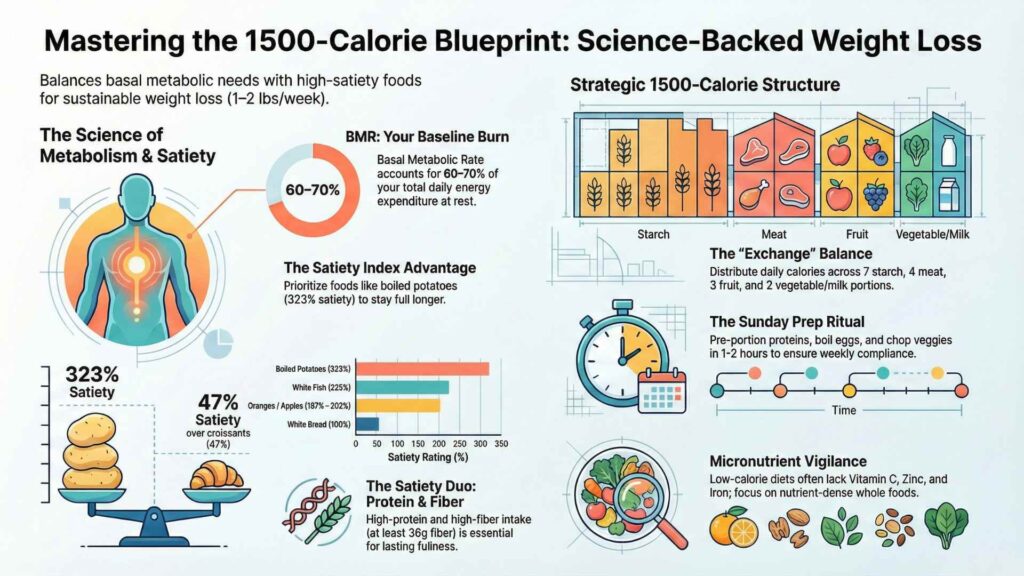
To lose fat effectively on a 1500 calorie diet plan, you must maintain your metabolism. When the deficit is too high, the body enters “adaptive thermogenesis,” where it burns fewer calories to survive. We prevent this by focusing on the Thermic Effect of Food (TEF).
Protein has the highest TEF, meaning your body burns more energy just digesting it compared to fats or carbs. By ensuring 25% of your 1500 calories come from protein, you keep your “metabolic fire” burning.
Balancing Your Macronutrients
The 2024 ICMR guidelines recommend a specific balance for the Indian body type to manage insulin levels:
- Complex Carbs (45-55%): Use whole wheat, brown rice, or millets like ragi and jowar for slow-release energy.
- Lean Proteins (15-25%): Essential for muscle repair. Vegetarians should use a cereal-to-legume ratio of 3:1 to get complete amino acids.
- Healthy Fats (20-30%): Prioritize Omega-3s from walnuts, flaxseeds, and fatty fish to reduce inflammation.
| Nutrient | Target for 1500 kcal | Examples |
| Protein | 55 – 90g | Dal, eggs, paneer, sprouts |
| Carbohydrates | 160 – 200g | Oats, ragi, jowar roti |
| Fiber | 25 – 35g | Leafy greens, papaya, broccoli |
| Healthy Fats | 35 – 50g | Nuts, seeds, mustard oil |
Smart Food Swaps for a Sustainable 1500 Calorie Routine?
Sustainability is the heart of Diet Dekho’s philosophy. You don’t need to stop eating your favorite Indian meals; you just need to swap ingredients. For example, many restaurant curries use heavy cream. Replacing that with a tomato or curd-based gravy saves you up to 200 calories per bowl.
Regional Indian Swaps
Whether you are in North or South India, small changes make a big difference. In the North, swapping a fried paratha for a dry missi roti reduces oil significantly. In the South, opting for steamed idlis instead of a ghee-laden dosa provides the same fermented benefits with fewer calories.
| Item | Smarter Choice | Calorie Saving |
| White Rice | Brown Rice / Little Millets | 20 kcal + higher fiber |
| Samosa | Roasted Makhana (Fox Nuts) | 150 kcal per serving |
| Buffalo Milk Tea | Skimmed Milk Tea (no sugar) | 100 kcal per cup |
| Dal Makhani | Dal Tadka (Moong/Masoor) | 150 kcal per bowl |
| Sugary Lassi | Salted Buttermilk (Chaas) | 120 kcal per glass |
Tips for NRIs and Global Cooking
For our NRI community, you can still follow an Indian 1500 calorie diet using local ingredients. Use kale or spinach in your dals, and replace traditional atta with whole-grain oats or quinoa. Greek yogurt is an excellent, protein-rich substitute for traditional curd.

A Full Day 1500 Calorie Indian Meal Structure?
A practical 1500 calorie diet plan spreads energy throughout the day to prevent sugar crashes. This structure aligns with the 2024 ICMR focus on high vegetable and protein intake.
Morning and Breakfast (350 kcal)
Start with hydration—warm water with lemon or jeera (cumin) seeds. Follow this with 5 soaked almonds and 2 walnuts for essential fats.
- Vegetarian: 2 moong dal cheelas with mint chutney.
- Non-Vegetarian: 2 egg white omelets with 1 whole egg and a slice of multigrain toast.
Mid-Day and Lunch (500 kcal)
For a snack, have one seasonal fruit like an apple or guava (approx. 150g). This provides natural vitamins and fiber.
For lunch, follow the “Plate Method”: half the plate for veggies, one-quarter for protein, and one-quarter for grains.
- Menu: 1.5 cups of cooked brown rice or 2 small whole wheat rotis (no ghee), 1 cup of dal or grilled chicken/fish, and 1 cup of seasonal sabzi (bhindi, lauki, or beans).
Evening and Dinner (400 kcal)
Avoid the biscuit trap in the evening. Instead, have a handful of roasted chana or makhana with green tea.
Dinner should be light and eaten at least 2 hours before bed.
- Menu: 1 bowl of vegetable dalia or millet khichdi, or a tofu/paneer stir-fry with plenty of broccoli and bell peppers.
Managing Conditions: PCOS, Diabetes, and Thyroid
- Diabetes: Prioritize high-fiber grains like bajra and avoid fruit juices. Protein at every meal is non-negotiable for blood sugar stability.
- PCOS: Focus on anti-inflammatory foods like berries, fatty fish, and seeds (flax, pumpkin). Avoid refined sugars completely to manage insulin resistance.
- Thyroid: Ensure you get enough Selenium and Zinc from lentils and nuts. Always cook cruciferous vegetables (cabbage, cauliflower) to neutralize goitrogens.
- Hypertension (BP): Limit salt to less than 5g (one teaspoon) daily. Use potassium-rich foods like coconut water and leafy greens to naturally balance pressure.
Mistakes That Stall Progress on a 1500 Calorie Plan?
Even with a great 1500 calorie diet plan, small habits can block your results. One major hurdle in the Indian context is the “tea and biscuit” routine. While a cup of tea seems minor, adding sugar and two digestive biscuits can add nearly 200 “empty” calories to your day.
Why the Tea and Biscuit Habit Hurts Your Progress
Many of us view biscuits as a “light” snack. In reality, two biscuits can have as many calories as a small roti but offer zero fiber or protein. This leads to a quick insulin spike and subsequent hunger. Furthermore, we often overlook hidden calories in cooking oils. A single tablespoon of oil has 120 calories. If you use 3-4 tablespoons for one sabzi, you might double the meal’s calorie count without knowing it.
| Hidden Source | Caloric Hit | Better Alternative |
| 1 cup Sugary Lassi | 250 kcal | Salted Chaas (30 kcal) |
| 1 tbsp Ghee on Roti | 120 kcal | Dry Roti (0 extra kcal) |
| 1 tbsp Tomato Ketchup | 20 kcal | Fresh Mint Chutney (5 kcal) |
Distracted Eating and Meal Skipping
Skipping breakfast is another common error. This usually leads to excessive consumption later in the day when your hunger becomes unmanageable. Similarly, eating while watching TV prevents your brain from recognizing “fullness” signals, often causing people to eat 20% more than they planned.

Embracing a Healthier Relationship with Your Daily Meals?
Successful weight management on a 1500 calorie diet plan is about “intentional nourishment,” not punishment. In simple terms, this means seeing food as the fuel that helps you perform your best at work and home.
Social events and festivals are part of our culture. Instead of avoiding them, learn to navigate them. Eat a small, protein-rich snack before you head out, and choose grilled or tandoori items over deep-fried snacks. This allows you to stay within your daily budget while still enjoying the celebration.
Mindful Eating and Weekly Prep
Mindfulness is a powerful tool. Chewing slowly and focusing on the flavors allows your stomach time to signal your brain that it is full—a process that takes about 20 minutes.
For busy professionals, Sunday meal prep makes the 1500 calorie diet plan effortless. You can:
- Pre-chop your vegetables and boil your lentils.
- Knead atta in bulk (lasts 3 days in the fridge).
- Prepare healthy snack jars with roasted nuts or makhana so they are ready when you are tired.
Get a Personalized Nutrition Strategy for Your Unique Body
While a general 1500 calorie diet plan provides a solid foundation, every body is different. Factors like stress levels (cortisol), gut health, and hormonal shifts mean that what works for your friend might not work exactly the same way for you.
At Diet Dekho, we combine modern clinical science with traditional Indian wisdom to build a plan that fits your life perfectly. We don’t just count calories; we count the nutrients that make you feel alive.
Get a Personalized Macro-Balanced Plan with a Diet Dekho Expert
Our senior consultants can adjust your 1500 calorie diet plan based on your specific medical markers and lifestyle. Whether you need to manage PCOD, diabetes, or simply want to feel lighter and more energetic, we provide the precision you need.
Start Your Journey to Holistic Health with a Diet Dekho Consultant
Weight loss is a transition toward a better, healthier version of yourself. Take the first step today by connecting with a professional who understands the Indian diet and your unique health goals.

Frequently Asked Questions (FAQs)
How much weight can I lose in a month on a 1500 calorie diet plan?
If you stay consistent and include 30 minutes of walking, you can safely lose 2 to 4 kilograms per month. This gradual rate is best because it protects your muscle mass and ensures the weight stays off.
Is rice allowed in an Indian 1500 calorie diet?
Yes, in controlled portions. The trick is to choose brown or red rice and pair it with lots of fiber (vegetables) and protein (dal or lean meat). This prevents the blood sugar spikes that lead to fat storage.
What are the best Indian snacks for weight loss?
The best snacks are high in fiber and protein to keep you satiated. Options include roasted chana (chickpeas), makhana (fox nuts), sprouts salad, or a small bowl of curd with seeds. Avoid biscuits and sugary lassis.
Can I follow this plan if I have high blood pressure?
Absolutely. The DASH principles fit perfectly within a 1500-calorie budget. Focus on reducing salt (less than 1 tsp daily) and increasing potassium-rich foods like bananas, spinach, and coconut water.
Disclaimer:
This blog post was written to help you make healthier food choices altogether. So, be aware and take care. The important thing to consider is your health before starting a restrictive diet. Always seek advice from a doctor or dietitian before starting if you have any concerns.
BOOK YOUR APPOINTMENT
Dr. Ritika is a nutrition and lifestyle expert with 2+ years of experience, helping clients manage weight and health through practical, personalized diet plans.