
Have you ever spent months grinding in the gym, pushing your limits on every set of squats and deadlifts, only to look in the mirror and see the exact same person staring back? It is a frustrating, silent epidemic in the fitness world. Take the example of a young trainee named Arjun, who worked out religiously but lived on a haphazard diet of tea, toast, and occasional home-cooked meals. Despite his effort, his weight didn’t budge.
Here is the thing: muscle isn’t just built in the gym; it is constructed in the kitchen using the raw materials you provide. Without a structured, balanced diet chart for muscle gain, you are essentially trying to build a skyscraper with no bricks. What this really means is that your nutrition is the architect of your physique. Let’s break down how you can flip the switch from stagnant to growing by mastering the science of mass.
The Biological Foundation of Muscle Hypertrophy
Table of Contents
- 1 The Biological Foundation of Muscle Hypertrophy
- 2 Mastering the Caloric Surplus for Mass
- 3 Macronutrient Ratios for Maximum Growth
- 4 The 3000 Calorie Meal Plan for Muscle Gain
- 5 Optimized Pre and Post-Workout Nutrition
- 6 Deep Dive: Soya Chunks vs. Chicken Breast
- 7 The Anabolic Diet Plan: A Different Approach
- 8 Inclusive Nutrition: Muscle Gain for All Bodies
- 9 High Calorie Snacks for Weight Gain
- 10 Success Stories: From Skinny to Sculpted
- 11 The Truth About the Anabolic Window
- 12 Budget-Friendly Muscle Building Foods for Beginners
- 13 Common Muscle Building Misconceptions
- 14 Expert Guidance: The Diet Dekho Difference
- 15 Frequently Asked Questions (FAQs)
- 16 Final Thoughts on Building Your Kingdom
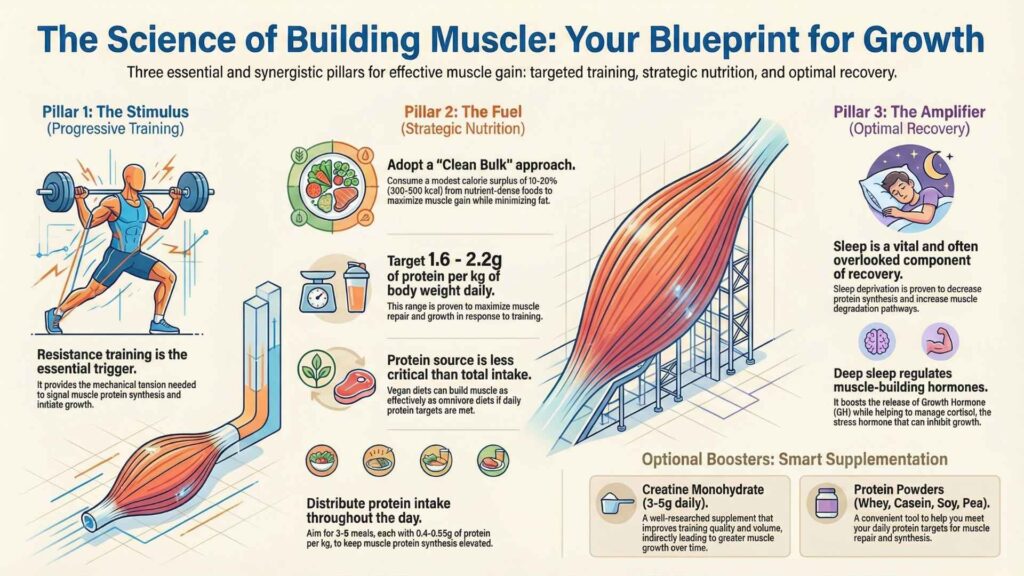
To understand how a muscle gain diet works, we have to look at the cellular level. Muscle growth, or hypertrophy, is the result of a positive net protein balance. Every day, your body is in a constant state of flux between Muscle Protein Synthesis (MPS) and Muscle Protein Breakdown (MPB).1 When you lift weights, you create micro-tears in the muscle fibers. If you provide enough amino acids and energy, the body repairs these tears, making the fibers thicker and stronger than before. This is the essence of adaptation.
The Role of Nitrogen Balance
Your body uses nitrogen as a marker for protein status. When you consume enough protein to exceed what you lose through sweat, urine, and metabolic processes, you are in a positive nitrogen balance. This state is mandatory for anabolism.2 Research from the National Institutes of Health (NIH) indicates that resistance exercise improves muscle protein net balance for at least two days following a session.2 However, this improvement only translates to actual muscle growth if exogenous nutrients are available.
The mTOR Signaling Pathway
The master regulator of muscle growth is a protein complex called mTOR (mammalian target of rapamycin). Think of mTOR as the “growth switch” in your cells. It is primarily activated by three things: mechanical tension (lifting weights), insulin, and the amino acid leucine.1 If any of these are missing, the switch stays off. This is why just eating protein isn’t enough; you need the insulin spike from carbohydrates and the mechanical stimulus from the gym to truly maximize hypertrophy nutrition.3
Mastering the Caloric Surplus for Mass
You cannot create matter out of nothing. To build new muscle tissue, you must consume more energy than your body burns—a state known as a caloric surplus.3 For beginners, this doesn’t mean eating everything in sight. We want clean bulking, which focuses on adding muscle while keeping body fat gains to a minimum.6
Calculating Your Total Daily Energy Expenditure (TDEE)
Before you can add calories, you need to know your baseline. Your TDEE is the total number of calories your body needs to maintain its current weight. To start with, it is calculated by taking your Basal Metabolic Rate (BMR) and multiplying it by an activity factor.5 We use the Mifflin-St Jeor equation for precision:
$$BMR = (10 \times weight\ in\ kg) + (6.25 \times height\ in\ cm) – (5 \times age\ in\ years) + s$$
In this formula, $s$ is a constant: $+5$ for males and $-161$ for females.5 What this really means is that your biological sex at birth influences your baseline burn rate. Once you have this number, you must account for your daily movement.
| Activity Level | Description | Multiplier |
| Sedentary | Desk job, little to no exercise | 1.2 5 |
| Lightly Active | Light exercise 1-3 days/week | 1.375 5 |
| Moderately Active | Moderate exercise 3-5 days/week | 1.55 5 |
| Very Active | Hard exercise 6-7 days/week | 1.725 5 |
| Extra Active | Physical job or 2x/day training | 1.9 5 |
Setting the Surplus Target
Once you have your TDEE, you need to add a “growth margin.” For most beginners, a surplus of 250 to 500 calories per day is the sweet spot.5 This is enough to fuel the muscle-building process without causing excessive fat storage. If you find you are gaining more than 1 pound per week, you are likely eating too much and should dial it back slightly.6
Macronutrient Ratios for Maximum Growth
A balanced diet chart for muscle gain is defined by its macro ratio for muscle growth. While calories determine if you gain weight, macros determine what kind of weight you gain.6 Essentially, you want to prioritize protein for repair and carbs for energy.
Protein: The Essential Building Blocks
Protein is the most discussed macro in the bodybuilding meal plan, and for good reason. It provides the essential amino acids that your body cannot produce on its own.5 For muscle repair and growth, you should aim for 0.7 to 1 gram of protein per pound of body weight.9 For a 150-pound person, this means roughly 105 to 150 grams of protein daily.5
Carbohydrates: The Energy Driver
Carbohydrates are often unfairly demonized, but for hypertrophy, they are your best friend. They fuel your workouts by filling your muscles with glycogen and help prevent the breakdown of protein for energy.3 In contrast to low-carb diets, a typical hypertrophy diet should consist of 45% to 60% carbohydrates.6
Healthy Fats: The Hormonal Foundation
Fats are crucial for the production of hormones, including testosterone, which is the primary driver of muscle growth.11 You should never drop your fat intake too low. Aim for 20% to 35% of your total daily calories from healthy sources like avocados, nuts, and olive oil.8

The 3000 Calorie Meal Plan for Muscle Gain
Consuming 3,000 calories can be a challenge if you aren’t prepared. The key is to eat frequent, nutrient-dense meals rather than three massive ones.15 Here is a breakdown of how to structure your day for maximum mass.
Breakfast: Kickstarting the Anabolic State
After 7–9 hours of sleep, your body is in a fasted, catabolic state. You need to break this fast with a combination of fast-acting protein and complex carbohydrates.3 Specifically, this stops muscle breakdown and starts the rebuilding process.
- Option 1: 3 whole eggs, 2 slices of whole-wheat bread, 1 cup of oatmeal with berries.6
- Option 2: Oats porridge made with whole milk, topped with 2 tbsp of peanut butter, a handful of walnuts, and a scoop of whey protein.20
Mid-Morning: Sustaining the Amino Acid Flow
Eating every 3-4 hours ensures that your muscles always have a supply of amino acids available for repair.4 Consequently, you avoid large energy dips throughout the day.
- High-Calorie Snack: 1 cup of Greek yogurt mixed with 1/4 cup of granola and sliced banana.6
- Alternative: 2 cheese slices with a bowl of pineapple or watermelon.23
Lunch: The Mid-Day Power Surge
Lunch should be a balanced plate of lean protein, starchy carbs, and fibrous vegetables. To make this work, focus on variety in your protein sources.
- Option 1: 150g of grilled chicken breast, 1.5 cups of brown rice, and 1 cup of steamed broccoli drizzled with olive oil.12
- Option 2 (Veg): 150g of paneer (cottage cheese) curry, 2-3 chapatis with ghee, and 1 cup of dal (lentils).20
Optimized Pre and Post-Workout Nutrition
What you eat around your training window can dictate the intensity of your session and the speed of your recovery. This is where the best pre-workout meals for mass come into play.
Pre-Workout: Fueling the Fire
60 to 90 minutes before your session, consume a meal that is high in carbs and moderate in protein. This provides glucose for energy and amino acids to prevent muscle breakdown during the lift.3 Actually, this is the most critical window for workout performance.
- Quick Option: A banana with 2 tbsp of peanut butter.20
- Heavier Option: 1 cup of cooked white rice with 100g of chicken or tofu.6
Post-Workout Nutrition for Muscle Repair
The goal here is to spike insulin and deliver protein to the muscles as quickly as possible. While the “anabolic window” is wider than 45 minutes, it is still wise to eat within 2 hours of training.2
- The Gold Standard: 1 scoop of whey protein mixed with 1 glass of milk or water and 1 medium banana.6
- Whole Food Alternative: 1 cup of cottage cheese with strawberries and a handful of almonds.11

Deep Dive: Soya Chunks vs. Chicken Breast
In the Indian fitness community, there is a massive debate about whether soya chunks or chicken breast is the better protein source. Let’s look at the facts. Specifically, soya chunks are incredibly protein-dense—100g of dry chunks contains about 52g of protein.27 In contrast, chicken breast contains about 31g of protein per 100g.28
Bioavailability and Absorption
However, chicken has a higher Biological Value (BV) and a more complete amino acid profile than soy.28 This means your body can use the protein from chicken more efficiently. Soya is also high in fiber, which is great for digestion but can cause bloating in some people.28
Cost-Efficiency in India
If you are on a budget, soya is the clear winner. For the same price, you get nearly double the protein compared to chicken.27 The best strategy? Use a mix of both. This ensures you get a wide variety of amino acids and micronutrients without breaking the bank.
| Feature | Soya Chunks (100g Dry) | Chicken Breast (100g Raw) |
| Protein | ~52g 27 | ~31g 28 |
| Calories | ~312 27 | ~165 29 |
| Fiber | ~13% 30 | 0% 29 |
| Fat | ~1% 30 | ~3.6g 29 |
The Anabolic Diet Plan: A Different Approach
Dr. Mauro Di Pasquale developed the anabolic diet plan as a way to manipulate the body’s hormones through cyclical carbohydrate intake.14 Unlike a standard hypertrophy diet, this involves alternating between low-carb and high-carb phases.
Weekday Phase: The Fat-Burning Anabolic State
From Monday to Friday, you consume a diet very high in fat and protein but extremely low in carbs (less than 30g).14 This forces your body to switch from burning sugar to burning fat as its primary fuel. Specifically, it puts you in a state of ketosis during the week.
- Macro Breakdown: 60%–65% fat, 30%–35% protein, 5%–10% carbs.14
- Foods: Red meat, whole eggs, cheese, butter, and oils.14
Weekend Phase: The Glycogen Refeed
On Saturday and Sunday, you flip the script. You consume high amounts of carbohydrates to replenish your muscle glycogen and spike your insulin to drive growth.14 This is not a “cheat day” but a strategic nutritional tool.
- Macro Breakdown: 60%–80% carbs, 10%–20% fat, 10%–20% protein.14
- Foods: Rice, pasta, bread, and fruits.32
Inclusive Nutrition: Muscle Gain for All Bodies
People often worry that a muscle gain diet will make them look “bulky” or “unnatural.” Here is the truth: individuals with lower testosterone levels find it much harder to build massive amounts of muscle.34 For a beginner, muscle gain usually results in a more defined, athletic silhouette.
Addressing Caloric Needs
Average burn rates can vary significantly. For instance, some individuals burn 5% to 10% fewer calories at rest than others of the same height and weight.8 Therefore, a 3000-calorie plan might be too aggressive for some people. Many find success starting with 2,000 to 2,400 calories and adjusting based on progress.8
Micronutrient Focus
All trainees should pay extra attention to iron and calcium. Intense training can deplete iron stores, leading to fatigue.23 Calcium is vital for bone density, which is a key health concern for everyone as they age.36
| Micronutrient | Importance for Muscle Gain | Best Sources |
| Iron | Oxygen transport to muscles | Spinach, red meat, lentils 22 |
| Calcium | Muscle contraction and bone health | Milk, yogurt, sardines 16 |
| Vitamin D | Hormone production and strength | Sun exposure, egg yolks 23 |
| Magnesium | Sleep and muscle recovery | Almonds, pumpkin seeds 7 |

High Calorie Snacks for Weight Gain
One of the biggest hurdles for beginners is the sheer volume of food. If you can’t stomach another bowl of rice, you need high calorie snacks for weight gain that are small in volume but large in energy. Specifically, these help you hit your targets without feeling overstuffed.
The Power of Liquid Calories
Drinking your calories is often easier than chewing them. A homemade weight-gain shake can easily provide 800 to 1,000 calories.16 To start with, try blending whole milk, oats, and nut butter for a quick boost.
- The “Mass Monster” Shake: 2 cups of whole milk, 1 scoop of whey protein, 1 cup of oats (blended), 2 tbsp of peanut butter, and 1 frozen banana.16
- The Nut Density Secret: Adding a tablespoon of olive oil or flaxseed oil to your protein shake adds 120 calories without changing the taste.16
Portable Mass Builders
If you are on the go, these snacks are essential for maintaining your surplus:
- Trail Mix: A handful of almonds, raisins, and pumpkin seeds.15
- Peanut Butter Toast: Two slices of whole-wheat bread with thick layers of peanut butter.20
- Hard-Boiled Eggs: A simple, high-protein snack you can prep in advance.6
Success Stories: From Skinny to Sculpted
Looking at success stories can provide the psychological boost needed to stay consistent. For instance, take Antun, a trainee who weighed only 68kg when he started. By focusing on a high-carb, high-protein diet—including lots of eggs and dairy—he put on 10kg of lean muscle without using expensive supplements .
The Bony to Beastly Transformation
Jared and his partner were “skinny graphic designers” who knew nothing about lifting. They focused on compound lifts like squats and chin-ups and paired them with a consistent caloric surplus. In their first three months, they gained nearly 60 pounds of muscle between them.8 What this really means is that even if you have “bad genetics,” the right combination of food and intensity can override your starting point.
Amela’s Journey
Amela was bullied for being too thin. She used strength training and a structured diet to gain 8kg of lean muscle. Her journey shows that weight gain isn’t just about physical changes; it’s about gaining the self-confidence that comes from being strong and healthy.7
The Truth About the Anabolic Window
Is it true that you lose your gains if you don’t eat within 30 minutes of a workout? The science says no. Specifically, a recent meta-analysis showed that the total amount of protein you eat in a day is much more important than the exact timing.25
When Timing Matters
However, if you train in a fasted state (like first thing in the morning before breakfast), getting protein in quickly after your session becomes more important to stop muscle breakdown.25 For most people, as long as you have a pre-workout meal and a post-workout meal within a few hours of each other, you are in the clear.2
The Role of Whole Foods
While protein shakes are convenient, research shows that whole food sources—like eggs and beef—often provide other bioactive components that can support muscle protein synthesis better than isolated protein alone.2

Budget-Friendly Muscle Building Foods for Beginners
Building muscle doesn’t have to be expensive. You don’t need fancy salmon and grass-fed beef to see results. Specifically, focus on staples that provide the most “protein per penny.”
Indian Budget Staples
- Dals (Lentils): Moong, Masoor, and Toor dal are cheap and provide 7–9g of protein per cup.29
- Sprouts: Moong dal sprouts are high in protein and vitamins, making them a perfect snack.23
- Sattu: Roasted gram flour is a traditional Indian powerhouse. It has up to 20g of protein per 100g and is extremely affordable.37
- Eggs: In India, eggs are often the cheapest source of high-quality animal protein.29
Buying in Bulk
Save money by buying your grains (rice, oats, quinoa) and legumes in large quantities. Seasonal vegetables are always cheaper and more nutrient-dense than imported ones.17
| Budget Food | Protein per Serving | Approx. Cost (Low/Med/High) |
| Soya Chunks | ~15g per 30g dry | Low 27 |
| Eggs | ~6g per egg | Low 37 |
| Peanuts | ~7g per handful | Low 21 |
| Whey Protein | ~24g per scoop | High 29 |
Common Muscle Building Misconceptions
Let’s clear up some of the myths that keep people from reaching their goals. Essentially, misinformation is the biggest hurdle to progress.
Myth: Muscles are Made in the Gym
Here’s the thing: you don’t grow while you are lifting weights. You grow while you are sleeping.13 Training is the stimulus that tells your body it needs to get stronger, but the actual repair happens during rest. If you aren’t getting 7–9 hours of sleep, you are leaving 50% of your gains on the table.7
Myth: You Need a Gym to Gain Muscle
While heavy weights are great for mechanical tension, you can build a significant amount of muscle using your own body weight.39 Calisthenics exercises like push-ups, pull-ups, and lunges are highly effective for beginners. Consequently, you can start today even without a membership.
Myth: Muscle Turns to Fat
Muscle and fat are two different tissues. It is biologically impossible for one to turn into the other.34 What actually happens is that if you stop exercising and keep eating high calories, your muscle shrinks (atrophy) and your fat cells grow.40 To put it simply, they are separate compartments in the body.
Expert Guidance: The Diet Dekho Difference
Navigating the world of nutrition can be overwhelming. Every “influencer” has a different opinion on the best way to eat. This is why professional guidance is so valuable. According to Harvard T.H. Chan School of Public Health, personalized nutrition plans are significantly more effective for long-term health than generic diets.8
If you are tired of guessing and want a plan tailored specifically to your body type, goals, and food preferences, we are here to help. At Diet Dekho, we combine scientific data with practical lifestyle strategies to ensure you reach your goals without the burnout.
Ready to start your transformation? Get your custom diet plan here!

Frequently Asked Questions (FAQs)
What is the best muscle gain diet for beginners?
The best muscle gain diet focuses on a caloric surplus of 250–500 calories, a high protein intake (0.7–1g per lb of body weight), and plenty of complex carbohydrates to fuel intense workouts. Specifically, it should consist of whole, unprocessed foods like eggs, oats, chicken, lentils, and healthy fats.5
How can I gain muscle fast with diet?
To gain muscle fast, you must prioritize protein-rich foods and ensure you are in a consistent caloric surplus. Incorporating a bodybuilding meal plan that includes pre and post-workout nutrition can help maximize muscle protein synthesis. Consistency is key; hits your targets every day, not just on training days.3
Is a vegetarian muscle gain diet chart effective?
Yes, a vegetarian muscle gain diet chart is very effective as long as you consume complete protein sources. Vegetarians should focus on dairy (paneer, milk, curd), soya chunks, tofu, and combining grains with legumes (like rice and dal) to ensure they get all essential amino acids.20
How many calories are in a 3000 calorie meal plan for muscle gain?
A 3000 calorie meal plan for muscle gain provides 3,000 total calories, typically distributed as 150–200g of protein, 350–450g of carbohydrates, and 70–100g of fat. This provides the necessary energy for hardgainers and active individuals to build new muscle tissue.12
What are the best protein-rich foods for hypertrophy?
The top protein-rich foods for hypertrophy include chicken breast, lean beef, eggs, whey protein, soya chunks, paneer, fish, and Greek yogurt. These foods contain high levels of the amino acid leucine, which is the primary trigger for muscle protein synthesis.4
Final Thoughts on Building Your Kingdom
Jack LaLanne once said, “Exercise is king. Nutrition is queen. Put them together and you’ve got a kingdom”.42 Building a strong, muscular physique is a marathon, not a sprint. It requires the discipline to train hard and the wisdom to eat right. By focusing on a balanced diet chart for muscle gain, hitting your caloric targets, and prioritizing recovery, you are setting yourself up for a lifetime of health and strength.
Don’t let another month of “hard work” go to waste because of a poor diet. Take control of your nutrition today.
Start your journey with a professional, science-backed plan:
Fill out our assessment form here!
BOOK YOUR APPOINTMENT
Abhinav is the Founder of Diet Dekho, helping people manage weight and lifestyle health through simple, practical nutrition and personalized diet plans.