
Imagine you’re at the gym, three-quarters of the way through a challenging workout. Your lungs are burning, and you’re wondering if you have enough left in the tank for that final set. Now, what if a simple glass of deep-red juice could make that last mile feel 15% easier? This isn’t a fitness myth; it’s the proven power of beetroot benefits. For over a decade at (https://dietdekho.com/form/), we’ve seen clients transform their energy levels and metabolic health by embracing this ruby-colored root. Beetroot (Beta vulgaris L.) has evolved from an ancient remedy to a science-backed “superfood” essential for anyone serious about fitness and sustainable weight loss. Whether you’re managing blood pressure or looking for a natural skin glow, the unique compounds in beets work like a nutritional orchestra to repair and revitalize your body from the inside out.
The Nutritional Value of Beetroot: A Deep Dive into the Ruby Root
To truly appreciate the range of beetroot benefits, we have to look past its earthy smell and focus on its physiological architecture. Beetroot is a “volume food”—meaning it allows you to eat a large portion for very few calories. This is a game-changer for my clients focusing on weight management.
Macronutrient and Micronutrient Architecture
A standard 100-gram serving of raw beetroot contains just 43 to 44 calories, with water making up roughly 88% of its weight. This high water content, combined with nearly 3 grams of dietary fiber, keeps you hydrated and satiated. But the real magic lies in its micronutrients. Beetroot is a leading source of folate (Vitamin B9), providing up to 27% of your Daily Value (DV) in a single serving—critical for DNA synthesis and cellular repair.
| Nutrient (per 100g Raw) | Measured Value | Percentage of Daily Value (DV) |
| Energy | 43.00 kcal | 2% |
| Protein | 1.61 g | 4% |
| Carbohydrate | 9.56 g | 3% |
| Dietary Fiber | 2.80 g | 11% |
| Potassium | 325.00 mg | 9.6% |
| Folate (B9) | 109.00 μg | 27% |
| Manganese | 0.33 mg | 14% |
| Magnesium | 23.00 mg | 5.5% |
| Iron | 0.80 mg | 10% |
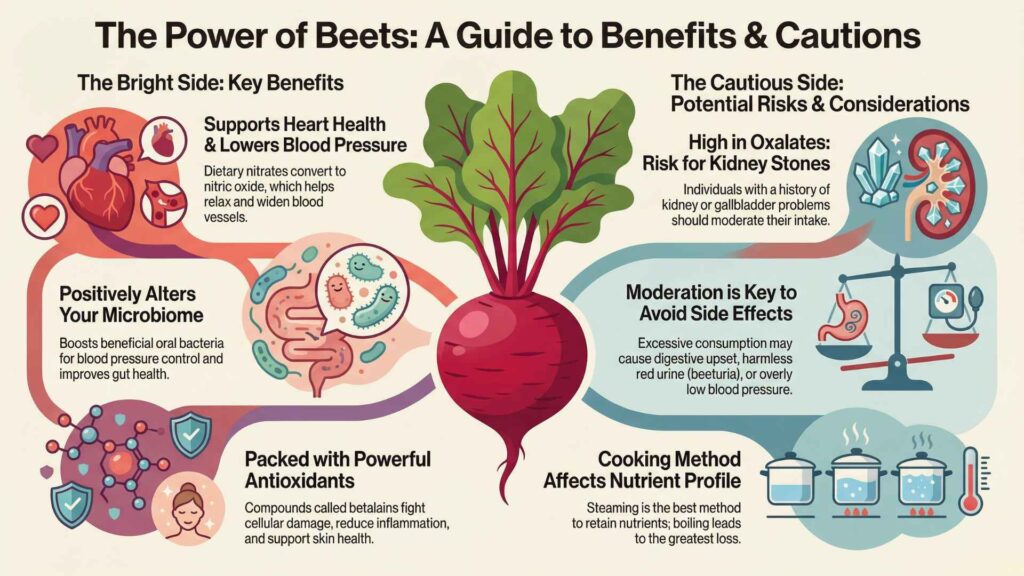
The Betalain Matrix: Natural Protection
The vibrant red-violet hue of beets comes from betalains, a rare class of water-soluble pigments. These aren’t just for color; they are potent antioxidants that inhibit the oxidation of LDL cholesterol and protect the liver. Research indicates that betanin, the primary betalain, has radical-scavenging power nearly double that of many common berries.
Nitrates and the “Secret” Circuit
The most famous of all beetroot benefits comes from its concentration of inorganic nitrates (NO3−), which average 1379 mg/kg. Here’s the thing: your body uses a unique “enterosalivary circuit” to process these. After you eat beets, about 25% of the nitrate is concentrated in your saliva. Bacteria on your tongue then convert it to nitrite, which becomes nitric oxide (NO) in your stomach. This NO is a powerful vasodilator, relaxing your blood vessels and significantly improving oxygen delivery throughout your body.
Cardiovascular Beetroot Benefits: Managing Hypertension and Arterial Health
High blood pressure is a silent risk factor for heart disease, but the National Institutes of Health (NIH) has identified beetroot juice as a highly cost-effective, non-drug intervention. The nitrates in beets help maintain vascular “suppleness,” which is vital as we age.
Quantitative Impact on Blood Pressure
Clinical reviews show that consistent beetroot consumption can lower systolic blood pressure (SBP) by an average of 3.5 to 4.4 mmHg. However, in higher-weight populations and those with existing hypertension, the drop can be as much as 11.3 mmHg when combined with light exercise.
| Population Group | Typical SBP Reduction | Clinical Context |
| Hypertensive Adults | 4.0−11.0 mmHg | Sustained over ≥14 days |
| Normotensive Adults | 2.0−4.0 mmHg | Acute effect (3-6 hours) |
| Higher-weight Adults | Up to 11.3 mmHg | Combined with moderate exercise |
| Older People | 5.36 mmHg | Improved microvascular flux |
Arterial Stiffness and Brain Health
Harvard-trained experts emphasize that the nitric oxide produced from beets doesn’t just lower numbers; it improves “flow-mediated dilation” (FMD), a measure of how well your vessels can widen. This is especially critical for older people, whose natural nitric oxide production can decline by 50% by middle age. By boosting blood flow to the brain’s frontal lobe, beets may even support memory and faster decision-making.

Benefits of Beetroot Juice for Athletic Stamina
In the fitness community, beetroot juice is often called “the athlete’s secret sauce”. It is one of the few supplements with enough evidence to be classified as a “Group A” aid by the International Olympic Committee. The primary goal here is efficiency: beets reduce the “oxygen cost” of exercise, making your muscles work harder with less effort.
Mitochondrial and Muscular Efficiency
Beet nitrates appear to optimize your cellular power plants—the mitochondria. This allows your body to produce more ATP (the energy currency of your cells) for every breath you take. Furthermore, nitric oxide improves how fast-twitch muscle fibers handle calcium, leading to more explosive power during sprints or heavy lifting.
Measurable Gains in Speed and Endurance
Data from hundreds of studies confirms the following beetroot benefits for athletes:
- Time to Exhaustion: One study showed an increase from 9:43 to 11:15 minutes in severe intensity cycling—a 16% improvement.
- Running Speed: Physically fit runners who ate a cup of baked beets 75 minutes before a 5K race ran 5% faster in the final mile.
- Female Athletes: A 2025 study found that a single dose of beet juice increased VO2 max (aerobic capacity) by nearly 5% in female endurance athletes.
Strategic Timing for Your Workout
To get the most out of your pre-workout beet juice, timing is everything. Nitrate levels in your blood peak between 2 and 3 hours after you drink it. We recommend a dose of 70 mL to 500 mL—providing 300 to 600 mg of nitrates—roughly 2 hours before your session.
Metabolic Beetroot Benefits: Insulin, Glucose, and Liver Health
At Diet Dekho, we focus on metabolic health as the foundation for long-term weight loss. Beetroot supports this through bioactive pathways that improve insulin sensitivity and protect the liver from fat accumulation.
Glycemic Control and Insulin Sensitivity
Beetroot contains alpha-lipoic acid (ALA), which activates AMPK (a cellular energy sensor). This helps your cells use glucose more effectively and inhibits sugar production in the liver, effectively increasing your insulin sensitivity. Clinical trials show that beetroot intake can significantly lower insulin and glucose responses in the hour following a meal.
Protecting Your Liver (NAFLD Management)
The liver is your primary metabolic engine, and beetroot is its strongest ally. Beets are rich in betaine, which prevents fat deposits in the liver—a condition known as Non-Alcoholic Fatty Liver Disease (NAFLD).
A study compared beetroot juice against the Mediterranean diet in NAFLD patients, and the combination proved remarkably effective.
| Biochemical Parameter | Baseline (Mean) | Post-Intervention (Mean) | Significance (p) |
| Serum Cholesterol | 244.9 mg/dL | 188.8 mg/dL | 0.001 |
| Triglycerides | 243.1 mg/dL | 175.5 mg/dL | 0.001 |
| HDL (Good) | 30.2 mg/dL | 41.5 mg/dL | 0.001 |
| LDL (Bad) | 142.4 mg/dL | 128.8 mg/dL | 0.001 |

Beetroot Benefits for Skin: Anti-Aging and Radiant Complexion
Dermatologists are now viewing beetroot as a potent botanical for skin health. Glowing skin isn’t just about what you put on it; it’s about internal circulation, collagen quality, and hydration.
The “Youthful Flush”
By boosting microcirculation through nitric oxide, beets increase the delivery of nutrients to your skin cells. This results in a brighter, more even tone that experts often call a “youthful flush.” Additionally, beetroot peel extract has been shown to inhibit the enzymes (elastase and collagenase) that break down the skin’s structural proteins, helping to keep skin firm.
Hyperpigmentation and Acne
- Dark Spots: The Vitamin C in beets blocks melanin formation, helping to fade acne scars and sunspots.
- Acne Relief: Beetroot’s anti-inflammatory nature soothes reactive skin. By supporting Phase 2 liver detox, beets help clear the metabolic waste that often leads to hormonal breakouts.
The Weight Loss Wonders of Beetroot: Satiety and Caloric Deficit
Sustainable weight loss isn’t about eating less; it’s about eating smart. Beetroot is a powerhouse tool because it supports satiety through fiber while improving your ability to burn calories during exercise.
High Volume, Low Calories
With only 43-45 calories per 100 grams, you can eat 300 grams of beetroot salad (a massive portion) for just 135 calories. This allows you to feel physically full while maintaining a calorie deficit.
The Dual Role of Fiber
- Prolonged Fullness: The soluble fiber in beets delays “gastric emptying,” keeping food in your stomach longer.
- Stable Blood Sugar: Fiber prevents the insulin spikes and subsequent crashes that trigger cravings for high-sugar snacks.
- Visceral Fat: Chronic inflammation is a hidden trigger for belly fat storage. The anti-inflammatory betalains in beets help lower cortisol and support the reduction of visceral fat.
Bioavailability and Cooking: Maximizing Nutrient Retention
How you prepare your beets determines how many beetroot benefits you actually receive. Boiling them until they are soft is the quickest way to lose the nitrates and antioxidants you’re looking for.
The Best Ways to Cook Beets
- Raw: Grating raw beets into salads or cold-pressing them into juice preserves Vitamin C and folate, which are highly sensitive to heat.
- Steaming: This is the “gold standard” of cooking. Steaming for under 15 minutes softens the cell walls (making antioxidants more bioavailable) while minimizing nutrient loss.
- Roasting: Low-temperature roasting (350∘F) intensifies sweetness without destroying the nutritional profile.
Juice vs. Powder: Which is Better?
Athletes seeking a massive nitric oxide boost should choose concentrated juice shots. However, for those on a keto-style diet or managing diabetes, beetroot powder is a better “hack”—it offers the potassium and some nitrates with far fewer carbs and sugars.

Potential Side Effects and Safety Considerations
While beetroot is a superfood, moderation is key, and some people need to be cautious.
Beeturia and Iron Deficiency
About 14% of the population experiences pink or red urine (beeturia) after eating beets. While harmless, if this happens every single time, it can be a sign of iron deficiency or low stomach acid, as both conditions increase the uptake of red pigments in the gut.
Kidney Stones and Oxalates
Beets are high in oxalates, which can bind with calcium to form stones in susceptible people. If you have a history of kidney stones, limit your intake to small portions or look for oxalate-free supplements.
Low Blood Pressure Warning
Because beets are so good at lowering blood pressure, people who already have low pressure (hypotension) or those on strong medications should be careful. Too much vasodilation can cause dizziness.
Diet Dekho Recipes: Tasty Ways to Eat Beetroot
1. The ABC Stamina Juice
- Blend: 1 medium beet, 1 apple, 2 carrots, 1/2 inch ginger, and a squeeze of lemon.
- Tip: Lemon juice adds Vitamin C, which prevents the formation of harmful nitrosamines when nitrates are eaten with animal proteins.
2. Weight Loss Tikki (Patties)
- Method: Mix grated raw beet with mashed boiled sweet potato and gram flour (besan). Season with cumin and ginger-garlic paste. Shallow-fry with minimal oil.
- Tip: Raw beet in the mix preserves maximum fiber for satiety.
Conclusion: Start Your Journey Today
The evidence for beetroot benefits is overwhelming. From the world-class labs at Harvard and the NIH to the training grounds of Olympic athletes, this root vegetable has proven its worth as a functional superfood. Whether you want to protect your heart, run faster, or simply look your best, beets provide a science-backed, affordable solution.
Ready to transform your health with a plan that fits your life? (https://dietdekho.com/form/)

Frequently Asked Questions (FAQs)
1. Is raw or cooked beetroot better for weight loss? Raw beetroot is generally better for weight loss because it contains more intact fiber and higher levels of Vitamin C. This combination keeps you full longer and supports your metabolism more effectively than overcooked versions.
2. Can I drink beetroot juice every day? Most healthy adults can safely drink 100-200 mL of juice daily to support blood pressure. If you have a history of kidney stones or low blood pressure, consult your dietitian first due to the high oxalate and nitrate content.
3. Does beetroot juice really help with workout stamina? Yes. Over 300 studies show that beet nitrates improve oxygen efficiency, allowing you to exercise for up to 16% longer before hitting exhaustion. For the best effect, drink it 2 hours before your workout.
4. Why is my urine pink after eating beets? This is a benign condition called “beeturia.” It happens when your body doesn’t fully break down the red pigment betanin. It is more common in people with low stomach acid or iron deficiency.
5. Are beet powders as effective as juice? Not always. Powders are convenient and lower in sugar, but many lack the high nitrate levels found in fresh juice. Whole beets are the best for general health because they retain all the fiber and phytonutrients that processing can remove.
BOOK YOUR APPOINTMENT

Abhinav is the Founder of Diet Dekho, helping people manage weight and lifestyle health through simple, practical nutrition and personalized diet plans.