
Weight loss in 3 months is often viewed through the lens of aesthetic transformation, yet from a clinical perspective, it represents a profound ninety-day physiological shift. For anyone starting their journey, the initial question is usually simple: is it actually possible to see real results without turning my life upside down? The answer lies in understanding that the human body is not a static machine but a dynamic biological system that responds to specific signals. When we talk about how to lose weight in 3 months, we aren’t just talking about eating less; we are talking about recalibrating the metabolic environment to favor fat oxidation over energy storage.
What this really means is that the first few weeks are often a whirlwind of rapid changes as the body sheds excess water and begins to tap into glycogen stores. However, the real magic happens in the second and third months, where systemic adaptations in insulin sensitivity and muscle protein synthesis begin to redefine the body’s composition. This report breaks down the mechanics of a 3-month weight loss plan, moving beyond the surface-level advice to explore the second and third-order effects of caloric restriction, high-protein intake, and metabolic flexibility.
The Bioenergetics of the Calorie Deficit
Table of Contents
- 1 The Bioenergetics of the Calorie Deficit
- 2 Macronutrient Optimization: Why Protein is the Secret Weapon
- 3 The 12-Week Roadmap: Physiological Milestones
- 4 The Role of Strength Training and HIIT
- 5 Intermittent Fasting: Timing Your Intake for Success
- 6 The Indian Context: Navigating Snacks and Cravings
- 7 Breaking Through the 6-Week Plateau
- 8 Success Stories: Lessons from the Diet Dekho Community
- 9 Psychology and Behavior: The Foundation of Change
- 10 Measuring Progress Beyond the Scale
- 11 Meal Planning for Weight Loss: A Daily Blueprint
- 12 Frequently Asked Questions (FAQs)
- 13 Final Thoughts: Your 90-Day Commitment
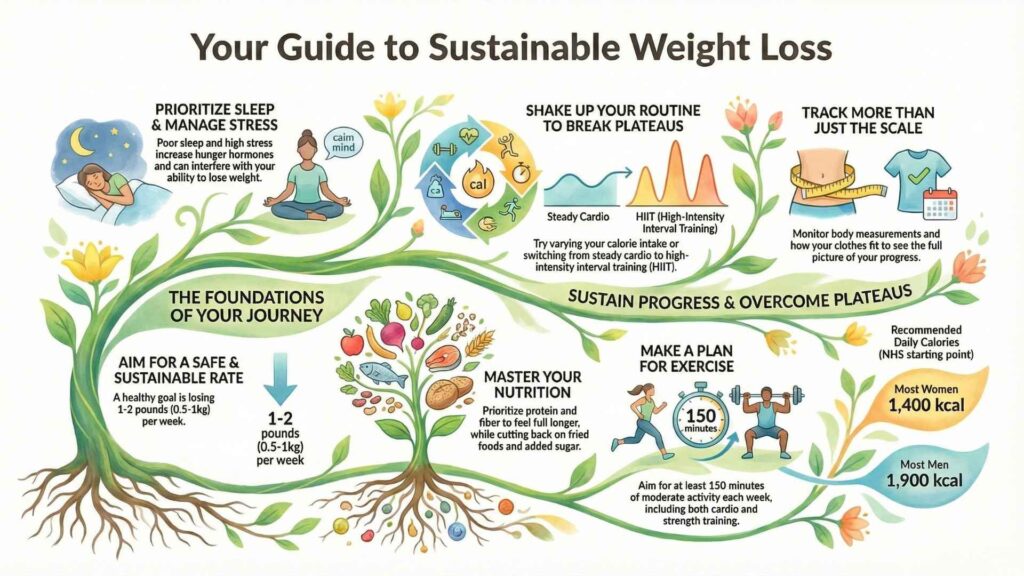
At its core, every successful fat loss transformation is governed by the laws of thermodynamics. You cannot lose weight without a calorie deficit, which is the state where your body is forced to burn its internal energy stores—fat—to meet its daily operational needs. While it sounds straightforward, the execution is where most beginners struggle. The National Heart, Lung, and Blood Institute (NHLBI) suggests that a deficit of 500 to 1,000 calories per day is the gold standard for healthy weight loss, typically resulting in a loss of 1 to 2 pounds per week.
Here’s the thing: a deficit that is too aggressive can backfire. If you drop below 1,200 calories for women or 1,500 for men, your body may trigger a “starvation mode,” technically known as adaptive thermogenesis, which slows your metabolism to conserve energy. This is why we focus on a “goldilocks” deficit—enough to drive fat loss but not so much that it sabotages your resting metabolic rate.
Calculating Your Metabolic Starting Point
To find your unique numbers, you first need to understand your Basal Metabolic Rate (BMR) and your Total Daily Energy Expenditure (TDEE). Your BMR is what your body burns just staying alive, while TDEE factors in your movement.
The Mifflin-St Jeor equation is the clinical standard for this:
For males: P=(10×weight in kg)+(6.25×height in cm)−(5×age in years)+5
For females: P=(10×weight in kg)+(6.25×height in cm)−(5×age in years)−161
Once you have your BMR, you multiply it by an activity factor to find your maintenance calories.
| Activity Level | Multiplier | Description |
| Sedentary | 1.2 | Little to no exercise |
| Lightly Active | 1.375 | 1–3 days of light exercise/week |
| Moderately Active | 1.55 | 3–5 days of moderate exercise/week |
| Very Active | 1.725 | 6–7 days of hard exercise/week |
The Impact of Energy Density on Satiety
When we look at calorie deficit for weight loss, the quality of the food matters as much as the quantity. Low-energy-density foods, such as leafy greens and watery vegetables, allow you to eat larger portions for fewer calories, which is a major factor in feeling satisfied. Harvard Health researchers emphasize that choosing minimally processed whole foods helps regulate hunger signals more effectively than simply counting numbers.
By filling half your plate with non-starchy vegetables, you leverage the physical volume of the food to signal fullness to your brain before you overconsume energy-dense fats or carbs. This is often the simplest weight loss strategy for beginners who find calorie tracking overwhelming.
Macronutrient Optimization: Why Protein is the Secret Weapon
In a high protein diet, we aren’t just looking to build muscle; we are looking to protect it. When you are in a calorie deficit, your body is prone to breaking down muscle tissue for energy along with fat. This is a disaster for your metabolism because muscle is metabolically active—it burns calories even while you sleep.
By increasing your protein intake to between 1.2 and 2.0 grams per kilogram of body weight, you provide the building blocks necessary to maintain that muscle. This keeps your metabolism humming even as you get smaller. Furthermore, protein has a higher thermic effect than other nutrients, meaning your body burns more energy just trying to digest a piece of chicken than it does a bowl of pasta.

The Satiety Power of Protein
Protein also plays a starring role in hormone regulation. It reduces levels of ghrelin, the hormone that makes you feel hungry, and boosts levels of peptide YY, which makes you feel full. What this really means for your 3 month weight loss results is fewer cravings and less “hangry” late-night snacking.
| Protein Source | Protein per 100g | Key Benefit |
| Chicken Breast | 25-30g | Lean, high bioavailability |
| Eggs | 6g (per egg) | Ideal amino acid profile |
| Paneer (Low-fat) | 18-20g | High in calcium and satiety |
| Moong Dal | 7-9g (cooked) | Fiber-rich plant protein |
| Fish (Rohu/Surmai) | 20-22g | Omega-3s for metabolism |
Weaving Protein into an Indian Lifestyle
For many Indian dieters, the challenge is finding high-protein options within a vegetarian framework. This is where traditional foods like sprouts, dal, and Greek yogurt (hung curd) become essential. The key is to include a protein source at every single meal and snack. Instead of a plain potato paratha, choosing a moong dal chilla or an egg bhurji provides the protein needed to stabilize blood sugar and prevent the energy crashes that lead to sugar cravings.
The 12-Week Roadmap: Physiological Milestones
A fat loss transformation doesn’t happen all at once. It’s a series of staggered adaptations. Understanding what is happening inside your body at each stage can help you stay motivated when the scale doesn’t seem to be moving as fast as you’d like.
Month 1: The Rapid Adaptation Phase
The first four weeks of a weight loss plan are often characterized by a “whoosh” effect. As you cut back on processed carbs and salt, your body releases stored glycogen. Because glycogen is stored with three to four parts water, you see a significant drop on the scale almost immediately. While some of this is water, it’s a vital phase for reducing inflammation and improving your relationship with food.
During this period, your nervous system is also learning how to move again. Beginners often notice rapid strength gains in the first month—not necessarily because they’ve built new muscle yet, but because their brain is getting better at “recruiting” the muscle fibers they already have.
Month 2: The Metabolic Shift
Weeks five through eight are where the real work begins. The initial water weight is gone, and the body must now get efficient at burning actual fat. This is also the time when metabolic adaptation starts to kick in. Your body realizes it’s getting less energy and tries to compensate by making you move less throughout the day.
This is often where people hit their first plateau. It is essential here to increase your non-exercise activity—like taking the stairs or walking while on the phone—to keep your total energy burn high. This is also the month to intensify your strength training for fat loss to ensure you are continuing to challenge your muscles.
Month 3: The Transformation Phase
In the final four weeks, the cumulative effects of your consistency become visible. Noticeable muscle definition in the arms, shoulders, and legs typically appears between weeks 8 and 12. At this stage, your cardiovascular endurance will have improved significantly, allowing for longer and more intense workouts.
By now, your hormones have begun to find a new “set point.” If you’ve been consistent, your cravings should have diminished as your blood sugar levels stabilized. The goal of month three is to refine your habits so they become a permanent part of your identity, rather than just a temporary project.

The Role of Strength Training and HIIT
If there were a magic bullet for fat loss transformation, it would be the combination of resistance training and high-intensity interval training (HIIT). While cardio is great for burning calories during the session, strength training changes your body’s metabolic rate for the long haul.
Strength Training: The Metabolic Engine
Building lean muscle is the only way to effectively increase your BMR. Research indicates that strength training can increase your resting metabolic rate by up to 7%. For beginners, focusing on compound movements—exercises that use multiple joints and muscle groups—is the most efficient way to work. Think of squats, push-ups, lunges, and rows. These movements burn more calories per rep and provide a larger hormonal stimulus for fat loss.
HIIT: The Afterburn Effect
High-intensity interval training, or HIIT, involves short, intense bursts of effort followed by brief recovery periods. The beauty of HIIT is the “afterburn effect,” or Excess Post-exercise Oxygen Consumption (EPOC). This process requires your body to work harder to return to its resting state, burning extra calories for hours after you’ve left the gym.
| Exercise Type | Duration | Caloric Benefit | Best For |
| Brisk Walking | 60 mins | Steady burn, low impact | Heart health and recovery |
| HIIT | 20 mins | High burn, high “afterburn” | Rapid fat loss and efficiency |
| Strength Training | 45 mins | Increases BMR over time | Body shaping and muscle |
| Yoga/Mobility | 30 mins | Stress reduction | Cortisol management |

Intermittent Fasting: Timing Your Intake for Success
Intermittent fasting for weight loss has become a popular tool, and for good reason. It’s not a magic pill, but it acts as a powerful framework for discipline. The most common method, the 16:8 protocol, involves fasting for 16 hours and consuming all your calories within an 8-hour window.
The Hormonal Benefits of Fasting
When you fast, your body’s insulin levels drop significantly. This low-insulin environment makes it much easier for your body to access stored fat for fuel. Furthermore, fasting can help reduce oxidative stress and improve circadian rhythms, which are often disrupted in those struggling with their weight.
However, timing matters. Harvard research suggests that an early eating window—say, from 9:00 AM to 5:00 PM—is often more effective for blood sugar control and blood pressure than eating late into the evening. If you can finish your dinner by 6:00 PM or 7:00 PM, your body has a much longer period to rest and repair overnight.
Safety and Compliance
For beginners, the key is to start slow. You might begin with a 12-hour fast and gradually work your way up to 16 hours. It’s also important to stay hydrated during the fasting window—water, black coffee, and green tea are your best friends here. Most importantly, intermittent fasting is a tool to help you reach a calorie deficit, not an excuse to eat poor-quality food during your eating window.
One of the biggest hurdles in an Indian weight loss plan is the sheer abundance of calorie-dense snacks. From samosas to sugary chai, the environment is full of “hidden” calories. However, traditional Indian cuisine also offers some of the best weight loss tips for beginners in the form of nutrient-dense snacks.
The Power of Makhana and Roasted Chana
Makhana, or fox nuts, are an incredible alternative to fried chips. They provide a satisfying crunch but are extremely low in fat and sodium when air-roasted. Similarly, roasted chana (Bengal gram) is a powerhouse of plant-based protein and fiber, which helps keep you full for hours.
What this really means is you don’t have to give up snacking; you just have to switch the type of snack. By replacing a packet of chips with a bowl of spiced makhana, you can save hundreds of calories while actually nourishing your body with magnesium and potassium.
Traditional Wisdom Meets Modern Science
- Sprouts Salad: A mixture of moong and mixed sprouts with lemon and spices is one of the most effective healthy weight loss foods. It’s high in protein, low in calories, and the enzymes from sprouting aid digestion.
- Buttermilk (Chaas): A glass of buttermilk is a natural probiotic that aids gut health and keeps you hydrated without the sugar found in sodas or juices.
- Besan Chilla: A gram flour pancake loaded with vegetables is a fantastic high-protein breakfast or snack that supports sustained energy levels.

Breaking Through the 6-Week Plateau
Almost everyone trying to lose 20 pounds in 3 months safely will hit a point where the scale stops moving. This is perfectly normal. Hitting a plateau is actually a sign that your body has successfully adapted to its new habits.
The Science of Metabolic Adaptation
As you lose weight, your body requires fewer calories to function. If you keep eating the same amount that helped you lose the first 10 pounds, you might eventually find yourself in a “maintenance” state rather than a “deficit” state. This is your body’s way of trying to find a new equilibrium.
To break through, you have to reassess your habits. Have your portions started to creep up? Have you been less active during the day? Sometimes, the body just needs a “shock” to the system, like switching up your workout routine or slightly increasing your protein intake to reignite the thermic effect of food.
Strategies to Restart Weight Loss
- Recalculate Your TDEE: Use your new, lower weight to find your updated calorie needs.
- Increase NEAT: Focus on non-exercise movements like standing more or walking 6,000 to 10,000 steps daily.
- Prioritize Sleep: Poor sleep increases cortisol, which triggers belly fat storage and drives cravings for sugary foods.
- Track Everything: For a few days, use an app like MyFitnessPal to record every bite. Hidden calories in cooking oils or coffee creamers can easily stall progress.
Success Stories: Lessons from the Diet Dekho Community
The data is clear, but the human element is what makes a transformation sustainable. At Diet Dekho, we’ve seen thousands of people navigate these exact challenges. Their stories highlight that while the biology is the same, the journey is personal.
Case Study: Ayushi’s Hormone Reset
Ayushi, a 21-year-old student weighing 93 kg, struggled with low self-esteem and body dysmorphia. Her 3 month weight loss results were just the beginning of a larger 32 kg loss over six months. The breakthrough for Ayushi wasn’t a crash diet; it was learning about portion control and making healthier versions of her favorite foods, like pizza and burgers. This taught her that deprivation is the enemy of consistency.
Case Study: Samvit’s Lifestyle Integration
Samvit Mishra lost 19 kg in three months without ever steping foot in a gym. His secret? Sustainable lifestyle changes. He focused on climbing 100 stairs daily and cycling for 30 minutes thrice a week. By replacing fast food cravings with roasted makhana and fruits, he proved that a busy full-time job isn’t a barrier to health if you have the right strategy.
| Name | Starting Weight | Weight Lost | Duration | Key Strategy |
| Vaishali | 129 kg | 18 kg | 3 Months | Live 1-on-1 yoga and cardio |
| Samvit | 98 kg | 19 kg | 3 Months | Stair climbing and whole foods |
| Ayushi | 93 kg | 32 kg | 6 Months | Portion control and healthier “junk” |
| Rupali | 48 kg | +13 kg | 3 Months | High-protein, nutrient-dense gain |

Psychology and Behavior: The Foundation of Change
If you want to lose 20 pounds in 3 months safely, you have to realize that weight loss is 80% nutrition and 20% psychology. Your environment and your mindset are often the biggest predictors of whether you’ll succeed.
Identifying Your Triggers
We don’t always eat because we are hungry. Emotional eating—eating in response to stress, boredom, or sadness—is a major hurdle. Social eating, where you consume more because you are in a group, is another common trigger. Identifying these patterns allows you to create “if-then” plans. For example, “If I feel stressed after a work call, then I will go for a 10-minute walk instead of reaching for a snack”.
The Importance of SMART Goals
Vague goals lead to vague results. Experts at Harvard and the CDC recommend setting SMART goals: Specific, Measurable, Achievable, Relevant, and Time-bound. Instead of saying “I want to exercise more,” say “I will walk for 30 minutes every Monday, Wednesday, and Friday morning before work.” This creates a clear roadmap for success and makes it easier to track your progress.
Measuring Progress Beyond the Scale
The scale is a blunt instrument. It doesn’t tell you if you’ve lost fat or muscle, and it doesn’t account for the glass of water you just drank. To stay motivated, you need to track “Non-Scale Victories” (NSVs).
Non-Scale Victories to Look For
- Clothing Fit: Notice how your clothes feel loose around the waist or tighter in the shoulders.
- Energy Levels: If you find you have more energy throughout the afternoon and no longer need a sugar hit to stay awake, your metabolism is improving.
- Stamina: Being able to play with your kids or climb stairs without getting winded is a significant health milestone.
- Biomarkers: Improved blood pressure, cholesterol, and blood sugar readings are the ultimate indicators of health.
Meal Planning for Weight Loss: A Daily Blueprint
The following blueprint is designed for a beginner looking for a nutrient dense meal plan that fits an Indian lifestyle. It balances protein, complex carbs, and fiber to ensure you stay in a calorie deficit without feeling deprived.
Sample Daily Structure
- Early Morning: Warm lemon water with 5 soaked almonds to kickstart digestion.
- Breakfast: Moong dal chilla with lots of grated vegetables or a 2-egg omelet with spinach.
- Mid-Morning Snack: One seasonal fruit like an apple, guava, or pear for fiber.
- Lunch: A balanced thali—1 whole wheat roti, a bowl of dal, a large portion of seasonal sabzi, and a cup of curd.
- Evening Snack: Roasted makhana or a handful of roasted chana with green tea.
- Dinner: A lighter meal for easy digestion—grilled paneer or chicken with sautéed broccoli and bell peppers.

Frequently Asked Questions (FAQs)
How can a beginner lose weight in 3 months?
To lose weight effectively, a beginner should focus on a 500-calorie daily deficit through whole foods and regular movement. A combination of high-protein meals (like dal and eggs) and increasing daily activity (like walking 10,000 steps) provides a sustainable path toward a fat loss transformation.
Is it possible to lose 20 pounds in 3 months safely?
Yes, losing 20 pounds in 12 weeks is possible and falls within the healthy range of 1 to 2 pounds per week. It requires a consistent calorie deficit and a focus on nutrient-dense foods to ensure the weight lost is primarily fat and not muscle.
What are the best exercises for weight loss in 3 months?
The most effective routine combines strength training thrice weekly with HIIT sessions. Strength training preserves muscle, while HIIT creates a powerful “afterburn effect” that keeps your metabolism elevated for hours post-workout.
How do I break a 3 month weight loss plateau?
Plateaus are broken by reassessing your calorie intake, increasing your protein, and varying your workout intensity. Often, simply increasing non-exercise activity (NEAT), like standing more or walking further, is enough to nudge the scale back down.
Is intermittent fasting good for weight loss for beginners?
Intermittent fasting is a powerful tool for weight loss because it helps control insulin and naturally limits the eating window. Beginners should start with a 12-hour window and focus on high-quality foods during their eating periods.
Final Thoughts: Your 90-Day Commitment
Weight loss in 3 months is not about a quick fix; it’s about a lifestyle overhaul. By focusing on a calorie deficit, prioritizing protein, and embracing both strength training and HIIT, you can fundamentally change your body composition. Remember, the journey isn’t always linear. There will be weeks where the scale doesn’t move and days where your motivation flags.
The key is to keep going. Focus on the small wins—the clothes fitting better, the improved energy, and the better sleep. These are the true indicators of a successful transformation. At Diet Dekho, we believe that health should be accessible and sustainable. You don’t need fancy meals or expensive gym memberships to see results. You just need a plan that works for your life.
Are you ready to start your own success story? Our expert dietitians are here to help you navigate every step of your 90-day journey with personalized guidance and 1-on-1 support. Take the first step toward the best version of yourself today.
Get started with your personalized weight loss plan here:(https://dietdekho.com/form/)
BOOK YOUR APPOINTMENT
Abhinav is the Founder of Diet Dekho, helping people manage weight and lifestyle health through simple, practical nutrition and personalized diet plans.