Are you sick of feeling heavy and slow even though you try to eat healthy home-cooked meals? Many people find it challenging to stick to a 7 day, 1.0 g diet plan for weight loss because they have strong cravings for certain foods and feel pressure from society. Following an Weight loss diet chart Indian can finally help you get past that plateau.
A diet plan chart The Indian plan focuses on well-balanced meals with 50% fiber-rich vegetables, 25% lean protein (like dal, paneer, and eggs), and 25% complex carbs (like millet and brown rice). Following the ICMR-NIN 2024 guidelines to eat 400 grams of vegetables and cut back on refined oils can help people lose fat in a healthy way. People with PCOS and diabetes can also benefit from this plan. This 7-day weight loss plan is best for the Indian metabolism.
Why Your Current Indian Diet Might Be Stalling Your Weight Loss
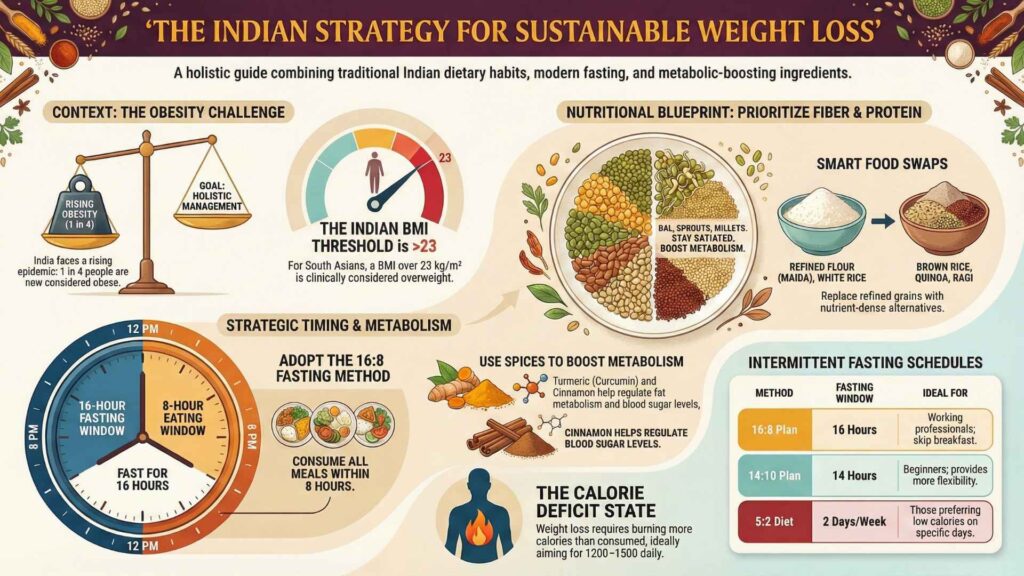
The contemporary Indian dietary landscape has undergone a radical transformation over the last few decades, moving away from diverse regional grains toward a highly refined, cereal-heavy pattern. Modern preparation methods and increased portion sizes of refined carbohydrates have created a metabolic crisis, despite the perception of traditional meals as healthy. The National Family Health Survey-5 (NFHS-5) shows that a shocking number of people are now living with a higher weight. Almost 25% of people now have a higher BMI.
The Cereal-Heavy Metabolic Crisis
One big reason for this change is that modern home-cooked meals are “high carb, high oil.” Cereals like white rice and refined wheat make up about 62% of the calories we eat each day. When the body gets more energy from carbs than it can use, it stores the extra energy as fat, mostly in the stomach area. This tendency is especially bad for Indians, who have the “Asian Indian Phenotype,” which means they have more body fat and are more resistant to insulin even when their BMI is low.
Understanding the Asian Indian Phenotype
Understanding the Asian Indian Phenotype means that a standard Western diet may not be effective for your daily routine. A weight loss chart for an average Indian must be specifically calibrated to address high triglycerides and low HDL cholesterol, which are common metabolic markers in the subcontinent. Moreover, the “hidden” caloric density in Indian cooking often comes from excessive use of fats. While ghee and vegetable oils are staples, their unregulated use can quietly add hundreds of calories to a meal. A single teaspoon of ghee adds roughly 45 to 50 calories. Consequently, when multiplied across multiple rotis and subzis throughout the day, these additions can stall weight loss even if you eat seemingly healthy home-cooked food.
Addressing the Protein Gap
Furthermore, the Indian diet is notoriously deficient in protein. Studies indicate that 73% of individuals fail to fulfill their daily protein needs, frequently misidentifying lentils as a primary protein source, whereas they are actually a blend of carbohydrates and protein. So, a successful 7-day weight loss diet plan must make sure you get enough protein to keep your muscles while you lose fat.
| Demographic Group | NFHS-4 (2015-16) % | NFHS-5 (2019-21) % | Significance |
| Children (<5 years) | 2.1 | 3.4 | 60% increase in early-onset risk |
| Adolescent Girls | 2.4 | 5.4 | Future risk of PCOS and infertility |
| Adult People | 19.8 | 23.5 | High prevalence of abdominal fat |
The Hidden Struggle: Why is it hard for Indian families to lose weight?
Losing weight is rarely just a physical journey; it is a social and emotional one, particularly within the context of an Indian joint family or a close-knit community. Food is the main way that people in India show love and hospitality. Refusing an extra paratha from your mother or sweets at a party can be seen as a sign that you reject love.
Navigating the Language of Love
This leads to something called “social undermining,” where family members who mean well accidentally sabotage health goals by encouraging overeating or bringing unhealthy snacks into the house. I know it’s challenging to make time for yourself when you have to take care of kids, older adults, and work. In many homes, the homemaker eats last, often eating leftovers to avoid wasting food. Such habits can cause meals to be served at strange times and make it hard to control portions.

Breaking Free from Mindless Leftover Eating
The psychological pressure to “fit in” during festivals and family gatherings makes it challenging to maintain a consistent weight loss diet in India. Studies indicate that family social undermining of healthy eating is strongly linked to weight gain, while support for physical activity within the family is a key predictor of success. Furthermore, it is essential to take the first step in communicating your goals.
Let’s simplify this struggle by acknowledging that you don’t have to isolate yourself to lose weight. You need to make sure everyone in your Indian household knows that putting your health first is important for the whole family’s health. To keep your weight in check, you need to set clear rules. Changing the kitchen to use healthier fats and more vegetable-based meals can help everyone, from kids who are still growing to older people who have high blood pressure or diabetes.
Common Myths: Does Eating Roti and Rice Really Stop Weight Loss?
One of the most persistent myths in the Indian fitness world is that rice and roti are the “enemies” of fat loss. This has led many to adopt extreme low-carb diets that are culturally unsustainable. The short anis no,: no, you do not need to quit rice and roti. Weight loss is determined by the overall caloric balance and the quality of those calories, rather than the elimination of a specific food group.
The Truth About Glycemic Index
The “Glycemic Index” (GI) is what really matters. It shows how quickly a food raises your blood sugar levels. Refined white rice and maida (refined flour) have a high glycemic index (GI), which means they raise insulin levels quickly and make you store fat. Whole wheat, brown rice, and millets have a lower glycemic index (GI) and a lot of fiber, which slows down digestion and makes you feel full for longer. A medium-sized whole wheat roti (about 40 g) has about 120 calories and 3–4 grams of fiber, which makes it a good choice for an Indian weight loss diet.
Rethinking Healthy Fats
Another myth is that “all fats are bad.” While deep-fried snacks should be avoided, healthy fats are essential for hormone production and vitamin absorption. The ICMR-NIN 2024 guidelines emphasize choosing a varietoilseeds,eeds, nuts, and moderate amounts of healthy vegetable oils rather than total elimination. Accordingly, the goal is to move away from “empty calories” and toward “nutrient-dense” calories.
Comparison of Indian Flatbreads for Weight Loss
| Roti Type | Calories per Roti (approx.) | Protein (g) | Fiber (g) | Key Health Benefit |
| Whole Wheat | 120 | 3.5 | 3.5 | Versatile and balanced |
| Ragi (Finger Millet) | 165 | 3.6 | 5.7 | High calcium for bone health |
| Bajra (Pearl Millet) | 110 | 4.0 | 4.2 | Rich in magnesium; good for BP |
| Jowar (Sorghum) | 100 | 3.2 | 3.3 | Naturally gluten-free; easy to digest |
| Besan (Chickpea) | 100 | 6.0 | 3.0 | Highest protein; low GI |

The Science of Satiety: How Do Protein and Fiber Work in an Indian Context?
Satiety is the feeling of fullness and satisfaction that stops us from overeating. In an Indian context, the traditional diet is often high in carbohydrates but low in protein and fiber, which leads to frequent hunger pangs and midday energy crashes. What this means for your daily routine is that increasing protein and fiber is the most effective way to make your Indian weight loss diet work without feeling deprived.
Why ProIsin is Your Best Friend
Protein is the most satiating macronutrient. It takes longer to digest and requires more energy for the body to process (the thermic effect of food). However, 7 out of 10 people in India are protein-deficient. For vegetarians, this gap can be filled by including low-fat dairy like paneer and curd, soy chunks, and properly combined pulses and cereals. The current recommendation for a sedentary adult is approximately 0.8 g to 1.0 g of protein per kilogram of body weight.
Fiber: The Natural Way to Bulk Up
Fiber is a natural way to “bulk” up the stomach. When you eat local vegetables that are high in fiber, like bottle gourd (lauki), ridge gourd (turai), or leafy greens (palak), they soak up water and get bigger. This signal tells your brain that you are full. The ICMR-NIN 2024 guidelines have increased the recommended intake of vegetables to 400 g per day to combat micronutrient deficiencies and rising weight levels. In simple terms, if you fill half your plate with vegetables, you will naturally eat fewer calories from rice and roti without feeling hungry.
Protein Density in Common Indian Foods
| Food Source | Serving Size | Protein (g) | Calories (approx.) |
| Soya Chunks | 100g (unboiled) | 52.0 | 345 |
| Paneer (Low-fat) | 100g | 18.0 | 250 |
| Moong Dal (Cooked) | 1 Cup | 8.0 | 150 |
| Egg White | 1 Large | 3.6 | 17 |
| Greek Yogurt | 100g | 10.0 | 60 |
| Mixed Sprouts | 1 Cup | 9.0 | 150 |
Your 7-Day Weight Loss Diet Chart includes both Indian vegetarian and non-vegetarian options.
This 7-day weight loss plan is easy to follow because it uses foods that you probably already have in your kitchen. It strikes a balance between regional tastes and modern nutritional needs.
| Day 1 to Day 3: Priming Your Metabolism | Day 1 Breakfast | 2 Vegetable Moong Dal Chillas with mint chutney. |
| Day 2 Breakfast | 1 bowl Oats Upma with plenty of carrots, peas, and beans. | |
| Day 3 Breakfast | 2 Boiled Eggs (or 1 cup Sprouts Salad) + 1 slice whole wheat toast | |
| Daily Lunch Strategy: 1.5 to 2 Multigrain Rotis + 1 bowl Dal + 1 cup seasonal Sabzi + Fresh Salad. | ||
| Day 4 to Day 5: Low-GI and Fiber Focus | Day 4 Lunch | 1 bowl Quinoa Pulao or Dalia Pulao + 1 bowl Masoor Dal + Curd. |
| Day 5 Lunch | 2 Bajra Rotis + 1 bowl Mixed Vegetable Curry + 1 cup Buttermilk. | |
| Snack Tip: 1 cup Roasted Makhana or a small handful of roasted Chana. | ||
| Day 6 to Day 7: Weekend Sustainability | Day 6 Dinner | 1 bowl Moong Dal Khichdi with lots of spinach + 1 bowl Roasted Veggies. |
| Day 7 Breakfast | Paneer Paratha (made with 1 tsp ghee/oil) + 1 bowl Curd | |
| Closing Meal: 1 bowl Vegetable Soup + 1 Multigrain Roti + 1 bowl Dal. | ||

Smart Swaps: How to Make Your Favorite Desi Meals Low-Calorie?
What this means for your daily routine is that you don’t need to eat bland food. The secret to a successful Indian weight loss plan is “volume eating”—increasing the quantity of food while decreasing the calorie density. You can enjoy traditional flavors without gaining weight by making smart swaps in the kitchen.
Transforming Breakfast Staples
Many people eat parathas for breakfast, which can be high in calories because of the amount of oil used. It’s tough to say goodbye to parathas, but I suggest you try a “Paneer-stuffed Besan Chilla.” It has the same comforting texture but a lot more protein and not as many refined carbs. Also, if you like rice, try mixing white rice with the same amount of steamed vegetables or cauliflower rice to lower the glycemic load.
Choosing the Right Cooking Medium
Furthermore, changing your cooking medium is an actionable solution. Transitioning from refined “white” oils to cold-pressed mustard or groundnut oil in limited quantities (3-4 teaspoons per day) provides essential fatty acids without the inflammation associated with ultra-processed fats. By following this 7-day diet plan for weight loss, you can gradually retrain your taste buds to appreciate real, whole foods.
| Traditional Dish | Low-Calorie Smart Swap | Nutritional Benefit |
| Fried Samosa | Roasted Makhana or Chana | High fiber, 70% fewer calories |
| White Rice Biryani | Quinoa or Brown Rice Pulao | Lower GI; sustained energy |
| Full-fat Milk Chai | Toned/Skimmed Milk Tea | Reduces saturated fat and calories |
| Ghee-laden Paratha | Multigrain/Millet Roti | Higher fiber and minerals |
| Potato Sabzi | Lauki or Ridge Gourd Sabzi | High water content; aids digestion |
Mistakes to Avoid: Why “Salad Only” Diets Don’t Work for Indians?
Many weight loss seekers, in their enthusiasm, attempt “crash diets” or “salad only” regimens. Let’s simplify why this usually fails: your body is a smart machine. When you suddenly restrict calories too severely, your basal metabolic rate (BMR) drops. Consequently, your body enters “starvation mode,” holding onto fat more stubbornly.
The Cultural Mismatch of Raw Salads
Also, a diet that only includes salads doesn’t fit with the culture of most people in India. Our gut microbiome is ready for warm, cooked, and spiced foods. Raw salads can often cause bloating and digestive distress if introduced too rapidly. More importantly, salads often lack the essential protein and complex carbohydrates needed to sustain a busy professional or a homemaker throughout the day.
The Slow and Steady Philosophy
In simple terms, weight loss should be a “slow and steady” journey. Aim for a loss of 0.5 kg to 1 kg per week. This slow pace makes sure that you are losing fat and not muscle. You should be able to stick to an Indian diet plan for weight loss for more than just ten days. You should be able to stick to it for ten years. A 7-day diet plan for weight loss should also be the start of changes you make to your lifestyle that will last.
Staying Consistent: Small Wins for Long-Term Health Success
Maintaining consistency is essential for successful weight loss. When the scale doesn’t show progress every day, it can be challenging to stay motivated. This is why we emphasize “Non-Scale Victories” (NSVs). For instance, are your clothes fitting better? Do you have more energy to play with your kids? Is your digestion improved? These are the real markers of a successful 7-day diet plan for weight loss.
The Power of Indian Meal Prepping
One practical way to stay consistent is “meal prepping.” For a busy professional, spending 15 minutes on a Sunday to batch-chop vegetables or prepare a healthy “onion-tomato masala” base can save hours during the week. When you have healthy food ready, you are less likely to reach for a packet of biscuits or order takeout.

Handling the Social Cheat Meal
Keep in mind, striving for perfection can hinder your progress. If you have a “cheat meal” at a wedding, don’t throw away the whole week. Simply return to your macro-balanced diet chart for Indian weight lossat the very next meal. Success is about what you do 80% of the time, not 100% of the time. Simultaneously, tracking your progress using SMART goals can keep you focused.
Setting SMART Goals for Success
- Specific: Aim for a target, like “I want to lose 5kg.”
- Measurable: Use a measuring tape to track inch loss in your waist.
- Achievable: Aim to lose 2-3 kg per month, which is realistic for most people.
- Relevant: Focus on health—improving your HbA1c or lowering your BP.
- Time-Bound: Set a target for the next 12 weeks to see visible results.
Get Your Personalized Indian Weight Loss Plan from Diet Dekho Experts
Every body is unique. While a general weight loss diet chart Indian is a great starting point, factors like your age, activity level, and medical history (PCOS, Thyroid, Diabetes) require a personalized touch. At Diet Dekho, we bridge the gap between traditional Indian wisdom and modern nutritional science.
Our experts don’t just give you a list of foods to eat; we help you build a lifestyle. We understand the struggle of the Indian kitchen and the pressure of the Indian household. Let us help you navigate your journey to holistic health with a 7 day diet plan for weight loss that actually fits your life.
Get a Personalized Macro-Balanced Plan with a Diet Dekho Expert

Frequently Asked Questions (FAQs)
What Indian foods are best for losing weight?
While there isn’t a single “magic” food that can aid in weight loss, incorporating foods rich in fiber and protein is typically the most effective approach. Moong dal, soya chunks, sprouts, and millets like ragi and jowar are some examples of these foods. These choices can help you stay full longer and keep your blood sugar levels stable.
How can I lose weight by eating Indian food without going to the gym?
People can lose weight by following a 7-day diet plan that limits calories and by doing more Non-Exercise Activity Thermogenesis (NEAT) every day. This could mean doing 150 minutes of brisk walking each week and doing demanding chores around the house, like mopping or gardening.
Is it okay to eat rice at night on an Indian weight loss diet?
Yes, you can eat rice at night, provided you control the portion size and pair it with fiber and protein. For example, 1/2 cup of brown rice with a large bowl of dal and a side of vegetables is a balanced dinner.
Which Indian cooking oil is best for weight loss?
If you want to lose weight in India, you should use cold-pressed oils like mustard oil or groundnut oil, but only in small amounts. To keep your heart healthy, you should only eat 3 to 4 teaspoons of it a day.
If I have PCOS or thyroid problems, can I follow a 7-day diet plan to lose weight?
Yes, this 7-day diet plan for losing weight is low-GI and full of nutrients, so it’s beneficial for managing PCOS and thyroid problems. Make sure to eat goitrogenic vegetables if you have thyroid problems.
Final Summary of the Weight Loss Diet Chart Indian
Achieving your goal weight doesn’t require extreme measures. By focusing on high-fiber vegetables, adequate protein, and low-GI grains, you can reclaim your health while still enjoying the rich flavors of Indian cuisine. Use the ICMR-NIN 2024 guidelines as your compass: more vegetables, less refined sugar and salt, and consistent physical activity. Your journey starts with the very next meal you put on your plate.
Disclaimer: This blog post was written to help you make healthier food choices altogether. So, be aware and take care. The important thing to consider is your health before starting a restrictive diet. Always seek advice from a doctor or dietitian before starting if you have any concerns.

Dr. Ritika is a nutrition and lifestyle expert with 2+ years of experience, helping clients manage weight and health through practical, personalized diet plans.