
Ever felt that heavy, familiar sigh of frustration when your favorite pair of jeans just won’t zip up, despite your best efforts to eat healthy? You are certainly not alone in this struggle. Consequently, finding a sustainable diet for quick weight loss and a reliable Indian weight loss diet in a traditional household can feel like an uphill battle against convenience and confusing advice.
The short answer is that a diet for quick weight loss requires a structured daily calorie deficit of 500–1,000 calories, prioritizing 400 g of vegetables and 25–30 g of fiber as per ICMR-NIN 2024 guidelines. Focus on high-protein swaps like moong dal chilla and millets, rather than refined wheat, to achieve rapid, healthy results.
Is your current Indian weight loss diet failing? Why is progress slow?
I know it’s hard to find time to analyze every bite, but the truth is that most traditional meals are unintentionally skewed toward high-energy, low-nutrient choices. What this means for your daily routine is that even home-cooked staples like parathas can lead to metabolic stalls if portions aren’t managed. According to the National Family Health Survey (NFHS-5), nearly 24% of Indian women and 23% of men now have a higher body weight, a figure that has more than doubled in just 15 years. Consequently, this isn’t just about willpower; it’s about a fundamental shift in our food environment.
The epidemiological transition in an Indian weight loss diet
Furthermore, let’s simplify this: our bodies are currently navigating what scientists call an epidemiological transition. In simple terms, while our ancestors were physically active and ate whole grains, our modern lifestyle is sedentary. However, our plates remain heavy with refined carbohydrates and hidden sugars. Additionally, the ICMR-NIN 2024 guidelines emphasize that our current nutrition scenario is leading to a rise in chronic conditions, which now cause 63% of all deaths in India.
The mismatch between activity and intake
One major reason a typical Indian weight-loss diet fails is the overestimation of calories burned compared to those consumed. For instance, a single aloo paratha with butter can easily exceed 400 calories, yet it takes nearly an hour of brisk walking to burn that off. Moreover, in the Indian context, eating healthy often mistakenly means eating more traditional foods originally designed for laborers, rather than for professionals sitting at desks for 8 hours.
Understanding the MONO phenotype
A startling revelation from the ICMR-INDIAB national study is the high prevalence of the MONO subtype—metabolically heavier, normal weight. About 43.3% of Indians may have a normal Body Mass Index (BMI) but have high levels of internal fat and adverse metabolic markers, such as insulin resistance. Therefore, looking thin doesn’t always mean you are healthy, and it explains why many struggle to lose that final layer of stubborn belly fat.
Struggling with a higher weight? How a diet for quick weight loss helps
The emotional weight of weight gain often hurts more than the physical burden. Whether it’s an NRI missing the taste of home but struggling with portion control abroad, or a busy homemaker who finishes the family’s leftovers to avoid waste, the struggle is universal. Often, we see weight gain as a personal failure. However, the science suggests it’s a complex interplay of genetics, environment, and hormonal health.
[Image: A person checking their waist measurement while wearing a traditional kurta. Alt: Following a diet for quick weight loss to manage central fat accumulation in an Indian weight loss diet.]
The impact of South Asian genetics
South Asians are genetically predisposed to storing fat around the abdomen—often called the central fat accumulation effect—even at lower BMIs. Because of this, the WHO and ICMR have recommended lower BMI thresholds for Indians: a BMI of 23 is considered the beginning of higher weight for us, whereas it’s 25 for Western populations.
| BMI Category | International Standard | Indian/Asian Standard (ICMR) |
| Underweight | < 18.5 | < 18.5 |
| Normal | 18.5 – 24.9 | 18.5 – 22.9 |
| Higher Weight | 25.0 – 29.9 | 23.0 – 24.9 |
| Heavily Weighted | > 30.0 | > 25.0 |
Why the Favorite Clothes test matters
Moreover, the inability to fit into old clothes is a practical indicator of visceral fat. In simple terms, when your waist circumference exceeds 90 cm for men or 80 cm for women, it acts as a silent warning for metabolic issues. Therefore, an Indian weight loss diet isn’t just about aesthetics; it’s about reducing this specific type of fat to protect your heart and liver.

Busting common myths about a fast weight loss diet plan and crash dieting
There is a massive difference between a crash diet and a rapid result diet. Most people think that to lose weight fast, they must stop eating entirely or survive on green tea alone. Let’s simplify this: that is a recipe for metabolic disaster.
The 3500-Calorie Myth
For decades, we were told the Wishnofsky Rule—that a 3500-calorie deficit equals one pound of fat loss. However, NIH research now shows that this rule grossly overestimates weight loss because it doesn’t account for how the body slows its metabolism to save energy. Therefore, a sustainable diet for quick weight loss must be dynamic rather than a fixed mathematical equation.
The No-Carb Fallacy
Many Indians believe they must eliminate roti and rice completely to see results. I know it sounds logical, but suddenly removing all carbs leads to intense brain fog and eventually, a tendency to over-consume during the next meal. Furthermore, Indian bodies are genetically adapted to carbs; the secret is not elimination but choosing smart carbs like millets (ragi, jowar), which have a lower Glycemic Index (GI). This is a core principle of any effective Indian weight loss diet.
The Green Tea Trap
Additionally, drinking green tea five times a day won’t melt fat if your main meals are unbalanced. In fact, excessive green tea on an empty stomach can cause acidity and block the absorption of iron, which is particularly dangerous for the 50% of Indian women who are already anemic.
Common Nutrition Myths Debunked
| Myth | The Reality | The Science |
| All fats are bad for the heart | Healthy fats (Omega-3s) are essential. | Fats like DHA/EPA reduce inflammation. |
| Skipping dinner burns more fat | Spikes stress hormones and leads to over-eating. | Disrupts circadian rhythms. |
| Honey in hot water melts fat | Honey is still sugar; it adds calories. | Calories in vs. out still applies. |
| Potatoes are the enemy | Boiled potatoes are nutrient-dense. | Rich in Vitamin C and Potassium. |
The science of shedding kilos: Calorie deficits in an Indian weight loss diet
To achieve a diet for quick weight loss, we must look at the math, but with a heart. Weight loss occurs when you create an energy deficit. This is the gap between the energy you eat and the energy your body uses to function.
Calculating the safe deficit
Most experts recommend a daily deficit of 500 to 1,000 calories. For a typical Indian adult, this usually means consuming 1,200-1,500 calories. However, women should never drop below 1,200 calories and men below 1,500 calories without medical supervision, as this can lead to muscle loss and nutrient deficiencies. Consequently, a balanced Indian weight-loss diet ensures you lose fat, not muscle.
The Body Mass Index formula is a simple starting point:
BMI= weight(kg)/height(m)²
While BMI isn’t perfect, it helps identify the degree of intervention needed.
The role of protein and fiber
Furthermore, the 2024 ICMR guidelines have made a major shift: they now recommend 400 g of vegetables daily, up from 300 g. This means that half of your lunch and dinner plates should be filled with seasonal vegetables. Moreover, fiber acts as a natural bulking agent, absorbing water and signaling your brain that you are full, which is vital for any diet for quick weight loss.

7-Day Indian Meal Plan: Your Daily Diet for Quick Weight Loss
I know it’s hard to find time to cook elaborate meals, so this plan uses simple, home-based ingredients that align with a quick way to lose weight.
- Day 1 (Metabolism Kickstart): Begin with warm lemon water and 5 soaked almonds. Enjoy 2 moong dal chillas for breakfast. For lunch, choose a multigrain roti with lauki sabzi and a bowl of dal. Finish with a light vegetable soup and grilled paneer.
- Day 2 (Fiber Focus): Start with methi water. Prepare a vegetable oats upma for breakfast. For lunch, try a small cup of brown rice with mixed sprouts curry. End the day with a bajra roti and stir-fried spinach.
- Day 3 (South Indian Twist): Sip on jeera water early. Eat 2 idlis with sambar for breakfast. For lunch, have a roti with bhindi sabzi and masoor dal. Dinner can be vegetable khichdi made with brown rice and beans.
- Day 4 (High Protein): Consume cinnamon water first thing. Eat boiled egg whites and toast for breakfast. For lunch, grilled chicken breast or tofu with salad is ideal. Dinner can be a warm chicken stew or dal soup.
- Day 5 (Detox Approach): Drink chia seed water early. Eat vegetable poha with added peas for breakfast. For lunch, enjoy tofu bhurji with a massive salad. Dinner should be stir-fried zucchini and bell peppers.
- Day 6 (Millet Day): Start with ginger-tulsi tea. Prepare a ragi dosa for breakfast. For lunch, 2 jowar rotis with palak paneer work perfectly. Dinner is tandoori paneer or grilled fish with boiled vegetables.
- Day 7 (The Final Cleanse): Sip low-fat turmeric milk. Eat a besan chilla for breakfast. For lunch, choose millet khichdi with kadhi. Finish your week with a light moong soup and one phulka.
From poha to sprouts: Choosing speedy weight loss meals for your routine
A crucial strategy in an Indian weight loss diet is upgrading your favorites. Most of our breakfasts are carb-heavy, which gives us a quick burst of energy followed by a crash that leaves us hungry by 11 AM.
Upgrading the Indian Breakfast
Let’s simplify this: if you eat 1 bowl of plain Poha, you get energy but very little protein. However, if you add half a cup of sprouts to that Poha, you significantly increase the protein content. This is a prime example of a speedy weight-loss meal that keeps you satiated for hours.
| Traditional Breakfast | The Weight Loss Swap | Why it Works |
| White Bread Toast | Besan Chilla | Higher protein, keeps you full. |
| Sugar-laden Cornflakes | Vegetable Dalia | Complex fiber prevents sugar spikes. |
| Aloo Paratha | Paneer Paratha (no oil) | Protein from paneer boosts metabolism. |
| Sweetened Poha | Sprouts Salad/Poha | Massive fiber and protein hack. |
The Roti vs. Rice Debate
This is an age-old query in Indian households. In simple terms, for a diet focused on quick weight loss, roti is generally a better choice because it has a lower GI and more fiber.
- White Rice: GI of 72 (High). It digests quickly and can cause hunger pangs sooner.
- Whole Wheat Roti: GI of 62 (Medium). It provides sustained energy.
- Millet Roti (Ragi/Bajra): GI of 54 (Low). This is the gold standard for fat loss.

Hidden weight loss killers: Avoid over-satiating on secret calories.
What this means for your daily routine is that the little things often matter more than the big meals. We often ignore the hidden calories that act as silent saboteurs to a diet for quick weight loss.
The Sugar Trap
Moreover, hidden sugars are not just in mithai; they are in your bread, your ketchup, and even your healthy digestive biscuits. A single tablespoon of packaged tomato ketchup can have an entire teaspoon of sugar. Consequently, you must read labels to ensure your Indian weight loss diet stays on track.
The Beverage Blunder
I know it’s hard to find time to drink plain water, but your chai might be the problem. Two cups of masala chai with full-fat milk and 2 teaspoons of sugar can add up to 200 calories a day. Over a month, that’s 6,000 extra calories—nearly enough to gain a kilogram of fat!
Common Hidden Calorie Sources
| Item | Hidden Killer | Smart Swap |
| Restaurant Gravies | Cream and Butter | Tandoori or grilled options |
| Fruit Juices | Lack of fiber, sugar spikes | Whole fruit |
| Pickles & Chutneys | Excessive oil and sugar | Fresh mint/coriander chutney |
| Cooking Oil | Adding oil to roti | Oil-free/Phulka style roti |
Managing medical conditions: How an Indian weight loss diet helps PCOS and thyroid
A diet for quick weight loss must be safe and therapeutic if you are managing a medical condition.
PCOS and PCOD: The Insulin Connection
For women with PCOS, weight loss is about managing insulin resistance. High-fiber carbohydrates like bajra and jowar are essential to prevent insulin spikes. Furthermore, losing just 5-10% of your body weight can significantly improve hormonal balance and restore regular periods. This makes a focused Indian weight loss diet your best medicine.
Thyroid: The Metabolic Stall
If you have hypothyroidism, your metabolism is naturally slower. Therefore, a diet for quick weight loss in thyroid patients should prioritize iodine- and selenium-rich foods such as walnuts and curd. Additionally, always cook cruciferous vegetables, such as cabbage, to reduce their goitrogenic effects.
Hypertension: The DASH Approach
The DASH (Dietary Approaches to Stop Hypertension) diet is the gold standard for blood pressure.
- Salt Restriction: Keep daily salt intake below 5 g.
- Potassium Power: Include bananas, coconut water, and spinach to help your body flush out excess sodium.

Staying consistent: Why slow progress is still a win for your health.
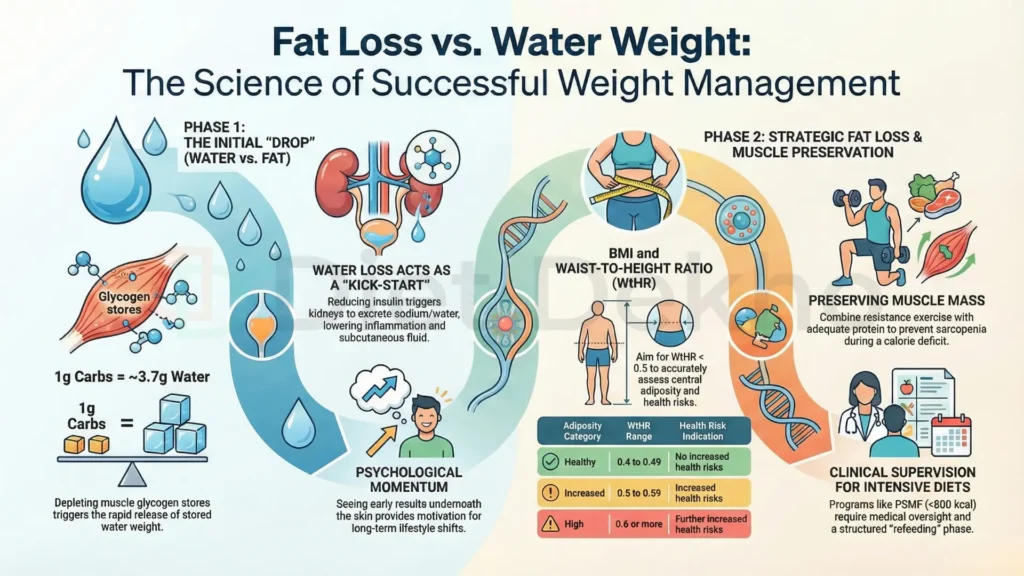
At the beginning of a diet for quick weight loss, you might see the scale move rapidly. This is often water weight as your body uses up stored glycogen. However, do not be discouraged when the loss slows down to 0.5 kg a week—that is actually the sweet spot where you are burning real fat, not just losing water.
The Psychological Battle
I know it feels like a struggle when you don’t see instant results in the mirror. But remember, internal health changes happen before external ones. Consequently, your liver fat decreases, your insulin sensitivity improves, and your heart becomes more efficient. Therefore, staying committed to your Indian weight loss diet pays off in longevity.
[Image: A happy person holding a plate of fresh fruit. Alt: Maintaining success with an Indian weight loss diet for long-term health results.]
Non-Scale Victories (NSVs)
While following your diet for quick weight loss, track these changes too:
- Are you feeling less bloated after meals?
- Do you have more energy to finish your workday?
- Are your clothes fitting more comfortably around the waist?
- Is your sleep quality better than before?
Ready for a transformation? Book a personalized consultation with Diet Dekho today!
Everybody is different, and while a general Indian weight loss diet works for many, a personalized plan ensures you get results without the guesswork. At Diet Dekho, we understand the Indian kitchen and the challenges of a modern lifestyle. We don’t believe in starving; we believe in smart eating.
Get a Personalized Macro-Balanced Plan with a Diet Dekho Expert
Stop guessing your calories, and let our senior strategists design a plan that includes your favorite Indian foods while meeting your health goals. Whether you are managing PCOS or just trying to fit into that wedding outfit, we are here to guide you.
Start Your Journey to Holistic Health with a Diet Dekho Consultant.
Click the link below to share your details, and a Diet Dekho consultant will reach out to help you start your journey toward a healthier, lighter you. https://dietdekho.com/form/

Frequently Asked Questions (FAQs)
What is the best diet for quick weight loss?
There is no single “best” diet for quick weight loss. Diets that reduce calories while providing enough protein, fiber, and micronutrients tend to produce faster short-term results, but long-term success depends on sustainability rather than speed.
How do I start a diet for weight loss?
A weight loss diet should start with modest calorie reduction, regular meal timing, adequate protein, high-fiber foods, and reduced intake of ultra-processed foods. Extreme restriction increases the risk of failure and weight regain.
Which diet works best for quick weight loss?
Low-calorie, high-protein diets may lead to quicker initial weight loss compared to high-carbohydrate diets, but no diet is superior in the long term without adherence. Personal preferences and medical conditions matter more than diet labels.
Are eggs and oats good for weight loss?
Yes. Eggs provide high-quality protein that increases satiety, while oats are rich in soluble fiber that helps control appetite. When included in a calorie-controlled diet, both support weight loss.
Can I lose weight fast without exercise?
Weight loss can occur without exercise through calorie reduction, but exercise helps preserve muscle mass, improve insulin sensitivity, and reduce the risk of weight regain.
Why do many quick weight loss diets fail?
Quick weight loss diets often fail because severe calorie restriction slows metabolism, increases hunger hormones, and is difficult to maintain. This leads to overeating and weight regain once the diet ends.
Is keto or liquid diet safe for quick weight loss?
Keto and liquid diets may cause rapid weight loss but are not safe for everyone and can lead to nutrient deficiencies, fatigue, and digestive issues. These diets should only be followed under medical supervision.
Who should avoid quick weight loss diets?
Quick weight loss diets should be avoided by people with diabetes, thyroid disorders, PCOD, eating disorders, heart disease, pregnant or breastfeeding women, and adolescents.
Contact Us
We understand how overwhelming nutrition and weight loss information can feel. With so many opinions and confusing advice online, it’s easy to feel stuck or unsure about what to do next.
At Diet Dekho, you never have to figure it out alone. You can contact us anytime with any questions or concerns. Our expert dietitians are available 24/7 to guide, support, and help you stay on track. Whether your goal is weight loss or building healthier habits, we’re here to make the journey simpler and more sustainable for you.
Disclaimer
This blog is intended to help readers make healthier food choices. Your health should always be the top priority. Before starting any restrictive or special diet, especially if you have a medical condition or health concern, please consult a doctor or a qualified dietitian. Each body responds differently to food and lifestyle changes. Always choose what is safe and suitable for you.

Dr. Ritika is a nutrition and lifestyle expert with 2+ years of experience, helping clients manage weight and health through practical, personalized diet plans.