Are you tired of being told to just eat more without seeing any results on the scale? At DietDekho.com, we understand that finding an effective vegetarian diet plan for weight gain requires more than just extra rotis; it requires a scientific approach to nutrient density and metabolic health.
A healthy vegetarian diet plan for weight gain involves consuming a consistent caloric surplus of 300–500 calories daily from nutrient-dense sources like paneer, nuts, ghee, and pulses. By prioritizing high-quality plant proteins and healthy fats while performing light resistance exercise, Indian vegetarians can build lean muscle mass safely and sustainably at home.
The struggle to gain weight on a veg diet for weight gain
The pursuit of healthy growth within the Indian vegetarian demographic presents unique physiological and socio-cultural challenges. While much of the global nutritional discourse focuses on weight loss, significant portions of the Indian population remain clinically underweight. According to data from the National Family Health Survey (NFHS-5), the prevalence of underweight individuals persists despite improvements in overall child nutrition indicators. For many, the difficulty in sticking to a veg diet for weight gain is not merely a lack of food but involves a complex interplay of metabolic rates, dietary diversity, and the bioavailability of nutrients in a plant-heavy diet.
The hardgainer phenomenon in India is often characterized by individuals who possess a naturally high Basal Metabolic Rate (BMR). For these individuals, the body consumes energy as fast as it is ingested, making it difficult to maintain the positive energy balance required for tissue synthesis. In an Indian context, the dietary landscape is dominated by cereals and millets, which, while energy-dense, may lead to early satiety due to high fiber content. This creates a paradox where the very foods recommended for health—whole grains and vegetables—can sometimes hinder the caloric goals of a vegetarian diet plan for weight gain.
Why eating more isn’t enough for a vegetarian weight gain meal plan
A frequent error in weight gain strategies is the assumption that simply increasing the quantity of food will result in success. From a biochemical perspective, your vegetarian weight gain meal plan is governed by the principles of energy thermodynamics, but the quality of that energy determines the health of the outcome. The basic equation for weight management is the energy balance:
EnergyBalance=EnergyIntake−EnergyExpenditure
To gain weight, one must achieve a consistent state where EnergyIntake>EnergyExpenditure. However, the body’s adaptive thermogenesis can often compensate for increased intake by increasing the metabolic rate. This is why many people find they can eat significantly more without seeing any change. Furthermore, a vegetarian weight gain meal plan often fails when busy professionals forget to eat during high-stress periods, leading to accidental caloric deficits.
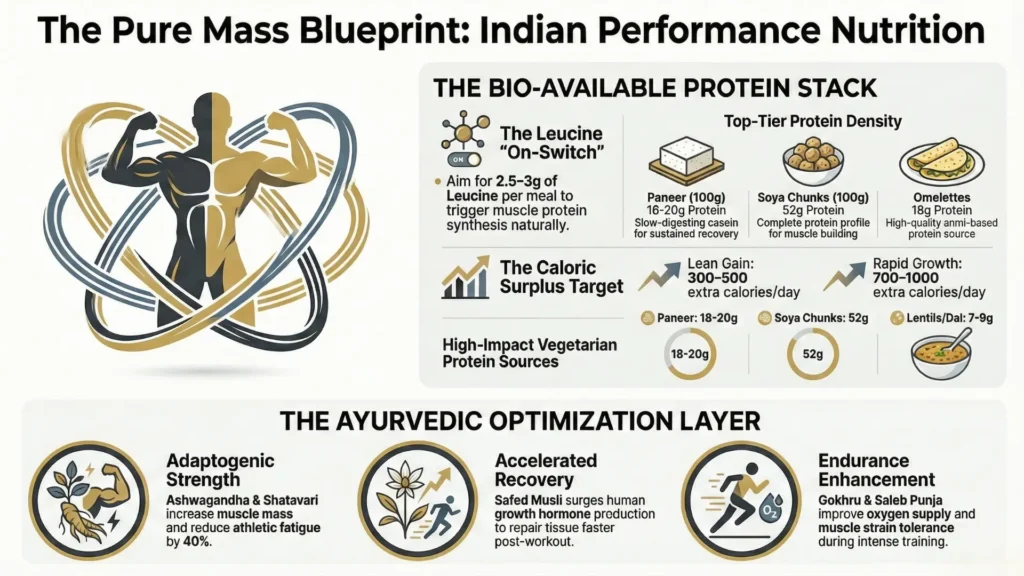
Healthy weight gain requires a strategic surplus, typically 300 to 500 extra calories per day for slow, sustainable gain, or 700 to 1,000 extra calories for rapid gain. This surplus must be distributed across nutrient-dense sources. Consuming empty calories from ultra-processed junk might lead to weight gain, but it also increases the risk of systemic inflammation and insulin resistance.

Common myths: Can you really bulk up on a pure veg diet for weight gain?
The myth that muscle building is the exclusive domain of meat-eaters is a significant psychological barrier. This misconception stems from an oversimplified view of protein quality. While animal proteins are complete, a pure veg diet for weight gain can be strategically structured to achieve the same result.
Most Indian vegetarian staples, like wheat or rice, are limiting in certain amino acids. However, pulses and legumes are rich in what grains lack. When consumed together—as in the classic dal-chawal or khichdi—they provide a complete amino acid profile that is as effective for muscle synthesis as animal-based proteins. Another myth is that bulk gain on a pure veg diet for weight gain consists mostly of fat. On the contrary, high-quality plant proteins like paneer and soy provide the branched-chain amino acids (BCAAs) that are critical for triggering muscle protein synthesis.
Table 1: Protein Content of Indian Vegetarian Sources
| Food Item (100g) | Protein (g) | Type | Strategic Benefit |
| Paneer | 18 – 20 | Vegetarian | Complete protein; slow digestion |
| Moong Dal (Raw) | 24 | Vegetarian | High zinc; easy to digest |
| Soy Chunks | 52 | Vegetarian | High-density complete plant protein |
| Almonds | 21 | Vegan | Calorie-dense healthy fats |

The science of a calorie surplus: How to structure a veg meal plan to gain weight
To move beyond mere weight gain and into healthy bulking, you must understand the metabolic partition of macronutrients. The 2024 ICMR-NIN guidelines have shifted focus toward a more balanced distribution of energy sources, particularly emphasizing the quality of fats in a veg meal plan to gain weight.
For an adult Indian, the Acceptable Macronutrient Distribution Ranges (AMDRs) suggest:
- Carbohydrates: 45–65% of total calories. These are essential for glycogen replenishment.
- Proteins: 10–35% of total calories. These serve as the structural framework for muscle.
- Fats: 20–35% of total calories. Fats are the most energy-dense macronutrient (9kcal/g) and are vital for hormone production.
In a veg meal plan to gain weight, achieving a calorie surplus is easiest through the inclusion of healthy fats. The updated 2024 guidelines recommend limiting saturated fats and eliminating trans-fats. For the Indian vegetarian, this means moving away from refined oils toward traditional sources like desi ghee and cold-pressed mustard oil. Ghee is a source of butyrate, which supports gut health; a single tablespoon adds roughly 120 calories with negligible digestive load.
Top Indian superfoods: Paneer, nuts, and lentils for weight gain
Indian cuisine offers an array of weight gain foods list that act as natural mass gainers. Integrating these into your vegetarian diet plan for weight gain is the most effective way to reach targets without resorting to junk.
Paneer (Cottage Cheese)
Paneer is arguably the most important muscle-building food for Indian vegetarians. It is rich in casein, a slow-digesting protein that provides a steady release of amino acids. This makes paneer an ideal food for consumption before sleep to prevent muscle breakdown overnight.
High Calorie Vegetarian Foods: Nuts and Seeds
Nuts are a concentrated source of calories and healthy fats. Peanuts, in particular, are affordable and provide high protein. Peanut chikki—a traditional snack made of peanuts and jaggery—is a calorie-dense bomb that provides both instant energy and long-term satiety.
Millets: The Ancient Mass Gainer
Millets like Ragi (Finger Millet) and Bajra (Pearl Millet) are nutritionally superior to refined wheat. Ragi is exceptionally high in calcium, which is vital for bone density—a common concern for underweight individuals. Bajra is high in protein and iron, supporting oxygen transport during the bulking process.

Sample 7-day vegetarian diet plan for weight gain
A structured routine is essential for ensuring a consistent caloric surplus. This vegetarian diet plan for weight gain integrates regional diversity and emphasizes meal frequency.
| Day | Early Morning (7 AM) | Breakfast (8:30 AM) | Lunch (1:30 PM) | Evening Snack (5 PM) |
| Mon | Milk + Almonds + Dates | 2 Paneer Parathas + Ghee | Rajma Chawal + Ghee | Mango Shake + Cashews |
| Tue | Milk + Ghee + Jaggery | Veg Uttapam + Chutney | Chole Rice + Veg Raita | Fruit Bowl + Peanuts |
| Wed | Milk + Almonds + Dates | Poha + Banana Shake | Dal Makhani + Paratha | Jaggery Tea + Makhana |
| Thu | Milk + Walnuts + Dates | 2 Besan Cheelas + Paneer | Soyabean Curry + Roti | Peanut Butter Toast |
| Fri | Milk + Almonds + Dates | Oats with Milk + Nuts | Pulao + Raita + Salad | 2 Besan Chilla |
| Sat | Milk + Ghee | Stuffed Paratha + Smoothie | Dal Tadka + Mango Lassi | Fruit Chaat + Nuts |
| Sun | Milk + Almonds + Dates | Potato Sandwich + Smoothie | Dal Khichdi + Ghee + Curd | Sweet Potato Salad |
Adapting for Medical Conditions
For those managing PCOS, Diabetes, or Thyroid disorders, the vegetarian diet plan for weight gain must be fine-tuned.
- PCOS/PCOD: Prioritize fiber-rich carbs like Ragi and Jowar over white rice to manage insulin levels while adding calories.
- Diabetes: Use the plate method—half non-starchy vegetables, one-quarter whole grains, and one-quarter protein—to ensure stable blood sugar during weight gain.
- Thyroid: For hyperthyroidism, you require a significantly higher caloric intake to prevent muscle wasting. Avoid caffeine which can exacerbate heart rate.

Common mistakes: Over-reliance on junk food and skipping meals
The dirty bulking trap is the most common reason for failed weight-gain attempts. While samosas and biscuits are calorie-dense, they are primarily refined flour (maida) and poor-quality oils. This leads to gaining visceral fat rather than the lean muscle targeted by a vegetarian diet plan for weight gain.
According to the National Institutes of Health (NIH), ultra-processed food consumption can lead to systemic inflammation. For a healthy veg diet for weight gain, the goal is to choose minimally processed whole foods. Another mistake is drinking large amounts of water immediately before a meal, which fills the stomach prematurely. It is advisable to hydrate 30 minutes before or after your meals.
Stay consistent: Small dietary changes lead to big results
Weight gain is a marathon. Your body can only build a limited amount of muscle each week—typically 0.5 to 1 pound. Exceeding this through massive surpluses will lead to excess fat storage.
Behavioral Strategies for Success
- Use Bigger Plates: This psychological trick prevents feeling overwhelmed by food volume.
- Protein First: Eat your protein sources first during a meal to ensure muscle-building blocks are consumed before you get full.
- Consistent Sleep: Growth hormone is released during deep sleep. 7–9 hours of rest is non-negotiable for a successful vegetarian diet plan for weight gain.
Get your personalized Indian veg weight gain plan with Diet Dekho
The journey to healthy weight gain is deeply personal. Factors such as age, genetics, and medical conditions like PCOS or Thyroid issues mean that a one-size-fits-all approach rarely works. At Diet Dekho, we combine traditional Indian wisdom with modern science to create a vegetarian diet plan for weight gain that is culturally relevant and effective.
Whether you are a busy professional needing quick weight gain foods list or a homemaker looking to optimize family nutrition, our senior consultants provide the professional oversight needed for success. Our focus is not just on the scale, but on creating a vibrant, energetic version of you through optimized vegetarian nutrition.

Frequently Asked Questions (FAQs)
1. Can I gain weight fast on a vegetarian diet plan for weight gain?
Yes, by maintaining a consistent caloric surplus of 500–1000 calories through calorie-dense foods like ghee, paneer, and nuts, you can see progress within 4–6 weeks.
2. What are the best high calorie vegetarian foods for quick gain?
Nut butters, full-fat dairy (paneer/curd), ghee, bananas, dates, and starchy vegetables like sweet potatoes are the most effective local options.
3. Is late-night eating okay for a veg diet for weight gain?
Yes, a protein-rich bedtime snack like warm milk or paneer helps prevent muscle breakdown while you sleep.
4. How many meals should I eat in a vegetarian weight gain meal plan?
Instead of 2–3 large meals, aim for 5–6 smaller, nutrient-dense meals to avoid feeling overly full and ensure consistent caloric intake.
5. Can I follow this plan if I have PCOS or Diabetes?
Absolutely, but you must focus on low-GI complex carbohydrates (like millets) and healthy fats to manage insulin sensitivity while gaining weight.
Contact Us
We understand how overwhelming nutrition and weight loss information can feel. With so many opinions and confusing advice online, it’s easy to feel stuck or unsure about what to do next.
At Diet Dekho, you never have to figure it out alone. You can contact us anytime with any questions or concerns. Our expert dietitians are available 24/7 to guide, support, and help you stay on track. Whether your goal is weight loss or building healthier habits, we’re here to make the journey simpler and more sustainable for you.
Disclaimer
This blog is intended to help readers make healthier food choices. Your health should always be the top priority. Before starting any restrictive or special diet, especially if you have a medical condition or health concern, please consult a doctor or a qualified dietitian. Each body responds differently to food and lifestyle changes. Always choose what is safe and suitable for you.

Dr. Ritika is a nutrition and lifestyle expert with 2+ years of experience, helping clients manage weight and health through practical, personalized diet plans.