At DietDekho, we often hear from clients who feel invisible because of their weight, struggling with the frustration of a high metabolism that seems to burn through everything they eat. If you are tired of being told to just eat more, you need to realize that choosing the best weight gain foods is about strategy, not just volume.
The best weight gain foods in an Indian context include nutrient-dense options like full-fat paneer, desi ghee, almonds, walnuts, and starchy whole grains like Ragi. To gain weight healthily, maintain a daily caloric surplus of 300–500 calories by choosing healthy weight gain foods that provide a balance of high-quality protein and complex carbohydrates.
Weight Gain Foods: The Ultimate Indian Diet Guide to Bulking Up Healthy
1. Why is eating more not always working for you?
I know it’s hard to find time to eat constantly, and it’s even more frustrating when the scale doesn’t move despite your efforts. In my 10+ years at DietDekho, I’ve seen many people fail because they focus on quantity over nutrient density. Being underweight—clinically defined as a Body Mass Index (BMI) of less than 18.5kg/m2—is a complex metabolic state.
The latest National Family Health Survey (NFHS-5) shows that while India is battling an obesity rise, nearly 16.2% of men and 18.7% of women remain underweight. If you are eating more but not gaining, your body might be in a catabolic state where it burns muscle for fuel, or you might have poor nutrient absorption. Simply adding junk won’t solve this; you need to identify the best foods to gain weight that actually stick to your frame.
What this means for your daily routine is that we need to fix your Agni or digestive fire. In simple terms, if your gut isn’t healthy, even the most high calorie foods for weight gain will just pass through your system without building tissue. We want to move you from a state of depletion to a state of growth by using a structured weight gain diet.
2. How does proper nutrition impact your energy and immunity?
Beyond the mirror, your weight is the foundation of your biological defense system. When you are underweight, your body lacks the energy stores required to produce essential antibodies, leaving you susceptible to frequent infections and prolonged recovery times. I’ve seen clients who catch a cold every time the weather changes; usually, it’s because their fuel tank is empty.
Low body weight also has a silent impact on your skeletal health. Research from the ICMR and global bodies like the NIH indicates that being underweight significantly increases the risk of osteoporosis and low bone mineral density. Without enough nutrient dense weight gain foods, your body begins to leach minerals from your bones to maintain basic functions.
For the busy professionals and homemakers we advise, low weight often manifests as chronic fatigue. If you feel drained by noon, it’s because your glycogen stores are depleted. By incorporating the best weight gain foods, you aren’t just changing your look—you are building a resilient immune system, stronger bones, and the stamina to handle a demanding Indian lifestyle.

3. Why do junk food and dirty bulking do more harm than good?
It is a common myth that you should eat pizzas, burgers, and samosas to bulk up quickly. In the fitness world, we call this dirty bulking, and it is a recipe for metabolic disaster. While these foods are high in calories, they are packed with trans fats and refined sugars that trigger skinny fat syndrome—where you have a protruding belly but thin arms and legs.
Dirty bulking can cause insulin resistance and systemic inflammation, which is particularly dangerous for our clients managing PCOD/PCOS or a family history of diabetes. Instead of building muscle, dirty calories often lead to visceral fat—the dangerous fat that wraps around your organs.
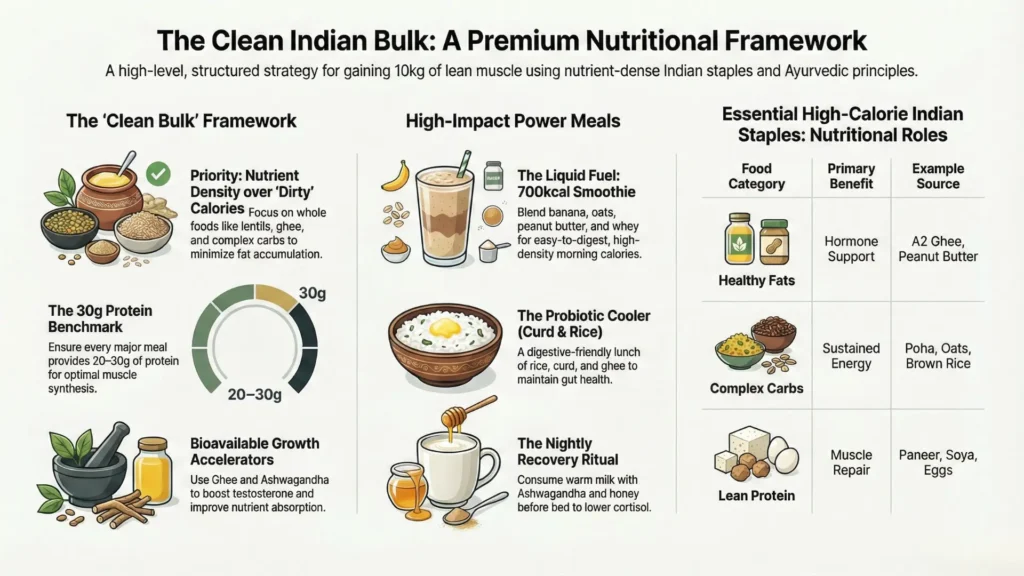
Let’s simplify this: the goal is Clean Bulking. This means choosing healthy weight gain foods like nuts, seeds, and whole grains that provide vitamins and minerals alongside calories. Clean bulking ensures that your weight gain is functional, meaning it improves your strength and health rather than just increasing your dress size at the cost of your heart health.
4. How do you understand the science of a caloric surplus?
Healthy weight gain is governed by the law of thermodynamics. To grow, you must consume more energy than you expend. This is known as a caloric surplus. At DietDekho, we calculate your Total Daily Energy Expenditure (TDEE) to find your unique growth number.
The formula we use is:
TDEE=BMR × Activity Factor + Thermic Effect of Food
For most people, adding a surplus of 300 to 500 calories per day results in a sustainable gain of about 0.5 kg per week. If you jump to a 1000-calorie surplus immediately, you will likely face bloating and excessive fat storage. Gradual progression is the secret to a successful weight gain meal plan.
What’s more important than the calories is the macro-split. To ensure the weight you gain is muscle, your diet should roughly consist of 50% carbohydrates, 20-25% protein, and 25-30% healthy fats. Carbohydrates are protein-sparing; they provide the energy so that the protein you eat can do its job of repairing and building muscle tissue.

5. What are the top Indian weight gain foods for your pantry?
Indian kitchens are a goldmine for best foods to gain weight. You don’t need expensive protein tubs; you need the wisdom of traditional Indian ingredients. Here is a breakdown of the nutrient dense weight gain foods you should prioritize.
Desi Ghee: The Ancient Calorie Booster
Ghee is one of the most effective high calorie foods for weight gain. A single tablespoon adds approximately 120 calories to your meal without increasing the volume of food you have to eat. It also contains butyric acid, which improves gut health and helps you absorb nutrients from your other meals.
Paneer and Full-Fat Dairy
Paneer is Desi Muscle Fuel. It provides high-quality casein protein, which is slow-digesting and keeps your body in an anabolic (building) state for hours. Drinking a glass of buffalo milk (which is higher in fat than cow milk) before bed can significantly boost your overnight recovery and growth.
Nuts and Nut Butters
If you struggle with a low appetite, nuts are your best friend. Almonds, cashews, and walnuts are healthy weight gain foods that are extremely calorie-dense. A small handful can provide over 170 calories. Peanut butter is another effortless addition; two tablespoons on a slice of whole-wheat bread can add nearly 200 calories to your snack time.
Starchy Grains and Millets
While the world talks about low carb, for weight gain, we embrace complex carbs. Ragi (Finger Millet) is excellent for weight gain because it is rich in calcium and iron, which are often deficient in underweight individuals. Sweet potatoes and bananas are also among the best weight gain foods for providing the fast-digesting energy needed for muscle protein synthesis.
| Food Group | Examples | Benefit for Bulking |
| Healthy Fats | Ghee, Coconut Oil, Avocado | High calorie density, hormone support |
| Proteins | Paneer, Eggs, Soya, Chicken | Muscle repair and growth |
| Complex Carbs | Ragi, Sweet Potato, Brown Rice | Sustained energy, spares protein |
| Calorie Boosters | Dates, Raisins, Peanut Chikki | Easy snacking for low appetite |
6. What does a sample day on a high-calorie Indian diet look like?
Structure is the enemy of being underweight. To succeed, you need a weight gain meal plan that spaces out calories so you don’t feel uncomfortably full. At DietDekho, we recommend eating every 3 hours.
- Early Morning (7:00 AM): 1 glass of whole milk with 2 tsp skimmed milk powder + 2 bananas + 5 soaked almonds.
- Breakfast (8:30 AM): 2 Paneer-stuffed parathas with ghee + 1 bowl of thick curd sweetened with jaggery.
- Mid-Morning (11:30 AM): A large glass of mango lassi or a handful of roasted peanuts and dried figs.
- Lunch (1:30 PM): 1 cup Rajma or Chicken curry + 2 ghee-laden rotis + 1 cup rice + a side of sautéed vegetables.
- Evening (5:30 PM): Roasted makhana (fox nuts) in ghee or 2 besan chillas with paneer stuffing.
- Dinner (8:30 PM): Dal makhani or Paneer Bhurji + 2 rotis + small portion of vegetable pulao.
- Bedtime (10:00 PM): Banana shake with peanut butter or a glass of warm saffron milk with dates.
By following this diet plan for weight gain, you are consistently providing your body with the building blocks it needs to add healthy mass.

7. What are the crucial mistakes you must avoid?
The most common mistake I see is an over-reliance on supplements. While a whey protein shake can help, it should never replace a meal. Whole foods contain fiber and micronutrients that powders lack. According to ICMR-NIN 2024 guidelines, obtaining protein through a diverse diet is superior for long-term health than relying solely on supplements.
Another error is skipping meals when you’re busy. For an underweight person, a missed meal is a step backward. If you can’t sit for a meal, carry a calorie pack of nuts, dates, or peanut chikki. Inconsistent eating is why many people feel they are eating a lot but not seeing results.
Finally, don’t ignore strength training. Many people think they should avoid exercise to save calories. In reality, without the stimulus of lifting weights or doing bodyweight exercises like squats, your body has no reason to turn those extra calories into muscle. It will simply store them as fat or burn them off as heat.
8. Why is sustainable weight gain a marathon, not a sprint?
I know you want results fast, but gaining 5kg of healthy muscle is very different from gaining 5kg of fat. Sustainable weight gain requires patience. Your body needs time to adjust its hormonal levels and metabolic rate to a higher weight. Aiming for a slow, steady increase is the only way to ensure the weight stays on.
Consistency is more important than intensity. It’s better to maintain a 300-calorie surplus every day than to eat 1000 extra calories one day and skip breakfast the next. Think of your body like a garden—you can’t pour a year’s worth of water in one day and expect the plants to grow. You need to nourish it daily.
Ayurveda also teaches us that Dinacharya (daily routine) is vital for weight gain. Eating at the same time every day helps your digestive enzymes work more efficiently. When your lifestyle is in sync with your body’s natural rhythms, your Agni stays strong, allowing you to get the most out of the best weight gain foods you consume.
9. Specialized Advice: PCOS, Diabetes, and Thyroid
Gaining weight with a medical condition requires a precision nutrition approach. You cannot follow a standard weight gain diet if your insulin or thyroid levels are out of balance.
- For PCOS: Avoid high-sugar weight gainers. Focus on healthy weight gain foods like walnuts, seeds, and lean proteins (eggs, chicken, fish) to manage insulin resistance while bulking.
- For Diabetes: Use the Plate Method. Ensure half your plate is non-starchy vegetables to provide fiber, which slows down sugar absorption while you enjoy your high-calorie proteins and healthy fats.
- For Thyroid: If you have hypothyroidism, your metabolism is slow, so you might gain fat easily. Focus on strength training and high-protein foods like paneer and soya to ensure the gain is muscle-centric.
At DietDekho, we don’t believe in one-size-fits-all. Every body is different, and every medical condition requires a different macro-map. This is why a personalized consultation is often the turning point for our clients.

Frequently Asked Questions (FAQs)
What are the best weight gain foods for Indian males?
The best weight gain foods for Indian males include high-protein and high-calorie combinations like paneer parathas with ghee, whole eggs, buffalo milk, and calorie-dense snacks like peanut chikki and dry fruit mixes. Pairing these with consistent strength training ensures the weight is added as muscle mass.
How can I gain weight fast for females at home?
To gain weight fast, females should focus on frequent, nutrient-dense meals. Incorporate healthy weight gain foods like full-fat curd, nuts, seeds, and starchy vegetables like sweet potatoes. Drinking homemade smoothies with bananas, oats, and peanut butter is an easy way to add calories without feeling overly full.
Is it safe to use desi ghee for weight gain?
Yes, in moderation. Desi ghee is one of the best foods to gain weight because it is a clean fat that supports digestion and provides essential fatty acids. Adding 1–2 teaspoons to your dal or rotis daily can provide a significant calorie boost without digestive distress.
Can I gain weight without supplements?
Absolutely. By choosing the best weight gain foods available in an Indian kitchen—such as milk, paneer, lentils, nuts, and ghee—you can easily achieve a caloric surplus. Supplements are only meant to supplement a diet when you cannot meet your protein or calorie goals through whole foods.
Contact Us
We understand how overwhelming nutrition and weight loss information can feel. With so many opinions and confusing advice online, it’s easy to feel stuck or unsure about what to do next.
At Diet Dekho, you never have to figure it out alone. You can contact us anytime with any questions or concerns. Our expert dietitians are available 24/7 to guide, support, and help you stay on track. Whether your goal is weight loss or building healthier habits, we’re here to make the journey simpler and more sustainable for you.
Disclaimer
This blog is intended to help readers make healthier food choices. Your health should always be the top priority. Before starting any restrictive or special diet, especially if you have a medical condition or health concern, please consult a doctor or a qualified dietitian. Each body responds differently to food and lifestyle changes. Always choose what is safe and suitable for you.

Dr. Ritika is a nutrition and lifestyle expert with 2+ years of experience, helping clients manage weight and health through practical, personalized diet plans.