The struggle to achieve a healthy weight is viewed with the same clinical urgency as the management of heavier body weights. For many individuals, including busy professionals and homemakers, the challenge of seeing results despite increased food intake is a significant source of frustration, often requiring the strategic use of weight gain smoothies to bridge the caloric gap.
The most effective weight gain smoothies are nutrient-dense, homemade smoothies crafted from whole Indian ingredients like sattu (roasted gram flour), full-cream milk, ghee, bananas, dates, and nuts. By providing high-quality liquid calories, these drinks allow for an easy daily surplus of 300–500 calories, promoting healthy growth without the inflammation associated with artificial mass gainer powders.
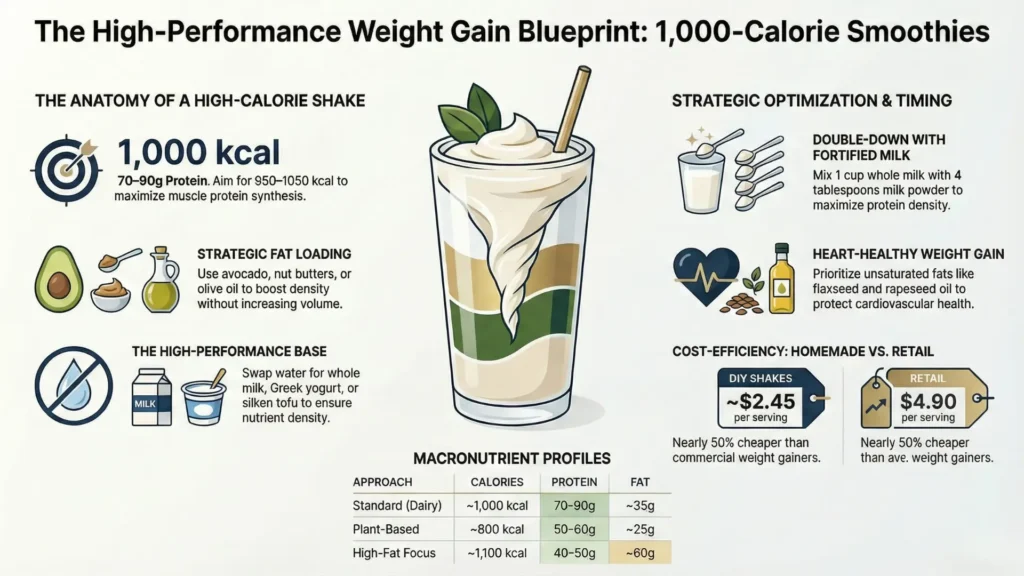
Why is it so hard to see results despite eating more?
The physiological resistance to weight gain often stems from a complex interplay of metabolic efficiency and biological regulation. It is a common observation that some individuals remain lean regardless of their caloric intake, a phenomenon often driven by a high Basal Metabolic Rate (BMR) and efficient non-exercise activity thermogenesis (NEAT). Consequently, the energy balance model dictates that weight gain occurs only when energy intake consistently exceeds energy expenditure.
In the Indian context, the National Institute of Nutrition (NIN) has observed a dual burden where undernutrition and higher-weight conditions coexist. While food production has increased significantly, per capita calorie intake in both rural and urban populations has faced historical fluctuations. For a hardgainer, the body may subconsciously increase its energy expenditure—such as through fidgeting or improved posture—in response to extra calories, effectively burning off the surplus before it can be stored as muscle or fat.
Furthermore, the Carbohydrate-Insulin Model suggests that the hormonal response to food determines whether calories are stored or utilized for immediate fuel. If the diet is predominantly composed of refined carbohydrates without sufficient protein and healthy fats, the body may fail to maintain a positive energy balance. This highlights why the structure of weight gain smoothies is critical; they must provide a balanced ratio of macronutrients to support tissue synthesis.
Understanding the Basal Metabolic Rate (BMR)
Resting metabolic rate (RMR) represents the energy required to maintain basic physiological functions, such as respiration, cardiac function, and temperature regulation. For an adult sedentary male in India, the ICMR 2020 guidelines suggest a reference requirement of approximately 2110 Kcal per day. However, this is merely a baseline; individuals with higher physical activity or specific genetic predispositions may require significantly more.
The calculation for BMR often follows established scientific formulas, which can be represented as:
BMR = (10 \times weight\ in\ kg) + (6.25 \times height\ in\ cm) – (5 \times age\ in\ years) + s
where s is a constant (+5 for males, -161 for females). When attempting to gain weight, one must ensure that the daily intake through meals and weight gain smoothies exceeds the total daily energy expenditure (TDEE).
The Role of Thermic Effect and NEAT
Admittedly, it is also important to consider the thermic effect of food (TEF), which is the energy spent on digestion. Interestingly, high-protein smoothies have a higher TEF compared to high-fat drinks, meaning the body uses more energy to process them. For individuals struggling to gain weight, excessive NEAT—spontaneous physical activity—can derail a calorie surplus. Studies suggest that some individuals are metabolic spenders who naturally increase their calorie burn as they eat more, making liquid calories an essential tool for overwhelming this metabolic resistance.

The frustration of being underweight and the struggle with a low appetite
For many, the physical sensation of fullness acts as a barrier to achieving a healthy weight gain diet plan. Research indicates that hunger is not a linear sensation; if a person ignores hunger for long periods, it often abates rather than increasing, leading to chronically low intake. This is particularly prevalent among busy professionals who skip meals due to work demands.
Moreover, the mechanical act of chewing plays a vital role in satiety signaling. Mastication triggers the release of hormones such as Glucagon-like peptide-1 (GLP-1) and Peptide YY (PYY), which signal to the brain that the body is full. For someone with a low appetite, a large solid meal can be intimidating and physically difficult to finish. This is where the strategy of drinking weight gain smoothies becomes highly effective.
In simple terms, liquid calories bypass the fullness sensors in the brain that are usually activated by chewing and long gastric processing times. This allows an individual to consume 600–800 calories in a single glass without feeling the same level of over-fullness that a similar plate of solid food would provide. What this means for your daily routine is that you can stack calories between your main meals without ruining your appetite for dinner.
The Psychology of Small, Frequent Meals
Admittedly, it is hard to find time to eat six times a day, but the evidence suggests that breaking down caloric intake into smaller, more frequent portions is more effective than increasing the size of existing meals. For those managing medical conditions like PCOS or thyroid disorders, this frequency also helps in maintaining steady blood sugar and energy levels, preventing the fatigue that often accompanies being underweight.
| Sensation | Solid Meals | Weight Gain Shakes (Liquid) |
| Chewing Stimulus | High (Triggers Satiety) | Low (Bypasses Satiety) |
| Gastric Emptying | Slow (Stays in stomach) | Rapid (Moves to intestine) |
| Hormonal Response | High GLP-1/PYY | Reduced GLP-1 Release |
| Volumetric Load | High (Large plate) | Low (Single glass) |
Addressing Malnutrition Statistics in India
The ICMR-INDIAB study highlights a concerning trend: even individuals who appear slim can be metabolically unhealthy, a condition known as Thin-Outside-Fat-Inside (TOFI). Approximately 71.6% of Indians are metabolically unhealthy, including a significant portion who are non-higher weight but harbor hidden body fat or high blood sugar. This emphasizes the need for healthy smoothies made from whole ingredients rather than sugary processed powders, ensuring that the mass gained is healthy muscle rather than visceral fat.

Myth: All weight gain smoothies need artificial mass gainer powders
A common myth among the non-gym audience is that building a stronger frame requires expensive, chemically formulated mass gainer powders. In reality, the(https://www.nin.res.in/dietaryguidelines/pdfjs/locale/DGI24thJune2024fin.pdf) and the National Institute of Nutrition (NIN) in their 2024 guidelines have cautioned against the indiscriminate use of protein supplements, noting that a significant portion of India’s disease burden is linked to unhealthy, ultra-processed diets.
On the contrary, artificial powders often contain high amounts of maltodextrin, a complex carbohydrate with a very high glycemic index that can lead to rapid insulin spikes and subsequent fat storage. For those with PCOS or diabetes, these powders can actually worsen hormonal imbalances and insulin resistance. Natural, home-based weight gain smoothies provide a superior alternative by utilizing whole grains, healthy fats, and biological proteins.
Let’s simplify this: the body prefers the architecture of whole foods. When you blend a banana, sattu, and dates, you are providing the body with a complex matrix of vitamins, minerals, and fiber that no isolated powder can replicate. According to NIH research, natural food sources are more effective for sustained muscle repair and growth because they contain bioactive substances that aid in nutrient absorption.
The Superiority of Sattu as a Natural Gainer
Sattu, a traditional Indian staple made from roasted gram flour, has been nicknamed the poor man’s protein, but its nutritional profile is far from poor. It provides approximately 20-26 grams of protein per 100g and is rich in essential minerals like iron, magnesium, and potassium. Unlike whey protein concentrates, sattu is minimally processed, highly affordable, and exceptionally gentle on the digestive system.
| Nutrient (per 100g) | Sattu (Roasted Gram) | Commercial Mass Gainer (Average) |
| Calories | ~413 Kcal | ~380 Kcal |
| Protein | 20-26 g | 15-20 g |
| Fiber | 15-18 g | <2 g |
| Sugar/Additives | 0 g (Natural) | High (Artificial) |
| Iron | 8.7 mg | Negligible |
The Danger of Processed Fillers
Many commercial drinks rely on thickeners, emulsifiers, and gums to improve texture. Research from the(https://hsph.harvard.edu/news/diet-not-a-lack-of-exercise-is-main-driver-of-obesity-study-finds/) suggests that these additives can negatively impact the gut microbiome, which is the very system an underweight person needs to function optimally to absorb nutrients. By making your drinks at home, you eliminate these risks while tailoring the flavor to your personal preference.

The science of liquid calories: How smoothies help you reach a calorie surplus easily
The transition from a maintenance diet to a healthy calorie surplus diet is mathematically simple but physically demanding. To gain weight, a person typically needs to add 300 to 500 calories above their daily burn. While this sounds like a small amount, adding a full extra meal of solid food can cause bloating and lethargy. This is where smoothies become a metabolic cheat code.
Liquid calories travel through the digestive system at a much higher speed than solid food, a process known as fast gastric emptying. While this would be a disadvantage for weight loss, it is a significant advantage for those using weight gain smoothies. Because the stomach empties quickly, the feeling of fullness subsides much faster, allowing you to consume more total calories throughout the day without the constant feeling of being stuffed.
However, there is a fiber paradox to be mindful of. When fruits are blended, the structural integrity of the fiber is broken down. While the grams of fiber on the label stay the same, the body processes the sugar faster. To counter this, DietDekho experts recommend adding a fat anchor to your smoothies. Ingredients like ghee, nut butter, or avocado slow down the absorption of sugar, providing a steadier release of energy and preventing the insulin spikes that are harmful to those with PCOS or diabetes.
Gastric Emptying and Nutrient Absorption
Scientific studies have shown that when the same ingredients are eaten whole versus blended, the liquid version causes a higher glucose peak. For weight gain, this insulin response can be leveraged as an anabolic signal (muscle-building signal), provided it is paired with protein. This is why the best weight gain smoothies always combine a carbohydrate (banana/oats) with a protein (milk/sattu/paneer) and a fat (ghee/nuts).
The Osmolality of Shakes
The concentration of particles in a liquid, or its osmolality, affects how well the body tolerates it. Highly concentrated sugary drinks can draw water into the intestine, leading to dumping syndrome or diarrhea, which is counterproductive for weight gain. A well-balanced smoothies using whole ingredients like milk and oats has an osmolality closer to the body’s own fluids, ensuring better tolerance and nutrient uptake.
Best home-made ingredients for Indian weight gain smoothies
Creating a powerful smoothies requires an understanding of nutrient density. In the Indian kitchen, we have access to several superfoods that are perfectly designed for healthy growth. These ingredients are affordable, culturally familiar, and easy to blend.
Banana and Oats: The Energy Core
Furthermore, bananas are the quintessential base for these drinks, providing roughly 90–110 calories per fruit along with potassium and vitamin C. Similarly, oats add complex carbohydrates and fiber, ensuring that the energy from the shake is sustained. To achieve a better texture, grinding dry oats into a powder before adding liquids ensures a smooth texture without the sludge feeling.
Ghee: The Calorie Booster
Admittedly, it might sound unusual to add ghee to a smoothies, but just one teaspoon adds about 45 calories with zero digestive load. Ghee is rich in butyric acid, which supports a healthy gut lining, helping you absorb all the other nutrients in your smoothies more effectively. For individuals with high metabolism, ghee is a secret weapon to increase caloric density without increasing the volume of the drink.
Dates and Jaggery: The Natural Sweeteners
Dates are highly calorie-dense, providing roughly 282 Kcal per 100g. They are also a great source of iron, which is essential for busy professionals who often suffer from fatigue. Jaggery (Gur) is another excellent alternative to white sugar; it contains trace minerals like potassium and magnesium and provides a quick energy boost post-workout.
Paneer and Whole Milk: The Protein Anchors
For a vegetarian meal plan, paneer is an incredible ingredient. It contains casein protein, which digests slowly, making it perfect for an evening shake to support muscle repair while you sleep. Whole milk (full cream) provides a balance of whey and casein proteins along with essential fats.
| Ingredient | Caloric Value (per 100g) | Primary Benefit |
| Sattu | 413 Kcal | High protein, easy digestion |
| Paneer | 318-323 Kcal | Casein protein for muscle repair |
| Ghee | ~900 Kcal (45 Kcal/tsp) | Dense energy, gut health |
| Dates | 282 Kcal | Iron, natural energy |
| Almonds | 600-650 Kcal | Healthy fats, Vitamin E |

A 7-day smoothies schedule to kickstart your weight gain journey
Consistency is the cornerstone of any transformative change. To make this practical for busy professionals and homemakers, we have designed a schedule for your weight gain smoothies that rotates flavors and nutrient profiles, ensuring you don’t get smoothies fatigue.
Day 1: The Classic Banana-Peanut Butter Gainer
- Ingredients: 2 cups whole milk, 1 large banana, 2 tbsp peanut butter, 1/2 cup oats, 1 tsp honey.
- Calories: ~750–800 Kcal.
- The logic: Let’s begin with this massive carb load from oats and banana, while peanut butter offers healthy fats. This is the ultimate mass gainer for beginners.
Day 2: Sattu and Date Energy Punch
- Ingredients: 1 cup milk, 4 tbsp Sattu powder, 3 pitted dates, 1/2 tsp cardamom, 1 tsp ghee.
- Calories: ~550–600 Kcal.
- The logic: Continuing the week, the sattu is incredibly cooling and easy on the stomach. Dates provide a natural iron boost for energy that lasts all day.
Day 3: Tropical Mango-Cashew Delight
- Ingredients: 1 cup mango pulp (or chunks), 1 cup whole milk, 10 soaked cashews, 1 tbsp honey.
- Calories: ~500–550 Kcal.
- The logic: For a different flavor profile, try mangoes which are rich in antioxidants and enzymes. Cashews add a creamy texture and are calorie-dense.
Day 4: The Green Avocado-Spinach Custard
- Ingredients: 1/2 avocado, 1 cup milk, 1/2 cup Greek yogurt, 1 small banana, 1 handful spinach.
- Calories: ~600–650 Kcal.
- The logic: Next, we have avocado which is a healthy fat powerhouse. This shake is less sweet and incredibly nutrient-dense, perfect for those with PCOD.
Day 5: Chocolate-Almond Muscle Builder
- Ingredients: 2 cups milk, 2 tbsp almond butter, 1 tbsp cocoa powder, 1/2 cup oats, 1 tbsp jaggery.
- Calories: ~700–750 Kcal.
- The logic: Alternatively, for chocolate lovers, almonds support brain and heart health, while cocoa provides a magnesium boost to help with muscle recovery.
Day 6: Berry-Paneer Protein Blast
- Ingredients: 50g fresh paneer, 1 cup milk, 1/2 cup frozen strawberries/blueberries, 1 tsp honey.
- Calories: ~550–600 Kcal.
- The logic: In contrast, the berry blast uses paneer for a cheesecake-like texture. Berries are low-GI, making this a safer choice for those managing diabetes.
Day 7: The Nightcap Ashwagandha Shake
- Ingredients: 1.5 cups warm milk, 1 tsp Ashwagandha powder, 1 tsp ghee, 1 tbsp almond butter, a pinch of turmeric.
- Calories: ~450–500 Kcal.
- The logic: To wrap up the week, Ashwagandha helps in muscle recovery and managing stress (cortisol), which is often high in those who struggle to gain weight.

Common mistakes: Why drinking smoothies as meal replacements might stall your progress
In simple terms, weight gain smoothies should be an add-on, not a swap. A common mistake is drinking a high-calorie smoothies for lunch and skipping your usual dal, rice, and sabzi. Consequently, if your total calorie intake remains the same as before, you won’t see any growth on the scale.
Another error is drinking your smoothies too quickly. Because liquids bypass the mouth’s digestive enzymes, gulping a 800-calorie shake can lead to indigestion and bloating. The short answer is: sip slowly. Treat your smoothies like a meal that you are enjoying over 10–15 minutes.
Lastly, many people forget the importance of protein quality. Relying solely on fats to increase calories can lead to unhealthy weight gain, which is mostly fat storage around the midsection. To build effective muscle building meal plans, you must ensure your smoothies have at least 20–30 grams of protein from sources like milk, paneer, or pulses.
The Importance of Gastric Comfort
If you feel bloated after a shake, it might be due to the temperature. Ice-cold smoothies can slow down digestion in some individuals. Using room-temperature milk or slightly warmed milk (especially in winter) can make the shake much more digest-friendly for those with a weak appetite.
Volume Displacement Issue
There is a psychological trap where drinking a thick shake right before a meal makes you lose your appetite for solid food. To avoid this, DietDekho recommends having your smoothies at least 2 hours away from your main meals. Mid-morning (11:00 AM) or mid-evening (4:30 PM) are the golden windows for liquid calories.
Staying consistent: Why slow and steady healthy weight gain is the best approach
I know it’s tempting to want results overnight, but rapid weight gain is often just fat and water retention. A healthy calorie surplus diet aims for a gain of about 0.5kg to 1kg per week. This slow approach allows your skin to adapt, your hormones to stay balanced, and your muscle tissue to actually grow.
What this means for your daily routine is that consistency is more important than intensity. Missing one day of smoothies won’t ruin your progress, but skipping meals 3 days a week will. Setting SMART goals—Specific, Measurable, Achievable, Relevant, and Time-bound—can help keep you on track.
For busy professionals and homemakers, habit stacking is the best way to stay consistent. Pair your smoothies preparation with an existing habit, like making your morning tea or checking your emails. Within 4–6 weeks, you will begin to notice changes not just in your weight, but in your energy levels and skin health.
The Role of Strength Training
Gaining weight without any exercise usually leads to fat gain. Even for non-gym audiences, 20 minutes of light resistance training at home—like squats, push-ups, or using small dumbbells—signals to your body to use the calories from your weight gain smoothies to build muscle. This improves your body composition and makes the weight gain look healthy and filled out.
Monitoring Metabolic Markers
Regular check-ups are important. As you increase your caloric intake, it is vital to monitor your lipid profile and blood sugar, especially if you have a family history of diabetes or BP. The goal is metabolic health, not just a higher number on the scale.

Special Clinical Considerations for Weight Gain
When managing medical conditions, the approach to these smoothiess must be tailored to ensure they don’t aggravate existing symptoms.
PCOD and PCOS Management
Women with lean PCOS often struggle to gain muscle. However, high-sugar drinks can worsen insulin resistance and hormonal acne.
- Recommended Strategy: Use low-GI bases like ragi or oats. Add nature’s metformin—cinnamon—to every shake to help regulate blood sugar. Avoid adding honey or jaggery; instead, use 1–2 dates for mild sweetness.
Diabetes and Weight Gain
The fear of sugar spikes often prevents diabetics from eating enough to gain weight.
- Recommended Strategy: Focus on fat and protein first. Pair any fruit in your shake with a heavy dose of nuts or seeds. Use Greek yogurt or silken tofu to increase protein without adding carbs. Limit total carbs in a smoothies to under 45g.
Thyroid Disorders
Both hypo- and hyperthyroidism affect the metabolic rate. Hypothyroidism can cause fatigue that makes eating difficult, while hyperthyroidism burns calories too fast.
- Recommended Strategy: Ensure your smoothies are rich in Selenium (sunflower seeds) and Zinc (pumpkin seeds/almonds) to support thyroid health. If you have goiter, avoid raw cruciferous vegetables like kale in your smoothies.
Hypertension (High Blood Pressure)
For those with hypertension, the DASH (Dietary Approaches to Stop Hypertension) diet is the gold standard.
- Recommended Strategy: Use potassium-rich ingredients like bananas and dates to help lower BP. Avoid adding any salt or using processed nut butters that contain sodium. Focus on heart-healthy fats like walnuts and flaxseeds.
Get your personalized Indian weight gain diet plan from Diet Dekho expert
Every body is unique, and a one-size-fits-all approach rarely works for long-term health. Whether you are an NRI trying to find local substitutes or a homemaker managing PCOS and a busy family, professional guidance can make the difference between trying and succeeding.
Get a Personalized Macro-Balanced Plan with a Diet Dekho Expert
Start Your Journey to Holistic Health with a Diet Dekho Consultant

FAQs
Q1: Can weight gain smoothies replace my lunch or dinner?
Admittedly, no. These smoothies should not replace major meals. To achieve a calorie surplus, consume them as mid-meal snacks or as an addition to a smaller meal. Replacing a meal with a shake often results in the same total calorie intake, stalling your progress.
Q2: What is the best time to drink weight gain smoothies?
The short answer is mid-morning (around 11:00 AM) or mid-evening (around 4:30 PM). These golden windows allow you to digest the liquid calories without ruining your appetite for lunch or dinner. A protein-rich shake before bed can also support muscle repair overnight.
Q3: Is sattu better than whey protein for gaining weight?
Sattu is an excellent natural alternative, especially for non-gym audiences. It is a whole food, rich in fiber and minerals, and has a lower glycemic index. While whey is faster-absorbing, sattu provides sustained energy and is easier on the digestive system for many Indians.
Q4: How can I gain weight if I have a very low appetite?
If you have a low appetite, drinking your calories is much easier than eating them. Focus on high-calorie, low-volume weight gain smoothies. Adding calorie-dense but invisible ingredients like ghee or MCT oil to your smoothies can help you reach your goals without feeling over-full.
Q5: Are weight gain smoothies safe for children?
Yes, homemade smoothies using milk, nuts, and fruits are generally safe and nutritious for children. They provide essential calcium for bones and protein for growth. However, avoid using artificial mass gainer powders or excessive sugar, and always focus on whole-food ingredients.
Contact Us
We understand how overwhelming nutrition and weight loss information can feel. With so many opinions and confusing advice online, it’s easy to feel stuck or unsure about what to do next.
At Diet Dekho, you never have to figure it out alone. You can contact us anytime with any questions or concerns. Our expert dietitians are available 24/7 to guide, support, and help you stay on track. Whether your goal is weight loss or building healthier habits, we’re here to make the journey simpler and more sustainable for you.
Disclaimer
This blog is intended to help readers make healthier food choices. Your health should always be the top priority. Before starting any restrictive or special diet, especially if you have a medical condition or health concern, please consult a doctor or a qualified dietitian. Each body responds differently to food and lifestyle changes. Always choose what is safe and suitable for you.

Dr. Ritika is a nutrition and lifestyle expert with 2+ years of experience, helping clients manage weight and health through practical, personalized diet plans.