Are you tired of people telling you to just eat more when the scale refuses to budge? Gaining weight safely is often harder than losing it, but following a fast weight gain diet that uses traditional Indian wisdom can help you build healthy muscle mass effectively and sustainably.
To follow a fast weight gain diet naturally, aim for a daily caloric surplus of 300–500 calories by eating 5–6 nutrient-dense Indian meals. Prioritize high-protein foods like paneer and eggs, healthy fats like ghee and nuts, and complex carbohydrates like millets. Pairing this with strength training ensures calories become muscle, not just fat.
Is the Struggle of Being Underweight Overlooked in a Changing India?
DietDekho understands that in a country increasingly concerned with rising obesity, those who are naturally thin often feel invisible. I know it’s hard to find support when the public narrative focuses almost exclusively on weight loss, but for millions of Indians, the battle to gain a single kilogram is just as grueling. According to the National Family Health Survey (NFHS-5), while the prevalence of thinness has declined from 31.7% to 18.7% in women and from 20.2% to 16.2% in men over the last decade, a massive portion of our population remains significantly underweight. What this means for your daily routine is that you aren’t just lucky to be thin; you are facing a legitimate nutritional challenge that requires a structured fast weight gain diet.
The struggle of being underweight is often misunderstood as a simple lack of appetite. In reality, many hard gainers possess a high Basal Metabolic Rate (BMR) or face hormonal imbalances that make traditional eating habits insufficient. The NFHS-5 data also reveals that 32.1% of children under five are underweight, suggesting that nutritional foundations in many Indian households are centered on volume rather than density. For an adult, staying at a Body Mass Index (BMI) below 18.5 is not just a cosmetic issue; it reflects a state where the body may lack the reserves to maintain vital tissues and functions.
Understanding the Thin-Fat Phenotype in the Indian Context
Let’s simplify this: many people in India who appear thin are actually under-muscled. This is often called the thin-fat phenotype, where an individual has a low body weight but a high percentage of visceral fat due to a diet dominated by refined carbohydrates and a lack of protein. If you are following a fast weight gain diet, your goal shouldn’t be to just get bigger by any means necessary. You want to build functional tissue. The ICMR-NIN 2024 guidelines highlight that 56.4% of the total disease burden in India is due to unhealthy diets, and this includes the underweight population who rely on sugar and trans-fats to put on weight.
The cultural pressure in India can also be quite heavy. Traditional narratives often link fatness to wealth and prosperity, leading many well-meaning family members to push fried snacks and sweets onto those they perceive as thin. I know it’s hard to say no to your grandmother’s extra paratha, but if that paratha is dripping in reused vegetable oil, it might be doing more harm than good. A successful fast weight gain diet prioritizes the quality of the calorie, ensuring that the weight you gain supports your long-term health rather than leading to future metabolic issues like hypertension or type 2 diabetes.
Why Regional Variations Matter for Your Diet Plan
The prevalence of underweight status varies significantly across Indian states. For instance, states like Bihar and Gujarat show higher rates of malnutrition indicators compared to Kerala or Sikkim. This suggests that local dietary staples and availability play a huge role in how we approach a fast weight gain diet. Whether you are a professional in Bangalore, a homemaker in Delhi, or an NRI in London, your plan must be adaptable. A South Indian weight gain plan might focus more on coconut, fermented rices, and rasam, while a North Indian plan might lean heavily on paneer, dals, and ghee.
| Region | Staple Carbohydrate | Protein Source | Healthy Fat |
| North India | Whole wheat, Parathas | Paneer, Rajma | Desi Ghee, Butter |
| South India | Parboiled rice, Idli | Sambar (Lentils) | Coconut oil, Seeds |
| West India | Bajra, Jowar (Millets) | Chana, Sprouts | Groundnut oil |
| East India | White/Brown rice | Fish, Masoor Dal | Mustard oil |

Beyond the Mirror: Why Your Lack of Weight Gain Might Feel Frustrating?
The short answer is that being underweight affects your body far more than what you see in the mirror. For most adults, a BMI below 18.5 is a signal that the body may lack the nutrition it needs to maintain itself properly. I’ve seen many clients who feel chronically fatigued, find themselves falling ill more frequently, or notice that their hair and skin look dull. These are not just signs of aging; they are symptoms of nutrient deficiencies. When you don’t have enough body mass, your immune system doesn’t have the energy stores to fight off infections, and your bones may become brittle over time.
For women, the stakes are even higher. A low body weight can disrupt the delicate hormonal balance required for regular menstrual cycles. Conditions like Lean PCOS occur when an underweight individual still faces high androgen levels and insulin resistance. Furthermore, being underweight during pregnancy—or even while planning for it—can increase the risk of low birth weight and other complications. A structured fast weight gain diet is therefore a form of preventive medicine, preparing your body for the physical demands of life and future family planning.
The Hidden Health Risks of a Low BMI
In simple terms, your body is like a machine that needs a certain amount of fuel just to keep the lights on. If you are consistently under-fueled, the machine starts to borrow parts from itself to stay functional. This means breaking down muscle tissue to provide amino acids for vital organs. This loss of muscle mass, or sarcopenia, is a major risk factor for older adults but can start much earlier in those who are chronically underweight.
| Condition | Risk for Underweight Individuals | Why a Fast Weight Gain Diet Helps |
| Immune Function | Frequent infections and slow recovery | Provides energy for white blood cell production |
| Bone Health | Osteoporosis and fractures | Increases weight-bearing load and calcium stores |
| Mental Health | Depression, fatigue, and sluggishness | Stabilizes blood sugar and neurotransmitters |
| Fertility | Irregular periods and ovulation issues | Restores hormonal signals for reproduction |
The Psychological Toll of Being Too Thin
What this means for your daily routine is that you might feel a lack of confidence in social or professional settings. In some cultures, being thin is celebrated, but in the Indian context, it is often met with concerns about one’s health or homeliness. I know how it feels when people ask if you’ve been eating enough, as if you simply forgot to have dinner. This social pressure can lead to stress, which ironically increases cortisol levels and makes it even harder to gain weight. A supportive fast weight gain diet is not just about calories; it’s about regaining control over your body and your self-image.

Myth-Busting: Why Junk Food Is Not the Solution for Healthy Weight Gain?
There is a pervasive belief that if you want to gain weight, you should eat everything in sight—pizzas, burgers, samosas, and sweets. This is often called dirty bulking in the fitness world. Let’s simplify this: dirty bulking will certainly make the number on the scale go up, but most of that gain will be fat, not muscle. Consuming high-calorie junk foods loaded with refined sugars and trans-fats can lead to systemic inflammation and metabolic damage, where you end up skinny on the outside but with high cholesterol and high blood pressure on the inside.
The ICMR 2024 guidelines are very clear about the dangers of Ultra-Processed Foods (UPFs). These foods are designed to be hyper-palatable, meaning they override your body’s natural fullness signals, but they are incredibly low in nutrients. For a professional or a busy homemaker, relying on biscuits or instant noodles might seem convenient, but these foods cause rapid blood sugar spikes followed by crashes. This leaves you feeling sluggish and tired, which is the exact opposite of what a fast weight gain diet should achieve.
The Problem with Empty Calories and Liquid Sugar
The short answer is that sugar-sweetened beverages and fried snacks don’t provide the building blocks your body needs. A study on dirty bulking suggests that excessive simple carbohydrates can lead to increased fatigue and even symptoms of depression. Furthermore, high salt intake from packaged namkeens can lead to water retention, giving a false sense of weight gain while actually harming your cardiovascular system.
| Feature | Clean Bulking (Recommended) | Dirty Bulking (Avoid) |
| Primary Fuel | Whole grains, Millets, Nuts | Refined flour, White sugar |
| Protein Quality | Paneer, Eggs, Lentils | Processed meats, Low-quality powders |
| Energy Levels | Steady and consistent | Spikes followed by crashes |
| Long-term Health | Reduces risk of NCDs | Increases risk of Diabetes/BP |
| Digestion | Supports gut health with fiber | Often leads to bloating/diarrhea |
Indian Traditional Foods vs. Modern Junk
I know it’s hard to find time to cook, but traditional Indian snacks are naturally designed for a healthy fast weight gain diet. Instead of a packet of chips, consider a handful of roasted peanuts or makhana with a little bit of ghee and salt. Instead of a sugary soda, opt for a glass of thick, homemade mango lassi or a banana milkshake. These options provide the caloric density you need without the toxic additives that sabotage your metabolism.
The Science of Weight Gain: Understanding Caloric Surplus and Metabolism?
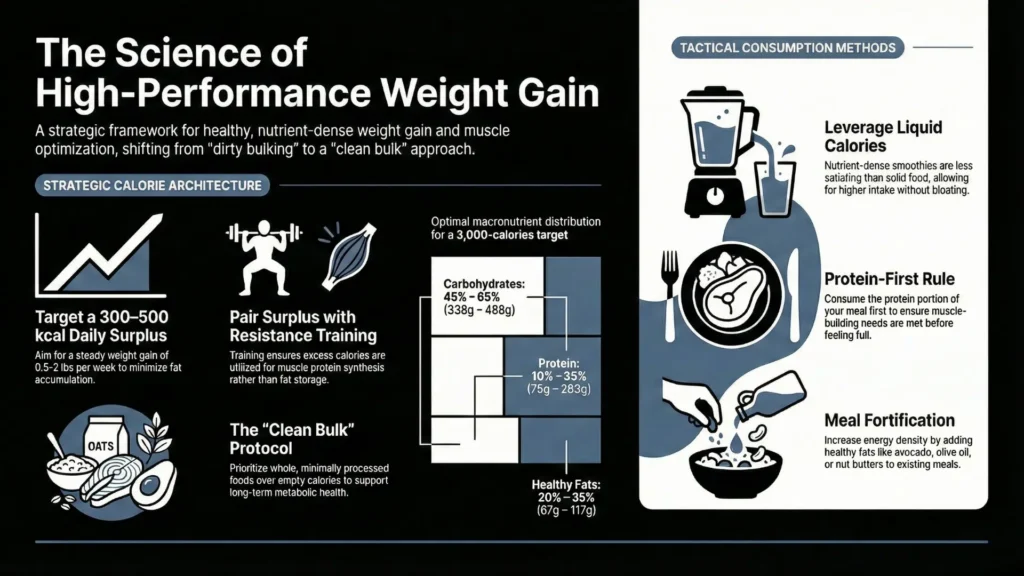
Let’s simplify the science: weight gain happens when you consistently consume more energy than your body burns. This is known as a caloric surplus. Every day, your body burns a specific number of calories just to keep you alive (Basal Metabolic Rate or BMR) plus whatever you burn through movement and digestion. To gain roughly 0.5kg of weight per week, you generally need a surplus of about 300 to 500 calories every day.
However, not all metabolisms are created equal. Some people have a high NEAT (Non-Exercise Activity Thermogenesis), which means they subconsciously move more when they eat more, essentially burning off the extra food. This is why a fast weight gain diet must be structured. You can’t just guess your intake; you need to ensure you are hitting your targets consistently. According to Harvard Health, genes do play a role in how we store fat, but they are not destiny—activity and diet quality remain the primary drivers of our physique.
Calculating Your Daily Needs
The ICMR provides a standard for the energy requirements of Indian adults. For a sedentary male (65kg), the requirement is around 2110 kcal, while for a sedentary female (55kg), it is 1660 kcal. To enter a healthy surplus for a fast weight gain diet, these numbers would increase to approximately 2600 kcal and 2100 kcal, respectively.
| Activity Level | Base Calories (Male) | Target for Weight Gain |
| Sedentary | 2110 kcal | 2400-2600 kcal |
| Moderate Work | 2710 kcal | 3000-3200 kcal |
| Heavy Work | 3470 kcal | 3800-4000 kcal |

The Importance of Protein and Muscle Synthesis
The short answer to why you shouldn’t just eat fat is that you need protein to build muscle. Without protein, those extra calories will simply be stored as adipose tissue (fat). The ICMR recommends about 0.83g of protein per kg of body weight for a sedentary person, but for someone on a fast weight gain diet who is also doing light strength training, this should increase to about 1.2g to 1.5g per kg. High-quality proteins found in milk, paneer, eggs, and legumes contain the essential amino acids like leucine that stimulate muscle growth.
Kitchen Essentials: High-Calorie Indian Foods for Your Weight Gain Diet?
I know it’s hard to know which foods to buy when you’re standing in the grocery aisle. The key to a successful fast weight gain diet is stocking your kitchen with calorie-dense whole foods. These are items that provide a lot of energy in a small volume. In an Indian kitchen, we have some of the world’s best weight-gain superfoods already sitting in our pantries.
The Power of Healthy Fats: Ghee and Oils
Let’s simplify this: fats have 9 calories per gram, while carbs and protein only have 4. This makes healthy fats your best friend for a fast weight gain diet. Desi Ghee is a traditional favorite that adds roughly 120 calories per tablespoon. It’s easy to digest and can be added to rotis, dals, and khichdis without making the meal feel too heavy. Cold-pressed oils like mustard, peanut, and coconut oil are also excellent for adding healthy fatty acids and extra calories to your sabzis.
Nutrient-Dense Carbohydrates
Instead of white bread or biscuits, look for complex carbohydrates that provide long-lasting energy. Millets like Ragi (Finger Millet), Bajra (Pearl Millet), and Jowar (Sorghum) are nutrient powerhouses. Ragi is particularly rich in calcium and iron, making it perfect for women and children on a fast weight gain diet. Potatoes and sweet potatoes are also essential staples; they provide the starch needed to fuel your daily activities and help replenish muscle glycogen.
Protein Staples for Vegetarians and Non-Vegetarians
For my vegetarian clients, Paneer (Indian cottage cheese) is the ultimate weight-gain food. It is rich in both fat and protein and can be cooked in dozens of ways. For non-vegetarians, whole eggs and fatty fish like Rohu or Salmon provide high-quality protein and Omega-3 fatty acids, which help reduce the inflammation that can sometimes occur when you increase your caloric intake.
| Food Item | Typical Calories | Key Benefit |
| Paneer (100g) | 265 kcal | High Protein + Fat |
| Desi Ghee (1 Tbsp) | 120 kcal | Easy calorie boost |
| Almonds (10 units) | 150 kcal | Healthy fats & Vit E |
| Banana (1 medium) | 95 kcal | Quick energy & Potassium |
| Whole Milk (250ml) | 150 kcal | Complete nutrient profile |
| Peanut Butter (2 Tbsp) | 190 kcal | High-density plant protein |

A Full Day of Eating: Sample Indian Weight Gain Diet Plan?
I know it’s hard to imagine how all these foods fit together, so let’s look at a sample of 2600-calorie day. This fast weight gain diet is designed for a typical Indian lifestyle, focusing on home-based solutions that don’t require fancy ingredients. The goal is to eat every 3 to 4 hours to keep your body in an anabolic or building state.
Early Morning (7:00 AM)
Start your day with a mix of healthy fats and natural sugars.
- 1 glass of whole milk with a pinch of turmeric.
- 5 soaked almonds, 2 walnuts, and 2-3 dates.
- Why? This provides immediate energy and essential micronutrients without filling you up too much before breakfast.
Breakfast (8:30 AM)
This is your most important meal for setting a caloric surplus.
- 2 Paneer-stuffed parathas made with ghee.
- 1 bowl of thick curd or a glass of sweet lassi.
- 1 large banana.
- Why? The combination of slow-digesting complex carbs and high-quality protein keeps your energy levels stable for hours.
Mid-Morning Snack (11:00 AM)
A liquid snack is easier to consume if you are busy at work.
- A thick fruit smoothie: Blend 1 cup milk, 1 tablespoon peanut butter, 1 banana, and a handful of oats.
- Why? Smoothies are calorie bombs that don’t require much chewing time, making them perfect for professionals.
Lunch (1:30 PM)
Aim for a balanced Thali style meal.
- 1.5 cups of Basmati rice or 2-3 whole wheat rotis with ghee.
- 1 cup of thick Dal (Rajma, Chole, or Dal Makhani).
- 1 cup of seasonal vegetable sabzi cooked in mustard or peanut oil.
- 100g of Paneer or Chicken curry.
- Why? Diversity is key. Different food groups provide a range of vitamins and minerals.
Evening Snack (5:00 PM)
Refuel your body as the workday ends.
- 2 whole-grain bread slices with peanut butter or a bowl of sprouted moong chaat with peanuts.
- A handful of roasted cashews or walnuts.
Dinner (8:30 PM)
Keep it calorie-dense but slightly lighter on spices to help with sleep.
- 2 Ragi or Bajra rotis with ghee.
- 1 cup of mixed vegetable curry or Egg bhurji.
- 1 small bowl of rice with dal.
Bedtime (10:30 PM)
- 1 glass of warm milk with 1 teaspoon of Ashwagandha or a piece of jaggery.
- Why? This supports overnight recovery and muscle repair.
Crucial Mistakes: Are You Over-Exercising or Skipping Meals?
The short answer is that many people fail at a fast weight gain diet because they treat it like a weight-loss plan. I know it’s hard to change your mindset, but you cannot cardio your way to a bigger physique. If you are doing hours of running or high-intensity aerobic activity, you are simply burning off the very calories you just worked so hard to eat. For someone trying to gain weight, cardiovascular exercise should be limited to 20-30 minutes of brisk walking 2-3 times a week for heart health.
Instead, you should focus on progressive resistance training. Whether it’s lifting weights at the gym or doing bodyweight exercises like push-ups and squats at home, you need to give your body a reason to use those extra calories for muscle building. Without this stimulus, the weight gain will be purely fat. According to the Cleveland Clinic, a personalized eating plan combined with supervised strength training is the clinical gold standard for treating underweight status.
The Danger of the All-or-Nothing Mindset
What this means for your daily routine is that consistency is more important than intensity. Skipping even one meal can put your body back into a catabolic state where it starts using its own tissue for energy. I’ve noticed that busy professionals often skip lunch and try to overeat at dinner, but this just leads to indigestion and poor nutrient absorption. Let’s simplify this: your body can only process so many calories at once. It is much better to have 5-6 small, nutrient-dense meals than 2 massive ones.

Stress and Sleep: The Silent Progress-Killers
I know how it feels to have a demanding job or a chaotic household, but chronic stress releases cortisol, a hormone that actively breaks down muscle and encourages abdominal fat storage. Similarly, if you aren’t getting 7-8 hours of sleep, your body isn’t producing the growth hormones needed for repair. A fast weight gain diet is a 24-hour commitment that includes rest as much as eating.
| Mistake | Why it Hurts Your Progress | How to Fix it |
| Too Much Cardio | Burns the calories needed for growth | Switch to strength/resistance training |
| Skipping Breakfast | Puts body in starvation mode | Have a quick smoothie or soaked nuts |
| Not Drinking Milk | Misses out on easy liquid calories | Add whole milk or curd to every meal |
| Poor Sleep | Slows down muscle repair | Aim for 7-9 hours of consistent sleep |
| High Stress | Cortisol breaks down muscle tissue | Practice deep breathing or light yoga |
Small Wins Matter: Staying Consistent on Your Weight Gain Journey?
I know it’s hard to stay motivated when the results don’t appear overnight. Gaining healthy weight is a marathon, not a sprint. You might only see a change of 200-500 grams a week on the scale, but those are quality grams. To stay on track with your fast weight gain diet, focus on habit stacking—adding one small calorie-dense item to an existing habit. For example, if you already drink tea, start adding two Marie biscuits with a thick layer of peanut butter.
Keeping a food journal is another powerful tool. In simple terms, we often overestimate how much we eat. You might think you had a huge lunch, but when you write it down, you realize it was mostly water-heavy vegetables and not enough protein or fat. Using a calorie-tracking app or a simple notebook can provide the data you need to adjust your portions. As emphasized by the WHO and NIH, self-monitoring is one of the most effective strategies for long-term weight management.
Managing Appetite and Digestion
If you struggle with a small appetite, don’t try to force-feed yourself huge plates of rice. Instead, use the liquid calorie strategy. It is much easier to drink a 500-calorie milkshake than it is to eat 500 calories of dal and roti. Also, pay attention to your gut health. In India, we use digestive spices like Hing (Asafoetida), Jeera (Cumin), and Ajwain (Carom seeds) for a reason—they help reduce the bloating that can come with an increased fast weight gain diet.
The NRI Perspective: Substitutes and Strategies
For my NRI clients in the US, UK, or Canada, I know it’s hard to find fresh paneer or specific millets. However, most Western supermarkets now carry high-protein Greek yogurt, which is an excellent substitute for thick curd. You can also use almond butter if peanut butter isn’t to your taste, and focus on heart-healthy fats like avocados and olive oil, which are readily available. The principles of the fast weight gain diet remain the same regardless of your geography.

Safety Considerations: PCOD/PCOS, Diabetes, Thyroid, and Hypertension?
The short answer is that if you have an underlying medical condition, your fast weight gain diet must be more clinical and precise. You can’t just eat anything; you need to choose foods that heal your body while adding mass.
Weight Gain with Diabetes and Hypertension
If you have Type 2 Diabetes, your primary challenge is gaining weight without causing dangerous blood sugar spikes. Let’s simplify this: focus on low glycemic index (GI) foods. Instead of white rice, choose brown rice or quinoa. Instead of sugar-laden sweets, use healthy fats like almonds and avocados to boost calories. For hypertension, the ICMR 2024 guidelines strongly advise keeping salt intake below 5g per day. Avoid processed namkeens and focus on home-cooked meals seasoned with herbs and lemon instead.
Weight Gain with PCOD/PCOS
For women with Lean PCOS, the goal is to improve insulin sensitivity while in a caloric surplus. This means your fast weight gain diet should be high in protein and fiber. Legumes like Chana, Rajma, and Moong Dal are excellent because they provide both protein and the complex carbs that stabilize hormones. Incorporating Ayurvedic herbs like Shatavari or Cinnamon can also help regulate menstrual cycles during the weight gain process.
Weight Gain with Thyroid Disorders
If you have hyperthyroidism, your body is essentially in overdrive, burning calories faster than you can eat them. You need an aggressively high-calorie diet rich in protein to prevent muscle wasting. Cruciferous vegetables like cabbage and cauliflower may help slightly slow down an overactive thyroid, but the main focus should be on calorie-dense foods like eggs, fatty fish, and full-fat dairy.
| Condition | Primary Dietary Focus | Foods to Prioritize |
| Lean PCOS | Hormone & Insulin balance | High-fiber veggies, Lentils, Seeds |
| Diabetes | Blood sugar stability | Healthy fats, Millets, Lean protein |
| Thyroid | Counteracting high BMR | Whole eggs, Paneer, Full-fat milk |
| Hypertension | Sodium control | Low-salt home meals, Potassium-rich fruit |

Frequently Asked Questions
Which Indian food is best for fast weight gain?
The short answer is that there is no single magic food, but Paneer, Whole Milk, Desi Ghee, and Bananas are the most effective staples. These foods are high in calories and provide a good balance of protein and healthy fats, which are the foundations of a successful fast weight gain diet.
How can I gain 5kg in a month naturally?
Gaining 5kg in a month is an ambitious goal that requires a strict caloric surplus of about 1000 calories per day above your maintenance needs. This can be achieved by adding two high-calorie smoothies to your existing diet and ensuring you never skip a meal. However, it is important to pair this with strength training to ensure the gain is healthy.
Is it okay to eat late at night to gain weight?
Yes, in fact, a bedtime snack is a core part of a fast weight gain diet. Consuming slow-digesting protein like a glass of milk or a few pieces of paneer before bed provides your muscles with amino acids throughout the night, supporting repair and growth while you sleep.
Can vegetarians gain weight as fast as non-vegetarians?
Absolutely! While non-vegetarians have access to eggs and meat, vegetarians can easily hit their targets using paneer, soy chunks, Greek yogurt, and a variety of dals. When you combine grains and pulses (like rice and dal), you get a complete protein that is just as effective for muscle building.
Why am I not gaining weight despite eating a lot?
What this means for your daily routine is that you are likely either overestimating your calorie intake or your BMR is higher than average. Stress, poor sleep, or digestive issues can also prevent nutrient absorption. Consulting an expert can help identify these hidden barriers and adjust your fast weight gain diet accordingly.
Contact Us
We understand how overwhelming nutrition and weight loss information can feel. With so many opinions and confusing advice online, it’s easy to feel stuck or unsure about what to do next.
At Diet Dekho, you never have to figure it out alone. You can contact us anytime with any questions or concerns. Our expert dietitians are available 24/7 to guide, support, and help you stay on track. Whether your goal is weight loss or building healthier habits, we’re here to make the journey simpler and more sustainable for you.
Disclaimer
This blog is intended to help readers make healthier food choices. Your health should always be the top priority. Before starting any restrictive or special diet, especially if you have a medical condition or health concern, please consult a doctor or a qualified dietitian. Each body responds differently to food and lifestyle changes. Always choose what is safe and suitable for you.

Dr. Ritika is a nutrition and lifestyle expert with 2+ years of experience, helping clients manage weight and health through practical, personalized diet plans.