
Why do some young men struggle to add mass despite consuming large quantities of food? Achieving a healthy weight gain diet for boys in the Indian context requires moving beyond the eat more mantra toward a scientifically structured caloric surplus. DietDekho identifies that successful muscle building involves balancing traditional staples like desi ghee and paneer with modern physiological insights to transform a lean frame into a resilient, healthy body.
The most effective weight gain diet for boys involves a daily caloric surplus of 300 to 500 kcal, primarily sourced from nutrient-dense Indian whole foods such as full-fat milk, nuts, and complex carbohydrates. By adhering to the 2024 ICMR protein recommendation of 0.83g per kg of body weight and engaging in resistance training, underweight individuals can build lean muscle mass safely without developing metabolic complications.
Why is it hard for some to follow a diet plan for underweight boys?
Many people dismiss the biological difficulty of gaining weight as a simple case of a fast metabolism. However, the reality involves a complex intersection of genetics, Non-Exercise Activity Thermogenesis (NEAT), and nutrient absorption efficiency. In the Indian demographic, adolescent growth spurts place an immense energy demand on the body, which often exceeds the standard 2000-calorie baseline. For many boys, the body prioritizes height growth and organ development over the storage of adipose tissue or muscle mass, leading to a persistently lean appearance.
Nutritional needs shift constantly throughout adolescence. The 2024 ICMR guidelines emphasize that requirements are not static; they evolve through the 1000-day nutrition window and beyond. A boy’s body may burn fuel as fast as he consumes it due to high physical activity or a biological predisposition for efficient glucose clearance. Furthermore, many Indian diets are high in volume but low in caloric density. A large bowl of watery dal or a plate of rice might feel filling, but it often lacks the concentrated energy required to trigger muscle protein synthesis.

Understanding the Hardgainer and NEAT
Non-Exercise Activity Thermogenesis (NEAT) refers to the energy you expend for everything that isn’t sleeping, eating, or intense exercise. Research suggests that some underweight individuals naturally increase their NEAT—fidgeting, walking more, or maintaining better posture—when they overeat. They effectively burn off the extra calories before the body can store them. This unconscious energy expenditure explains why you must precisely calculate a weight gain diet for boys to ensure a true surplus.
Moreover, the capacity-load model of glucose homeostasis suggests that South Asian populations may have a lower baseline for metabolic capacity. This means their bodies evolved to prioritize survival during energy stress rather than building large amounts of muscle. This evolutionary trait makes it harder for some to gain weight without combining resistance training with energy dense indian meals.
| Factor | Impact on Weight Gain | Mechanism |
| High BMR | Difficulty maintaining surplus | Body burns more calories at rest than average |
| Excessive NEAT | Caloric leakage | Unconscious movement burns off extra energy intake |
| Poor Absorption | Nutrient wastage | Digestive inefficiencies prevent full utilization of calories |
| Growth Spurts | Competitive energy demand | Nutrients fuel bone growth rather than muscle mass |

Why a weight gaining meal plan for boys involves more than just a fast metabolism
The psychological burden of being underweight in a culture that equates bulk with strength can lead to significant frustration. For adolescent boys, the skinny guy label often carries a stigma of weakness. However, focusing only on a fast metabolism ignores the critical role of hormones. Many slim Indian males suffer from the thin-fat phenotype, where they appear lean externally but harbor visceral fat around vital organs. This increases the risk of type 2 diabetes even at a low Body Mass Index (BMI).
Expert analysis indicates that nearly 71.6% of Indians are metabolically unhealthy. A significant portion falls into the MONO category. These individuals have a normal weight but high levels of internal fat, low muscle mass, and high blood sugar. For a boy starting a weight gain diet for boys, the goal involves building functional muscle rather than simply increasing the number on the scale, as the latter can lead to silent metabolic threats.
Body Image and the South Asian Context
South Asians are biologically prone to insulin resistance and reduced muscle mass compared to other ethnic groups. This genetic predisposition means that if a boy gains weight rapidly without the right muscle building nutrition plan, he may not gain it healthily. The frustration of being thin often stems from low lean mass rather than just low body fat. Increasing muscle mass not only improves aesthetics but also enhances insulin sensitivity.
Bulking myths: Do you need supplements or muscle gain food for males?
A pervasive myth in the Indian fitness landscape suggests that a weight gain diet for boys requires expensive mass gainer supplements or frequent junk food meals. In reality, the ICMR 2024 guidelines advise against using protein supplements to build muscle mass. They emphasize a balanced diet of whole grains, pulses, and dairy instead. Junk foods like samosas and sugary sweets are calorie bombs that spike insulin and promote fat storage rather than healthy muscle growth.
While mass gainers provide high calories, they often contain refined sugars and maltodextrin, which can cause digestive issues. Real Indian foods such as full-fat milk, paneer, and ghee offer a superior profile of fats and proteins. These staples support hormone production and tissue repair without synthetic additives.

The Truth About Supplements: Whey vs. Real Food
Whey protein is a safe byproduct of milk, but it isn’t a magic solution. Most boys can obtain the necessary protein through eggs, paneer, and dals. You should view mass gainers with caution; a homemade shake using a banana, whole milk, oats, and peanut butter can easily provide 600-800 calories of high-quality nutrition.
| Myth | Reality | Scientific Basis |
| Junk food helps bulking | Causes visceral fat and inflammation | High trans fats promote unhealthy weight |
| Supplements are mandatory | Whole foods are more effective | ICMR recommends whole foods over powders |
| Fat makes you fat | Healthy fats support hormones | Ghee and nuts are essential for testosterone |
| Carbs are the enemy | Carbs fuel muscle growth | Complex carbs provide energy and spare protein |
The science of a weight gain diet for boys: Caloric surplus and macros
To gain weight, you must consume more energy than your body expends. For a growing boy, this expenditure includes the Basal Metabolic Rate (BMR), the Thermic Effect of Food (TEF), and Physical Activity Levels (PAL). The 2024 ICMR RDA highlights that calorie needs can reach 3320 kcal per day for boys aged 16–18, depending on activity. A successful weight gain diet for boys identifies this baseline and adds a surplus of approximately 300 to 500 kcal.
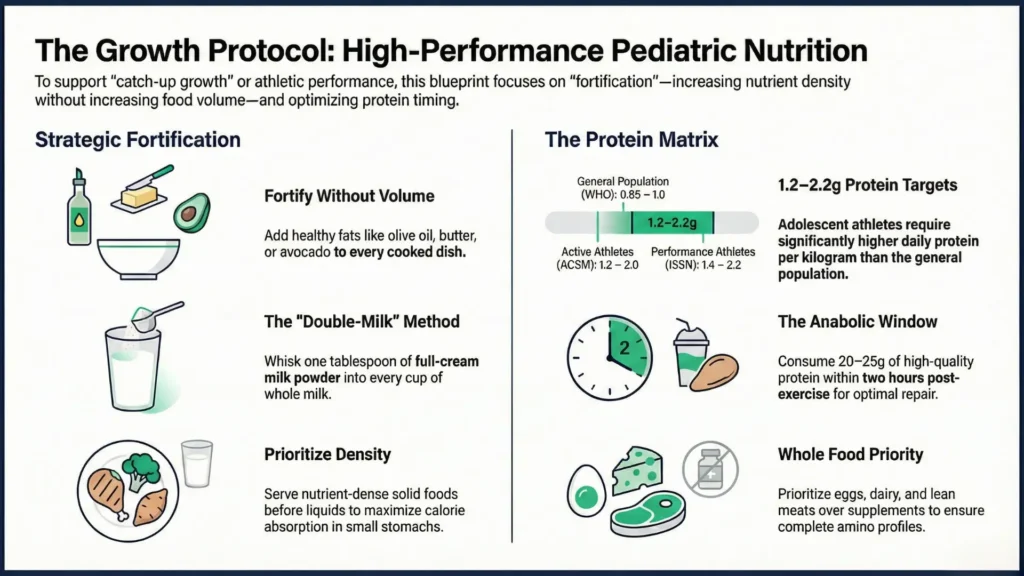
Macronutrient distribution serves as the next critical pillar. Carbohydrates should form 45–75% of total energy to provide fuel for daily activities. Protein, vital for muscle repair, should reach 0.83g to 1g per kg of body weight, or higher for active athletes. Fats should contribute 20–35% of daily calories, focusing on unsaturated sources to support brain health.
Recommended Dietary Allowance (RDA) 2024 for Indian Boys
The following table outlines the energy and protein requirements as per the latest ICMR-NIN guidelines for Indian boys.
| Age (Years) | Body Weight (kg) | Energy (kcal/day) | Protein (g/day) | Visible Fat (g/day) |
| 13–15 | 50.5 | 2860 | 45.4 | 45 |
| 16–18 | 64.4 | 3320 | 55.4 | 50 |
| Adult (Moderate) | 65.0 | 2710 | 54.0 | 30 |
High calorie Indian foods and nutrient-dense meal solutions
A common barrier to weight gain is the sheer volume of food required. To overcome this, DietDekho recommends high-calorie swaps that increase energy density without increasing the physical size of the meal. Simple changes, like replacing watery dal with dal makhani or adding a tablespoon of ghee to every roti, can add hundreds of calories to your daily routine.
Indian cuisine is naturally rich in superfoods for weight gain. Paneer provides a powerhouse of protein and fat, while full-fat buffalo milk delivers significantly more calories and protein than toned versions. Utilizing these staples effectively can transform a standard meal into a muscle building nutrition plan.

Top High-Calorie Indian Swaps
| Standard Item | High-Calorie Alternative | Benefit |
| Plain Roti | Paneer/Aloo Paratha with Ghee | Adds ~150-200 kcal and 10g protein |
| Toned Milk | Full-Fat Milk with Honey/Dates | Increases healthy fats and natural sugars |
| Watery Dal | Thick Rajma or Chole | Higher protein and complex carb density |
| Tea/Coffee | Fruit Smoothie with Nut Butter | Adds vitamins and 300+ calories |
| White Rice | Vegetable Pulao with Extra Ghee | Increases total caloric density |
For those with medical conditions, you must choose swaps carefully. Boys with diabetes should favor low-GI swaps like sweet potatoes and ensure they use honey or jaggery only under clinical guidance. Boys with hypertension should focus on homemade nut butters to control sodium intake.
A muscle building nutrition plan: From breakfast to pre-sleep snacks
A successful weight gain diet for boys is not just about what you eat, but when you eat. Spreading meals across 5–6 smaller portions prevents digestive overload and maintains a steady stream of amino acids. Breakfast should be the largest meal of the day, occurring within an hour of waking to stop the body’s overnight catabolic state.
Post-workout nutrition is equally crucial; consuming a protein and carb-rich snack within 30-60 minutes of exercise helps replenish glycogen stores. Finally, a pre-sleep snack, such as warm milk or paneer, provides the body with slow-digesting protein to sustain muscle synthesis during rest.
A 7-Day Indian Weight Gaining Meal Plan (3000-3500 kcal)
This plan integrates high-calorie Indian staples and is structured for maximum absorption.
Monday
- Breakfast: 2 Stuffed Aloo Parathas with a bowl of curd and 1 tablespoon of butter.
- Mid-Morning: 1 Banana with 1 tablespoon of peanut butter and a handful of almonds.
- Lunch: 2 bowls of Rajma, 1 cup of Basmati Rice with ghee, and salad.
- Evening: A bowl of roasted makhana and a glass of full-fat Mango Lassi.
- Dinner: 2 Rotis with ghee, a bowl of Chicken Curry (150g), and seasonal sabzi.
- Bedtime: 1 Glass of warm buffalo milk with honey and 2 dates.
Tuesday
- Breakfast: A bowl of Paneer Bhurji with 2 Rotis and fresh orange juice.
- Mid-Morning: Fruit smoothie (Banana + Oats + Nut butter).
- Lunch: 2 Rotis, 1 bowl of Chana Masala, and 1 cup of Jeera Rice with extra ghee.
- Evening: Sprouted Moong Bhel with peanuts.
- Dinner: Paneer Tikka with 2 parathas and thick dal.
- Bedtime: Warm milk with turmeric and a handful of walnuts.

Mistakes to avoid on a weight gain diet for boys
One primary reason boys fail on a weight gain diet for boys is the calorie-gap created by skipping meals. Even a single missed breakfast puts the body in an energy deficit that is hard to recover. Furthermore, many underweight boys attempt to gain mass by doing excessive cardiovascular exercise without adding resistance training. While cardio is healthy, it burns high amounts of calories that the body could otherwise use for muscle building.
Another common error involves neglecting sleep. Hormones like testosterone and growth hormone peak during deep sleep cycles. Sleep deprivation (less than 5 hours) can reduce testosterone by as much as 15%, directly sabotaging your efforts. For boys managing hypertension, the stress of sleep deprivation can also lead to elevated blood pressure.
Top 5 Progress Killers
- Low Caloric Consistency: Eating big one day and very little the next.
- Drinking Water with Meals: Filling up on zero-calorie fluid instead of food.
- Ignoring Gut Health: Chronic bloating or indigestion prevents nutrient absorption.
- Excessive Stress: High cortisol levels break down muscle tissue.
- Not Tracking Progress: Guessing caloric intake usually leads to under-eating.
Healthy weight gain for teenage boys: Why consistency beats speed
Consistency is more valuable than intensity. Health experts consider a weight gain of 0.5 kg to 1 kg per month to be healthy and sustainable. Rapidly gaining 5 kg in a month is often just fat and water retention, which does not improve physical strength. Slow, steady progress allows the skin to adapt and gives internal organs time to adjust to the increased metabolic load.
In the Indian lifestyle context, social events can disrupt a weight gain diet for boys. However, carrying high-calorie snacks like roasted chana, peanuts, or home-made protein laddus can help maintain your caloric surplus. This long-term commitment to quality nutrition builds a metabolic reserve that protects against future illnesses and supports a vibrant adult life.
Medical Considerations: PCOS, Diabetes, and Thyroid Management
While the focus remains on gaining weight, boys with pre-existing conditions must take precautions. Diabetes management requires avoiding refined sugars; instead, use whole fruits and complex grains like millets to provide energy without causing hazardous glucose spikes. Thyroid patients should ensure their weight gain is muscle-focused by including selenium and zinc-rich foods like sunflower seeds and eggs.
For boys with Hypertension (BP), the challenge involves increasing calories without increasing salt. They should avoid processed mass gainers and rely instead on potassium-rich foods like bananas and spinach to naturally balance blood pressure. A weight gain diet for boys should always be a health-first endeavor, prioritizing internal markers like cholesterol as much as external muscle mass.

Frequently Asked Questions
Q1: Can I gain weight with a purely vegetarian Indian diet?
Absolutely. A vegetarian weight gain diet for boys can be highly effective by utilizing high-protein sources like paneer, thick dals, chickpeas, and nuts. Combining cereals and pulses in a 3:1 ratio further improves protein quality.
Q2: Will eating ghee cause high cholesterol while I’m trying to gain weight?
When used in moderation (2-4 teaspoons daily) as part of an active lifestyle, ghee is a healthy source of energy. However, individuals with a family history of heart disease should consult a dietitian to balance ghee with healthy unsaturated fats.
Q3: How many eggs should a boy eat per day for muscle gain?
For most healthy boys, consuming 2–5 whole eggs daily is a safe way to get complete protein. The yolk contains vital fat-soluble vitamins and selenium, which protects the thyroid gland.
Q4: Is it necessary to lift heavy weights to gain weight?
Diet alone can cause weight gain, but it will mostly be body fat. To ensure the weight you gain is lean muscle mass, some form of resistance training is highly recommended. This tells your body to use the extra calories for muscle synthesis.
Q5: Why is sleep so important for gaining weight?
Sleep is when the body enters an anabolic state, repairing muscle fibers and releasing growth hormones. Chronic lack of sleep raises cortisol, which breaks down muscle and encourages abdominal fat storage.
Contact Us
We understand how overwhelming nutrition and weight loss information can feel. With so many opinions and confusing advice online, it’s easy to feel stuck or unsure about what to do next.
At Diet Dekho, you never have to figure it out alone. You can contact us anytime with any questions or concerns. Our expert dietitians are available 24/7 to guide, support, and help you stay on track. Whether your goal is weight loss or building healthier habits, we’re here to make the journey simpler and more sustainable for you.
Disclaimer
This blog is intended to help readers make healthier food choices. Your health should always be the top priority. Before starting any restrictive or special diet, especially if you have a medical condition or health concern, please consult a doctor or a qualified dietitian. Each body responds differently to food and lifestyle changes. Always choose what is safe and suitable for you.

Dr. Ritika is a nutrition and lifestyle expert with 2+ years of experience, helping clients manage weight and health through practical, personalized diet plans.