At DietDekho, we often hear from clients who are frustrated because their “healthy” home-cooked meals aren’t resulting in weight loss. If you feel like you are doing everything right but the scale won’t budge, the answer might lie in your Indian metabolism.
Fat loss is difficult for Indians due to a unique biological “thrifty gene” that stores fat for survival, combined with a “thin-fat” phenotype where fat accumulates around organs (visceral fat) even at a low body weight. High carbohydrate intake and insulin resistance further slow the Indian metabolism, making traditional calorie-counting ineffective.
Why is fat loss so difficult for the Indian body type?
I know it’s hard to find time to exercise when your daily routine is already packed, but understanding your body is the first step to changing it. Many of our clients at DietDekho struggle with what we call the “Stubborn Fat Mystery.” You might be eating ghar ka khana like dal, roti, and sabzi, yet your waistline continues to grow.
In simple terms, the traditional Indian plate is often heavy on refined carbohydrates—like white rice and polished wheat—and low in quality protein. This combination spikes your insulin, a hormone that tells your body to “store fat” rather than burn it. Even if a meal is home-cooked, if it’s 70% carbs, your Indian metabolism will naturally prioritize fat storage over energy expenditure.
The “Thin-Fat” Paradox
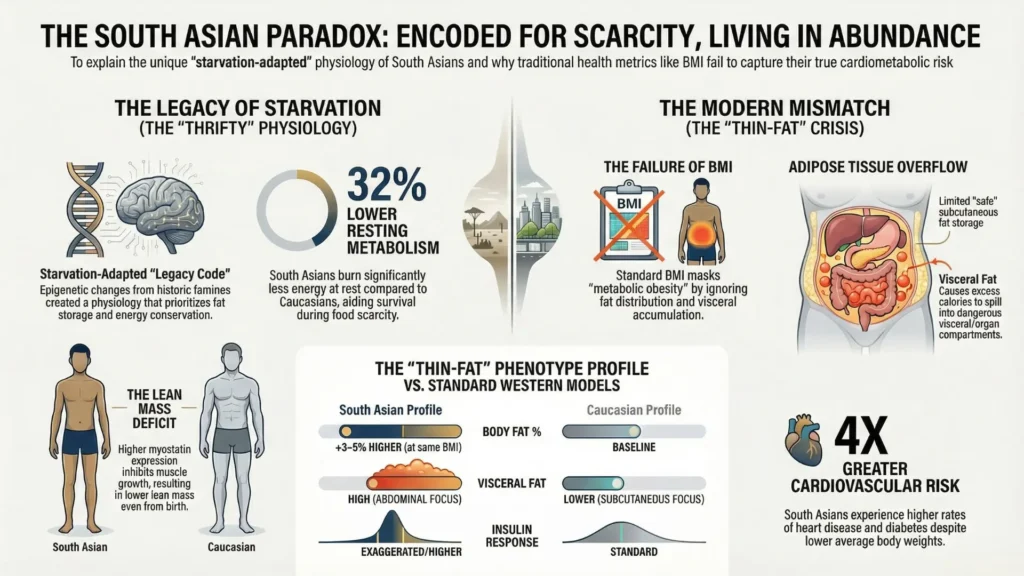
What this means for your daily routine is that you cannot rely on the weighing scale alone. Indians often suffer from the “YY Paradox,” where a person looks thin on the outside but has high levels of internal fat (visceral fat) around the liver and heart. Research shows that for the same Body Mass Index (BMI) of 22.3 kg/m2, an Indian can have over 21% body fat, while a European may have only 9%.
The Danger of Ectopic Fat
Because our bodies have a limited capacity to store fat under the skin, excess calories “spill over” into our organs. This leads to Non-Alcoholic Fatty Liver Disease (NAFLD), which is now alarmingly common, affecting up to 32% of the Indian population. This internal fat is metabolically active and causes inflammation, further slowing down your Indian metabolism.

What is the “Thrifty Gene” hypothesis?
Let’s simplify this: your body is essentially operating on “famine mode” software in a world of “feast” hardware. For generations, the Indian population survived frequent famines. Evolution favored those who could survive on very little food by storing every extra calorie as fat. This is known as the “Thrifty Genotype”.
A Legacy of Survival
When you try a crash diet or skip meals, your Indian metabolism perceives this as a return to famine. It immediately slows down to protect its fat stores. This is why you might lose 2 kilograms initially and then hit a plateau for months. Your body is simply too good at surviving.
The Role of Birth Weight
The “Thrifty Phenotype” also plays a role. Many Indians are born with lower birth weights due to maternal malnutrition. Scientific studies suggest that babies born smaller are programmed to accumulate central fat quickly when they encounter high-calorie foods later in life. This early-life programming sets the stage for a slower Indian metabolism in adulthood.
How does the carbohydrate-insulin connection impact you?
The traditional Indian diet has shifted from diverse millets like Jowar and Bajra to refined white rice and maida. Today, the average Indian gets 62% to 75% of their calories from carbohydrates. When you eat these high-glycemic foods, your blood sugar spikes, forcing your pancreas to pump out massive amounts of insulin.
The Problem with High Insulin
High insulin levels essentially “lock” your fat cells. Your body cannot burn fat for fuel when insulin is high. Over time, your cells become “deaf” to insulin, a condition called insulin resistance. For the Indian metabolism, this is particularly dangerous because we develop these issues at a much lower BMI than Westerners.
The Silent Protein Crisis
According to the ICMR-INDIAB study, protein intake in India is suboptimal, averaging only 12% of daily calories. Protein has a high “thermic effect,” meaning your body burns more energy just to digest it. Without enough protein, you lose muscle mass. Since muscle is the primary engine that burns calories, losing muscle means your Indian metabolism slows down even further.
| Food Item | Glycemic Category | Impact on Metabolism |
| White Rice / Maida | High GI | Spikes insulin, promotes fat storage |
| Ragi / Sorghum | Medium-High GI | Good for fiber but needs portion control |
| Moong Dal / Chana | Low GI | Stabilizes sugar, supports fat burning |
| Soya Chunks / Paneer | Low GI | Builds muscle, fires up metabolism |

Which metabolic superfoods are in your kitchen?
You don’t need expensive supplements to fix a slow Indian metabolism. Your kitchen cabinet is already full of science-backed fat burners. Spices like turmeric, ginger, and fenugreek (methi) are not just for flavor; they are powerful metabolic triggers.
The Power of Indian Spices
- Fenugreek (Methi): Contains 4-hydroxyisoleucine, which helps your insulin work more effectively.
- Turmeric (Haldi): Curcumin reduces the inflammation caused by visceral fat, helping your cells “hear” metabolic signals again.
- Cinnamon (Dalchini): Helps stabilize blood sugar levels after a high-carb meal, preventing the dreaded insulin spike.
- Ginger (Adrak): Increases thermogenesis, meaning it slightly raises your body temperature to burn more calories.
Strategic Food Swaps
At DietDekho, we recommend simple swaps rather than total elimination. Instead of white rice, try hand-pounded rice or millets. Instead of a biscuit with your tea, try roasted makhana (fox nuts) or black chana. These small changes reduce the glycemic load on your Indian metabolism, allowing your body to start using fat for energy.
How can you improve metabolic flexibility?
Metabolic flexibility is your body’s ability to switch between burning carbs and burning fat. Most Indians are “stuck” in carb-burning mode because they eat frequently. To fix your Indian metabolism, you need to give your digestive system a break.
The Importance of NEAT
You don’t need a high-intensity gym session to see results. Non-Exercise Activity Thermogenesis (NEAT) is the energy you burn during daily chores. For homemakers, this means active cooking or gardening. For professionals, it means a 10-minute walk after every meal—a practice that helps blunt the post-meal glucose spike.
Managing PCOS, Thyroid, and Diabetes
If you have PCOD/PCOS or a thyroid disorder, your Indian metabolism faces additional hurdles. For PCOS, weight loss is often driven by managing insulin rather than just counting calories. For thyroid patients, extreme “crash” diets are dangerous because eating under 1500 calories can further suppress your thyroid function. Always consult with a DietDekho expert to tailor your plan to these medical needs.
Better Sleep and Stress Management
Chronic stress releases cortisol, a hormone that specifically tells your body to store fat in the abdominal area. Combined with poor sleep (less than 7 hours), this creates a metabolic nightmare. Prioritizing rest is just as important as your diet for a healthy Indian metabolism.
Get a Personalized Macro-Balanced Plan with a Diet Dekho Expert
Stop guessing and start following a plan designed for your specific biological needs. At DietDekho, we understand the nuances of the South Asian body. We focus on “Metabolic Restoration”—not just weight loss.
Conclusion
The struggle with fat loss isn’t a lack of willpower; it is a battle with your evolutionary history and modern dietary traps. Your Indian metabolism is unique, and it requires a unique approach that prioritizes protein, manages insulin, and respects your hormonal balance. By making small, science-backed lifestyle swaps, you can unlock your body’s natural fat-burning potential.

FAQs for Google Featured Snippets
1. Why is the Indian metabolism different from others? Indians have a “thrifty gene” that stores fat more efficiently for survival. This leads to a “thin-fat” phenotype, where we carry more body fat and less muscle than other ethnicities at the same weight, increasing the risk of diabetes and heart disease earlier in life.
2. Can I lose weight while eating roti and dal? Yes, but balance is key. Traditional dal and roti are high in carbs. To support your Indian metabolism, you must increase the proportion of dal (protein) and sabzi (fiber) while reducing the number of rotis to prevent insulin spikes.
3. Does home-cooked food cause weight gain?
Even home-cooked meals can lead to weight gain if they are dominated by refined oils, sugar in tea, or excessive carbohydrates like white rice and maida. These habits contribute to insulin resistance and a slower Indian metabolism.
4. How does PCOS affect weight loss in Indian women? PCOS causes high insulin levels and “metabolic inflexibility,” making it harder for the body to switch from burning sugar to burning fat. Indian women often experience these symptoms earlier, requiring a low-GI diet and strength training to see results.
Contact Us
We understand how overwhelming nutrition and weight loss information can feel. With so many opinions and confusing advice online, it’s easy to feel stuck or unsure about what to do next.
At Diet Dekho, you never have to figure it out alone. You can contact us anytime with any questions or concerns. Our expert dietitians are available 24/7 to guide, support, and help you stay on track. Whether your goal is weight loss or building healthier habits, we’re here to make the journey simpler and more sustainable for you.
Disclaimer
This blog is intended to help readers make healthier food choices. Your health should always be the top priority. Before starting any restrictive or special diet, especially if you have a medical condition or health concern, please consult a doctor or a qualified dietitian. Each body responds differently to food and lifestyle changes. Always choose what is safe and suitable for you.

Dr. Ritika is a nutrition and lifestyle expert with 2+ years of experience, helping clients manage weight and health through practical, personalized diet plans.