Have you ever wondered why you can spend weeks cutting calories and walking every morning, only to find the numbers on the scale haven’t budged? If you are struggling to see results, you are not alone. At DietDekho, we understand that the secret to achieving weight loss faster isn’t found in starvation, but in mastering the unique way our Indian bodies process energy and fat.
To achieve weight loss faster, you must address insulin resistance by reducing refined carbohydrates to under 45% of daily calories and increasing protein to at least 15–20%. Incorporating high-fiber millets, practicing 14–16 hour time-restricted eating, and performing 150 minutes of weekly HIIT or strength training effectively targets stubborn abdominal fat in the Indian phenotype.
Why Your Weight Isn’t Budging Despite Your Effort to Weight Loss Faster?
It is incredibly frustrating when you feel like you are doing everything right skipping sweets, drinking more water, and staying active yet your clothes still feel just as tight as they did a month ago. I know it’s hard to stay motivated when the effort doesn’t match the outcome, but the reason might be more scientific than you think. In simple terms, many Indians face a unique metabolic hurdle often called the thin-fat phenotype, where we carry a high percentage of internal visceral fat even if our overall body weight seems normal.
What this means for your daily routine is that the standard advice of just eating less and moving more often fails because your body is chemically signaling itself to hold onto every calorie as fat. This internal fat acts like a metabolic brake, making it difficult for the body to tap into stored energy. Furthermore, research shows that Asian Indians manifest a high degree of insulin resistance even without being clinically categorized as higher weight.
| Metabolic Marker | Impact on Indian Fat Loss | Scientific Relevance |
| Insulin Resistance | High levels of insulin block the body from burning stored fat. | Triggered by high carb intake (62.3% of Indian diets). |
| Leptin Levels | Higher in Indians, leading to reduced satiety and constant hunger. | Not explained by body fat content alone. |
| Adiponectin | Significantly lower in Indians; this hormone is key for fat breakdown. | Low levels contribute to T2DM and heart disease risk. |
| Visceral Fat | Fat stored around organs impairs metabolic flexibility. | Prevalent even in normal weight Indians. |

Is Slow Progress Frustrating in a Fast-Paced World?
Let’s simplify this: we live in a world where everything is instant, yet fat loss remains a slow, biological process. For a busy professional in Bengaluru or a homemaker in Jaipur, the emotional toll of a stagnant scale can lead to yo-yo dieting. You might try a crash diet for a week, lose two kilos of water weight, and then gain it all back plus an extra kilo the moment you eat a normal meal.
In fact, recent findings from the ICMR highlight that 351 million Indians suffer from abdominal obesity. This isn’t just a cosmetic issue; it’s a sign that our metabolic health is struggling under a diet dominated by low-quality carbohydrates like white rice and refined wheat. If you feel like your progress is too slow, it may be because your body is first working to fix internal metabolic damage before it can start shedding visible weight.
Debunking Fat Loss Myths: Why Starvation is Not the Answer?
You’ve probably seen the advertisements for magic tea or lemon-honey water that claim to melt fat overnight. I know it’s tempting to believe there is a quick fix, but let’s be honest: if those worked, we wouldn’t be seeing a 10-fold rise in obesity rates over the last few decades. One of the most dangerous myths is that you have to starve yourself to see results. The short answer is: you don’t. In simple terms, severe calorie restriction often leads to the loss of muscle mass, which is your body’s primary calorie-burning engine.
Another common misconception is that all calories are created equal. In reality, 100 calories of a sugary drink affect your hormones very differently than 100 calories of almonds or sprouts. While the drink causes an insulin spike that stores fat, the protein and fiber in sprouts help stabilize your blood sugar and keep you full for hours.
| Weight Loss Myth | The Scientific Truth |
| Lemon water melts fat | Lemon is healthy, but it does not trigger a biochemical fat-melting reaction. |
| Starvation is effective | It slows metabolism and triggers survival mode, causing weight gain. |
| Spot reduction exists | You cannot target fat loss in just one area (like the belly) with crunches. |
| Eggs raise cholesterol | Dietary cholesterol has minimal impact on blood cholesterol for most. |
| Cardio is the only way | Strength training is equally vital to boost resting metabolic rate. |

The Science of Thermogenesis: How to Weight Loss Faster?
To achieve weight loss faster, we need to understand how our body burns energy. Thermogenesis is the production of heat in the body, which occurs during digestion, physical activity, and even at rest. In the Indian context, our metabolic health is often compromised by a cluster of factors known as Metabolic Syndrome. This includes high blood pressure, elevated blood sugar, and a wide waistline all of which are driven by insulin resistance.
What this means for your daily routine is that when you eat a high-carb meal, your body releases a flood of insulin. For someone who is insulin resistant, this insulin stays high for too long, essentially locking your fat cells so they cannot be burned for energy. To fix this, you don’t just need to eat less; you need to eat smarter to lower those insulin levels, allowing your body to finally enter a state of fat oxidation.
Understanding the Indian BMI Thresholds
Most global weight loss advice is based on Western body types. However, the WHO and ICMR have established that for South Asians, the risk of disease starts at a much lower weight.
| Category | Global BMI (kg/m²) | Asian/Indian BMI (kg/m²) |
| Normal Range | 18.5 – 24.9 | 18.5 – 22.9 |
| High weight | 25.0 – 29.9 | 23.0 – 24.9 |
| Higher Weight | 30 | 25 |
Practical Indian Kitchen Swaps to Weight Loss Faster
Let’s simplify this: you don’t need to switch to expensive superfoods like kale or quinoa to lose weight. Our traditional Indian kitchen is already filled with powerful fat-burning ingredients; we just need to use them correctly. The biggest challenge in the average Indian diet is the reliance on refined cereals, which account for over 60% of our daily calories.
I know it’s hard to change lifelong habits, but making a few simple swaps can drastically change your metabolic health. For example, replacing your regular wheat roti with millets like jowar (sorghum) or bajra (pearl millet) increases your fiber and protein intake while keeping your blood sugar stable .
Why Millets are the Secret Weapon for Indian Fat Loss?
Millets are not just old-fashioned grains; they are nutritional powerhouses. Bajra, for instance, is rich in magnesium and potassium, which help manage blood pressure and support heart health . Jowar is slightly lower in calories and much easier on the digestive system, making it perfect for those who feel bloated after eating wheat .
| Nutrient (per 100g) | Bajra (Pearl Millet) | Jowar (Sorghum) |
| Fiber | 8.0 g | 6.7 g |
| Protein | 11.6 g | 10.4 g |
| Calories | 361 kcal | 329 kcal |
| Iron | 2.8 mg | 3.36 mg |

A Sustainable Daily Routine to Weight Loss Faster
I know it’s hard to find time for complicated meal prep, but a little bit of planning goes a long way. The key to achieving weight loss faster is consistency and structure. According to the latest Harvard Health Publishing guidelines, the most effective strategies involve personalized approaches that prioritize sustainability over speed.
The Power of the Protein-First Rule
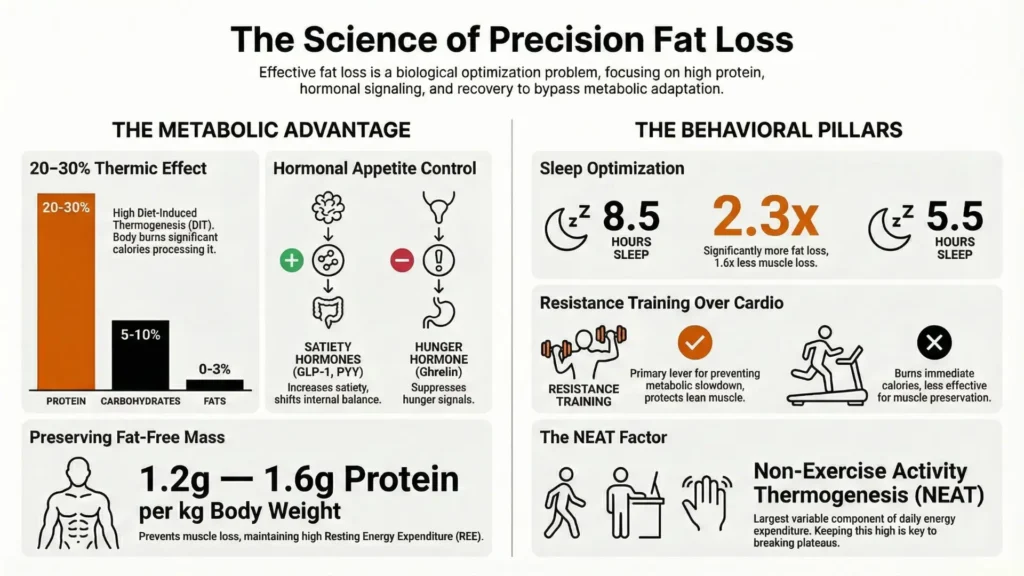
One of the most effective strategies is to ensure every meal contains at least 25–30 grams of protein. In an Indian vegetarian diet, this means incorporating more pulses, legumes, paneer, and curd. In simple terms, a high-protein diet can boost your metabolism by up to 30%.
What this means for your daily routine is that instead of having just poha for breakfast, you should add a bowl of sprouts or a paneer-stuffed cheela. This simple change keeps you full until lunch and prevents the mid-morning energy crash that leads to unhealthy snacking.
Sample 1500-Calorie Indian Fat Loss Plan
| Meal Time | Recommended Food Items | Metabolic Benefit |
| Early Morning | Warm water with 1/2 tsp cinnamon. | Helps regulate blood sugar levels. |
| Breakfast | Moong dal cheela or vegetable daliya. | High protein and fiber for morning satiety. |
| Mid-Morning | One small apple or buttermilk. | Provides antioxidants and gut-healthy probiotics. |
| Lunch | 2 small millet rotis, 1 bowl dal, large salad. | Balanced macros with high micronutrient density. |
| Evening | Green tea with a handful of roasted chana. | Sustained energy without the sugar spike . |
| Dinner | Grilled paneer/tofu or vegetable soup. | Low-carb evening meal to aid overnight fat burning. |

How Can I Weight Loss Faster with PCOS or Diabetes?
When you are managing a condition like PCOD/PCOS or diabetes, weight loss isn’t just about looking good it’s about medical management. For women with PCOS, hormonal imbalances like high insulin and cortisol can make losing even 500 grams feel like a battle. In simple terms, your body is struggling to regulate its energy switches.
The latest research suggests that Time-Restricted Feeding (TRF) and High-Intensity Interval Training (HIIT) are two of the most powerful tools for this group . By limiting your eating window to 8–10 hours, you give your body a chance to lower its insulin levels, which is the root cause of PCOS-related weight gain. Similarly, for those with thyroid issues, focusing on iodine-rich foods, lean proteins, and regular strength training can help rev up your metabolic furnace .
Common Pitfalls: Why Quick Fixes Often Fail?
I’ve seen so many clients come to DietDekho after failing with detox tea or juice fasts. The reason these fail is that they don’t teach you how to eat for the long term. Your body has its own built-in detoxification system your liver and kidneys and they don’t need expensive juices to do their job; they just need healthy fuel.
Another common mistake is being sedentary-active. This is when you work out for an hour but spend the other 23 hours sitting at a desk. Research suggests that NEAT (Non-Exercise Activity Thermogenesis) the calories you burn through walking, standing, and moving throughout the day is often more important for fat loss than a single gym session.
Staying Disciplined: Your Journey to a Healthier Self
Losing weight is rarely a straight line. There will be weeks when the scale doesn’t move, and there will be festivals where you indulge in your favorite sweets. The key is mental resilience. Instead of focusing on perfection, focus on consistency. A single cheat meal won’t make you gain weight, just as a single healthy meal won’t make you lose it. Treat yourself with kindness, stay patient, and trust the science-backed process.
Home-Based Exercises to Achieve Weight Loss Faster
You don’t need a fancy gym membership to lose weight. In fact, some of the most effective fat-burning exercises can be done in your living room in just 20–30 minutes. The goal is to combine cardio with strength to maximize your calorie burn both during and after the workout.
- Burpees: The ultimate full-body move that strengthens your arms and legs while rapidly increasing heart rate .
- Mountain Climbers: Perfect for targeting the core and burning belly fat .
- High Knees: A cardio-intensive move that strengthens your legs and torches calories .
- Bodyweight Squats: These build the large muscles in your legs, your body’s biggest calorie-burning engines .
- Planks: Essential for core stability and tightening the waist .

FAQs
How can I weigh faster without going to the gym?
The most effective way is to focus on your diet prioritizing protein and fiber and incorporating daily movement like brisk walking (30–45 mins) and bodyweight exercises like squats and planks at home .
Is a keto diet safe for Indians?
While keto can lead to fast results, it is often hard to sustain. A Low-Carb, High-Protein approach with millets is usually more sustainable and safer for long-term health.
Why is my weight stuck even though I am eating less?
You might be eating less but still eating low-quality calories that spike insulin. Additionally, lack of sleep or high stress can increase cortisol, which signals the body to store fat.
Can I lose weight faster if I have PCOS or Thyroid issues?
Absolutely. It may take more patience, but focusing on a low-GI diet, consistent strength training, and managing stress through yoga can help balance your hormones .
How much water should I drink for fat loss?
Aim for 2.5 to 3 liters daily. Water supports metabolism, helps flush out toxins, and often prevents false hunger where we mistake thirst for a craving.
Book a Consultation with Diet Dekho Experts for a Personalized Plan
Everybody is different, and what works for your neighbor might not work for you. At DietDekho, we specialize in creating realistic, home-based plans that fit into your busy Indian lifestyle. Whether you are managing PCOD, Diabetes, or just want to feel lighter and more energetic, we are here to guide you every step of the way.
Contact Us
We understand how overwhelming nutrition and weight loss information can feel. With so many opinions and confusing advice online, it’s easy to feel stuck or unsure about what to do next.
At Diet Dekho, you never have to figure it out alone. You can contact us anytime with any questions or concerns. Our expert dietitians are available 24/7 to guide, support, and help you stay on track. Whether your goal is weight loss or building healthier habits, we’re here to make the journey simpler and more sustainable for you.
Disclaimer
This blog is intended to help readers make healthier food choices. Your health should always be the top priority. Before starting any restrictive or special diet, especially if you have a medical condition or health concern, please consult a doctor or a qualified dietitian. Each body responds differently to food and lifestyle changes. Always choose what is safe and suitable for you.

Dr. Ritika is a nutrition and lifestyle expert with 2+ years of experience, helping clients manage weight and health through practical, personalized diet plans.