
Have you ever felt that sinking feeling in your stomach after seeing a high number on your glucometer? I know how it feels when you work hard to stay healthy, yet your blood sugar refuses to cooperate. Perhaps you are a busy professional skipping breakfast or a homemaker juggling a dozen tasks while trying to manage your family’s health. If you are struggling with your sugar levels, an ayurvedic diet for diabetes offers a gentle, time-tested way to bring your body back into balance without feeling like you are living in a hospital.
An ayurvedic diet for diabetes focuses on balancing your metabolic fire, or Agni, through whole grains like barley and millets, bitter vegetables like karela, and warming spices. By prioritizing light, dry, and easily digestible foods while avoiding refined sugars and heavy dairy, you can naturally improve insulin sensitivity and support your body’s innate ability to regulate glucose levels effectively.
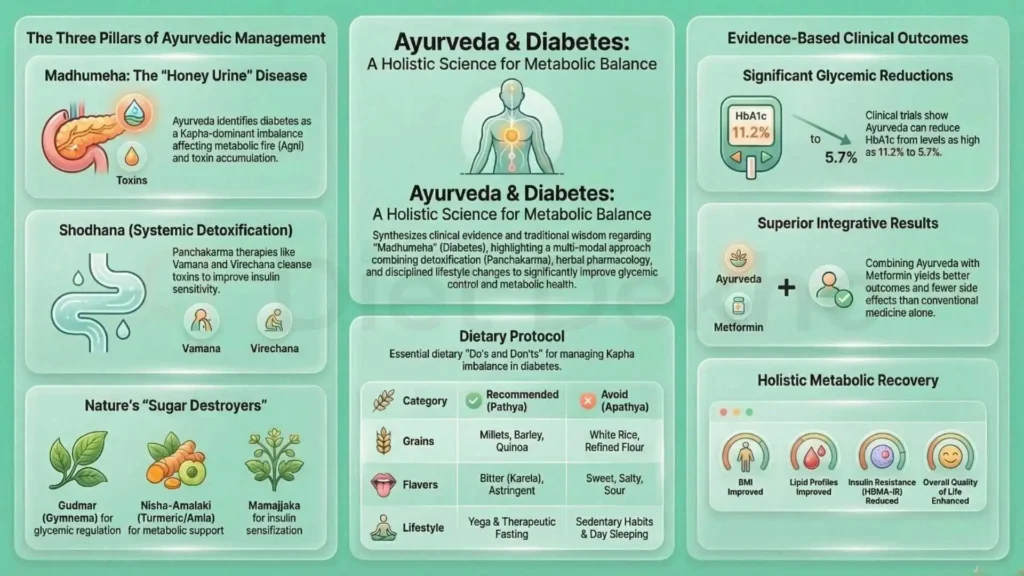
Understanding the Roots of Diabetes Through an Ayurvedic Lens
Table of Contents
- 1 Understanding the Roots of Diabetes Through an Ayurvedic Lens
- 2 The Scale of the Challenge in India Today
- 3 Why Your Prakriti Matters for Sugar Control
- 4 The Power Grains: Beyond White Rice and Wheat
- 5 Healing Herbs from Your Kitchen Pharmacy
- 6 Practical Lifestyle Habits for the Non-Gym Audience
- 7 Managing Stress: The Hidden Sugar Trigger
- 8 Office Lunch and Snack Ideas for Busy People
- 9 Success Stories: When Ayurveda Meets Science
- 10 Your Daily Ayurvedic Checklist
- 11 FAQs About Ayurvedic Diet for Diabetes
- 12 Taking the First Step Toward Balance
- 13 Contact Us
- 14 Disclaimer
In my years of helping people at DietDekho, I have found that looking at diabetes as a single problem is often where we go wrong. Ayurveda views this condition, traditionally known as Madhumeha, as a complex metabolic shift involving your Doshas, specifically Kapha and Vata. It is not just about the sugar in your blood. It is about how your body processes every experience and every meal.
| Key Ayurvedic Concepts for Diabetes | Description and Impact | Modern Metabolic Correlation |
| Agnimandya | Weakened or sluggish digestive fire | Impaired enzymatic function and metabolic syndrome |
| Ama | Toxic metabolic byproduct from undigested food | Systemic inflammation and cellular insulin resistance |
| Kleda | Excessive moisture or fluid accumulation | Hyperlipidemia and destabilized fat metabolism |
| Dhatu Kshaya | Depletion of vital tissues and energy | Chronic fatigue and diabetic complications like neuropathy |
When your Agni is low, the food you eat does not turn into energy. Instead, it turns into Ama, which blocks the tiny channels in your body. Think of it like a clogged pipe. When these channels are blocked, your cells cannot receive the glucose they need, and it ends up sitting in your bloodstream. I know it sounds technical, but what this means for your daily routine is that we need to clear those pipes and restart your internal fire.

The Scale of the Challenge in India Today
We are facing a situation that is quite literally hitting home for millions. Recent reports show that India is now home to nearly 101 million people living with diabetes. That is a staggering number. Even more concerning is that about 43 percent of adults with the condition do not even know they have it until complications start showing up.
| Diabetes Statistics in India (2024-2025) | Data Point |
| Estimated Number of Adults with Diabetes | 89.8 Million to 101 Million |
| Prevalence Rate in Adult Population | 10.5% to 11.4% |
| Percentage of Undiagnosed Cases | 43% |
| Deaths Related to Diabetes (Annual) | Over 334,922 |
| Estimated Total National Health Expenditure | Over USD 9.8 Billion |
Experts like Dr. Viswanathan Mohan have pointed out that while genetics play a role, our environment is the real driver. We are eating too many refined carbohydrates like white rice and wheat while moving far less than our ancestors did. This is why an ayurvedic diet for diabetes is so relevant now. It brings back the old grains and habits that kept our grandparents healthy even before modern medicine became common.

Why Your Prakriti Matters for Sugar Control
One thing I always tell my friends is that your body is unique. You might have noticed that some people can eat a bowl of rice and be fine, while your sugar spikes after just a few bites. This is because of your Prakriti, or your natural body constitution. In Ayurveda, people with a Kapha-dominant constitution are naturally more prone to diabetes because their metabolism tends to be slower.
| Dosha Predominance | Metabolic Tendency | Diabetes Risk Profile |
| Kapha | Slow, stable, heavy | High risk due to insulin resistance and weight gain |
| Pitta | Sharp, hot, fast | Moderate risk, often linked to inflammatory complications |
| Vata | Variable, dry, light | Risk at later stages or due to extreme tissue depletion |
If you have a Kapha constitution, you might feel sluggish or gain weight easily. For you, the goal of an ayurvedic diet for diabetes is to include warming and drying foods. On the other hand, if you are more Pitta-dominant, we need to focus on cooling foods that do not irritate your system. Understanding this helps us move away from a boring, one-size-fits-all diet plan.

The Power Grains: Beyond White Rice and Wheat
Let’s simplify your pantry. The biggest change you can make today is swapping out refined white rice and modern wheat for ancient functional grains. Ayurveda has praised Barley, known as Yava, as the best grain for diabetes for thousands of years. It has a very low glycemic index and helps scrape away excess fat and sugar from your system.
| Recommended Grains for Diabetes | Glycemic Index (Approx.) | Key Ayurvedic Benefit |
| Barley (Yava) | 25–35 | Scrapes excess fat and fluid from the body |
| Ragi (Finger Millet) | 54–68 | High in calcium and fiber for steady energy |
| Bajra (Pearl Millet) | 52–55 | High in magnesium to improve insulin sensitivity |
| Jowar (Sorghum) | 61–62 | Gluten-free and very easy on the digestive fire |
| Foxtail Millet | 54–58 | Excellent for preventing post-meal sugar spikes |
I know it is hard to give up rice if it is your staple. But what this means for your daily routine is that you can still enjoy your meals. You can make Ragi idlis, Jowar rotis, or even a Barley khichdi. These grains keep you full for much longer, which means you won’t be reaching for those sugary biscuits at 4 PM.

Healing Herbs from Your Kitchen Pharmacy
You don’t always need expensive supplements to manage your health. Some of the most potent medicines are likely already in your kitchen. Ayurveda uses herbs that don’t just lower blood sugar but actually help your pancreas work better. For instance, according to the National Institutes of Health (NIH), several plant-based compounds have shown significant promise in managing glucose levels.
The Bitter Truth About Karela and Jamun
Karela, or bitter gourd, contains a plant-based insulin called Polypeptide-p. It might be an acquired taste, but it is one of the most reliable ways to lower sugar naturally. Jamun seeds are just as powerful. They contain compounds like Jamboline that stop your body from turning starch into sugar too quickly. Many of my clients find that taking a small amount of Karela-Jamun juice in the morning acts as a wonderful primer for their metabolism.
Methi and Turmeric: The Daily Essentials
Methi seeds are small but mighty. They are packed with fiber that slows down sugar absorption. I suggest soaking a teaspoon of Methi seeds overnight and drinking the water in the morning. It is a simple habit that makes a big difference over time. Turmeric, especially when combined with Amla, helps reduce the inflammation that often comes with diabetes. In Ayurveda, this combination is called Nishamalaki, and it is considered a premier tonic for sugar patients.

Practical Lifestyle Habits for the Non-Gym Audience
I know you are busy, and the thought of spending an hour at the gym can feel overwhelming. The good news is that Ayurveda prioritizes consistency over intensity. Simple movements and timing your meals can be just as effective as a heavy workout. Research shared by Harvard Health indicates that even moderate exercise, like a 30-minute brisk walk, can significantly improve how your body uses insulin.
The Two-Meal Method and Timing
One of the most effective things I have seen is therapeutic fasting or the Two-Meal Method. Instead of grazing all day, try to have two substantial meals between 11 AM and 7 PM. This gives your digestive system a break and allows your body to burn through stored sugar. Also, try to avoid sleeping during the day. In Ayurveda, daytime sleep is known to increase Kapha and can actually make your sugar levels harder to control.
Yoga for Your Organs
You don’t need to be flexible to do Diabetes Yoga. Simple poses like Mandukasana (the frog pose) or Ardha Matsyendrasana (the half-spinal twist) work by gently massaging your abdominal organs, including the pancreas. This stimulation helps improve blood flow and can even help with insulin production. If you can spare just 15 minutes in the morning for these stretches and some deep breathing, your body will thank you.
| Simple Yoga Poses for Sugar Control | How to Do It | Primary Benefit |
| Mandukasana | Sit in Vajrasana, press fists into the belly, and lean forward | Stimulates the pancreas directly |
| Ardha Matsyendrasana | A seated twist that squeezes the abdominal region | Improves digestion and organ function |
| Kapalbhati | Rapid, rhythmic abdominal breathing | Clears toxins and improves metabolic rate |
| Paschimottanasana | A simple seated forward bend | Calms the nervous system and reduces stress spikes |

Managing Stress: The Hidden Sugar Trigger
I often see patients who eat perfectly and still have high sugar. When we talk, I realize they are carrying a lot of stress from work or home. Stress releases cortisol, which tells your liver to dump more sugar into your blood for energy. In Ayurvedic terms, this is a Vata imbalance.
Taking five minutes for Nadi Shodhana, or alternate nostril breathing, can be a game-changer. You can even do it while sitting at your desk between meetings. It calms your nervous system and stops those stress-related sugar spikes. Remember, managing your mind is just as important as managing your plate.

Office Lunch and Snack Ideas for Busy People
Let’s solve the what should I eat at work problem. When you are at the office, it is easy to fall into the trap of ordering a samosa or eating a heavy canteen meal. But with a little bit of prep, you can have a sugar-friendly lunch that keeps your energy steady all afternoon.
- The Millet Tiffin: Carry two Jowar or Bajra rotis with a bowl of Moong dal and a side of Lauki (bottle gourd) or Palak (spinach). This is a balanced meal that won’t make you feel sleepy after lunch.
- Vegetable Daliya: If you like one-pot meals, a Daliya (broken wheat) khichdi with lots of peas, carrots, and beans is excellent. It is high in fiber and keeps your glucose release slow and steady.
- Smart Snacking: Instead of biscuits, keep a jar of roasted Makhana (fox nuts) or roasted Chana (Bengal gram) at your desk. They are crunchy, satisfying, and have a very low glycemic index.
- The Best Drink: Swap your sugary tea for spiced buttermilk (Chaas). Add a pinch of roasted cumin and ginger. It aids digestion and is much better for your sugar levels than any diet soda.
Success Stories: When Ayurveda Meets Science
I want to share something encouraging. A case study recently documented a patient who brought their HbA1c down from a dangerous 14.87 percent to a healthy 6.05 percent in just eight months using Ayurvedic principles. They didn’t use magic; they used a combination of traditional herbs and a low-glycemic diet centered around grains like Barley and Millets.
Another clinical study showed that adding Ayurvedic herbal formulations to standard metformin treatment resulted in a much better reduction in blood sugar than metformin alone. What this means for you is that an ayurvedic diet for diabetes is not about rejecting modern medicine; it is about giving your body the extra support it needs to heal itself.

Your Daily Ayurvedic Checklist
To make this easy for you, I have put together a simple daily routine. You don’t have to do everything at once. Start with one or two changes this week and see how you feel.
- Morning (6 AM – 7 AM): Wake up early. Drink a glass of warm water with a teaspoon of Methi seeds (soaked overnight) or 30ml of Karela-Jamun juice.
- Breakfast (8 AM – 9 AM): Have a bowl of vegetable Daliya or a Ragi chilla. Avoid sugary cereals or white bread.
- Lunch (12 PM – 1 PM): Make this your largest meal. Include whole grains like Jowar rotis or Barley khichdi with plenty of cooked vegetables.
- Afternoon (4 PM): If you are hungry, have some roasted Makhana or a handful of walnuts. Avoid the office biscuits!.
- Evening (6 PM – 7 PM): Keep dinner light and early. A bowl of lentil soup (Moong dal) or a vegetable salad is perfect.
- Night: Try to be in bed by 10 PM. Quality sleep is essential for regulating your hormones and sugar.

FAQs About Ayurvedic Diet for Diabetes
Is it okay to eat fruits in an ayurvedic diet for diabetes?
Yes, but you have to be selective. Choose fruits with a lower glycemic index like Amla, Jamun, green apples, and pomegranates. It is best to avoid very sweet fruits like mangoes, grapes, and bananas, as they can cause quick spikes in your blood sugar levels.
Can an ayurvedic diet for diabetes help me reduce my medications?
Many people find that as their sugar levels stabilize through diet and lifestyle, their doctors are able to reduce their dosage of allopathic medicines. However, never stop or change your prescribed medication without consulting your doctor first. Ayurveda works beautifully as a supportive therapy.
How long does it take to see results with an ayurvedic diet for diabetes?
Most people start noticing a difference in their energy levels and digestion within 2 to 3 weeks. Significant changes in your HbA1c levels usually take about 3 months of consistent effort. Remember, Ayurveda focuses on long-term health, not just a quick fix.
Is honey a good substitute for sugar for a diabetes patient?
While Ayurveda sometimes uses old honey in specific medicines, for daily use, honey still contains sugar and can spike your levels. It is better to avoid it or use it very sparingly. The same applies to jaggery, which has a very high glycemic index and is not a safe sugar substitute for diabetics.
Taking the First Step Toward Balance
I know it can feel like a mountain to climb when you are first diagnosed or when your sugar stays high despite your best efforts. But remember, every small choice you make choosing Jowar over white rice or taking a walk after dinner is a step toward a healthier you. You don’t have to be perfect; you just have to be consistent.
An ayurvedic diet for diabetes is about being kind to your body and giving it the right fuel to thrive. If you feel overwhelmed, let us help you simplify the process. You can start today by filling out our personalized health assessment at Dietdekho to get a plan that fits your specific life and needs. Let’s work together to make your health a priority again.
Contact Us
We understand how overwhelming nutrition and weight loss information can feel. With so many opinions and confusing advice online, it’s easy to feel stuck or unsure about what to do next.
At Diet Dekho, you never have to figure it out alone. You can contact us anytime with any questions or concerns. Our expert dietitians are available 24/7 to guide, support, and help you stay on track. Whether your goal is weight loss or building healthier habits, we’re here to make the journey simpler and more sustainable for you.
Disclaimer
This blog is intended to help readers make healthier food choices. Your health should always be the top priority. Before starting any restrictive or special diet, especially if you have a medical condition or health concern, please consult a doctor or a qualified dietitian. Each body responds differently to food and lifestyle changes. Always choose what is safe and suitable for you.

Abhinav is the Founder of Diet Dekho, helping people manage weight and lifestyle health through simple, practical nutrition and personalized diet plans.