I know it’s hard to believe, but most vegetarian meals in India are still low in protein, even when the plate looks full. The short answer is that our diets rely too much on roti, rice, and refined grains, while protein takes a back seat. This is why understanding the Best Protein Sources for Vegetarians matters so much. Protein is not only about strength or weight loss. It helps control hunger, supports hormones, and keeps energy steady through long working days and busy home routines. When you choose the right vegetarian protein sources, your regular Indian meals start working for your body, not against it.
Start Your Free Diet AssessmentImmediately after this realization, many ask: What should I eat? The short answer is that the best protein sources for vegetarians in India include soya chunks, paneer, sprouted legumes (like moong and chana), Greek yogurt, and sattu. By combining these with grains like millets or brown rice, you create “complete proteins” that provide all essential amino acids. This approach is specifically effective for managing weight loss, PCOS, and diabetes within a high protein indian vegetarian diet.
The 2024 Revised Dietary Guidelines for Indians, published by the ICMR-National Institute of Nutrition (NIN), underscore a shift from focusing on isolated nutrients to emphasizing diverse food groups. Consequently, this report provides an exhaustive analysis of how to optimize a high protein indian vegetarian diet. We have tailored this specifically for those managing conditions like PCOS, Diabetes, Thyroid, and Hypertension, while adhering to the practicalities of a non-gym lifestyle.
The Protein Gap: Decoding the Indian Nutritional Crisis
Table of Contents
- 1 The Protein Gap: Decoding the Indian Nutritional Crisis
- 2 Understanding Complete vs. Incomplete Proteins
- 3 Top 10 Indian Superfoods: The Best Protein Sources for Vegetarians
- 4 Traditional Food Pairings: The Science of the Thali
- 5 Muscle Gain vs. Weight Loss: The Strategic Utility of Protein
- 6 Nutrition for Medical Conditions: A Safety-First Approach
- 7 Smart Swaps for Busy Professionals and Homemakers
- 8 Budget-Friendly Sources: Protein for Every Kitchen
- 9 Common Myths Surrounding Plant-Based Protein
- 10 Sample Day-on-a-Plate: High Protein Indian Vegetarian
- 11 Next Steps for Sustainable Health
The Indian dietary structure is traditionally cereal-centric, with rice and wheat providing the bulk of daily caloric intake. While these staples are essential for energy, their over-representation has led to a significant “Protein Gap.” Research indicates that even among the wealthiest 5% of the Indian population, protein intake remains below the EAT-Lancet reference levels. This gap is further complicated by the consumption of low-quality carbohydrates and ultra-processed foods, which have replaced traditional legumes and pulses.
Moreover, the ICMR-NIN has refined its recommendations to reflect the physiological needs of the Indian body type. This is important because Indians often possess a higher body fat percentage at a lower Body Mass Index (BMI) compared to Western counterparts—a phenotype often referred to as the “Thin-Fat Indian”. What this means for your daily routine is that you likely need more protein than you realize to maintain a healthy metabolism.
Understanding RDA and Requirements for the Indian Context
| Population Category | Reference Weight (kg) | EAR (Estimated Average Requirement) | RDA (Recommended Daily Allowance) | Total Daily Protein (g) |
| Adult Men (Sedentary) | 65 | 0.66 g/kg/d | 0.83 g/kg/d | 54.0 |
| Adult Women (Sedentary) | 55 | 0.66 g/kg/d | 0.83 g/kg/d | 45.7 |
| Pregnant People (3rd Trimester) | 55 + GWG | – | – | +17.6 (additional) |
| Lactating People (0-6 months) | 55 | – | – | +16.9 (additional) |
For those consuming a diet predominantly based on cereals with lower-quality plant protein, the effective requirement often rises to 1.0 g/kg/day. Therefore, for the busy professional or the homemaker, a simple “bowl of dal” is often insufficient to meet daily targets unless supplemented with the best protein sources for vegetarians.

Understanding Complete vs. Incomplete Proteins
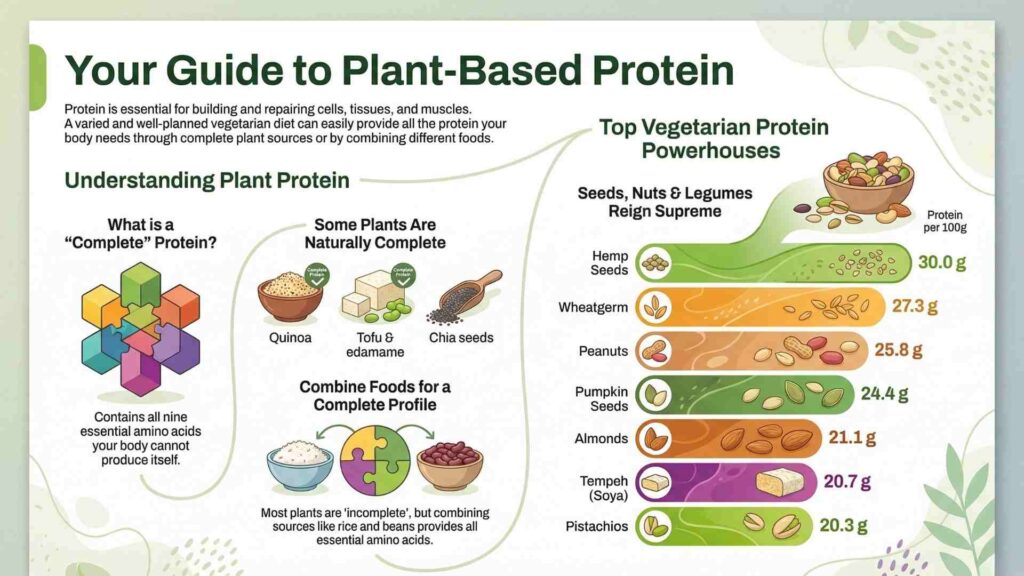
To identify the best protein sources for vegetarians, one must look beyond the total protein grams on a label and investigate the amino acid profile. Proteins are made of 22 amino acids, nine of which are “essential” (EAAs)—meaning the body cannot produce them, and they must be ingested.
The DIAAS vs. PDCAAS Paradigm in Quality Control
For decades, the Protein Digestibility Corrected Amino Acid Score (PDCAAS) was the standard for measuring protein quality. However, the 2024 guidelines have moved toward the Digestible Indispensable Amino Acid Score (DIAAS). Essentially, DIAAS is more accurate because it measures the digestibility of amino acids at the end of the small intestine, rather than the total nitrogen lost in feces.
Research indicates that many plant proteins have lower DIAAS scores because they lack specific amino acids. For instance, grains are typically low in Lysine, while legumes are low in Methionine. Consequently, this is the biological foundation for traditional Indian pairings like Dal-Chawal or Rajma-Roti. They are essentially “amino acid puzzles” that complete each other when eaten together.
| Food Group | High In | Limiting (Missing) Amino Acid |
| Legumes (Lentils, Beans) | Lysine, Leucine, Valine | Methionine, Cysteine |
| Grains (Rice, Wheat, Millets) | Methionine, Threonine | Lysine |
| Soy (Tofu, Soya Chunks) | All 9 EAAs | None (Complete) |
| Dairy (Paneer, Curd) | All 9 EAAs | None (Complete) |

Top 10 Indian Superfoods: The Best Protein Sources for Vegetarians
Integrating high-density protein sources into a vegetarian lifestyle requires focusing on foods that offer the most “protein per bite.” Below, we highlight ten superfoods selected for their accessibility, affordability, and nutritional density in the Indian context.
1. Soya Chunks (The High-Density Choice)
Soya chunks, often called Nutri-nuggets, are a powerhouse of nutrition. They contain approximately 52 g of protein per 100 g of dry product. As a complete protein, soy rivals animal sources in its amino acid profile. For busy professionals, soya chunks are a “pantry hero” because they have a long shelf life and can be quickly added to pulaos or wraps.
2. Paneer (The Slow-Digesting Powerhouse)
As a cultural staple, paneer provides 18–25 g of protein per 100 g. Furthermore, it is primarily composed of casein, a slow-digesting protein that provides a steady release of amino acids into the bloodstream. This makes it an ideal evening meal for non-gym goers, as it helps prevent muscle breakdown during sleep.
3. Greek Yogurt and Strained Curd
While regular dahi is a good probiotic, straining it to make Greek yogurt concentrates the protein content to nearly 10 g per 100 g. This is double that of regular yogurt. It is particularly beneficial for gut health, which is a critical factor for those with PCOD or digestive sensitivities.
4. Chickpeas (Chana)
Chickpeas offer ≈15 g of protein per cup. In addition to protein, they are high in fiber, which helps regulate blood sugar. This makes them one of the best protein sources for vegetarians managing Diabetes . Sprouting chickpeas further enhances their bioavailability.
5. Lentils (Dal)
The humble dal is the backbone of the Indian diet. Moong, Masoor, and Urad dal provide 7–9 g of protein per cooked cup. Urad dal, in particular, is denser in protein and is a key component in fermented dishes like idli and dosa.
6. Hemp Seeds (The Modern Addition)
Recently gaining popularity in India, hemp seeds are a rare complete plant-based protein, providing 31–33 g of protein per 100 g . They are also rich in Omega-3 and Omega-6 fatty acids, which helps reduce systemic inflammation—a common issue in Hypertension and PCOD.
7. Sattu (Roasted Gram Flour)
Sattu is a traditional “superfood” from Eastern India. It contains 25.4 g of protein per 100 g and has a high fiber-to-carb ratio. Moreover, it is an excellent travel companion for NRIs or professionals, as it can be consumed as a simple drink with water and lemon.
8. Quinoa (The Low-GI Grain)
While not native to India, quinoa has become a staple for weight loss seekers. It is a complete protein (8 g per cup) and is gluten-free. Its low Glycemic Index (53) makes it a superior alternative to white rice for managing insulin resistance in PCOD and Diabetes .
9. Peanuts and Peanut Butter
Peanuts are one of the most budget-friendly protein sources, offering 25 g of protein per 100 g . They are rich in healthy monounsaturated fats, which support heart health. For homemakers, adding crushed peanuts to poha is an easy way to “protein-ify” regular meals.
10. Millets (Nutri-Cereals)
Millets like Ragi, Bajra, and Jowar provide more protein and fiber than refined wheat or rice. Ragi is particularly high in calcium, while Bajra is rich in iron and magnesium. Therefore, these minerals are essential for thyroid function and bone health in older people.
Traditional Food Pairings: The Science of the Thali
The traditional Indian thali is a masterpiece of nutritional engineering. By combining various food groups, it achieves a “synergistic” protein effect. This magic of “complementation” allows vegetarians to get all nine essential amino acids without meat or eggs.
Synergy in the Indian Kitchen
Research on DIAAS scores shows that while a single pulse might have a limiting amino acid, blending it with a cereal elevates the total score of the meal. For example, Rice provides Methionine while Dal provides Lysine. Together, they create a complete protein profile that is easily digestible for older people and children.
Furthermore, fermentation—common in South Indian cuisines like Idli and Dosa—is a crucial technique for protein optimization. The process breaks down complex proteins into simpler amino acids and neutralizes anti-nutrients like phytic acid. Consequently, this ensures that the best protein sources for vegetarians are actually utilized for body repair rather than being lost during digestion.

Muscle Gain vs. Weight Loss: The Strategic Utility of Protein
For the “Weight Loss Seeker,” protein is the most valuable tool in the kit. It has a high “Thermic Effect of Food” (TEF), meaning the body burns more calories digesting protein than it does digesting fats or carbs. Additionally, protein stimulates the release of hormones that signal the brain to stop eating.
Managing Abdominal Fat and Metabolic Health
The ICMR-NIN guidelines specifically highlight the danger of “abdominal obesity” in Indians. High-protein diets (≈25–35% of total energy) have been shown to specifically target visceral fat while preserving lean muscle mass. For a professional sitting at a desk for 8 hours, this shift in body composition is vital for metabolic health.
In addition to dietary changes, Harvard research has identified a protein called “irisin” that is released during exercise and helps convert “white fat” into energy-burning “brown fat” . While supplements cannot replace exercise, a high-protein diet supports the muscle health necessary to stimulate irisin production during moderate activities like walking or household chores .

Nutrition for Medical Conditions: A Safety-First Approach
For individuals with underlying medical conditions, identifying the best protein sources for vegetarians requires precision. Below, we examine the dietary adjustments needed for common health challenges.
1. PCOD/PCOS and Insulin Resistance
Women with PCOS often experience insulin resistance, leading to weight gain and hormonal imbalances.
- The Strategy: Focus on proteins that are also high in fiber to slow down glucose absorption. Chickpeas, lentils, and sprouted moong are ideal.
- Insight: Research shows that increasing protein helps manage the intense sugar cravings often associated with the condition.
- Avoid: High-fat dairy and processed “vegan” meats that contain hidden sugars.
2. Diabetes and Prediabetes
Managing blood sugar is about controlling the “Glycemic Load” of a meal.
- The Strategy: Use protein as a “buffer.” Always pair a carbohydrate (like roti) with a significant portion of protein (like paneer or dal) to blunt the insulin response.
- Top Choice: Quinoa and Soya chunks are excellent because they provide high protein with a minimal impact on blood sugar .
3. Thyroid Health (Hypothyroidism)
There is significant misinformation regarding “goitrogens” in soy and cruciferous vegetables like cauliflower.
- The Soya Myth: While soy isoflavones can interfere with thyroid hormone synthesis in the presence of iodine deficiency, modern research indicates that for healthy individuals with sufficient iodine intake, soy does not adversely affect thyroid function .
- Safety Tip: Patients on thyroid medication should avoid soy for 4 hours after taking their medicine to ensure proper absorption .
- Crucial Nutrients: The thyroid needs Zinc (found in Pumpkin Seeds) and Selenium (found in Lentils) to function correctly.
| Medical Condition | Recommended Protein Sources | Precautions |
| PCOS | Sprouted Moong, Soya Chunks, Tofu | Avoid refined carbs; monitor dairy intake. |
| Diabetes | Quinoa, Chana, Low-fat Paneer | Focus on low-GI sources. |
| Thyroid | Moong Dal, Pumpkin Seeds, Lentils | Cook cruciferous veggies; time soy away from meds. |
| Hypertension | Almonds, Peanuts, Beans, Lentils | Use unsalted nuts; focus on potassium-rich legumes. |
4. Hypertension (High Blood Pressure)
The DASH (Dietary Approaches to Stop Hypertension) diet emphasizes plant proteins like beans, nuts, and seeds.
- The Strategy: Plant-based proteins contain fiber and minerals like Magnesium and Potassium, which help in vascular relaxation.
- Top Choice: Almonds and walnuts provide magnesium, while lentils provide potassium, both of which counteract the effects of sodium.
Smart Swaps for Busy Professionals and Homemakers
Time is the greatest barrier to healthy eating. For a professional with back-to-back meetings, “quick” usually means “unhealthy.” However, the following swaps transform standard meals into high-protein powerhouses without adding hours to the cooking process. These are essentially the best protein sources for vegetarians in a convenient format.
- Regular Poha → Protein Poha: Add 1/2 cup of boiled moong or soya granules to the poha. This simple addition boosts the protein from ≈3 g to ≈12 g.
- Aloo Paratha → Paneer or Sattu Paratha: Swap the potato filling for grated paneer or sattu. This reduces the glycemic load and significantly increases amino acid availability.
- Plain Idli → Millet or Dal Idli: Use ragi or jowar flour, or increase the ratio of urad dal in the batter for a denser protein profile.
Budget-Friendly Sources: Protein for Every Kitchen
A common misconception is that a “protein-rich diet” is expensive. However, some of the best protein sources for vegetarians are also the most affordable. Specifically, soya chunks and roasted chana offer the highest protein-to-cost ratio in India.
Cost-Effectiveness Analysis
| Protein Source | Protein per 100g | Typical Cost (INR) | Cost per gram of Protein |
| Soya Chunks | 52g | ₹18 per 200g | ≈₹0.17 (Cheapest) |
| Roasted Chana | 15g | ₹60 per 500g | ≈₹0.80 |
| Moong Dal | 9g (cooked) | ₹110 per kg | ≈₹1.22 |
| Paneer | 18g | ₹90 per 200g | ≈₹2.50 |
For those looking to save money while maximizing health, a combination of soya chunks, lentils, and sprouted moong should form the core of the diet. Paneer and nuts can be used as supplementary sources to provide variety and micronutrients.

Common Myths Surrounding Plant-Based Protein
Myth 1: “Plant proteins are incomplete and therefore inferior.”
Fact: While it is true that many plants lack certain amino acids, your body maintains a “pool” of amino acids. As long as you eat a variety of protein sources throughout the day, your body will synthesize complete proteins.
Myth 2: “Soy increases estrogen in men.”
Fact: Soy contains phytoestrogens, which have a much weaker effect than human estrogen. Large-scale reviews of over 40 clinical trials found that soy consumption does not affect testosterone or estrogen levels in men .
Myth 3: “You can only get enough protein through supplements.”
Fact: The ICMR-NIN 2024 guidelines explicitly state that whole foods are the preferred source of nutrition. Therefore, finding the best protein sources for vegetarians in your kitchen is always better than relying on powder.
Sample Day-on-a-Plate: High Protein Indian Vegetarian
This plan is optimized for a sedentary professional or homemaker focusing on weight management and steady energy.
- Breakfast (8:30 AM): 2 Moong Dal Chillas stuffed with 50 g of crumbled paneer.
- Mid-Morning Snack (11:00 AM): A small bowl of roasted chana (30g).
- Lunch (1:30 PM): 1 cup Rajma, 1 small bowl of Brown Rice, and 1 bowl of homemade curd.
- Evening Snack (4:30 PM): 1 glass of buttermilk (chaas) or a sattu-lemon drink.
- Dinner (8:00 PM): Soya Chunk and Vegetable Curry with 1 multigrain roti.
Total Daily Protein: ≈73 g
Next Steps for Sustainable Health
Transitioning to a high-protein lifestyle does not require an overnight overhaul. Instead, it requires “intentional eating.” For the busy professional, the key is preparation—soaking lentils overnight and keeping roasted chana at the desk.
The future of Indian nutrition lies in reviving traditional wisdom and combining it with modern science. By focusing on these best protein sources for vegetarians, you are not just changing your diet; you are building a foundation for a life free from the constraints of metabolic disease.

Frequently Asked Questions (FAQs)
1. Is it safe to eat soya chunks every day?
Yes, for most people, consuming moderate amounts (25–30g dry) daily is perfectly safe. If you have a thyroid condition, ensure you consume it a few hours away from your medication .
2. Which dal is best for weight loss?
Moong dal is often considered one of the best protein sources for vegetarians for weight loss because it is light, easy to digest, and low in calories.
3. How can I increase protein in my children’s diet?
Adding sattu or soy flour to regular wheat atta is an easy way to increase protein. You can also blend paneer into paratha fillings.
4. Can I get enough Vitamin B12 from a vegetarian diet?
Vitamin B12 is primarily found in animal products. For vegetarians, dairy is the only natural source. If your intake is low, you may need to consult a doctor for a supplement.
5. Are sprouted grains better than regular grains?
Yes. Sprouting increases the activity of enzymes that break down proteins into more absorbable forms.
Start Your Free Diet AssessmentDisclaimer: This blog post was written to help you make healthier food choices altogether. So, be aware and take care. The important thing to consider is your health before starting a restrictive diet. Always seek advice from a doctor or dietitian before starting if you have any concerns.

Dr. Ritika is a nutrition and lifestyle expert with 2+ years of experience, helping clients manage weight and health through practical, personalized diet plans.