
Have you ever wondered why your weight loss progress stalls just when you feel you are doing everything right? For many of us, the biggest problems people face while following a diet are not just about a lack of willpower, but a deep conflict between our traditional food culture and modern metabolic needs.
The biggest problems people face while following a diet in India include managing intense social pressure to overeat at family gatherings, overcoming a heavily cereal-based and protein-deficient nutritional landscape, and navigating hormonal resistance from conditions like PCOS, thyroid disorders, or diabetes. Success requires balancing cultural food traditions with scientific nutrient density and circadian-aligned meal timings.
Table of Contents
- 1 Why do Indian social structures make it so difficult to stay consistent on a diet?
- 2 What is the true extent of the protein deficiency in the Indian diet?
- 3 How do PCOS and insulin resistance create biological barriers to weight loss?
- 4 Is the “hidden salt” in Indian food sabotaging your blood pressure?
- 5 Why do we struggle with emotional eating in India?
- 6 What are the most common dieting mistakes for Indians?
- 7 How to handle social pressure during dieting at Indian weddings?
- 8 When is the best time to eat dinner for weight loss in India?
- 9 How to Track Calories in Indian Home Cooking Without Getting Confused ?
- 10 Recognizing signs of nutritional deficiencies in vegetarians
- 11 PCOD/PCOS and Thyroid: Strategic Indian meal prep tips
- 12 How can NRIs maintain an Indian diet while living abroad?
- 13 Conclusion: Turning obstacles into stepping stones
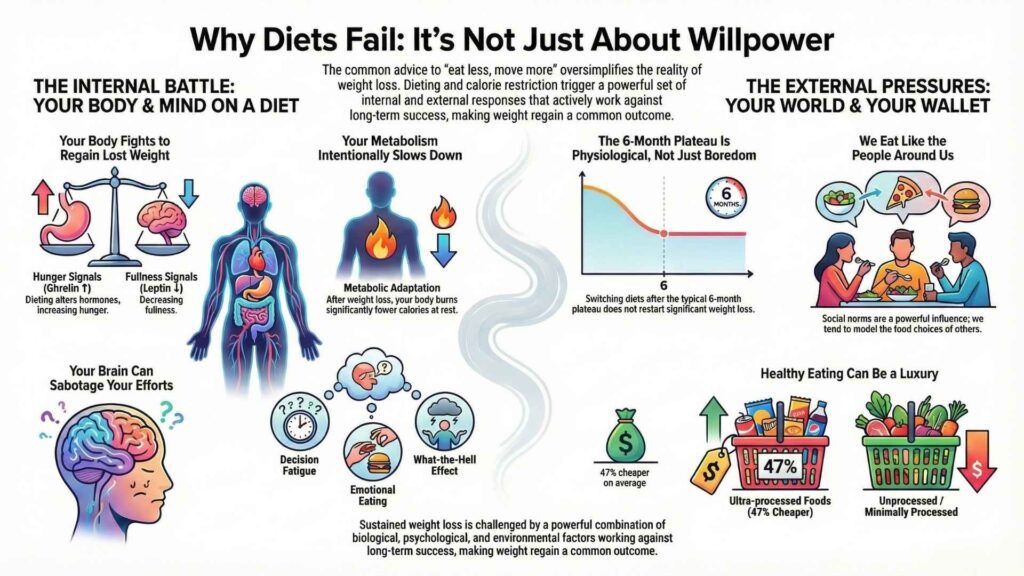
One of the primary reasons why Indian diets fail is the deep-rooted socio-cultural framework that defines our relationship with food. In our community, food is far more than fuel; it is a primary expression of love, respect, and hospitality. Research into the “social food environment” suggests that our eating behaviors are heavily influenced by subjective norms—the social pressure we feel to conform to the habits of those around us.
I know it’s hard to find time to explain your health goals to a pushy relative, but understanding the psychology behind this can help. In many Indian homes, refusing a second helping or a sweet is often perceived as a personal rejection of the host’s affection. This is especially true when an elder has prepared the meal. Refusing food may be considered rude and act against the social norm of respecting elders, making the individual feel inclined to eat out of a sense of duty rather than hunger.
How do “food pushers” impact our weight loss efforts?
The phenomenon of the “food pusher” is a significant hurdle in the Indian context. These are well-meaning friends or family members who insist that “one bite won’t hurt” or “you’ve already lost enough weight, just enjoy today.” This “one bite won’t hurt” culture reflects a general lack of understanding regarding structured, medically necessary diets.
What this means for your daily routine is a constant battle against social sabotage. Neuroscience shows that social rejection lights up the same pain centers in the brain as physical pain. In a culture where food equals love, saying no can feel like hurting someone emotionally. This cultural layer makes us especially vulnerable to food pushers, even when we are highly motivated to improve our health.
| Type of Social Pressure | Psychological Driver | Common Manifestation |
| Hospitality Norms | Sacred duty of the host | Insistence on overfilling the guest’s plate |
| Generational Conflict | Traditional vs. modern views | Elders viewing dieting as “weakness” or “starvation” |
| Festival Culture | Ritualized consumption | Mandatory eating of sweets (mithai) during celebrations |
| Peer Mimicry | Desire for social belonging | Feeling awkward as the only one refusing snacks at a party |
What is the true extent of the protein deficiency in the Indian diet?
When we look at the macronutrient profile of our plates, a staggering data point emerges: 73% of Indians are protein deficient, and over 90% are unaware of their daily protein requirement. This is one of the biggest problems people face while following a diet, as protein is essential for satiety and muscle preservation. The average Indian adult consumes only about 0.6 grams of protein per kilogram of body weight, far below the recommended 0.8 to 1.0 gram.
Our diets are predominantly cereal-based. We derive nearly 60% of our protein from cereals like rice and wheat, which have poor digestibility and a low-quality amino acid profile. This cereal dominance is partly a legacy of agricultural policies like the Green Revolution, which prioritized calorie security (rice/wheat) over nutrient adequacy (pulses/millets).
Why is protein so vital for weight loss in vegetarians?
The importance of protein in an Indian vegetarian diet cannot be overstated. Since 39% of Indians are vegetarian and 81% avoid meat or eggs at some point, many struggle to find “complete” protein sources. For a weight seeker, a low-protein diet often leads to a “skinny fat” physique, where muscle mass is low but body fat percentage remains high.
In simple terms, protein is the most satiating macronutrient. It stimulates the release of hormones that tell your brain you are full. Without enough protein, your body remains in a state of “hidden hunger,” leading to constant cravings for simple carbohydrates like biscuits or white bread. This is why many Indian weight loss attempts end in frustration—the biological drive to eat remains high because the body is still searching for the building blocks it needs.
| Protein Source | Protein Quality/Bioavailability | Challenges for Indians |
| Lentils (Dals) | Moderate (Incomplete amino acids) | High carb-to-protein ratio |
| Dairy (Milk/Paneer) | High (Complete protein) | Saturated fat content in full-fat versions |
| Cereals (Rice/Wheat) | Low | Main source of protein for 60% of Indians |
| Eggs/Meat | Very High | Cultural and religious restrictions |
How do PCOS and insulin resistance create biological barriers to weight loss?
For women in India, PCOD/PCOS diet challenges are among the most difficult to navigate. PCOS is not just a reproductive issue; it is a metabolic disorder. An estimated 50-80% of women with PCOS have insulin resistance, meaning their body’s cells don’t respond efficiently to insulin. This leads to high insulin levels, which signal the body to store fat, particularly around the stomach.
This biological reality is why generic low-calorie diets often fail for women with PCOS. It isn’t just a matter of willpower; their hunger signals are often dysfunctional. The “hunger hormone” ghrelin can remain high even after a meal, leading to intense cravings for sugary foods. This biological imperative makes adherence to restrictive diets a grueling and often unsustainable fight.
What is the connection between PCOS and thyroid disorders?
Let’s simplify this complex connection. PCOS and hypothyroidism often coexist, sharing symptoms like weight gain, insulin resistance, and fatigue. Both conditions increase the risk of obesity and cardiovascular disease. One study suggests that thyroid function plays a crucial role in the development and progression of PCOS, necessitating regular screening for both.
What this means for your daily routine is that weight loss may be significantly slower. Hypothyroidism reduces your basal metabolic rate, meaning you burn fewer calories at rest. Strategic dietary shifts, such as focusing on a low-glycemic index diet and anti-inflammatory spices like turmeric and cinnamon, are essential for “unlocking” this resistance.
Managing the Glycemic Load in the Indian Kitchen
In simple terms, the glycemic index (GI) measures how quickly a food spikes your blood sugar. For those with PCOS or diabetes, managing the glycemic load—the total impact of a meal—is critical. White rice and maida (refined flour) have a high GI, causing sharp insulin spikes that worsen hormonal imbalances.
I know it’s hard to find time to cook separate meals, but a simple hack is “pairing.” Always pair your carbohydrates (like a roti) with a large portion of fiber (salad) and protein (dal or paneer). This pairing slows down digestion, leading to a gradual rise in blood sugar rather than a sharp spike. Traditional grains like ragi, bajra, and jowar naturally have a lower GI and are excellent substitutes for refined wheat.
Hypertenion (BP) is often called a silent killer, and in the Indian diet, salt is its hidden accomplice. Research from the ICMR-NIN reveals that Indians consume an average of 11 grams of salt per day—2.2 times higher than the WHO-recommended limit of 5 grams. Much of this excess sodium is hidden in traditional favorites that many people don’t even consider “salty.”
Items like pickles (achaar), papad, namkeen, and even bread and biscuits are major contributors to our sodium load. Regular iodized salt contains about 40% sodium. Excess sodium triggers water retention, increases blood volume, and raises blood pressure, leading to higher risks of stroke and kidney disease.
| Common Indian Food | Hidden Sodium Concern | Health Impact |
| Pickles (Achaar) | Extremely high salt for preservation | Spikes blood pressure immediately |
| Papad | High sodium in the dough and salt seasoning | Contributes to water retention |
| Namkeen/Chips | Processed salts and flavor enhancers | Encourages overeating and dehydration |
| Biscuits/Bread | Sodium used as a rising agent/preservative | Often overlooked as a salt source |

How can we reduce salt without losing flavor?
The short answer is to use our heritage of spices. Instead of reaching for the salt shaker, use flavors like lemon juice, tamarind (imli), amchur (dry mango powder), and fresh herbs like coriander and mint. These provide the “tang” we crave without the sodium hit.
The ICMR also suggests a meaningful switch to low-sodium salt (LSS) for those with hypertension. Studies show that simply switching to low-sodium salt can lower blood pressure by an average of 7/4 mmHg. However, please check with your doctor first if you have kidney issues, as the higher potassium levels in LSS may not be suitable for everyone.
Why do we struggle with emotional eating in India?
Emotional eating is the act of using food to soothe negative emotions like stress, boredom, sadness, or loneliness. In our culture, this is often complicated by the fact that our most “comforting” memories are tied to high-calorie, sugary, or fried foods. Think of a mother giving a child a sweet after a fall or a family celebrating a promotion with a heavy feast.
When chronic stress hits—which is very common for busy professionals and homemakers—the body produces high levels of cortisol. This hormone triggers cravings for “comfort foods” that give a quick burst of pleasure. The trouble is that while the food provides temporary relief, the underlying emotional issue remains, often followed by a secondary wave of guilt and shame.
How to tell the difference between physical and emotional hunger?
Understanding your body’s signals is the first step toward breaking the cycle. Physical hunger comes on gradually and can be satisfied by almost any food (even a bowl of simple dal). Emotional hunger, on the other hand, feels sudden and urgent. It usually craves a specific “comfort food,” like a particular brand of chocolate or a specific fried snack. Recognizing this “head hunger” allows you to pause and choose a different coping mechanism, such as a 10-minute walk or a glass of water.
Practical ways to manage hunger while dieting
I know it’s hard to find time for mindfulness, but these small shifts can help:
- The 20-Minute Rule: It takes about 20 minutes for your brain to receive the signal that your stomach is full.
- Hydration Check: Often, our brains confuse thirst for hunger. Drink a glass of water and wait 10 minutes.
- The “Apple Test”: If you aren’t hungry enough to eat an apple, you probably aren’t physically hungry.
- Tame Your Environment: If unhealthy snacks are in plain sight, they will be eaten. Keep roasted chana on the counter instead.

What are the most common dieting mistakes for Indians?
Many weight loss attempts fail because we fall for “quick fix” myths that actually damage our metabolism. One of the biggest problems people face while following a diet is the “all-or-nothing” mentality—the idea that if you eat one jalebi, the whole day is “ruined,” so you might as well keep eating.
The myth of the 1200-calorie diet
Many believe that eating as little as possible is the key to weight loss. However, for most Indian bodies, a 1200-calorie diet is too restrictive. When you severely cut calories, your body enters “survival mode” (adaptive thermogenesis), slowing down your metabolism. It’s like teaching your metabolism to run on emergency power permanently.
Is green tea on an empty stomach a good idea?
While green tea is healthy, drinking it five times a day on an empty stomach is a common mistake. This habit can cause severe acidity and block the absorption of iron. Given that 50% of Indian women are already anemic, this is a serious concern. It is better to have green tea between meals rather than as a meal replacement.
The danger of “boiled food” and “zero oil” diets
Fat is an essential nutrient for hormone production and the absorption of vitamins A, D, E, and K. Using a limited amount (25-30 ml per day) of quality oils like cold-pressed mustard oil, groundnut oil, or a teaspoon of ghee is far healthier than a zero-oil approach. Avoid refined and reused oils, which contain harmful trans fats.
| Dieting Mistake | Better Alternative | Scientific Reason |
| Skipping Breakfast | High-protein breakfast (Moong chilla/eggs) | Regulates blood sugar and prevents late-day over-indulging |
| Zero Fat Diet | 2-3 tsp of Ghee or cold-pressed oil | Needed for hormone health and vitamin absorption |
| Aggressive Fasting | Gradual 12/12 or 14/10 method | Allows the body to adapt without spiking stress hormones |
| Targeting Belly Fat | Full-body strength training | “Spot reduction” is a myth; muscle burns more fat |
Wedding season is often where even the best-laid plans go to die. However, you can enjoy the festivities without derailing your progress.
The “Pre-Game” strategy: Never arrive hungry
The biggest mistake is “saving your calories” for the party. If you skip lunch for a heavy wedding dinner, you will arrive with low blood sugar and high cravings, making you dive straight into the fried starters. Instead, eat a small, protein-rich snack before you leave—a bowl of curd with flaxseeds or two boiled egg whites.
Navigating the wedding buffet like a pro
- Load up on: Paneer Tikka, Mushroom Tikka, Grilled Fish, or Tandoori Chicken. These are roasted, not fried.
- The Salad Bar: Fill half your plate with cucumbers and fresh veggies first.
- The “Drink OR Dessert” Rule: Both alcohol and sugar spike insulin rapidly. Make a deal with yourself: either enjoy one drink OR have a small portion of your favorite dessert. Pick one.

When is the best time to eat dinner for weight loss in India?
Timing is just as important as content. Both Ayurvedic tradition and modern circadian science agree: our bodies are designed to eat with the sun.
Why early dinner is a game-changer
Research indicates that those who regularly have dinner after 9 PM face a 28% higher chance of stroke or heart-related events compared to those who eat before 8 PM. Each hour’s delay in dinner increases the risk by 8%. An early dinner (at least 2-3 hours before sleep) improves blood sugar stability and allows your body to enter “fat-burning mode” overnight.
| Time Block | Ayurvedic Rule | Modern Science Insight |
| 10 AM – 2 PM | Pitta Time (Strong Agni) | Peak metabolic efficiency for processing heavy meals |
| 6 PM – 10 PM | Kapha Time (Sluggishness) | Insulin sensitivity drops; easier to store fat |
| After 10 PM | Body enters repair mode | Late eating disrupts melatonin and sleep quality |
How to Track Calories in Indian Home Cooking Without Getting Confused ?
One of the biggest problems people face while following a diet is the perceived difficulty of tracking “complex” Indian dishes. How do you track a thali or a bowl of mixed sabzi?
Leverage technology: The AI advantage
We now have tools like NutriScan, which are built specifically for the Indian lifestyle. These apps use AI to recognize regional Indian dishes from a photo, distinguishing between a katori of dal and a portion of sabzi. This removes the “guesswork” that often leads to underestimating calorie intake.
The “Raw Weight” rule for home cooks
- List and Weigh: Weigh raw lentils, vegetables, and oil.
- Calculate Total: Find the total calories for the entire pot.
- Divide: Divide that total by the number of servings.
- Save as a Recipe: Create your own personal “Recipe Bible.”

Recognizing signs of nutritional deficiencies in vegetarians
When you focus on the scale, it’s easy to miss the signs that your body is lacking essential nutrients. This is especially common in Indian vegetarian diets.
Hair loss and fatigue: The usual suspects
If you notice your hair thinning or feel constantly exhausted, you may be facing an iron or Vitamin B12 deficiency. B12 is primarily found in animal products, making vegetarians a high-risk group.
Skin changes and “Hidden” hunger
- Zinc Deficiency: Manifests as dry, rough skin and slow wound healing.
- Protein Deficiency: Leads to weak, lusterless hair and fragile skin.
- Vitamin D: Essential for stimulating hair follicles and immunity.
| Deficiency | Key Signs | Recommended Food Source |
| Iron | Pale skin, breathlessness | Spinach, lentils, pomegranate |
| Vitamin B12 | Tingling in hands/feet, extreme fatigue | Curd, fortified cereals, milk |
| Zinc | Acne, slow wound healing | Pumpkin seeds, whole grains, nuts |
| Magnesium | Muscle cramps, poor sleep | Bananas, almonds, dark chocolate |
PCOD/PCOS and Thyroid: Strategic Indian meal prep tips
Managing a medical condition requires a “smart” kitchen strategy. For those with PCOS or Thyroid issues, meal prep ensures you have “safe” foods available.
The “Power of Pairing” prep
- Prep Your Grains: Cook a batch of millets (ragi, bajra) in advance.
- The Protein Buffer: Keep boiled chickpeas (chana) or moong sprouts ready in the fridge.
- Anti-Inflammatory Mix: Prepare a blend with turmeric, cinnamon, and black pepper. Black pepper increases curcumin absorption by 2000%.
Diabetic friendly meal prep for busy professionals
- Vegetable Daliya: Broken wheat cooked with carrots and peas.
- Quinoa Khichdi: Quinoa has a much lower GI than white rice.
- Oats Upma: Use steel-cut oats instead of instant oats.
How can NRIs maintain an Indian diet while living abroad?
For our NRI community, the biggest problems people face while following a diet are often related to cultural identity. Ghee and turmeric are now sold as “non-native” superfoods in high-end Western markets, often stripped of their cultural context.
Your grandparents lived long lives not because they ate non-native superfoods, but because they ate simple, fresh, home-cooked meals like daal-chawal-sabzi and worked physically. In a Western sedentary lifestyle, the goal is to keep the “soul” of Indian food (the spices) but reduce the portions of starchy staples.

Conclusion: Turning obstacles into stepping stones
By addressing the biggest problems people face while following a diet in India, you can build more resilient habits. Remember, you don’t have to be perfect. Consistency beats intensity every single time. Focus on adding more protein, reducing hidden salts, and honoring your body’s natural rhythm.
FAQs for Google Featured Snippets and AI Answers
Q1: What are the most common dieting mistakes for Indians?
A: Common mistakes include skipping breakfast, which leads to over-indulging later; following “zero-fat” diets that disrupt hormones; and consuming too much “hidden salt” in pickles and papad.
Q2: How to handle social pressure while dieting in Indian families?
A: Use the “I’m full” hack—don’t say you’re on a diet. Instead, say “I’m so full right now, I’ll try that in a bit.”
Q3: What is the best time to eat dinner for weight loss in India?
A: Both Ayurveda and modern science recommend an early dinner, ideally before 8 PM or within 2 hours of sunset, to align with your body’s circadian rhythm.
Q4: Why is protein important in an Indian vegetarian diet for weight loss?
A: Protein is the most satiating nutrient. Since many Indian diets are 65-75% carbohydrates, increasing protein helps manage hunger and stabilize insulin levels.
Disclaimer: This blog post was written to help you make healthier food choices altogether. So, be aware and take care. The important thing to consider is your health before starting a restrictive diet. Always seek advice from a doctor or dietitian before starting if you have any concerns.
BOOK YOUR APPOINTMENT
Dr. Ritika is a nutrition and lifestyle expert with 2+ years of experience, helping clients manage weight and health through practical, personalized diet plans.