Are you watching your father quietly push aside his dinner, or noticing your mother reaching for the salt shaker more often than she used to? Finding the right BP diet for older people loved ones often feels like a balancing act between their health and their happiness. I know it is hard to find time between your office calls and home duties, but we can simplify this together starting today.
A proper BP diet for older people focus involves the DASH (Dietary Approaches to Stop Hypertension) plan, prioritizing low-sodium, high-potassium, and easy-to-digest foods. Focus on steamed idlis, moong dal khichdi, and fresh vegetables while limiting pickles and papads. This approach helps lower blood pressure naturally within weeks by managing fluid balance and supporting vascular health.
The Silent Epidemic in Indian Homes: What the Data Tells Us
Table of Contents
- 1 The Silent Epidemic in Indian Homes: What the Data Tells Us
- 2 Why Your Parents’ Heart Health is Actually Brain Health
- 3 The Biochemistry of the DASH Diet: Simplified for You
- 4 Indianizing the DASH Approach: A Local BP Diet for Older people Loved Ones
- 5 Why Easy Digestion is a Priority in a BP Diet for older people Parents
- 6 Salt: The Hidden Enemy in Your Kitchen Cabinets
- 7 Retraining the Palate: The Two-Week Rule for Your BP Diet for Older people
- 8 Strategies for the Busy Professional and Homemaker
- 9 Movement for the Non-Gym Audience
- 10 Frequently Asked Questions (FAQs)
- 11 A Final Word of Support
- 12 Contact Us
- 13 Disclaimer
Let us look at what is happening in our country today. Hypertension is no longer just a medical term; it is a household reality in India. Recent data from the fifth National Family Health Survey (NFHS-5) shows that nearly one in four adults deals with high blood pressure. What this means for your daily routine is that the risk of heart attack or stroke is much closer than we like to admit.

I want you to understand that this is not just about age. While the prevalence of hypertension in Indian adult males is 21.78% and 12.35% in females, the numbers jump significantly once we cross the age of 40. In fact, for those over 40, the prevalence rises to 33.45% for men and 24.08% for women. If we follow the latest global standards, the reality is even more staggering, with nearly 63% of women and 74% of men over 40 falling into the hypertensive category.
| Demographic Category | Hypertension Prevalence (NFHS-5) | Prevalence (AHA/2025 Standards) |
| All Adults (National) | 27.2% | 45.5% – 62.5% |
| Urban Residents | 13.53% | 24.9% (Stage 1) |
| Rural Residents | 11.98% | 21.0% (Stage 1) |
| Men (Age 40+) | 33.45% | 74.79% |
| Women (Age 40+) | 24.08% | 63.66% |
| higher-weight person (BMI > 25) | 22.76% | 28.2% (Stage 1) |

The numbers tell us a story of a wealth paradox.Interestingly, the highest prevalence is seen among the richest class (13.48%) compared to the poorest (11.58%). This often happens because as we become more successful, our lives become more sedentary. We eat more processed foods and deal with higher stress. I know you are working hard to provide for your family, but this success should not come at the cost of your parents’ health.
Why Your Parents’ Heart Health is Actually Brain Health
I often hear children say they are worried about their parents’ hearts. But did you know that controlling blood pressure is one of the best ways to protect their memory? There is a beautiful saying often cited by Harvard Health: What is good for your heart is good for your brain. High blood pressure is the leading risk factor for vascular dementia and cognitive decline.

The brain is a hungry organ. It only makes up 2% of our body weight but uses 20% of our blood supply. When blood pressure is high, it damages the tiny blood vessels in the brain. Over time, this can lead to small strokes, white matter shrinkage, and memory loss. Research from the NIH shows that for every 10-mmHg increase in systolic pressure, the risk for poor cognitive function rises by 9%.
Managing a BP diet for older people parents is about more than just numbers on a monitor. It is about making sure they can remember your name and share stories with their grandchildren for years to come. In the older people, even a slight increase above 120/80 mm Hg can be risky. This is why we must act now, using food as our first line of defense.

The Biochemistry of the DASH Diet: Simplified for You
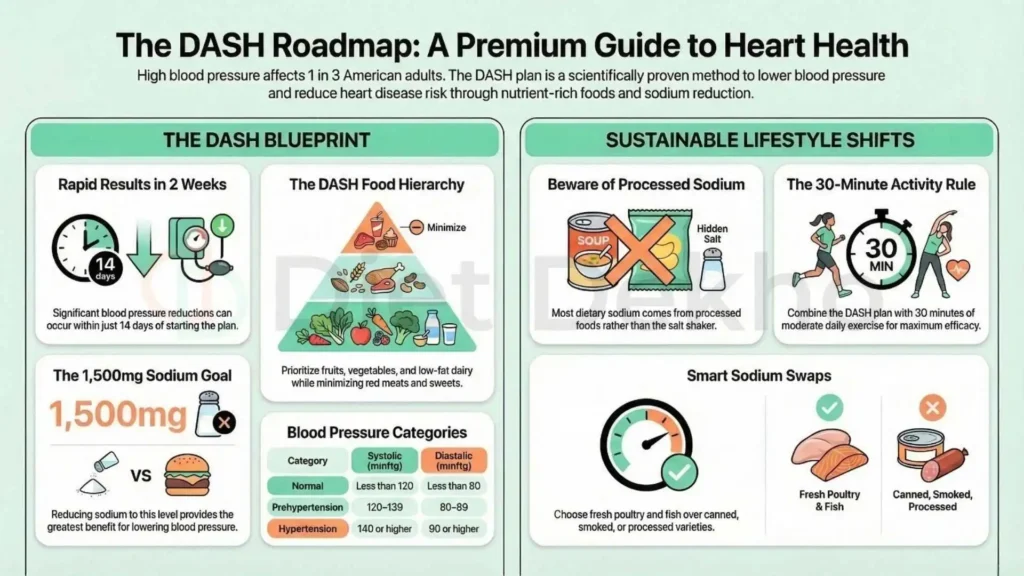
Let us simplify the science behind the DASH diet. DASH stands for Dietary Approaches to Stop Hypertension. It is not a diet in the restrictive sense. It is a flexible eating plan that focuses on minerals like potassium, calcium, and magnesium. These three minerals are the heroes of our story.
Potassium helps the kidneys flush out extra sodium through urine. It also helps relax the walls of the blood vessels. Magnesium acts like a natural relaxant for the heart, and calcium helps the vessels contract and expand properly. The DASH plan is so effective that it can lower blood pressure within just two weeks.
| Food Group | Daily Servings (2000 kcal) | What a Serving Looks Like |
| Grains | 6 – 8 | 1 slice whole-wheat bread or 1/2 cup cooked rice |
| Vegetables | 4 – 5 | 1 cup raw leafy greens or 1/2 cup cooked veggies |
| Fruits | 4 – 5 | 1 medium fruit or 1/2 cup fresh fruit |
| Low-fat Dairy | 2 – 3 | 1 cup milk or yogurt |
| Lean Protein | 6 or less (oz) | 1 egg or 1 oz cooked fish/chicken |
| Nuts & Seeds | 4 – 5 (Weekly) | 1/3 cup nuts or 2 tbsp seeds |
| Fats & Oils | 2 – 3 | 1 tsp vegetable oil or 1 tbsp low-fat mayo |

The goal here is to keep sodium below 2,300 mg daily. If we can get it down to 1,500 mg, the results are even better. One teaspoon of salt contains about 2,300 mg of sodium. Think about that for a second. Most of us eat much more than that without even realizing it.
Indianizing the DASH Approach: A Local BP Diet for Older people Loved Ones
I know what you are thinking. The DASH diet sounds very Western. How do I make this work in an Indian kitchen?The good news is that traditional Indian food is naturally very close to DASH if we make a few smart tweaks. We do not need to buy expensive, foreign ingredients to maintain a BP diet for older people and family members.
Let us start with grains. Instead of white rice or refined flour (maida), we can use Dalia (broken wheat), Ragi (finger millet), or Jowar (sorghum). These are rich in fiber and magnesium. For protein, Moong Dal is your best friend. It is very light on the stomach and easy for older people to digest.
For breakfast, a bowl of vegetable Upma or Poha with sprouts is perfect. You can also make Besan Chilla (gram flour pancakes) with finely chopped spinach and carrots. These are high in potassium and protein but low in salt if you are careful. Even our beloved Idli and Sambhar are fantastic because fermentation makes the nutrients easier to absorb.

Why Easy Digestion is a Priority in a BP Diet for older people Parents
As our parents age, their digestive systems slow down. They produce less stomach acid, and their gut motility decreases. This means heavy, oily, or very spicy foods can make them feel bloated and uncomfortable. When the body is stressed by poor digestion, it can actually cause blood pressure to fluctuate.
This is why an effective BP diet for older people must prioritize soft, cooked foods. Raw salads might be great for us, but for a 70-year-old, they can be hard to break down. Steaming, boiling, or pressure cooking are the best methods. A warm bowl of Moong Dal Khichdi with a little ghee is often better for their blood pressure than a cold raw salad.
| Easy Digestion Dish | Why It Works for BP | Key Ingredients |
| Moong Dal Khichdi | Light protein; easy on the gut | Yellow moong, rice, turmeric |
| Vegetable Dalia | High fiber; slow energy release | Broken wheat, carrots, beans |
| Steamed Idli | Probiotic-rich; no oil | Fermented rice and dal |
| Curd Rice | Cooling; probiotic; calcium-rich | Soft rice, fresh curd, curry leaves |
| Palak Soup | Liquid nutrition; high nitrates | Spinach, garlic, light seasoning |
What this means for your daily routine is that you can prepare one large pot of khichdi or dalia that the whole family can enjoy. Just keep the salt low for the elders and add a little more to your own bowl if you must. It saves you time and ensures they get the nutrition they need without the struggle of chewing hard foods.
Salt: The Hidden Enemy in Your Kitchen Cabinets
In many Indian homes, the biggest source of salt is not the salt shaker. It is the hidden sodium in our traditional favorites like pickles, papads, and namkeens. I know your mother loves her mango pickle, and your father enjoys a papad with his lunch. But these are salt bombs that can ruin a BP diet for older people.
A single piece of commercial pickle can contain enough salt for half the day. Papads use special salts to get that crispy texture, which are very high in sodium. Even healthy-looking snacks like biscuits or frozen parathas are loaded with salt because it acts as a preservative.
I am not saying they have to give them up forever. Let us just change how often they have them. Instead of a pickle every day, try a fresh chutney made with coriander, mint, and lemon juice. Lemon is a magic ingredient. Its tanginess can trick the taste buds into thinking there is more salt than there actually is. You can also try roasting Makhana (foxnuts) with a little black pepper instead of giving them salty chips.
Retraining the Palate: The Two-Week Rule for Your BP Diet for Older people
If you suddenly remove all salt, the food will taste like cardboard. This often leads to frustration and your parents might sneak extra salt when you are not looking. I have seen this happen many times. The trick to a successful BP diet for older people transition is to be gradual.
Our taste buds are actually very smart. If you reduce salt by just a tiny bit every week, your parents will not even notice the difference. Within two to three weeks, their taste buds will adapt, and they will start to find regular restaurant food too salty. It is a journey we take together, one pinch at a time.
| High-Sodium Item | Smart Heart-Healthy Swap | The Benefit |
| Store-bought Pickle | Fresh Coriander/Mint Chutney | 80% less salt; fresh antioxidants |
| Fried Papad | Roasted Makhana (Foxnuts) | No papad khar; low calorie |
| Salted Namkeen | Unsalted Roasted Peanuts/Chana | Natural protein; no hidden sodium |
| Table Salt | Lemon juice, Jeera powder, Garlic | Enhances flavor naturally |
| Packaged Soup | Homemade Vegetable Broth | Controlled salt; no preservatives |
Instead of focusing on what they can’t have, let us focus on what they can have more of. Garlic is a wonderful addition because it helps relax blood vessels. Turmeric reduces inflammation, and Ajwain (carom seeds) helps with that slow geriatric digestion. These spices provide the soul of Indian cooking without the sodium.
Strategies for the Busy Professional and Homemaker
I know your schedule is packed. Between your 9 AM meeting and the kids’ school projects, cooking a separate BP diet for older people meals feels impossible. Let’s simplify this with a few caregiver hacks.
Batch prepping is your best friend. On Sundays, you can grind a fresh ginger-garlic paste and make a large batch of low-sodium tomato puree. These can be used to whip up a Dal or Subzi in minutes during the week. You can also buy pre-cut vegetables to save that precious morning time.
If you are cooking a meal for the whole family, try the two-version trick. For example, if you are making a Chana Masala, cook the chickpeas and the tomato base first. Take out a portion for your parents and season it with lemon and herbs. Then, add the extra salt and spices to the rest of the pot for the others. This way, everyone eats the same food, but the nutrition is tailored to each person’s needs.
Movement for the Non-Gym Audience
You do not need to buy your parents a gym membership to support a BP diet for older people’s health. In fact, for older people, consistency is much more important than intensity. Simple, home-based movements can do wonders for their heart health.
A 20-minute slow walk after dinner, some light stretching, or even a few minutes of deep breathing (Pranayama) can lower blood pressure. Yoga is particularly effective because it manages both the body and the mind. Since stress is a major trigger for BP spikes, a calm mind leads to a calmer heart.
I know they might be resistant at first. Remind them that this movement is what keeps their joints lubricated and their blood flowing smoothly. It is not about exercise; it is about staying independent and strong.
Frequently Asked Questions (FAQs)
What is the best BP diet for older parents in India?
The best BP diet for older people is the Indianized DASH plan. It includes low-sodium, high-potassium foods like Ragi, Moong Dal, and leafy greens. Avoid high-salt items like commercial pickles, papads, and namkeens. Focus on soft, cooked meals like Khichdi and Upma for better digestion.
Is rock salt (Sendha Namak) better for high blood pressure?
I hear this a lot, but the truth is that all salts, including rock salt and pink salt, contain sodium. While they may have tiny amounts of minerals, they still raise blood pressure in the same way. The key is not the type of salt, but the quantity.Keep it to less than one teaspoon a day.
How can I make my parents’ food taste good without salt?
Use natural flavor boosters! Fresh lemon juice, tamarind, roasted jeera (cumin), and garlic add a lot of depth to food. Fresh herbs like coriander and mint also make the food feel fresh and flavorful without needing extra sodium in their BP diet for older people routine.
Can my parents stop their BP medicine if they follow this diet?
A healthy BP diet for older people can significantly lower blood pressure, sometimes enough to reduce the dose of medication. However, you must never stop or change their medicine without talking to their doctor. Think of the diet as a partner to the medicine, not a replacement.
Why are fermented foods like idli recommended for older people with BP?
Fermented foods are excellent for a BP diet for older people because they are easy to digest and rich in probiotics. A healthy gut helps the body absorb magnesium and potassium more effectively, which are crucial for maintaining healthy blood pressure levels.
A Final Word of Support
I know it is not easy being a caregiver. There are days when you feel overwhelmed, and it seems like your parents are not listening. But every small change you make-swapping a salty snack for a fruit or adding a little more garlic to the dal-is an act of love. You are building a safety net for their heart and their brain.
Let us simplify this journey. Start with one small change this week. Maybe replace the table salt with a bowl of lemon wedges. Or try a new Moong Dal recipe. What this means for your daily routine is a little more peace of mind and a lot more healthy years with your loved ones.
We are here to help you every step of the way. If you need a personalized plan that fits your family’s unique tastes and schedule, our team at DietDekho is ready to guide you.
Your parents deserve the best care, and you deserve a partner in their health.
Contact Us
We understand how overwhelming nutrition and weight loss information can feel. With so many opinions and confusing advice online, it’s easy to feel stuck or unsure about what to do next.
At Diet Dekho, you never have to figure it out alone. You can contact us anytime with any questions or concerns. Our expert dietitians are available 24/7 to guide, support, and help you stay on track. Whether your goal is weight loss or building healthier habits, we’re here to make the journey simpler and more sustainable for you.
Disclaimer
This blog is intended to help readers make healthier food choices. Your health should always be the top priority. Before starting any restrictive or special diet, especially if you have a medical condition or health concern, please consult a doctor or a qualified dietitian. Each body responds differently to food and lifestyle changes. Always choose what is safe and suitable for you.

Abhinav is the Founder of Diet Dekho, helping people manage weight and lifestyle health through simple, practical nutrition and personalized diet plans.