I still remember talking to Rajesh, a bank manager in Lucknow who felt his world collapsing when his doctor handed him a high blood pressure diagnosis. He sat in my office, his hands trembling slightly, worried that he would have to choose between his family’s grocery budget and his own survival. Rajesh represents millions of Indians who believe that heart health is a luxury they cannot afford. I am here to tell you that a Budget Friendly BP Diet Plan is not only possible but likely sitting in your pantry right now.
A Budget Friendly BP Diet Plan focuses on affordable, nutrient-dense Indian staples like millets, pulses, seasonal green leafy vegetables, and bananas to lower blood pressure naturally. This plan prioritizes reducing sodium to under 2,300 mg daily while increasing potassium and magnesium through low-cost ingredients, making it ideal for busy professionals and homemakers seeking heart-healthy results without expensive supplements.
The Growing Crisis of Hypertension in Modern India
Table of Contents
- 1 The Growing Crisis of Hypertension in Modern India
- 2 Designing a Budget BP Diet with Indian Staples
- 3 Cutting Hidden Sodium in Traditional Indian Meals
- 4 Why Potassium and Magnesium Lower Blood Pressure
- 5 Millets and Pulses: The Affordable BP Diet Core
- 6 Pulses: The Heart-Healthy Protein Powerhouse
- 7 Seasonal Shopping Hacks for Heart Health
- 8 Professional Meal Prep for Heart Health
- 9 Expert Quotes on Managing BP at Home
- 10 Sample 7-Day Heart-Healthy Meal Plan (Veg & Non-Veg)
- 11 Frequently Asked Questions
- 12 Contact Us
- 13 Disclaimer
The situation across our country is becoming quite serious. Recent data from the fifth National Family Health Survey (NFHS-5) reveals that hypertension now affects roughly 22.6% of the Indian population. This is no longer a disease that only touches the older people or the very wealthy. We are seeing a rapid spread of high blood pressure across every socio-economic group, including those in rural areas where the prevalence has reached 21.4%.
What this means for your daily routine is that the environment we live in has shifted. Our traditional diets, once rich in fiber and minerals, are being pushed aside by processed alternatives. Between 2015 and 2023, household spending on ultra-processed foods in India nearly doubled from 6.5% to 12%. This nutrition transition is a primary reason why even younger professionals are starting to see their blood pressure numbers climb.
| Demographic Group | Hypertension Prevalence (NFHS-5) |
| Overall Indian Population | 22.6% |
| Men (Age 15 and above) | 24.1% |
| Women (Age 15 and above) | 21.2% |
| Urban Residents | 25.0% |
| Rural Residents | 21.4% |
| Individuals Aged 60+ | 48.4% |

I know it is hard to find time to research these numbers, but understanding the scale of the problem helps us realize we aren’t alone. In some states, like Sikkim, the rate is as high as 37.9%. This tells us that our local environments and what we choose to put on our plates every day are the most powerful tools we have for change.
Designing a Budget BP Diet with Indian Staples
When doctors talk about a heart-healthy diet, they are usually referring to the(https://www.nhlbi.nih.gov/health/dash-eating-plan), which stands for Dietary Approaches to Stop Hypertension. This framework was developed decades ago with support from the National Institutes of Health (NIH) and has consistently been rated as the best diet for heart health. It focuses on foods naturally rich in potassium, calcium, magnesium, fiber, and protein.
The core principle of the DASH plan is balance. It encourages us to eat more vegetables, fruits, and whole grains while limiting foods high in saturated fat, such as fatty meats and full-fat dairy. For a standard 2,000-calorie diet, the plan suggests specific daily servings that help create a heart-healthy style for life.
| Food Group | Daily Servings (2,000 kcal) | Weekly Servings |
| Whole Grains | 6–8 | – |
| Vegetables | 4–5 | – |
| Fruits | 4–5 | – |
| Low-fat or Fat-free Dairy | 2–3 | – |
| Lean Meats, Poultry, Fish | 6 or less | – |
| Fats and Oils | 2–3 | – |
| Nuts, Seeds, Legumes | – | 4–5 |
| Sweets and Added Sugars | – | 5 or less |
Let’s simplify this for your home. You do not need to hunt for non-native ingredients. A Budget Friendly BP Diet Plan simply asks you to rearrange the proportions on your plate. Instead of a mountain of white rice with a little bit of dal, we want to see more dal, more seasonal sabzi, and a smaller portion of fiber-rich grains.

Cutting Hidden Sodium in Traditional Indian Meals
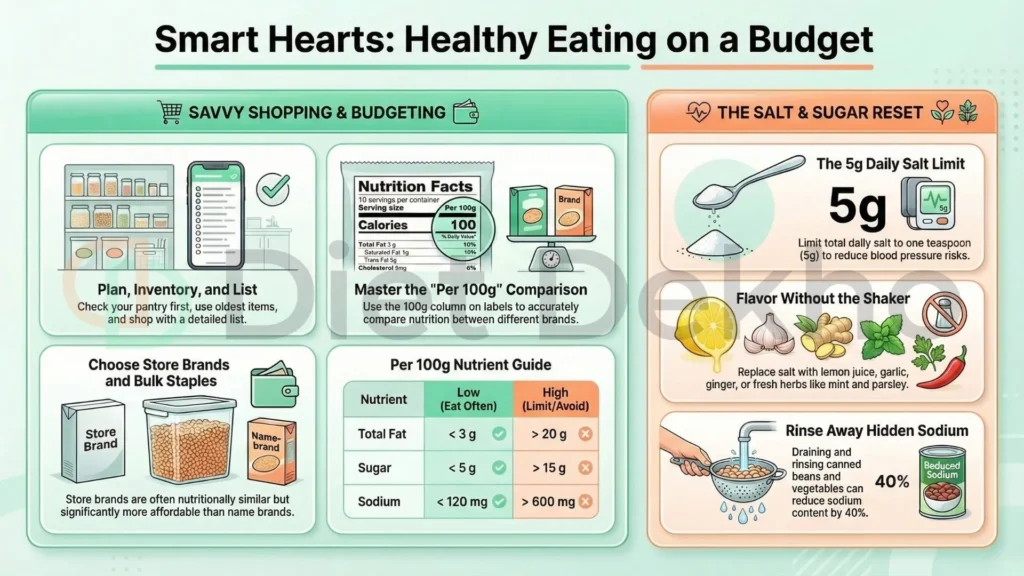
Most of us know that salt is linked to blood pressure, but the numbers can be confusing. The World Health Organization recommends limiting sodium to 2,000 mg per day, which is about one teaspoon of salt. However, for those already struggling with hypertension, dropping that limit to 1,500 mg can lead to even greater reductions in blood pressure.
In a typical Indian household, most of the salt doesn’t come from the shaker on the table. It is hidden in our traditional favorites. Pickles (achaar), papad, and salted snacks like bhujia or namkeen are incredibly high in sodium. Even the salt used in a tadka can add up quickly. Research from the(https://nutritionsource.hsph.harvard.edu/healthy-weight/diet-reviews/dash-diet/) has shown that cutting sodium intake in half can result in the most significant improvements in heart health within just a few weeks.
| Common Indian Food Item | Typical Sodium Content Concern |
| Mixed Vegetable Pickle (Achaar) | High (Preserved in salt) |
| Roasted/Fried Papad | High (Added leavening salts) |
| Salted Lassi or Buttermilk | Moderate (Hidden added salt) |
| Store-bought Bakery Bread | Moderate (Preservative sodium) |
| Restaurant/Street Food | Very High (Flavor enhancement) |
I know it feels like food might become bland without salt, but your taste buds actually adapt in about two to four weeks. What this means for your daily routine is using more spices like cumin, coriander, and turmeric to provide flavor. Spices not only make the food delicious but also offer anti-inflammatory benefits that support your arteries.

Why Potassium and Magnesium Lower Blood Pressure
If sodium is the villain in our story, potassium and magnesium are the heroes. These two minerals work together to ease the tension in your blood vessel walls. Potassium specifically helps your body flush out excess sodium through your urine. The more potassium you eat, the more sodium you lose, which directly helps lower the pressure against your artery walls.
Magnesium plays a slightly different but equally important role. It acts like a natural vehicle that helps transport potassium into your heart cells. It also helps regulate other electrolytes like calcium and sodium. Without enough magnesium, your body can’t use potassium effectively, and your arteries can begin to stiffen or even calcify.
| Mineral | Daily Goal for Adults | Top Budget-Friendly Sources |
| Potassium | 3,500 – 5,000 mg | Bananas, Rajma, Spinach, Potatoes |
| Magnesium | 310 – 420 mg | Pumpkin seeds, Ragi, Peanuts, Dal |
The beauty of an affordable heart-healthy plan is that these minerals are found in abundance in our local markets. For example, a medium-sized banana contains about 422 mg of potassium. Even better, cooked rajma (kidney beans) contains roughly 1,324 mg of potassium per 100 grams, which is nearly triple what you get from a banana.
Millets and Pulses: The Affordable BP Diet Core
For years, many of us shifted away from traditional grains like Ragi, Jowar, and Bajra in favor of refined wheat and white rice. However, millets are nutritionally superior and are perfect for a Budget Friendly BP Diet Plan. They are rich in fiber, which helps you feel full longer and supports weight management-a key factor in controlling blood pressure.
Millets are also excellent sources of magnesium and potassium. India is currently the world’s largest producer of millets, making them widely available and cost-effective when bought in bulk. Replacing white rice with a millet-based khichdi or using Jowar flour for your rotis can significantly boost your mineral intake without increasing your spending.
| Millet Variety | Local Name | Key Mineral | Best Use |
| Finger Millet | Ragi | Magnesium & Calcium | Porridge, Dosa, Roti |
| Pearl Millet | Bajra | Magnesium | Winter Rotis, Khichdi |
| Sorghum | Jowar | Magnesium | Soft Rotis, Upma |
| Amaranth | Chaulai | Potassium | Dal additive, Laddoos |
I often tell my clients that if they make just one change, it should be to embrace these grains. They have a lower glycemic index, which helps control blood sugar levels, and their high fiber content aids in reducing cholesterol-two other major risk factors for heart disease.

Pulses: The Heart-Healthy Protein Powerhouse
In an Indian vegetarian diet, pulses are our primary source of protein. They are also incredibly rich in the minerals we need to fight hypertension. Legumes like chickpeas (chole), lentils (dal), and beans are naturally low in sodium and high in fiber. The Indian Council of Medical Research recommends 40 grams of pulses daily for a balanced diet.
Whether it is a simple yellow moong dal or a hearty rajma curry, these foods are the backbone of heart health. They help lower the incidence of type 2 diabetes and coronary heart disease. For a busy homemaker, cooking dal in bulk is one of the smartest ways to save time and money.
| Legume/Pulse | Magnesium (per 100g) | Potassium (per 100g) |
| Rajma (Kidney Beans) | 45 mg (boiled) | 1,324 mg (boiled) |
| Urad Dal (Black Gram) | 57 mg (boiled) | Moderate |
| Chole (Chickpeas) | 48 mg (cooked) | High |
| Moong Dal (Green Gram) | 30-40 mg | High |
One small tip that makes a big difference: soak your legumes and pulses overnight. This reduces anti-nutrients like phytates that can block the absorption of minerals like magnesium and calcium. It also makes them easier to digest, which is a common concern I hear from many of my clients.

Seasonal Shopping Hacks for Heart Health
One of the easiest ways to keep your grocery bill low is to buy what is in season. When vegetables are in their peak season, they are not only at their cheapest but also at their most nutrient-dense. In states like Uttar Pradesh, the local markets offer incredible variety depending on the time of year.
In the winter, we have access to radishes (mooli), carrots, and fenugreek (methi) leaves. Radish is particularly high in potassium, which helps regulate blood pressure levels. In the summer, hydrating fruits like watermelon contain an amino acid called citrulline, which helps relax your blood vessels.
| Season | Best BP-Friendly Produce | Why It Works |
| Winter | Radish, Spinach, Carrots, Methi | High potassium and soluble fiber |
| Summer | Watermelon, Mangoes, Lauki (Gourd) | Hydration and natural nitrates |
| Year-Round | Bananas, Tomatoes, Garlic, Onions | Steady mineral and allicin sources |
Let’s look at garlic, or lehsun, for a moment. This pungent bulb is a heart’s best friend. It contains allicin, which is created when you crush or chop it. Allicin helps your blood vessels expand and increases nitric oxide production, which lets the blood flow more easily. Adding a simple garlic tadka to your dal is an easy, low-cost way to support your vascular system.
Professional Meal Prep for Heart Health
If you’re a professional balancing long hours, the biggest threat to your Budget Friendly BP Diet Plan is the urge to order out for lunch. Preparing your meals in advance-what we call meal prepping-is your best defense. It doesn’t mean you have to cook everything on Sunday, but being organized makes a huge difference.
One of my favorite hacks is to prepare tadka pastes or tomato purees in bulk and freeze them in ice cube trays. When you come home late, you can just pop out a couple of cubes, add some chopped vegetables or boiled dal, and have a fresh meal in minutes. This prevents the high-sodium trap of ready-to-eat packets.
- Batch Cook Grains: Boil a large pot of brown rice or millets and keep it in the fridge for 2-3 days.
- Pre-cut Veggies: Spend 20 minutes on the weekend chopping carrots, beans, or cauliflower. They stay fresh for a week if stored correctly.
- Boil Legumes: Chickpeas and kidney beans can be boiled in large quantities and stored in the freezer for up to a month.
What this means for your daily routine is that you can have a 20-minute meal ready almost every night. For example, a quick stir-fry of pre-cut vegetables with boiled chickpeas and a side of brown rice is a perfect heart-healthy dinner that costs almost nothing compared to a restaurant meal.
Expert Quotes on Managing BP at Home
It always helps to hear from the experts. As stated by Professor Vijay Kunadian, an interventional cardiology specialist, Blood pressure is the most common condition that causes heart attack but yet is commonly undiagnosed. People need to feel empowered to take steps to reduce their blood pressure at home, as simple changes can make a big difference.
These simple changes include focusing on fiber, which is cheap and easy to get. Research shows that adding just an extra 5 grams of fiber a day can lower systolic blood pressure by 2.8 and diastolic by 2.1. I know it’s hard to find time for the gym, but Professor Kunadian also reminds us that Regular consistent exercise is like taking five tablets. This can be anything from walking… as long as it is regular it is the best thing you can do for your heart.

Sample 7-Day Heart-Healthy Meal Plan (Veg & Non-Veg)
This plan is designed to be affordable, using common Indian ingredients that support your heart health goals.
| Day | Breakfast | Lunch | Snack | Dinner |
| Mon | Oats in toned milk with apple | 2 Chapathis + Moong Dal + Bhindi Sabzi | Roasted Chana + Green Tea | Vegetable Pulao + Raita |
| Tue | 2 Rice Idlis + Sambar + Mint Chutney | Brown Rice + Rajma Curry + Salad | 1 Banana | 2 Ragi Rotis + Lauki Sabzi |
| Wed | Vegetable Poha with peanuts | 2 Chapathis + Paneer/Soya Sabzi + Buttermilk | Handful of Walnuts/Almonds | Dal Tadka + Brown Rice |
| Thu | Moong Dal Cheela with chutney | 2 Chapathis + Fish/Chicken Curry (minimal oil) | Papaya Chunks | 2 Jowar Rotis + Mixed Vegetable Curry |
| Fri | Ragi Porridge with flaxseeds | Brown Rice + Palak Dal + Salad | Coconut Water | Vegetable Khichdi + Curd |
| Sat | Vegetable Upma (Dalia) | 2 Chapathis + Dal + Cucumber Raita | Roasted Makhana | Grilled Tofu/Fish + Sautéed Veggies |
| Sun | Stuffed Methi Paratha (less oil) | Brown Rice + Chole (Chickpea) Curry | 1 Apple | 2 Chapathis + Tinda/Torai Sabzi |
I recommend keeping your portions in check by using the small bowl logic-serving your dals and sabzis in 100ml bowls to help manage calorie intake.
Frequently Asked Questions
How quickly can a Budget Friendly BP Diet Plan lower my blood pressure?
Most people begin to see a measurable improvement in their blood pressure readings within two to four weeks of consistently following the DASH eating plan and reducing sodium. For some, systolic pressure can drop by as much as 8-11 points during this time.
Can I follow the Budget Friendly BP Diet Plan if I am a strict vegetarian?
Absolutely! The DASH diet is naturally very friendly to vegetarians because it emphasizes plant-based proteins like lentils, beans, nuts, and seeds. You can easily meet all your heart health needs through an Indian vegetarian diet.
Is it expensive to buy heart-healthy grains like millets?
While some specialty brands are pricey, millets like Ragi, Jowar, and Bajra are very cost-effective when purchased from local grain markets or in bulk. They are often more affordable than modern cereals and provide much better nutrition.
Do I have to stop eating rice and roti entirely?
Not at all. The key is to choose the right kind and the right amount. Switch from white rice to brown or semi-polished rice, and from refined flour (maida) to whole wheat or multigrain flour.
What is the best low-cost snack for blood pressure?
Roasted chickpeas (chana) and foxnuts (makhana) are excellent low-sodium, high-fiber snacks. A medium-sized banana is also one of the most affordable and effective snacks for a quick potassium boost.
Contact Us
We understand how overwhelming nutrition and weight loss information can feel. With so many opinions and confusing advice online, it’s easy to feel stuck or unsure about what to do next.
At Diet Dekho, you never have to figure it out alone. You can contact us anytime with any questions or concerns. Our expert dietitians are available 24/7 to guide, support, and help you stay on track. Whether your goal is weight loss or building healthier habits, we’re here to make the journey simpler and more sustainable for you.
Disclaimer
This blog is intended to help readers make healthier food choices. Your health should always be the top priority. Before starting any restrictive or special diet, especially if you have a medical condition or health concern, please consult a doctor or a qualified dietitian. Each body responds differently to food and lifestyle changes. Always choose what is safe and suitable for you.

Abhinav is the Founder of Diet Dekho, helping people manage weight and lifestyle health through simple, practical nutrition and personalized diet plans.