
Many people ask me, “Can I gain 2 kg in a week?” when they feel they are too thin or recovering from an illness. While the scale might show a higher number quickly, we need to look at what that weight actually consists of. Let’s simplify the science behind rapid changes in your body weight.
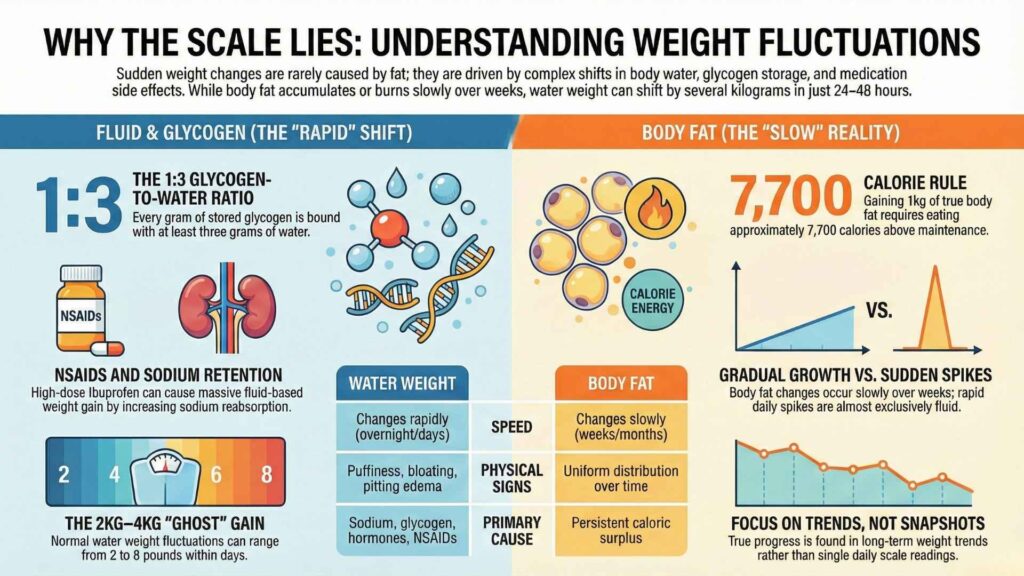
Yes, you can see a 2 kg increase on the scale within 7 days, but this is rarely pure muscle or fat. Most rapid weight gain is a combination of increased water retention, stored glycogen in muscles, and food volume. Consequently, gaining 2 kg of actual body tissue takes significantly longer.
The Math of Weight Gain: Calories Needed vs. Water Weight
Table of Contents
- 1 The Math of Weight Gain: Calories Needed vs. Water Weight
- 2 Why Your Scale Might Be Lying: Understanding Bloating and Sodium
- 3 The Risks of “Dirty Bulking” with Junk Food and Sugar
- 4 How to Gain Healthy Weight: The Role of Protein and Complex Carbs
- 5 High-Calorie Indian Food Swaps: From Paneer to Desi Ghee
- 6 A Sample 3,000 Calorie Indian Veg/Non-Veg Meal Plan
- 7 Why Consistency Matters More Than a Quick Fix
- 8 Get a Personalized Muscle Gain Plan from Diet Dekho Experts
I know it’s hard to find time to count every calorie, but understanding the logic is vital. To gain 2 kg of actual body fat, you would need a massive surplus of roughly 15,400 calories in seven days. This means eating 2,200 calories extra every single day on top of your normal meals.
Furthermore, building muscle is even more time-consuming. Even with the best healthy weight gain tips, a beginner can usually only gain 0.25 to 0.5 kg of muscle per week. Therefore, if you see the scale jump 2 kg in a week, it is mostly “water weight” triggered by higher salt or carbohydrate intake. What this means for your daily routine is that you should focus on progress over months, not just days.
Why Your Scale Might Be Lying: Understanding Bloating and Sodium
What this means for your daily routine is that the scale can be quite deceptive. Many Indian snacks, like namkeens or pickles, are very high in sodium. Consequently, when you eat these, your body holds onto extra water to balance the salt. Similarly, if you start eating more rotis or rice, your body stores that energy as glycogen, and each gram of glycogen carries about 3 to 4 grams of water.
If you have been wondering how to gain 2kg quickly, you must realize that a sudden spike is often just inflammation or bloating. In simple terms, your weight can fluctuate by 1-2 kg in a single day based on your last meal or hydration levels. Additionally, medical conditions like hypothyroidism can cause significant fluid retention, making the scale rise without any actual muscle gain.

The Risks of “Dirty Bulking” with Junk Food and Sugar
I often see clients trying to find vajan badhane ke tarike (ways to increase weight) by eating biscuits, samosas, and sugary sweets. While these are high-calorie Indian foods, this is known as “dirty bulking.” This approach is dangerous because it leads to “visceral fat,” which is fat that wraps around your internal organs.
Furthermore, Indians are genetically more prone to abdominal obesity even if they look thin elsewhere. If you have diabetes or hypertension, “dirty bulking” with fried foods can cause your blood sugar and BP to spiral out of control. Instead of building health, you might end up with insulin resistance or heart issues. Consequently, we must prioritize “clean” calories from whole grains and proteins.
How to Gain Healthy Weight: The Role of Protein and Complex Carbs
Let’s simplify this: the secret to a weight gain diet India loves is a balance of protein and slow-digesting carbs. Proteins are the building blocks of your muscles. Since nearly 40% of Indians fall short on protein, adding items like paneer, pulses, and eggs is essential.
In contrast, complex carbohydrates like Jowar, Bajra, or Ragi provide the energy your body needs to actually build that muscle. If you are managing PCOD or PCOS, these “slow carbs” are your best friends because they don’t spike your insulin. Moreover, research shows that herbs like Ashwagandha can support healthy weight by reducing stress and improving nutrient absorption.
High-Calorie Indian Food Swaps: From Paneer to Desi Ghee
To answer “Can I gain 2 kg in a week?” healthily, you need to make smart food swaps. You don’t need to eat more volume; you just need more “calorie density.” For example, instead of a plain roti, have a Paneer Paratha with a teaspoon of Desi Ghee. This swap adds nearly 200 calories without making you feel overly full.
Try these Indian food swaps for better results:
- Swap White Bread for: Whole wheat bread with 2 tablespoons of peanut butter (adds ~190 kcal).
- Swap Water for: A glass of full-fat milk or a thick mango lassi (adds ~150-250 kcal).
- Swap Plain Dal for: Dal cooked with extra ghee and a handful of crushed peanuts.
- Swap Biscuits for: A handful of dry fruits like almonds, walnuts, and dates (~600 kcal per 100g).

A Sample 3,000 Calorie Indian Veg/Non-Veg Meal Plan
If you are looking for a weight gain diet India style, consistency is your best friend. Below is a structured routine designed to provide the surplus you need to see real changes.
Early Morning: 1 glass warm milk + 5 soaked almonds + 2 walnuts.
Breakfast: 2 Aloo or Paneer Parathas with Ghee + 1 bowl of curd OR 3 Egg Omelet with 2 slices of buttered toast.
Mid-Morning: 1 Banana + 1 glass of Lassi or a handful of roasted chana with jaggery. 2
Lunch: 1 large bowl of Rice + 2 Chapatis with Ghee + 1 bowl of Rajma/Chole + 1 bowl of vegetable sabzi + 1 bowl of curd.
Evening Snack: 1 Peanut butter sandwich + 1 glass of milk or coconut water.
Dinner: 1 cup Chicken Curry or Paneer Tikka + 2 Butter Rotis + 1 bowl of Dal + Mixed Salad.
Bedtime: 1 glass of warm Turmeric Milk + 2 dates.
Why Consistency Matters More Than a Quick Fix
When you ask, “Can I gain 2 kg in a week?”, you are often looking for a quick fix. However, true health isn’t built in seven days. If you gain weight too fast without exercise, it will likely be belly fat. Consequently, pairing this diet with 30 minutes of resistance training—even just using your own body weight at home—ensures the weight goes to your muscles.
I know it’s hard to find time, but even 3 days a week of lifting weights can make a difference. What this means for your daily routine is that you must be patient. In simple terms, a gain of 0.5 kg per week is much better for your heart and hormones than a sudden 2 kg bloat. Let’s focus on building a stronger version of you, one meal at a time.
Get a Personalized Muscle Gain Plan from Diet Dekho Experts
Are you tired of feeling weak or struggling with a low appetite? At Diet Dekho, we specialize in creating macro-balanced plans for the Indian lifestyle. Whether you are a busy professional or managing a condition like PCOS, we help you reach your goals safely.
Start Your Journey to Holistic Health with a Diet Dekho Consultant.
Click here to get your personalized plan!

Frequently Asked Questions (FAQs)
1. Can I gain 2 kg in a week if I have a very fast metabolism?
The short answer is that you might see the scale move, but it won’t be pure muscle. Even with a high-calorie weight gain diet India style, your body has a limit on how much tissue it can build in 7 days. Most of that gain will be water or glycogen.
2. Which high calorie Indian foods are best for a diabetic person?
Diabetics should avoid sugary sweets and instead focus on healthy fats and proteins. Foods like paneer, nuts, seeds, and roasted chana are excellent because they provide calories without causing dangerous blood sugar spikes.
3. Is it safe to eat extra ghee for weight gain?
Yes, Desi Ghee is a traditional superfat that aids digestion and provides energy. However, if you have high blood pressure, you should keep your total salt intake low and consult a expert to ensure your heart health is protected.
4. How can I gain 2kg quickly without getting a belly?
To avoid a “potbelly,” you must prioritize protein and resistance exercise. Simply eating more sugar or junk food will lead to visceral fat. What this means is you should focus on “clean bulking” with items like lentils, eggs, and millets.
5. Are there any vajan badhane ke tarike for busy professionals?
Liquid calories are a lifesaver for busy people. Instead of a heavy meal, try a homemade smoothie with milk, oats, peanut butter, and a banana. It’s quick to drink and provides over 500 healthy calories.
Disclaimer:
This blog post was written to help you make healthier food choices altogether. So, be aware and take care. The important thing to consider is your health before starting a restrictive diet. Always seek advice from a doctor or dietitian before starting if you have any concerns.
BOOK YOUR APPOINTMENT
Dr. Ritika is a nutrition and lifestyle expert with 2+ years of experience, helping clients manage weight and health through practical, personalized diet plans.