Imagine you’re rushing to finish a client presentation while your toddler demands attention, or perhaps you’re a homemaker managing a dozen chores at once. You feel that familiar, dull throb at your temples and a slight tightness in your chest. When you finally check your numbers, they’re high again. I know how overwhelming it feels to manage coconut water for BP when you barely have time to breathe, let alone meal prep.
Drinking coconut water for BP is highly effective because it contains high levels of potassium, which balances sodium and relaxes blood vessel walls. Clinical research shows that consuming 150ml to 300ml of fresh coconut water daily can significantly lower systolic blood pressure within seven to fourteen days, making it a powerful, natural adjunct for hypertension management.
Why Your Body Craves Potassium More Than You Realize
Table of Contents
- 1 Why Your Body Craves Potassium More Than You Realize
- 2 The Science of the Pressure-Release Valve
- 3 What the Clinical Studies Actually Tell Us
- 4 A Realistic Guide for the Busy Professional
- 5 Support for the Homemaker and Non-Gym Crowd
- 6 How to Store and Use Coconut Water Without the Stress
- 7 Addressing the Overrated Debate: A Balanced View
- 8 When You Should Be Careful (Safety First!)
- 9 Integrating Coconut Water into the DASH Diet
- 10 Frequently Asked Questions
- 11 Your Next Steps Toward a Healthier Heart
- 12 Contact Us
- 13 Disclaimer
I often tell my clients at DietDekho that our modern bodies are essentially fighting an uphill battle against salt. We live in an environment where hidden sodium is everywhere-in our breads, our healthy office snacks, and even our morning cereals. This salt makes your body hold onto water like a sponge, which puts immense pressure on your delicate arteries. What this means for your daily routine is that your heart has to work twice as hard just to keep your blood moving.

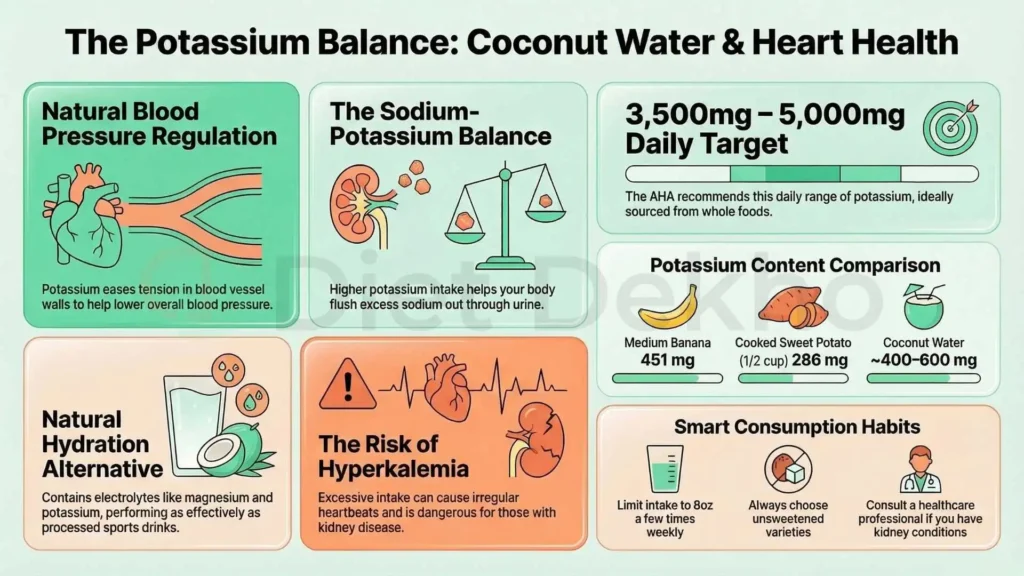
The magic of potassium is that it acts like a natural off-switch for the damage caused by sodium. Potassium and sodium are like two ends of a seesaw. In the typical urban diet, the sodium end is touching the ground while the potassium end is dangling high in the air. Our bodies actually need far more potassium than sodium every single day to stay healthy, yet most of us get the exact opposite. Harvard research points out that for every 1,000 mg increase in potassium you get, your risk of cardiovascular disease can drop by as much as 18%.
When you sip on coconut water, you aren’t just hydrating; you are delivering a concentrated dose of this mineral directly to your cells. This helps your kidneys flush out that stubborn salt through your urine, which naturally brings your blood volume-and your pressure-down. I know it’s hard to find time to cook elaborate low-sodium meals, but making this one small switch can start moving that seesaw back into balance.
The Science of the Pressure-Release Valve
Let’s simplify how this works inside your blood vessels without getting lost in textbook lectures. Think of your arteries as a garden hose. When there is too much salt, it’s like the water is turned on full blast, and the hose becomes stiff and prone to cracking. Potassium, which is found in abundance in coconut water, helps those hose walls relax and widen.
This relaxation is called vasodilation. When your blood vessels are wider, the blood flows through them with much less resistance. This is exactly what we want when we’re managing coconut water for BP goals. But coconut water goes a step further than just being a source of potassium. It also contains magnesium, which helps move that potassium into your muscles and heart where it can do the most good.

| Nutrient Component | Amount in 240ml (1 Cup) | Daily Value (DV) % | Primary Role in BP Control |
| Potassium | ~600 mg | 15–18% | Flushes sodium; relaxes arteries |
| Magnesium | ~60 mg | 14–19% | Supports heart rhythm and relaxation |
| Calcium | ~58 mg | 6% | Helps muscles and vessels contract properly |
| Sodium | ~45 mg | 2% | Maintains fluid balance without overloading |
| Vitamin C | ~24 mg | 40% | Fights inflammation in blood vessels |
Beyond these minerals, researchers have found that tender coconut water can actually influence the hormones that control your blood pressure. It can help suppress a system in your body called the RAAS (Renin-Angiotensin-Aldosterone System), which is often the culprit behind chronic hypertension. By calming this system down, coconut water helps prevent the sudden spikes in pressure that happen when you’re stressed at work or home.
What the Clinical Studies Actually Tell Us
I don’t want you to just take my word for it. I want you to see the evidence that real people, just like you, have seen results using this tropical drink. In one clinical trial conducted in Indonesia, people with stage I hypertension were asked to drink just 150ml of young coconut water once a day in the morning.

After only seven days, every single person in the group who drank the coconut water showed a significant drop in their blood pressure readings. Meanwhile, the group that just drank plain water saw no change at all. This tells us that there is something special about the electrolyte matrix in the coconut itself that plain water simply cannot replicate.
In another study involving 28 participants, researchers found that 71% of the people who drank coconut water regularly saw a meaningful decrease in their systolic pressure (that’s the top number on your monitor). Some participants saw their systolic pressure drop by as much as 24 mmHg, which is a massive win for a simple dietary change. These weren’t professional athletes; they were regular people managing their health at home.
| Study Population | Intervention | Duration | Systolic Reduction | Key Takeaway |
| Hypertensive Adults | 150ml daily | 7 Days | Significant (p<0.05) | Effective in very short term |
| Mixed Group | 300ml twice daily | 14 Days | 9–21 mmHg | Better results with consistency |
| Menopausal Women | 300ml twice daily | 7 Days | 11.25 mmHg | Helps during hormonal changes |
| Pregnant Patients | Moderate intake | Short term | Significant | Supports prenatal vascular health |
What this means for your daily routine is that you don’t need to drink gallons of the stuff to see a difference. Consistency is far more important than quantity. A single glass a day, preferably in the morning, seems to be the sweet spot for most people starting their journey with coconut water for BP.
A Realistic Guide for the Busy Professional
I know your mornings are a blur of emails, meetings, and coffee. It’s easy to grab another caffeine hit to stay awake, but that can actually cause your blood pressure to spike further. Let’s look at a simpler way to integrate this into your office life.
Instead of your second cup of tea or coffee, try sipping on chilled coconut water. It provides a light, natural energy boost without the jittery crash that comes from sugary sodas or caffeine. Because it contains natural electrolytes like magnesium, it also helps reduce that brain fog and fatigue that often hits around 3 PM.
If you’re worried about the sugar content, remember that natural coconut water is much lower in sugar than packaged orange juice or sodas. A typical cup has about 45 calories and 8 to 11 grams of natural sugar. For a busy professional, this is a much smarter choice than those healthy smoothies that are often hidden sugar bombs.
If you travel for work, I suggest looking for 100% natural, bottled versions with no added sugar. Just be sure to read the label-if you see ingredients like sucrose or flavorings, put it back. You want the stuff that is as close to the tree as possible.

Support for the Homemaker and Non-Gym Crowd
If you aren’t hitting the gym for an hour every day, you might think you don’t need electrolyte drinks. But your daily chores-chasing kids, carrying groceries, and managing a household-are physically demanding in their own way. For the non-gym audience, coconut water is actually better than traditional sports drinks.
Most sports drinks are designed for marathon runners who lose massive amounts of salt through heavy sweat. They are often loaded with extra sodium and artificial dyes. If you have high blood pressure, that extra sodium is the last thing you need. Coconut water is the natural alternative because it is high in potassium (which you need) and low in sodium (which you want to limit).
I often suggest to my homemaker clients to use coconut water as a base for a cool-down drink after the morning rush is over. It’s a moment of emotional support for yourself, too. Taking five minutes to sit and hydrate can lower your stress hormones, which works in tandem with the potassium to keep your pressure steady.

How to Store and Use Coconut Water Without the Stress
One of the biggest hurdles I hear from friends is, I don’t have time to go out and buy a fresh coconut every day! I hear you. Let’s simplify the storage so you can buy in bulk and still get the benefits.
If you buy fresh coconuts, you can actually have the vendor open them for you and pour the water into an airtight glass bottle. When you get home, put it straight into the fridge. It will stay fresh and keep all those vital minerals for about 24 to 48 hours. If you need it to last longer, you can actually freeze it! Pour the water into ice cube trays. You can then pop a couple of coconut cubes into your regular water throughout the day.
What this means for your daily routine is that you can prepare your hydration for the whole week in just ten minutes on a Sunday. It takes the guesswork out of it when you’re rushing out the door on Monday morning.
- Refrigeration: Keep it in the coldest part of your fridge in a sealed container.
- Avoid Heat: Never leave your coconut water in a hot car; the heat kills the delicate antioxidants.
- Label it: If you’re freezing it, label the bag with the date. It stays good for up to two months in the freezer.

Addressing the Overrated Debate: A Balanced View
You might have seen news reports or tweets from doctors, like the recent debate involving a Bengaluru cardiologist, calling coconut water overrated. It’s important to understand both sides of this. His point was that for a healthy person with no medical issues, plain water and a banana are much cheaper and provide similar nutrients.
He isn’t wrong about the cost, but for someone specifically managing coconut water for BP, there are nuances. A banana is great, but it doesn’t offer the same immediate hydration and unique RAAS-suppressing hormones found in the liquid water. For my clients who struggle with appetite or those who are managing morning sickness during pregnancy, drinking a light liquid is often much easier than eating a heavy piece of fruit.
We aren’t saying coconut water is a miracle cure. We’re saying it’s a very convenient, research-backed tool that fits into a busy lifestyle. If you have a coconut tree in your backyard, you’re lucky! If not, it’s a worthwhile investment in your heart health, provided you’re choosing the right kind.
When You Should Be Careful (Safety First!)
I love coconut water, but as your dietitian friend, I have to tell you that it’s not for everyone. Because it is so high in potassium, it can be dangerous for people whose kidneys aren’t working at 100%. Your kidneys are responsible for filtering out extra potassium. If they can’t do that, the potassium builds up in your blood, which can actually cause your heart rhythm to become irregular.
If you are on certain blood pressure medications, like ACE inhibitors (names ending in -pril) or potassium-sparing diuretics, you must talk to your doctor first. These medicines already hold onto potassium in your body. Adding a high-potassium drink on top of that could lead to Hyperkalemia, which is just a fancy word for too much potassium in the blood.
Also, if you have a surgery coming up, stop drinking coconut water at least two weeks before your appointment. It can affect your blood pressure and blood sugar during the procedure, and we want your surgical team to have total control.
| Condition | Risk Level | Action to Take |
| Chronic Kidney Disease | High | Avoid unless cleared by a doctor |
| ACE Inhibitor Meds | Medium | Consult your doctor; monitor levels |
| Type 2 Diabetes | Low | Watch for natural sugar spikes; limit to 1 cup |
| Pregnancy | Low | Generally safe; helps with swelling |
| Upcoming Surgery | High | Stop intake 14 days before |
Integrating Coconut Water into the DASH Diet
At DietDekho, we are huge fans of the DASH diet (Dietary Approaches to Stop Hypertension). This isn’t a fad diet; it’s a scientifically proven way to eat that lowers blood pressure as effectively as some medications. The DASH diet focuses on getting plenty of potassium, magnesium, and calcium while keeping sodium low.
Coconut water is like a DASH diet in a bottle. It provides all three of those key minerals in one go. If you find it hard to eat 8–10 servings of fruits and vegetables every day (and let’s be honest, who has the time?), having a glass of coconut water gets you a quarter of the way there with zero effort.
What this means for your daily routine is that you don’t have to overhaul your entire life overnight. Just start by replacing one salty snack or one sugary drink with a glass of coconut water. Small, consistent changes are what lead to those better check-ups at the doctor’s office.

Frequently Asked Questions
Q1: How much coconut water should I drink daily for high blood pressure?
For most adults, drinking 240ml to 480ml (about 1–2 cups) of fresh coconut water for BP daily is safe and effective. Consuming more than this may provide too much natural sugar or lead to an excessive buildup of potassium, especially if you have underlying kidney concerns.
Q2: Can coconut water interact with my blood pressure medication?
Yes, coconut water for BP can interact with medications like ACE inhibitors, ARBs, and potassium-sparing diuretics. Because both the drink and the medicine increase potassium levels, taking them together could cause dangerously high potassium in the blood. Always consult your physician before starting a daily habit.
Q3: Is it better to drink coconut water in the morning or at night for BP?
Drinking coconut water for BP in the morning on an empty stomach is often recommended for maximum nutrient absorption and to help flush out sodium from the previous day’s meals. However, it can be enjoyed any time of day to maintain hydration and steady electrolyte levels.
Q4: Can coconut water help with blood pressure during pregnancy?
Yes, the potassium in coconut water for BP can help manage fluid retention and support healthy vascular function during pregnancy. It is a natural way to stay hydrated and may reduce the risk of preeclampsia, though it should be used alongside regular prenatal medical care.
Q5: Does packaged coconut water work as well as fresh for blood pressure?
Fresh, tender coconut water is best as it contains the highest levels of active enzymes and vitamins. If you must use packaged versions, ensure they are 100% natural with no added sugars or preservatives, as extra sugar can lead to inflammation and weight gain, which negatively affects blood pressure.