Imagine coming home after a grueling ten-hour shift, your head throbbing, only to realize you still need to figure out what to eat that won’t send your blood sugar soaring. I know it’s hard to find time to care for yourself when everyone else depends on you, but finding the right diabetes mellitus diet chart can change everything about how you feel tomorrow morning. You are not alone in this struggle, and I am here to help you simplify the confusing world of nutrition into steps you can actually take today.
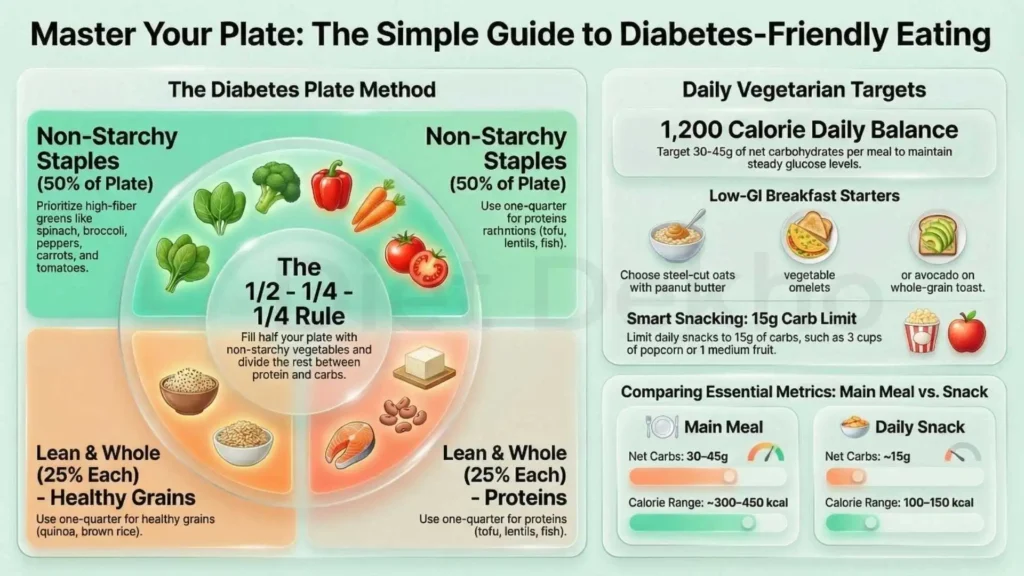
A diabetes mellitus diet chart is a structured nutritional plan that prioritizes low-glycemic index (GI) foods, high fiber, and balanced macronutrients to maintain stable blood glucose. For Indian patients, this typically involves a plate method featuring 50% non-starchy vegetables, 25% complex carbohydrates like millets, and 25% lean proteins such as lentils or eggs, adhering to 2024 ICMR-NIN guidelines.
Understanding the Landscape of Diabetes in India
Table of Contents
- 1 Understanding the Landscape of Diabetes in India
- 2 The New 2024 ICMR-NIN Nutritional Standards
- 3 Building Your Plate: The Foundation of Control
- 4 The Role of Fiber in Glucose Damping
- 5 Decoding the Glycemic Index of Indian Foods
- 6 Life Hacks for the Busy Professional
- 7 The Homemaker’s Guide to a Diabetic-Safe Kitchen
- 8 A Clinical Look: Type 1 vs. Type 2 Diets
- 9 Spices: Your Natural Pharmacy
- 10 A Personal Success Story: Reclaiming Health
- 11 A 7-Day Diabetes Mellitus Diet Chart for the Indian Home
- 12 Exercise: The Perfect Partner to Your Diet
- 13 Frequently Asked Questions
- 14 Conclusion
- 15 Contact Us
- 16 Disclaimer
We need to talk about why this is happening to so many of us in India right now. The numbers are a bit scary, but knowing the truth is the first step toward taking control. Recent reports show that over 101 million people in our country are living with diabetes. Even more concerning is that another 136 million are in the prediabetic stage. This is not just a health crisis; it is a sign that our traditional ways of eating and moving have been disrupted by the speed of modern life.
The Asian Indian Phenotype Challenge
In India, we face a unique challenge often called the Asian Indian Phenotype. What this means for your daily routine is that even if you do not look a person with higher weight, your body might still store fat around the abdomen. This internal fat makes it much harder for your insulin to work properly. Consequently, many of us develop Type 2 diabetes a full decade earlier than people in Western countries. Because our bodies react differently, a generic global diet chart won’t work for you. You need a solution that respects your love for dal, roti, and rice while making them safer for your system.
The Shift Toward Refined Grains
Furthermore, the shift toward refined grains like white rice and white bread has played a huge role in this epidemic. Statistics show that the average Indian adult gets about 62% of their daily energy from carbohydrates, mostly from low-quality, refined sources. When we eat this way, our blood sugar levels look like a roller coaster. I want to help you smooth out those peaks and valleys so you can have steady energy all day long.
| Parameter | Indian Statistics (2023-2026) | Impact on Health |
| Diagnosed Diabetics | 101 Million Adults | Increased risk of heart and kidney issues |
| Prediabetic Population | 136 Million Adults | Urgent need for lifestyle intervention |
| Carbohydrate Contribution | 62% of Total Energy | Frequent post-meal blood sugar spikes |
| Undiagnosed Cases | 43% of total cases | Silent damage to blood vessels |

The New 2024 ICMR-NIN Nutritional Standards
The Indian Council of Medical Research (ICMR) and the National Institute of Nutrition (NIN) recently updated their guidelines to help us fight back. These are not just rules; they are a roadmap for your new diabetes mellitus diet chart. One of the biggest changes is the push for more vegetables. We used to think 300 grams a day was enough, but the new goal is 400 grams. This includes a specific focus on green leafy vegetables, which should double from 50 grams to 100 grams daily.
Moreover, these guidelines also give us a very clear target for sugar. Specifically, we should aim to keep added sugars to less than 5% of our total daily calories. I know that’s tough when every celebration involves sweets, but what this means for your daily routine is finding sweetness in whole fruits rather than processed snacks. In addition, the guidelines suggest that at least half of our cereal intake should come from whole grains rather than refined flours.
| Dietary Component | 2011 Recommendation | 2024 Recommendation | Key Change |
| Total Vegetable Intake | 300 g/day | 400 g/day | 33% Increase |
| Green Leafy Veggies | 50 g/day | 100 g/day | 100% Increase |
| Added Sugar Limit | General restriction | <5% of total calories | Specific limit |
| Dietary Fiber | General advice | 25–30 g/day | Quantified target |
| Saturated Fat | General limitation | <7% of total energy | Focused quality |

Building Your Plate: The Foundation of Control
Let’s simplify this. If you look at your plate during lunch or dinner, I want you to visualize a line drawn right down the middle. Half of that plate should be filled with non-starchy vegetables. These are your best friends because they fill you up without raising your sugar. Think of things like spinach, bottle gourd (lauki), bitter gourd (karela), or cabbage. Notably, these foods provide the 25–30 grams of fiber you need every day to slow down sugar absorption.
Dividing the Remaining Half
The other half of the plate is divided into two smaller sections. One quarter is for your complex carbohydrates. Instead of a large pile of white rice, try a smaller portion of brown rice or a roti made from millets like Jowar or Bajra. The final quarter is for your protein. For my vegetarian friends, this means a bowl of thick dal, sprouts, or paneer. If you eat meat, this is where your grilled fish or skinless chicken goes.
Balancing Macronutrients for HbA1c
The math behind this is actually quite elegant. When we balance our plate this way, we aim for a macronutrient distribution of about 50–55% carbohydrates, 15–20% protein, and 20–30% fats. This balance is the secret to keeping your HbA1c levels in the healthy range, ideally below 7%. For instance, a small change in your protein-to-carb ratio can prevent that heavy, sleepy feeling after lunch.

The Role of Fiber in Glucose Damping
Fiber is essentially the brake for your metabolism. When you eat a meal high in fiber, it forms a gel-like substance in your gut. This gel slows down how quickly sugar enters your bloodstream. I know it’s hard to eat enough salad, but what this means for your daily routine is that you won’t feel that heavy, sleepy food coma after lunch.
Soluble fiber, found in oats, barley, and lentils, is particularly good at improving insulin sensitivity. In fact, the 2024 guidelines suggest we need at least 25–30 grams of fiber every day to keep our systems running smoothly. You can find more about the clinical benefits of fiber and diverse diets in the latest research from the NIH.

Decoding the Glycemic Index of Indian Foods
Not all carbohydrates are created equal. The Glycemic Index (GI) is a scale that tells us how fast a food will raise your blood sugar. A score of 55 or less is considered low, and these are the foods we want to build your diabetes mellitus diet chart around. Foods with a high GI (70 or more) cause a rapid spike and then a crash, leaving you hungry and tired.
I want you to think about Glycemic Load (GL) as well. This takes the portion size into account. For example, watermelon has a high GI but a low GL because it’s mostly water, so a small slice is usually okay. However, things like white rice or maida have both a high GI and a high GL, making them a double threat to your health.
| Food Item | Glycemic Index (GI) | Category | Why It Matters |
| Barley (Jau) | 25–28 | Very Low | Excellent for satiety |
| Soybeans | 15 | Very Low | High protein, low impact |
| Moong Dal | 38 | Low | Stable energy source |
| Brown Rice | 50–55 | Low/Medium | Better than white rice |
| White Rice | 73 | High | Causes rapid spikes |
| Maida (White Flour) | 71+ | High | Avoid in all forms |

The Millet Revolution
India is the land of millets, and for a long time, we forgot about these ancient superfoods. Jowar, Bajra, and Ragi are incredible additions to your diabetes mellitus diet chart. Jowar (Sorghum) has a GI of about 52, making it a much better choice for rotis than refined wheat. Ragi is famous for its calcium content, but we have to be careful it has a medium-to-high GI if eaten in a highly processed form.
What this means for your daily routine is mixing your flours. If you aren’t ready to give up wheat, try a multigrain approach. Specifically, mix wheat with gram flour (besan) or jowar to bring down the overall glycemic impact of your meal.

Life Hacks for the Busy Professional
I know it’s hard to find time to cook when you are juggling deadlines. Many of my clients tell me they end up eating whatever is available at the office canteen. Let’s change that with a few simple strategies. First, consider the one-pot meal. A vegetable-loaded quinoa upma or a millet khichdi is easy to pack and stays fresh in a lunch box.
The Science of Resistant Starch
Another great trick is the cold rice method. If you must eat rice, cook it the night before and let it cool in the fridge. This process creates resistant starch, which the body cannot digest as easily. When you reheat it the next day, the GI is significantly lower than fresh rice. This is a game-changer for someone who loves their rice but needs to keep their sugar in check.
- Pack Portable Proteins: Keep roasted chana, almonds, or walnuts in your desk drawer to avoid the temptation of biscuits during tea breaks.
- The Salad-First Rule: If you are eating out, always order a fresh green salad first. Eating your fiber before your carbs can reduce the sugar spike of the main meal.
- Hydration is Key: Sometimes our brain confuses thirst with hunger. Drinking 8–10 glasses of water daily helps your kidneys flush out excess sugar.

The Homemaker’s Guide to a Diabetic-Safe Kitchen
If you are the one cooking for a whole family, I know you don’t want to make three different meals. The good news is that a diabetes mellitus diet chart is actually a healthy way for everyone to eat. You can make subtle shifts that benefit your children and your spouse without them even noticing.
One of my favorite hacks is the Holy Trinity of Indian cooking: garlic, ginger, and green chilies. When you sauté these with onions, they release natural oils that allow you to cook with much less added oil or ghee. You can also hide fiber by grating bottle gourd (lauki) or finely chopping spinach into your roti dough. This adds moisture and nutrients without changing the flavor too much.
Smart Swaps in the Indian Kitchen
- Switch the Oil: Replace high-saturated fats like ghee or palm oil with mustard oil, peanut oil, or even a little olive oil for heart health.
- The Yogurt Trick: Instead of using heavy cream or cashews to thicken your gravies, use whisked low-fat curd. It gives that same creamy texture with added protein and probiotics.
- Fruit over Juice: Never drink your fruit. A whole apple has the fiber to slow down its natural sugars, but a glass of apple juice is just a sugar bomb that hits your liver instantly.

A Clinical Look: Type 1 vs. Type 2 Diets
While we often talk about diabetes as one thing, the way we handle the diet can differ. For those with Type 1 diabetes, the focus is on Carb Counting. This means matching the amount of insulin you take to the exact number of carbohydrates on your plate. It gives you more flexibility, but it requires more math.
For those with Type 2, we are usually looking at Insulin Sensitivity. This means we want to keep the carb load consistent so your body doesn’t have to work so hard to produce insulin. Whether you are managing Type 1 or Type 2, the goal remains the same: avoiding those sharp spikes that can damage your heart, eyes, and kidneys over time.
| Feature | Type 1 Diabetes (T1DM) | Type 2 Diabetes (T2DM) |
| Primary Focus | Insulin Dose Adjustment | Improving Insulin Sensitivity |
| Key Strategy | Carb Counting per meal | Portion Control & Weight Loss |
| Meal Timing | Tied to Insulin Activity | Consistent gaps (3-4 hours) |
| Staple Choice | Consistency is key | Low-GI is the priority |

Spices: Your Natural Pharmacy
One of the most beautiful parts of Indian culture is our knowledge of spices. We have a natural pharmacy right in our masala dabba. For example, cinnamon (dalchini) has been shown to improve how your body uses insulin. Adding a pinch to your morning tea or your bowl of oats can make a real difference.
Fenugreek (methi) is another powerhouse. Soaking a teaspoon of methi seeds in a glass of water overnight and drinking that water first thing in the morning can help lower fasting blood sugar levels. These are not miracle cures, but they are gentle, supportive tools that work alongside your medication and your diabetes mellitus diet chart to give you the best results.
The Power of Aromatic Roots
Ginger and garlic are not just for flavor. They help reduce inflammation in the body, which is a major factor in diabetes complications. When we use these fresh instead of using store-bought pastes (which often have hidden sugar and salt), we are giving our bodies a direct dose of metabolic support. You can read more about how an Indian-adapted Mediterranean diet incorporates these elements to protect the heart.
A Personal Success Story: Reclaiming Health
I want to share a story about one of my clients, Bhupender, who was diagnosed with Type 2 diabetes at age 33. Initially, his blood sugar levels were over 350 mg/dl, and he felt completely overwhelmed. However, by adopting a structured diabetes mellitus diet chart and committing to intermittent fasting, he lost 17 kg in just five months. As a result, his HbA1c dropped from a dangerous 9.5% to a healthy 5.6%. His journey proves that with the right mindset and a practical food plan, you can indeed reverse the cycle of metabolic disease.

A 7-Day Diabetes Mellitus Diet Chart for the Indian Home
I’ve put together a sample week for you. It’s designed to be realistic. I know you might have a busy Monday or a relaxed Sunday, so these meals are interchangeable.
One : Starting Your Week Strong
- Early Morning: Warm water with lemon and 5 soaked almonds.
- Breakfast: Vegetable oats upma with a small bowl of curd.
- Mid-Morning: One small guava or apple.
- Lunch: 2 multigrain rotis, 1 cup moong dal, and a large bowl of sautéed spinach.
- Evening: Green tea with a handful of roasted makhana.
- Dinner: Vegetable daliya khichdi with plenty of peas and carrots.
Two : Tuesday Protein Boost
- Early Morning: Cinnamon water and 2 walnuts.
- Breakfast: Besan chilla (gram flour pancake) with mint chutney.
- Mid-Morning: A small bowl of papaya.
- Lunch: 1/2 cup brown rice, rajma (kidney beans), and a fresh cucumber salad.
- Evening: Unsweetened buttermilk (chaas).
- Dinner: Grilled paneer with stir-fried beans and broccoli.
Three : The Mid-Week Millet Switch
- Early Morning: Soaked fenugreek (methi) water.
- Breakfast: Vegetable-loaded millet poha.
- Mid-Morning: A handful of roasted peanuts.
- Lunch: 2 Jowar rotis, 1 bowl of tur dal, and lauki (bottle gourd) sabzi.
- Evening: Sprouts chaat with lemon and onion.
- Dinner: Clear vegetable soup with a small serving of moong dal khichdi.
Four : Thursday South Indian Flavors
- Early Morning: Warm ginger tea (no sugar).
- Breakfast: 2 Ragi idlis with sambar (extra vegetables).
- Mid-Morning: One pear.
- Lunch: 2 multigrain rotis, 1 cup of chickpeas (chole), and cabbage sabzi.
- Evening: Roasted makhana or a boiled egg.
- Dinner: Tofu stir-fry with bell peppers and a small bowl of salad.
Five : Friday Hearty and Healthy
- Early Morning: Warm water and 5 almonds.
- Breakfast: Barley upma with vegetables.
- Mid-Morning: A small portion of pomegranate seeds.
- Lunch: 2 rotis, 1 bowl of masoor dal, and bhindi (okra) sabzi.
- Evening: Green tea and roasted chana.
- Dinner: Moong dal cheela stuffed with vegetables.
Six : The Weekend Warrior
- Early Morning: Jeera water.
- Breakfast: Vegetable omelet or paneer bhurji.
- Mid-Morning: A small bowl of berries.
- Lunch: 1/2 cup brown rice, fish curry or mixed veg curry, and raita.
- Evening: Buttermilk and flaxseeds.
- Dinner: Vegetable stew with one whole wheat phulka.
Seven : Sunday Relax and Reset
- Early Morning: Warm water with lemon.
- Breakfast: Ragi dosa with chutney.
- Mid-Morning: One apple.
- Lunch: Vegetable-rich daliya or quinoa khichdi.
- Evening: Herbal infusion and pumpkin seeds.
- Dinner: Grilled vegetables and paneer tikka (no heavy marinade).
Exercise: The Perfect Partner to Your Diet
I know you don’t have time to spend two hours at the gym. The good news is that your body doesn’t actually need that much. Just 30 minutes of brisk walking every day can improve how your cells respond to insulin. If you can walk for 10 minutes after each meal, you are doing something even better. You are helping your body process the sugar you just ate immediately.
What this means for your daily routine is finding hidden exercise. For instance, take the stairs instead of the lift. Similarly, walk while you are on a phone call. These small movements add up. Exercise isn’t just about weight; it’s about metabolic health. When your muscles move, they pull sugar out of your blood and use it for energy, even without needing as much insulin.
Practical Steps to Start Today
I know all this information can feel like a lot. Let’s break it down into three things you can do in the next 24 hours to begin your journey with a diabetes mellitus diet chart.
- Clear the Junk: Go to your pantry and move any sugary biscuits, white bread, or namkeens to a high shelf. If they aren’t easy to reach, you won’t eat them when you are tired.
- Shop for Color: On your way home, stop and buy three different types of green vegetables. Make them the star of your dinner tonight.
- Drink Water: Swap your evening tea or soda for a glass of plain water or unsweetened buttermilk. It’s the easiest way to cut sugar immediately.
Remember, perfection is not the goal. Progress is. If you have a bad day and eat a piece of cake, don’t throw away the whole week. Just make your next meal a healthy one. You are doing this for your future self, for your family, and for your peace of mind. I am proud of you for taking this step.

Frequently Asked Questions
Q1: Can I eat white rice on a diabetes mellitus diet chart?
While white rice has a high glycemic index, you can eat it in small portions if you pair it with double the amount of fiber and protein. Alternatively, use the cool and reheat method to increase resistant starch.
Q2: Which fruits are safest for diabetics in India?
Choose fruits with a low GI like guava, apple, pear, and jamun. These are rich in fiber and won’t cause the same spikes as mangoes, grapes, or bananas.
Q3: How many rotis should I eat per meal?
Most people find that 1–2 medium-sized rotis made from whole wheat or millets like jowar are sufficient when combined with a large bowl of sabzi and dal. Portion control is essential for managing your glycemic load.
Q4: Is jaggery (gur) better than white sugar?
Unfortunately, no. While jaggery has some minerals, it still raises your blood sugar almost as quickly as white sugar. It is best to avoid or strictly limit all forms of added sweeteners.
Q5: Can I drink milk with diabetes?
Yes, low-fat or skimmed milk is a good source of protein and calcium. However, avoid adding sugar or honey to it. Turmeric milk at bedtime is a wonderful, anti-inflammatory choice.
Conclusion
Your health is your most valuable asset, and it’s never too late to start protecting it. I’ve seen so many people reclaim their energy and their lives just by making these simple shifts in their diabetes mellitus diet chart. I know it’s hard at first, but your body is incredibly resilient. Once you start giving it the right fuel, you will be amazed at how much better you feel no more afternoon crashes, better sleep, and more patience for the people you love.
If you feel overwhelmed and need a personalized touch, our team at DietDekho is ready to walk this path with you. We can help you create a plan that fits your specific work hours, your favorite foods, and your health goals. Don’t wait for a perfect Monday to start. Start with your very next meal.
Contact Us
We understand how overwhelming nutrition and weight loss information can feel. With so many opinions and confusing advice online, it’s easy to feel stuck or unsure about what to do next.
At Diet Dekho, you never have to figure it out alone. You can contact us anytime with any questions or concerns. Our expert dietitians are available 24/7 to guide, support, and help you stay on track. Whether your goal is weight loss or building healthier habits, we’re here to make the journey simpler and more sustainable for you.
Disclaimer
This blog is intended to help readers make healthier food choices. Your health should always be the top priority. Before starting any restrictive or special diet, especially if you have a medical condition or health concern, please consult a doctor or a qualified dietitian. Each body responds differently to food and lifestyle changes. Always choose what is safe and suitable for you.

Abhinav is the Founder of Diet Dekho, helping people manage weight and lifestyle health through simple, practical nutrition and personalized diet plans.