I still remember the look on Sunita’s face when she first sat across from me in my clinic. She was a busy bank manager, a mother of two, and had just been diagnosed with type 2 diabetes. She felt completely overwhelmed and told me she just did not have the time for a complicated diabetic diet meal plan. If you are feeling that same weight on your shoulders, I want to tell you that managing your health does not have to be a second full-time job.
A diabetic diet meal plan is a structured way of eating that focuses on balanced portions of complex carbohydrates, lean proteins, and healthy plant-based fats. By choosing low-glycemic foods like millets, lentils, and fresh vegetables, you can keep your blood sugar stable throughout the day. This simple approach helps you avoid energy crashes and long-term health complications while still enjoying your favorite Indian flavors.
The Reality of the Diabetes Epidemic in India
Table of Contents
- 1 The Reality of the Diabetes Epidemic in India
- 2 Understanding the ICMR 2024 Dietary Guidelines
- 3 The Science of the Plate: Why Portions Matter
- 4 Carbohydrates: Making Smarter Choices
- 5 The Power of Millets: Jowar, Bajra, and Ragi
- 6 Protein: The Building Block of Satiety
- 7 Fats and Oils: Quality over Quantity
- 8 Hydration and the Importance of Fluid Management
- 9 The 7-Day Diabetic Diet Meal Plan: Your Weekly Schedule
- 10 Meal Prep Hacks for the Busy Indian Professional
- 11 Traditional Habits That Support Your Journey
- 12 Frequently Asked Questions
- 13 Making This a Way of Life
- 14 Contact Us
- 15 Disclaimer
When we talk about health in India, we have to look at the numbers because they tell a story about our changing lives. Recent data from the Indian Council of Medical Research (ICMR) indicates that over 101 million Indians are currently living with diabetes. This is not just a statistic; it represents mothers, fathers, and professionals who are struggling to find a balance between their traditional food habits and their medical needs. Another 136 million people are in the prediabetes stage, which means they have a golden window of opportunity to turn things around before the condition progresses.

What this means for your daily routine is that you are part of a massive demographic shift where our diets have become too rich in refined carbs and too low in movement. The prevalence of diabetes in India stands at about 11.4% nationally, but in urban areas, that number jumps to 14.2%. We are seeing that states like Goa and Punjab have some of the highest rates, reaching up to 26.4% and 19.0% respectively. I know it is hard to hear these numbers, but they highlight why a structured diabetic diet meal plan is the most powerful tool you have.
The burden of this condition is often invisible until it starts affecting our energy levels or leading to complications like neuropathy or heart issues. In India, people tend to develop diabetes nearly a decade earlier than those in Western countries, often at a lower body mass index. This means our bodies are uniquely sensitive to the quality of the food we eat. If we can simplify your kitchen, we can simplify your health.

| State/Region | Diabetes Prevalence (%) | Prediabetes Prevalence (%) |
| National Average | 11.4% | 15.3% |
| Urban India | 14.2% | – |
| Rural India | 8.3% | – |
| Goa | 26.4% | – |
| Punjab | 19.0% | – |
| Kerala | 25.5% (approx) | – |
Source: ICMR-INDIAB Study
Understanding the ICMR 2024 Dietary Guidelines
The Indian Council of Medical Research recently released updated guidelines for 2024 to help us navigate this crisis. These are not just academic rules; they are practical steps for your kitchen. One of the biggest shifts in these new guidelines is the recommendation to reduce our reliance on cereals and millets. In the past, we were told these could make up the bulk of our diet, but now the ICMR suggests they should account for no more than 45% of our total calories.
For a busy person like you, this means looking at your plate differently. Instead of two large rotis and a tiny bit of subzi, we want to flip that ratio. The guidelines emphasize that 15% of your calories should come from pulses, beans, or lean meats, while the rest should be filled with nuts, vegetables, fruits, and low-fat milk. This ensures you get enough micronutrients to prevent the insulin resistance that often starts in early childhood in our population.
The ICMR’s 17 guidelines cover everything from breastfeeding to salt intake, but for someone managing diabetes today, the most important points are eating a variety of foods, using oils in moderation, and restricting salt to less than 5 grams a day. I know it is hard to cut back on salt when our pickles and papads are so tempting, but your heart and kidneys will thank you.

The Science of the Plate: Why Portions Matter
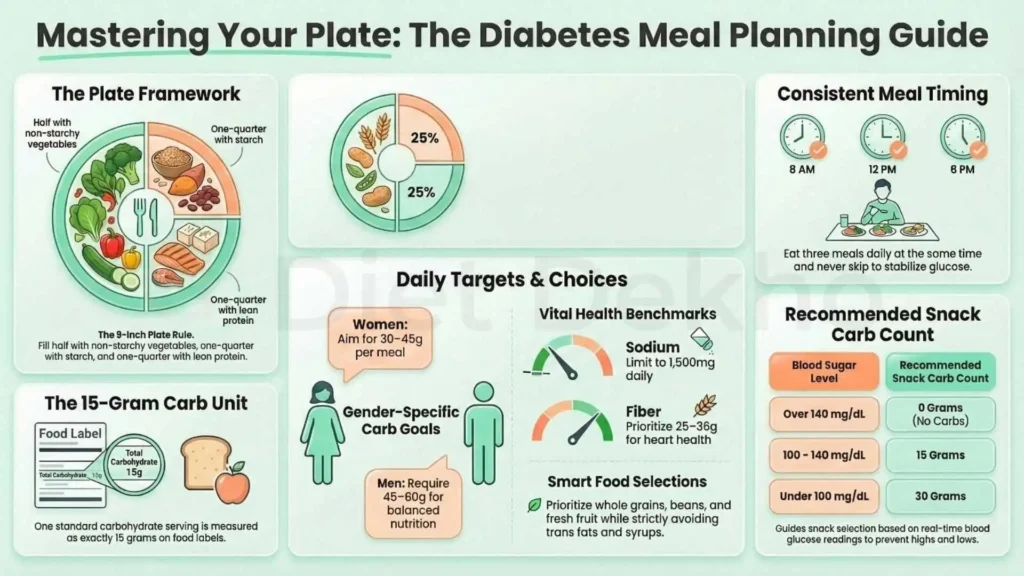
Let’s simplify this concept using the Plate Method. Imagine your dinner plate. I want you to draw an imaginary line down the middle. Fill one entire half with non-starchy vegetables like spinach, cauliflower, or bottle gourd. These are high in fiber and low in calories, which means they won’t spike your sugar levels. Now, divide the other half into two equal quarters.
One quarter is for your protein, think dal, paneer, tofu, or lean chicken. The final quarter is for your complex carbohydrates, such as a small portion of brown rice or one whole-wheat roti. This visual guide is much easier than counting every calorie, and it works whether you are at home or at a wedding. By following this structure, you are naturally limiting the glycemic load of your meal.
Glycemic Load ( GL ) is a way to measure how much a specific portion of food will raise your blood sugar. It is calculated as follows:
GL = frac{ {Glycemic Index (GI)} times {Carbohydrate Content (g)}}{100}
Choosing foods with a low GI and keeping your portions small ensures a lower GL , which is the secret to staying in your target range of 70 to 130 mg/dL before meals.
| Food Group | Recommended Portion | Key Benefit |
| Vegetables | 50% of the plate | High fiber, low calorie, prevents sugar spikes |
| Proteins | 25% of the plate | Builds muscle, increases satiety |
| Grains/Starches | 25% of the plate | Provides energy, needs careful monitoring |
| Healthy Fats | 1-2 teaspoons | Supports heart health |

Carbohydrates: Making Smarter Choices
I often hear patients ask if they have to give up rice forever. The short answer is no, but we need to talk about the type of rice. Research shows that high consumption of white rice more than 450 grams a day is linked to a significantly higher risk of diabetes, especially in South Asia. When rice is polished, the fiber-rich bran is removed, leaving behind mostly starch that hits your bloodstream like a dose of pure sugar.
What this means for your daily routine is that switching to brown rice, red rice, or even parboiled (ukada) rice can make a huge difference. These varieties retain their fiber, which slows down digestion. If you really love your white rice, try mixing it with a large portion of dal and vegetables. This food synergy lowers the overall glycemic response of the meal.
We also need to be careful with refined flour, or maida. Whether it is in the form of white bread, naans, or biscuits, maida is a major culprit in blood sugar spikes. I recommend my clients look for whole-grain alternatives like whole-wheat flour (atta) or, even better, traditional Indian millets.

The Power of Millets: Jowar, Bajra, and Ragi
Long before we had modern processed foods, our ancestors thrived on millets. These are nutri-cereals that are naturally low in glycemic index and high in minerals like magnesium and calcium. Magnesium is particularly important because it helps your body’s cells respond better to insulin.
Jowar (sorghum) is a fantastic option for your diabetic diet meal plan. It is a complex carb that is absorbed slowly, providing steady energy without the sugar high followed by a crash. Bajra (pearl millet) is another great choice, especially in the winter months, as it is rich in fiber and protein. Then there is Ragi (finger millet), which is a powerhouse of calcium essential as we age to keep our bones strong.
I know it takes a little practice to make a perfect Jowar bhakri, but the health benefits are worth it. If you find pure millet rotis hard to make, you can start by mixing millet flour with your regular atta. This small change adds a significant amount of fiber to your diet, helping you feel full for longer and reducing those late-morning cravings.
| Millet Type | GI Category | Key Nutrient | Best For |
| Jowar (Sorghum) | Low/Medium | Fiber, Magnesium | Rotis, Bhakris |
| Ragi (Finger Millet) | Low | Calcium, Iron | Breakfast porridges, Dosas |
| Bajra (Pearl Millet) | Medium | Protein, Magnesium | Winter meals, Parathas |
| Oats | Low | Beta-glucan fiber | Breakfast upma, Porridge |

Protein: The Building Block of Satiety
One of the mistakes I see most often is a diet that is too heavy on carbs and too light on protein. Protein is your best friend when it comes to weight loss and sugar control. It takes longer to digest than carbohydrates, which means it helps keep your blood sugar stable and keeps you from feeling hungry an hour after lunch.
For my vegetarian friends, lentils (dals), beans, and chickpeas (chana) are essential. They provide a double benefit because they are high in both protein and fiber. Paneer and tofu are also excellent choices, provided you use low-fat versions. If you eat eggs, they are a high-quality protein source that is very easy to prepare for a quick breakfast.
If you eat meat, I suggest sticking to skinless poultry and fish. Fish like salmon, mackerel, and sardines are rich in omega-3 fatty acids, which protect your heart a vital concern since diabetes can increase the risk of cardiovascular issues. I always tell my patients to avoid fried meats and instead choose grilling, baking, or steaming to keep the calories in check.

Fats and Oils: Quality over Quantity
There is a lot of confusion about fats, especially with the recent trends around ghee and butter. While small amounts of ghee are traditional, we have to remember that they are high in saturated fats. The ICMR guidelines suggest that we should prioritize unsaturated fats from sources like nuts, seeds, and vegetable oils.
I recommend using oils like mustard, groundnut, or olive oil for cooking. These contain monounsaturated and polyunsaturated fats that can actually help lower your cholesterol levels. Nuts like almonds and walnuts are also great to include in your diabetic diet meal plan because they provide healthy fats, fiber, and protein all in one package. Just a small handful a day is enough; remember that fats are calorie-dense, so portion control is still important.
Avoid trans fats at all costs. These are found in many packaged snacks, vanaspati, and bakery items like biscuits and puffs. They are incredibly damaging to your heart and can worsen insulin resistance. If you see partially hydrogenated oil on a label, it is best to put that item back on the shelf.
Hydration and the Importance of Fluid Management
I know you have a busy day, but are you drinking enough water? Many people don’t realize that dehydration can actually make your blood sugar appear higher than it is. When you are dehydrated, the sugar in your blood becomes more concentrated. Furthermore, high blood sugar itself can cause you to lose fluids because your kidneys try to flush out the excess sugar through urine.
This is especially critical if you are taking certain modern diabetes medications like SGLT2 inhibitors. These drugs work by making you urinate out excess sugar, which can lead to a risk of dehydration and even urinary tract infections if you aren’t drinking enough. I advise my clients on these medications to drink an extra 2-3 glasses of water daily.
If you find plain water boring, let’s get creative. Unsweetened buttermilk (chhachh), lemon water (nimbu paani) without sugar, or herbal teas are all great options. Tender coconut water can be okay in moderation, but be careful if you have high potassium levels or kidney issues. Avoid fruit juices and sodas, as they are essentially liquid sugar that will spike your levels almost instantly.

The 7-Day Diabetic Diet Meal Plan: Your Weekly Schedule
Let’s put all of this into a practical, easy-to-follow schedule. I have designed this to include familiar Indian meals that don’t require hours in the kitchen.
Starting Strong with Fiber (Day 1)
The first day is about setting a rhythm. We start with fenugreek seeds, which have been used for centuries to help manage blood sugar.
- Early Morning: 1 glass of warm water with 1 tsp soaked methi seeds.
- Breakfast: 1 bowl of vegetable oats upma with plenty of carrots and beans.
- Mid-Morning: 1 medium apple or guava.
- Lunch: 2 multigrain rotis, 1 bowl of moong dal, and a large portion of sautéed spinach.
- Evening Snack: 1 small bowl of roasted chana (Bengal gram).
- Dinner: 1 bowl of vegetable dalia with a side of cucumber salad.
The Power of Legumes (Day 2)
Legumes are a staple of the Indian diet for a reason they are nutritional powerhouses.
- Early Morning: 1 glass of cinnamon-infused water.
- Breakfast: 2 besan chillas with mint-coriander chutney.
- Mid-Morning: A small bowl of papaya slices.
- Lunch: ½ cup brown rice with a bowl of rajma and a green salad.
- Evening Snack: 1 glass of unsweetened buttermilk.
- Dinner: Grilled paneer cubes (100g) with a large bowl of stir-fried green beans.
Exploring Ancient Millets (Day 3)
Today we focus on Jowar, which is incredibly satisfying and great for your gut.
- Early Morning: 1 glass of warm lemon water.
- Breakfast: 1 bowl of vegetable poha with added peanuts for crunch.
- Mid-Morning: 5-6 almonds and 2 walnuts.
- Lunch: 1 jowar roti, 1 bowl of chole (chickpeas), and steamed lauki subzi.
- Evening Snack: 1 cup of green tea (no sugar).
- Dinner: 1 bowl of quinoa or moong dal khichdi with plenty of vegetables.
A Taste of South India (Day 4)
Fermented foods like idli are easy on the stomach, but we have to watch the portion sizes.
- Early Morning: Tulsi and ginger tea (no sugar/milk).
- Breakfast: 2 small idlis with a bowl of vegetable-loaded sambar.
- Mid-Morning: 1 pear or a small orange.
- Lunch: 1 ragi roti, 1 bowl of tur dal, and a portion of cabbage-mutter subzi.
- Evening Snack: 1 small bowl of roasted makhana (lotus seeds).
- Dinner: A large bowl of mixed vegetable soup with some paneer or tofu cubes.
Sustained Energy for the Week (Day 5)
As the week progresses, we keep the fiber high to avoid that afternoon slump.
- Early Morning: 1 glass of plain warm water.
- Breakfast: 1 bowl of vegetable upma (made with suji or daliya).
- Mid-Morning: A small handful of berries or a slice of melon.
- Lunch: ½ cup brown rice with masoor dal and bhindi (okra) fry.
- Evening Snack: A few fresh coconut slices (unsweetened).
- Dinner: 2 moong dal cheelas with a bowl of yogurt or raita.
Protein Focus (Day 6)
We emphasize lean proteins today to support muscle health and keep you full.
- Early Morning: 1 glass of jeera (cumin) water.
- Breakfast: Scrambled eggs or tofu bhurji with onions and tomatoes.
- Mid-Morning: 1 medium apple.
- Lunch: 1-2 multigrain rotis with mixed dal and a portion of green beans poriyal.
- Evening Snack: A handful of unsalted peanuts.
- Dinner: A light vegetable stew with a small piece of grilled fish or more paneer.
Weekend Balance (Day 7)
Sundays are for resting, but we keep our health goals in mind.
- Early Morning: Warm water with a dash of lemon.
- Breakfast: 1 ragi dosa with coconut or mint chutney.
- Mid-Morning: A bowl of seasonal fruit salad (avoid mango/grapes).
- Lunch: A comforting bowl of dal khichdi with a side of papad (roasted, not fried).
- Evening Snack: 1 cup of herbal tea.
- Dinner: Grilled vegetables (peppers, zucchini, broccoli) with paneer tikka.

Meal Prep Hacks for the Busy Indian Professional
I know your time is limited, so let’s talk about some hacks that make this diabetic diet meal plan sustainable. You don’t have to cook everything from scratch every single day.
One of my favorite tips is the Big Batch Masala. On Sunday, prepare a large batch of onion-tomato-ginger-garlic paste (bhuna masala). You can freeze this in an ice cube tray or small containers. During the week, you just pop a cube into your pan, add your vegetables or lentils, and dinner is ready in 15 minutes.
Another time-saver is boiling your pulses and beans in advance. You can boil a big batch of rajma, chole, or moong on the weekend and store them in the fridge for up to four days. They are perfect for a quick lunch or to toss into a salad. I also recommend washing and chopping all your vegetables as soon as you bring them home from the market. If your spinach is already cleaned and your beans are already snapped, you are much more likely to use them.
Finally, keep emergency snacks ready. A jar of roasted makhana or chana in your office drawer or car can save you from reaching for a samosa when hunger hits at 4 PM. These small preparations remove the friction from eating healthy and help you stay on track even on your busiest days.
Traditional Habits That Support Your Journey
We can also look to our traditional Indian wisdom for help. Have you heard of Shatpawali ? This is the ancient tradition of taking 100 steps after every meal. Modern science confirms that even a 10-minute walk after eating can significantly reduce the glucose spike that follows a meal. It helps your muscles soak up the sugar from your blood for energy.
Another great habit is having an early dinner. If you can finish your last meal by 7 PM or 8 PM, you give your body plenty of time to process the food before you go to sleep. This can lead to much better fasting blood sugar levels the next morning. These aren’t complicated medical interventions; they are simple lifestyle shifts that our grandparents practiced for a reason.
Frequently Asked Questions
Can I follow this diabetic diet meal plan if I am a vegetarian?
Absolutely! Most of the meals in this schedule are plant-based. You can easily get all the protein you need from lentils, beans, paneer, tofu, and low-fat dairy. The key is to include a protein source in every single meal to keep you satisfied.
Is it okay to eat fruit if I have diabetes?
Yes, you don’t have to give up fruit! However, some fruits are better than others. Choose low-GI fruits like apples, pears, guavas, and berries. Be careful with very sweet fruits like mangoes, grapes, and chikoo. It is best to eat fruit as a snack rather than with a heavy meal to avoid a massive sugar load.
How much water should I drink every day?
For most people, 8-10 glasses (about 2-2.5 liters) is a good goal. However, if you are active or taking medications like SGLT2 inhibitors, you may need more. Pay attention to your thirst and the color of your urine. It should be a pale straw color.
Can I eat out while following a diabetic diet meal plan?
You certainly can! When at a restaurant, look for grilled or tandoori items instead of fried ones. Ask for an extra side of vegetables and try to skip the heavy gravies and desserts. If the portions are huge, ask for a doggie bag at the start and set aside half to take home.
Making This a Way of Life
I know this feels like a lot of information, but remember what I told Sunita: we take it one meal at a time. You don’t have to be perfect. If you have a bad day or a meal that spikes your sugar, don’t beat yourself up. Just get back on track with your next snack or meal. Managing diabetes is a marathon, not a sprint.
By using this diabetic diet meal plan, you are giving your body the nutrients it needs to stay strong and your blood sugar the stability it needs to stay safe. You are taking charge of your health so that you can keep doing the things you love with the people you care about. If you need more personalized guidance or want to dive deeper into your nutrition journey, we are here to support you every step of the way.
Contact Us
We understand how overwhelming nutrition and weight loss information can feel. With so many opinions and confusing advice online, it’s easy to feel stuck or unsure about what to do next.
At Diet Dekho, you never have to figure it out alone. You can contact us anytime with any questions or concerns. Our expert dietitians are available 24/7 to guide, support, and help you stay on track. Whether your goal is weight loss or building healthier habits, we’re here to make the journey simpler and more sustainable for you.
Disclaimer
This blog is intended to help readers make healthier food choices. Your health should always be the top priority. Before starting any restrictive or special diet, especially if you have a medical condition or health concern, please consult a doctor or a qualified dietitian. Each body responds differently to food and lifestyle changes. Always choose what is safe and suitable for you.

Abhinav is the Founder of Diet Dekho, helping people manage weight and lifestyle health through simple, practical nutrition and personalized diet plans.