Meet Ananya. She’s 28, works a demanding job in Mumbai, and recently decided to get serious about her fitness. Like many of us, she started by making “healthy” food swaps. She ditched the buttered toast and sugary cereals for what she thought was the ultimate health food: the traditional South Indian dosa. Every morning, she enjoyed two crispy, golden dosas with a side of coconut chutney. But three weeks in, she felt more sluggish than ever, her jeans were still tight, and she was hit with a massive energy crash by 11 AM.
What Ananya didn’t realize is that the modern dosa often suffers from a “health halo.” We assume it’s healthy because it’s fermented and doesn’t look oily, but the metabolic reality is often quite different. Here’s the thing: while dosa has deep cultural roots, its modern incarnation—loaded with refined white rice and hidden fats—can actually be one of the major disadvantages of eating dosa daily for someone trying to slim down.
The Calorie Count Trap: It’s Not Just a Thin Crepe
Table of Contents
- 1 The Calorie Count Trap: It’s Not Just a Thin Crepe
- 2 The Glycemic Index Crisis: White Rice and Insulin Spikes
- 3 Gastric Problems After Eating Dosa: The Fermentation Paradox
- 4 Why Your “Instant” Mix is a Nutritional Red Flag
- 5 South Indian Food Health Risks: The South Asian Phenotype
- 6 Is Dosa Healthy for Weight Loss? Only With These Swaps
- 7 Common Mistakes Beginners Make
- 8 Expert Guidance for Your Journey
When you look at a plain dosa, it seems harmless. It’s thin, light, and crispy. However, the caloric architecture of a dosa varies wildly based on how it’s prepared. A medium-sized homemade plain dosa typically clocks in at about 104 to 120 calories.1 But let’s be real—how many of us stop at one plain dosa?
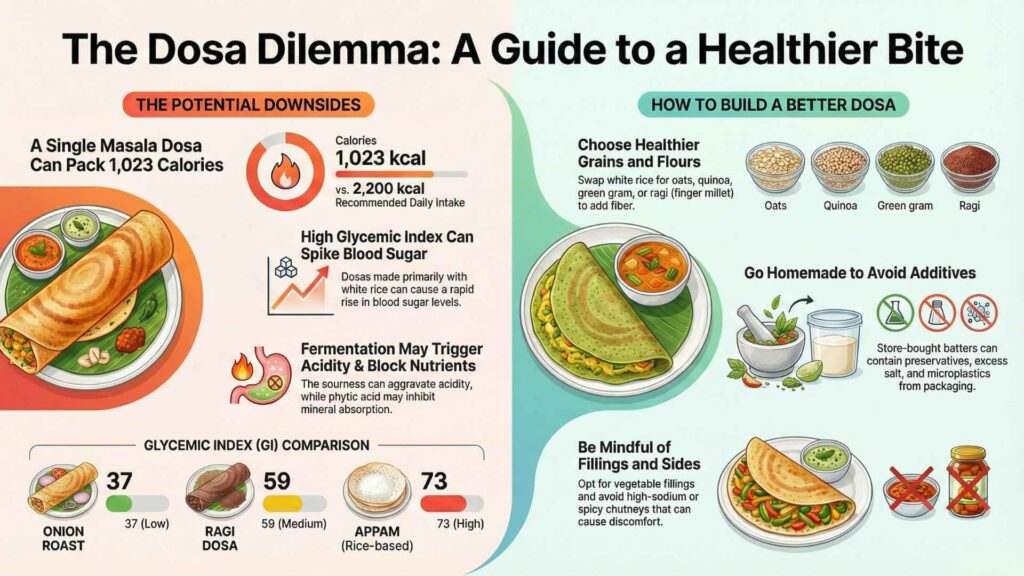
The real “calorie creep” happens when we move to restaurant-style variants. A single masala dosa, stuffed with oil-laden potatoes, can jump to 250–350 calories. If you’re at a popular joint ordering a “Butter Dosa” or a “Cheese Dosa,” you’re looking at a single meal that can exceed 400–500 calories before you even touch the sides.
| Dosa Type | Weight (approx.) | Calories (kcal) | Primary Macronutrient |
| Neer Dosa | 40g | 86 | Carbohydrates |
| Plain Dosa | 40g | 104 | Carbohydrates |
| Oats Dosa | 50g | 111 | Fiber |
| Ragi Dosa | 50g | 102 | Minerals |
| Masala Dosa | 150g | 250-350 | Starch/Fat |
| Paneer Dosa | 150g | 300 | Protein/Fat |
| Butter Dosa | 100g | 350 | Saturated Fat |
If your goal is a calorie deficit, eating two or three dosas with a full bowl of coconut chutney (which adds another 100 calories) can easily take up half your daily allowance in one sitting.
The Glycemic Index Crisis: White Rice and Insulin Spikes
What this really means for your body is a sugar roller coaster. Most dosas are made with a ratio of 3 parts white rice to 1 part urad dal. White rice is a refined grain that has had its bran and germ stripped away. This leaves you with pure starch that your body converts into glucose almost as fast as a candy bar.
The chemical process of starch hydrolysis looks like this:
(C6H10O5)n + nH2O → nC6H12O6
Because of this, white rice-based dosa has a high Glycemic Index (GI). Research published by the National Institutes of Health (NIH) shows that a plain rice dosa has a GI of approximately 79.39. For comparison, pure sugar is 100. When you eat this, your blood sugar spikes, your pancreas pumps out insulin, and your body enters “fat-storage mode” rather than “fat-burning mode”.
The Harvard Warning on Refined Grains
Researchers at the Harvard T.H. Chan School of Public Health have found that frequent consumption of refined white rice is linked to a higher risk of metabolic issues. According to their studies, each additional daily serving of white rice can increase the risk of Type 2 Diabetes by 10%. For fitness beginners, this makes the daily rice dosa a potential hurdle rather than a help. You can read more about these metabolic risks on the Harvard Health website.

Gastric Problems After Eating Dosa: The Fermentation Paradox
We often hear that fermentation is great for the gut because it provides probiotics like Lactobacillus. While that’s true for a perfectly fermented batter, many people suffer from dosa acidity and bloating.
If the batter is over-fermented (which often happens in hot Indian kitchens), it becomes excessively sour. This acidity can trigger what Ayurveda calls a Pitta imbalance, leading to heartburn and discomfort. During fermentation, the bacteria convert sugars into lactic acid:
C6H12O6 → 2C3H6O3
When this acid concentration gets too high, it can irritate the stomach lining, especially if you have a sensitive digestive system. Furthermore, fermented foods are high in histamines. If you find yourself with a headache or skin rash after a South Indian feast, you might be dealing with a histamine intolerance rather than a simple food allergy.
Why Your “Instant” Mix is a Nutritional Red Flag
Let’s break it down: we’re all busy, and instant dosa mixes seem like a lifesaver. However, instant dosa mix side effects are a real concern for the health-conscious. To keep these powders shelf-stable, manufacturers often add preservatives like Sodium Benzoate (C7H5NaO2) and Potassium Sorbate (C6H7KO2).
These additives can disrupt your gut microflora—the very thing fermentation is supposed to help. Many packaged mixes also contain:
- Excess Sodium: To enhance flavor and shelf life, which can lead to water retention and bloating.
- Raising Agents: Ingredients like E 500ii (Sodium Bicarbonate) can cause sudden gas and gastric pressure.
- Microplastics: Packaged liquid batters stored in plastic pouches risk leaching microplastics into the food, which act as endocrine disruptors.
South Indian Food Health Risks: The South Asian Phenotype
There’s a specific metabolic pattern called the “South Asian Phenotype.” Indians tend to have a higher body fat percentage and more visceral fat (fat around the organs) even at a lower Body Mass Index (BMI).
Because our bodies are genetically more prone to insulin resistance, a diet heavy in refined rice can be particularly damaging. Dr. Renan Bosio, a specialist in sports medicine, notes that refined white rice acts like a “glucose bomb” for those with sedentary lifestyles. When we consume these carbs without high physical activity, the excess glucose is stored directly as visceral fat, leading to that stubborn belly fat many fitness beginners struggle to lose.

Is Dosa Healthy for Weight Loss? Only With These Swaps
If you’re thinking, “Do I have to give up dosa forever?”—the answer is no. But you do need to stop eating the white rice version every day. To make it work for weight loss, you need to prioritize protein and fiber.
1. The Ingredient Swap
Instead of white rice, use brown rice, which keeps the fiber-rich bran intact. Even better, try:
- Moong Dal Dosa (Pesarattu): High in protein and keeps you full for hours.
- Ragi Dosa: Finger millet is rich in calcium and has a much lower glycemic impact.
- Oats Dosa: Provides beta-glucans that help manage cholesterol and slow down sugar absorption.
2. Ditch the Potato Filling
The “masala” in masala dosa is usually just mashed potatoes with oil. This is adding starch to starch. Swap it for:
- Spiced Paneer or Tofu (High Protein)
- Grated Carrots and Spinach (High Fiber)
- Boiled Sprouts (High Satiety)
3. Mind the Chutney
Coconut chutney is delicious but very high in saturated fats and calories. A small serving can have 80–100 calories. Try a Tomato-Onion Chutney or a Mint-Coriander Chutney instead to save nearly 60 calories per meal.
Common Mistakes Beginners Make
One of the biggest hurdles is the “reward” mentality. Many people go for a 30-minute walk (burning about 150 calories) and then “reward” themselves with two large masala dosas (600+ calories). This creates a caloric surplus, not a deficit.
Another mistake is eating dosa late at night. Our metabolism naturally slows down in the evening. Consuming a high-carb, fermented meal at 9 PM can lead to poor digestion and increased fat storage compared to eating the same meal at 9 AM.
Expert Guidance for Your Journey
Celebrity nutritionist Rujuta Diwekar often says, “Ask yourself, is this the food my Nani or Dadi ate?”. While they ate dosa, they used hand-pounded, unpolished rice and lived much more active lives. Today’s “chakachak” white rice and our sedentary office jobs are a recipe for weight gain if not managed mindfully.
If you want to see real results, you need a plan that respects your culture but understands your metabolic needs.
Stop the guesswork and get a plan that works.

Frequently Asked Questions (FAQs)
1. Can I eat dosa daily if I want to lose weight?
Eating traditional white rice dosa every day can stall weight loss due to its high carbohydrate content and glycemic index. If you want to enjoy it daily, switch to a high-protein version like moong dal or ragi dosa and keep the oil to a minimum.
2. Is dosa healthy for diabetics?
White rice-based dosas can cause rapid blood sugar spikes, which is dangerous for diabetics. Experts recommend millet-based dosas (like ragi or jowar) or lentil-heavy pesarattu as they have a lower glycemic index and provide more stable energy.
3. Why do I feel bloated or acidic after eating dosa?
This is usually caused by over-fermentation of the batter, which increases lactic acid levels, or a sensitivity to histamines. Eating fermented foods at night when digestion is naturally slower can also worsen these symptoms.
4. Which dosa is best for weight loss?
The moong dal dosa (Pesarattu) is generally considered the best for weight loss because it is significantly higher in protein and fiber compared to rice-based versions, helping you feel full for longer.
5. How many calories are in a masala dosa with chutney and sambar?
A standard restaurant masala dosa meal typically ranges from 450 to 550 calories. This includes the potato filling, oil, and calorie-dense coconut chutney.
Conclusion: Finding Your Metabolic Balance
Dosa is a beautiful, traditional dish that can have a place in a healthy lifestyle. But the disadvantages of eating dosa made from refined white rice cannot be ignored if you are on a fitness journey. By being mindful of your batter ingredients, controlling your portions, and choosing the right time to eat, you can enjoy your favorite food without stalling your progress.
Ready to take the next step toward a leaner, healthier you? Our experts at Diet Dekho are ready to help you craft the perfect meal plan.
BOOK YOUR APPOINTMENT
Abhinav is the Founder of Diet Dekho, helping people manage weight and lifestyle health through simple, practical nutrition and personalized diet plans.