At DietDekho, we understand that while much of the world focuses on shedding pounds, there is a large and often overlooked community struggling with the physical and emotional toll of being underweight. Furthermore, finding the right healthy weight gain foods is not just about eating more; it is about choosing nutrient-dense options that respect your body’s unique metabolic needs while fitting into a traditional Indian lifestyle.
To gain weight naturally and healthily, you must consume a consistent calorie surplus by prioritizing healthy weight gain foods such as desi ghee, full-fat dairy, starchy vegetables like sweet potatoes, and protein-rich pulses or lean meats. Specifically, focus on eating balanced, high-calorie meals every three to five hours, ensuring you combine complex carbohydrates with healthy fats and quality proteins to support muscle growth and sustained energy levels.
Why is it so hard to gain weight even after eating everything?
Table of Contents
- 1 Why is it so hard to gain weight even after eating everything?
- 2 What are the risks of being underweight and feeling low on energy?
- 3 Why is the myth of eating junk and oily food to gain weight fast dangerous?
- 4 How does the science of a calorie surplus work?
- 5 Which Indian healthy weight gain foods are most effective?
- 6 What does a full day Indian diet chart with healthy weight gain foods look like?
- 7 Why are supplements and skipping breakfast common mistakes?
- 8 How to manage healthy weight gain foods for specific medical conditions?
- 9 How to choose healthy weight gain foods for 2-year-olds?
- 10 Be patient with your body: Healthy weight gain is a marathon, not a sprint
- 11 Frequently Asked Questions (FAQs)
- 12 Contact Us
- 13 Disclaimer
I know it is incredibly frustrating when you feel like you are eating constantly, yet the numbers on the scale refuse to budge. However, many people assume that gaining weight is simply a matter of eating everything, but the biological reality is far more complex. In my experience at DietDekho, I have found that eating everything often translates to eating large volumes of food that are actually low in caloric density, such as watery dals or light salads.
Understanding Metabolism and Energy Balance
Let’s simplify the science behind this. Specifically, your body operates on a fundamental energy balance equation. If the energy you take in is equal to the energy you burn through daily activities and basic bodily functions, your weight remains stable. For instance, for those who find it hard to gain, their Basal Metabolic Rate (BMR) might be naturally high, or their bodies might be highly efficient at burning off excess calories through non-exercise activity thermogenesis (NEAT), such as fidgeting or walking.
What this means for your daily routine is that you might be consuming what feels like a lot of food, but it isn’t enough to cross the threshold of a calorie surplus. In fact, national health data shows that a significant portion of the Indian population—approximately 18.7% of women—is classified as underweight, often due to a combination of high metabolic demands and diets that lack sufficient energy density.
The Biology of Gaining Mass
The physical mechanism of weight gain involves the storage of excess energy as either adipose tissue (fat) or skeletal muscle. Consequently, to shift your body into an anabolic, or building, state, your caloric intake must consistently exceed your Total Daily Energy Expenditure (TDEE). This can be mathematically represented as:
ΔW=∫t1t2(Eintake(t)−Eexpenditure(t))dt
In other words, weight gain is the cumulative result of days and weeks where your food intake provides more fuel than your body spends.
What are the risks of being underweight and feeling low on energy?
I hear this from our clients every day: being underweight isn’t just about looking thin; it’s about feeling exhausted. Specifically, when your body doesn’t have enough energy stores, it begins to prioritize essential functions like your heartbeat and breathing over optional functions like muscle repair, hair growth, or even cognitive focus. This is why many underweight individuals struggle with persistent fatigue.
Moreover, the Indian Council of Medical Research (ICMR) has noted that malnutrition and undernutrition are leading contributors to the disease burden in India, affecting approximately 17.3% of the total health loss across the population. This isn’t just a number; it represents millions of people who wake up feeling tired because their fuel tank is perpetually near empty.

The Impact on Brain Fog and Immunity
For example, when you are underweight, your body lacks sufficient muscle glycogen stores. Glycogen is the primary fuel for your muscles and brain. As a result, you might feel brain fog or a lack of physical strength to get through a busy workday or manage household chores. For busy professionals and homemakers, this energy gap can be a significant barrier to productivity.
Additionally, this state of low energy also impacts your immune system. Research suggests that those with a BMI below the healthy range may have a harder time fighting off common infections like the cold or flu. At DietDekho, we believe that gaining weight is as much about building a strong immune defense as it is about physical appearance.
Why is the myth of eating junk and oily food to gain weight fast dangerous?
It is a common mistake to think that the fastest way to gain weight is by loading up on samosas, jalebis, and soft drinks. Instead, while these items are certainly high in calories, they are empty calories. They provide energy without the vitamins, minerals, and proteins your body needs to grow healthily. In fact, relying on dirty bulking can lead to what we call skinny fat—where you have a high percentage of body fat (especially around the belly) despite having low overall weight.
Let’s look at the data. Furthermore, the ICMR-NIN guidelines highlight that unhealthy diets, rich in ultra-processed foods (UPFs), are responsible for over 56% of the disease burden in India. Consuming excess trans fats from reused oils in street food or refined sugars from mithai doesn’t build healthy muscle; instead, it builds inflammation and increases your risk for Lifestyle Diseases like Type 2 Diabetes.
Choosing Quality Over Convenience
In simple terms, eating junk to gain weight is like putting low-quality, dirty fuel into a high-performance car. It might move for a while, but eventually, the engine will clog. Moreover, we want to build your body with high-quality materials like whole grains, healthy fats, and lean proteins, which are the true healthy weight gain foods.
| Category | High-Calorie Junk (Avoid) | Healthy Weight Gain Food (Choose) | Why it Matters |
| Snacks | Samosas, Pakoras | Roasted Peanuts, Makhana | Healthy fats vs. Trans fats |
| Sweets | Gulab Jamun, Jalebi | Dates, Fruit-Nut Laddoo | Natural sugars vs. Refined sugar |
| Grains | White Bread, Maida | Whole Wheat, Ragi, Bajra | Fiber & B-Vitamins for health |
| Drinks | Carbonated Sodas | Banana Shake, Mango Lassi | Protein & micronutrients |

How does the science of a calorie surplus work?
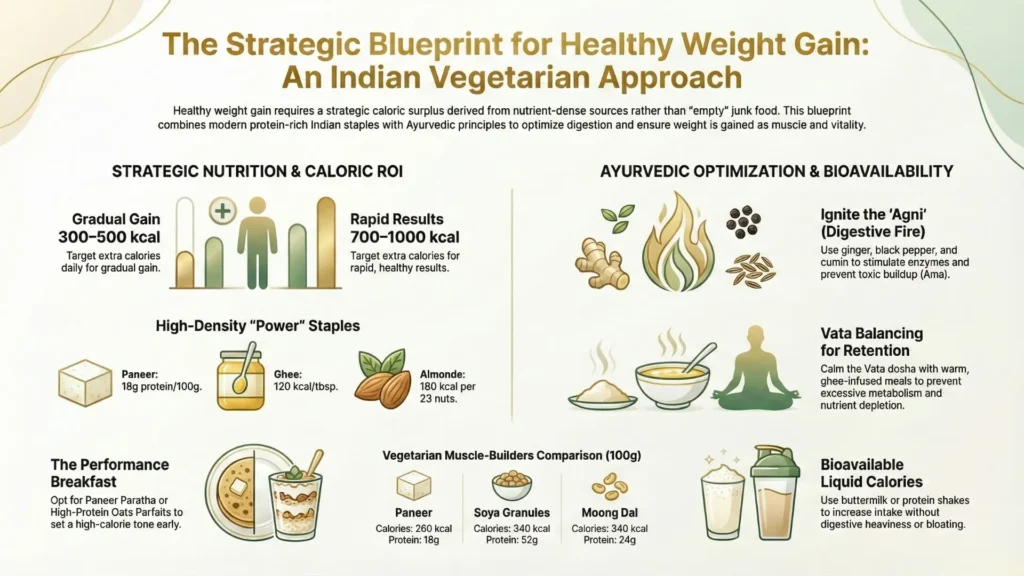
The core principle of gaining weight is the calorie surplus. Specifically, to gain roughly 0.5 kg of weight in a week, you generally need to consume an extra 500 calories every day beyond what you burn. However, if those 500 calories come entirely from sugar, you will likely gain fat. In contrast, if they come from a balance of protein, healthy fats, and complex carbohydrates, you will gain a mix of healthy fat and muscle. This is the goal when selecting healthy weight gain foods.
Quality matters because of the Thermic Effect of Food (TEF). Your body actually uses energy to digest food. Specifically, protein has a higher TEF than fats or carbs, meaning it helps stimulate your metabolism while providing the building blocks for muscle. Furthermore, fats are the most calorie-dense macronutrient, providing 9 calories per gram, compared to 4 calories per gram for protein and carbs. This makes fats a secret weapon for those with small appetites.
The Role of Nutrient Density
What this means for your daily routine is that you don’t necessarily need to eat double the amount of food; rather, you need to make your current food more energy-dense. For example, adding a tablespoon of desi ghee to your dal adds about 100-120 calories without increasing the volume of the meal at all. Moreover, the latest 2024 guidelines from the National Institute of Nutrition emphasize a shift toward nutrient density over calorie density alone.
Which Indian healthy weight gain foods are most effective?
Therefore, India is blessed with a variety of naturally calorie-dense foods that have been used for centuries to promote strength and vitality. Let’s explore the heavy hitters that should be staples in your kitchen.
Desi Ghee and High-Calorie Fats
Desi ghee is perhaps the most famous of all Indian healthy weight gain foods. Specifically, unlike highly processed vegetable oils, ghee contains medium-chain fatty acids that are easily absorbed by the liver and used for energy. In addition, it is rich in butyrate, which supports gut health—essential for absorbing the nutrients from the rest of your diet.
Paneer, Eggs, and Protein Sources
Furthermore, paneer is a unique combination of high protein and high fat. It contains casein protein, which is slow-digesting. This is why many experts suggest eating a small portion of paneer or paneer bhurji before bed; consequently, it provides your muscles with a steady stream of amino acids throughout the night. Additionally, if you are non-vegetarian, 2–5 whole eggs per day provide a complete source of protein essential for building muscle mass naturally.

Energy-Dense Fruits and Traditional Millets
Moreover, bananas and mangoes are nature’s energy boosters. If you are struggling to eat enough, blending a banana into a shake with full-fat milk and a spoonful of peanut butter can easily provide 400-500 calories in a single drink. Similarly, Ragi (finger millet) is exceptionally high in calcium and iron, making it a traditional superfood for weight gain.
Nuts, Seeds, and Sprouted Pulses
In addition, almonds, walnuts, and cashews are calorie-dense and easy to snack on for busy professionals. A small handful of almonds provides about 160 calories. While often thought of as light food, thick dals (like Dal Makhani or Rajma) are excellent for weight gain when prepared with traditional ingredients and extra ghee.
What does a full day Indian diet chart with healthy weight gain foods look like?
I know it’s hard to find time to plan every meal, but consistency is the secret to success. Accordingly, here is a sample plan that uses common Indian home-cooked meals to reach a target of approximately 2,800 to 3,000 calories.
The Early Morning Routine
- 6:30 AM – 7:30 AM: Firstly, start your day with a glass of warm full-fat milk.
- The Add-on: Specifically, add 5 soaked almonds and 2 walnuts. This provides a quick hit of healthy fats and protein to wake up your metabolism.
Balanced Breakfast and Mid-Morning Fuel
- Breakfast (8:30 AM): Next, have 2-3 Paneer-stuffed parathas or a large bowl of vegetable daliya. Use a generous amount of ghee and pair it with full-cream curd.
- Mid-Morning (11:00 AM): Meanwhile, consume one large banana and a handful of roasted peanuts or a glass of thick mango milkshake.
High-Calorie Lunch and Dinner
- Lunch (1:00 PM): Subsequently, eat 1.5 cups of rice and 2 rotis with ghee, 1 bowl of thick Dal, and 150g of Chicken or Fish curry.
- Evening Snack (4:30 PM): Additionally, have tea/coffee with whole milk and multigrain cookies or roasted makhana.
- Dinner (8:00 PM): Finally, for dinner, have 2-3 Rotis or 1 cup of Veg Pulao with a bowl of Paneer or Egg curry.
- Bedtime (10:00 PM): To finish, a glass of warm milk with Ashwagandha or a bedtime banana shake.

Why are supplements and skipping breakfast common mistakes?
One of the biggest hurdles I see at DietDekho is the supplement trap. Specifically, many people think that a mass gainer powder is the only way to see results. However, while supplements have their place, they are often loaded with artificial sugars and fillers that can cause bloating and digestive issues. Furthermore, the 2024 ICMR guidelines explicitly state that we should prioritize good quality proteins through an appropriate combination of foods rather than relying on protein supplements.
The Danger of Skipping the First Meal
In addition, skipping breakfast is another major error. Your body has been fasting for 8-10 hours while you sleep. Specifically, if you skip breakfast, your body continues to stay in a catabolic state, breaking down its own muscle and fat for energy. Even if you are a busy professional, a quick banana and a handful of nuts is better than nothing.
Is force-feeding effective?
Let’s be honest: if you aren’t used to eating a lot, trying to eat massive meals can make you feel nauseous. Instead, focus on frequent feeding. Specifically, six small, calorie-dense meals are much easier on your digestion than three giant ones. Use spices like ginger, cumin (jeera), and fennel (saunf) to help stimulate your appetite and aid digestion.
How to manage healthy weight gain foods for specific medical conditions?
Gaining weight when you have a medical condition like PCOS, Diabetes, or Thyroid issues requires a very careful, safety-first approach. Specifically, you cannot simply eat high-sugar foods, as these will worsen your condition.
Managing PCOS with Fiber and Protein
If you have PCOS, your body likely struggles with insulin resistance. Consequently, sugary weight gain foods can cause hormonal flare-ups. Instead, focus on high-protein and high-fiber options. Aim for at least 25 grams of fiber daily to help maintain blood sugar levels. Paneer, eggs, and nuts are your best friends here.
Diabetic-Friendly Calorie Surplus
Furthermore, for diabetics, the goal is to gain weight without spiking blood sugar. Specifically, focus on the Glycemic Index (GI). Foods like Moong Dal (GI 38), Paneer (GI 27), and Almonds (GI 0) are perfect. Additionally, you can increase your calorie intake by adding healthy fats like ghee to your meals, as fats have almost zero impact on blood sugar levels.
Supporting Thyroid Health and BP Management
Similarly, hypothyroidism often causes poor absorption. Accordingly, you need iodine and selenium from seafood, dairy, and Brazil nuts. Ensure B-vitamins (B12, B6) are adequate to support metabolic processes. In contrast, for Hypertension, avoid salty snacks and focus on potassium-rich healthy weight gain foods like avocados and bananas to help blood vessels relax.
| Condition | Primary Focus | Best Weight Gain Foods | Avoid/Limit |
| PCOS | Insulin Balance | Paneer, Walnuts, Sprouts | Sugary sweets, Maida |
| Diabetes | Low GI Surplus | Almonds, Whole Dals, Ghee | White Rice, Fruit Juices |
| Thyroid | Iodine & Selenium | Milk, Eggs, Cooked Saag | Raw Cruciferous Veggies |
| Hypertension | Low Sodium | Avocado, Banana, Seeds | Pickles, Processed Meats |

How to choose healthy weight gain foods for 2-year-olds?
Furthermore, for parents, seeing their child picky eat can be stressful. At age two, a child’s brain and bones are growing rapidly, requiring specific nutrients. In fact, the 1000-day nutrition window—from conception to age two—is the most critical time for establishing lifelong health.
The Best Toddler Weight Gain Foods
- Ragi Porridge: High in calcium for bone growth and energy.
- Mashed Banana with Ghee: A calorie-dense, soft food that kids love.
- Full-Fat Curd: Provides the probiotics needed for a healthy gut.
- Paneer Cubes: Great for self-feeding and packed with protein.
- Dal Khichdi: The ultimate Indian comfort food with extra ghee.
Additionally, avoid giving toddlers fruit juices or sugary snacks before mealtime, as this will spoil their appetite for the nutritious food they actually need. Specifically, offer small, frequent meals every 2-3 hours to support their unique energy requirements.
Be patient with your body: Healthy weight gain is a marathon, not a sprint
I want to be very real with you: your body cannot safely gain 5 kg of muscle in a week. Specifically, if you see rapid weight gain, it is usually water weight or fat. Ultimately, healthy weight gain—where you feel stronger and more energetic—takes time. Aim for a gain of about 0.25 kg to 0.5 kg per week. Consequently, this allows your skin, your heart, and your metabolism to adjust to your new size.
Consistency Over Intensity
What this means for your daily routine is that consistency is more important than intensity. Specifically, it is better to eat a slightly larger lunch every single day than to eat a massive feast once a week and skip meals the rest of the time. Furthermore, remember to sleep! Your muscles grow while you rest, not while you eat. Aim for 7-8 hours of quality sleep every night.
A Reassuring Note for Your Journey
In conclusion, gaining weight can feel like an uphill battle, especially when society focuses so much on weight loss. However, by choosing the right healthy weight gain foods and following a structured Indian diet plan, you are taking a major step toward a more vibrant, energetic version of yourself. Every healthy choice you make is a brick in the foundation of your future health.

Frequently Asked Questions (FAQs)
How can vegetarians gain weight fast in India?
Vegetarians can gain weight by focusing on high-calorie, protein-rich staples like paneer, full-fat milk, thick dals, and nuts. Furthermore, adding healthy weight gain foods like desi ghee to every meal is the most effective way to increase calories.
Which fruit is best for weight gain?
Bananas and mangoes are the best fruits for weight gain because they are higher in calories and carbohydrates than watery fruits. In addition, chikoo and custard apple (sitaphal) are also excellent seasonal Indian options.
Can I gain weight without going to the gym?
Yes, weight gain is primarily driven by your diet and a calorie surplus from healthy weight gain foods. However, light physical activity like yoga or walking can help stimulate your appetite and ensure the weight is distributed healthily.
Is it okay to eat ghee every day for weight gain?
For most healthy individuals, a teaspoon or two of ghee daily is perfectly safe and highly recommended for its calorie density and digestive benefits. Nonetheless, if you have heart issues, consult a DietDekho expert to find the right balance for you.
How can a busy professional find time to eat for weight gain?
The trick is snack density. Specifically, carry a box of mixed nuts, roasted chana, or peanut chikki. These are easy healthy weight gain foods that can be eaten between meetings and provide hundreds of calories.
Contact Us
We understand how overwhelming nutrition and weight loss information can feel. With so many opinions and confusing advice online, it’s easy to feel stuck or unsure about what to do next.
At Diet Dekho, you never have to figure it out alone. You can contact us anytime with any questions or concerns. Our expert dietitians are available 24/7 to guide, support, and help you stay on track. Whether your goal is weight loss or building healthier habits, we’re here to make the journey simpler and more sustainable for you.
Disclaimer
This blog is intended to help readers make healthier food choices. Your health should always be the top priority. Before starting any restrictive or special diet, especially if you have a medical condition or health concern, please consult a doctor or a qualified dietitian. Each body responds differently to food and lifestyle changes. Always choose what is safe and suitable for you.

Dr. Ritika is a nutrition and lifestyle expert with 2+ years of experience, helping clients manage weight and health through practical, personalized diet plans.