
Maya is forty-two years old and exhausted. Every morning, she drinks black coffee and runs five miles. She weighs her chicken breasts and counts every spinach leaf. Yet, the scale has not budged in three years. In fact, her jeans feel tighter around the waist than they did when she was twenty. She feels like her body is betraying her. If this sounds like your story, you are not failing your diet. Your diet might be failing your biology. For many women, the traditional eat less, move more mantra ignores the chemical messengers running the show. We need to talk about hormonal weight loss for women as a physiological puzzle rather than a math problem.
The reality is that your hormones dictate where you store fat and how easily you burn it. You can starve yourself, but if your insulin is high or your cortisol is peaking, your body will stay in storage mode. Think of your hormones as the software and your metabolism as the hardware. If the software is glitchy, the hardware will not perform. This report will break down the science of endocrine-driven weight management. We will move past the fluff and look at the actual clinical mechanisms that allow you to stop fighting your body and start working with it.
The Insulin Gatekeeper: Decoding the Fuel Switch
Table of Contents
- 1 The Insulin Gatekeeper: Decoding the Fuel Switch
- 2 Cortisol and the Stress-Weight Connection
- 3 The Estrogen Balance: Beyond Reproduction
- 4 Decoding Hunger: Leptin and Ghrelin Resistance
- 5 PCOS Weight Loss Tips: Navigating Hyperandrogenism
- 6 Perimenopause Weight Management: The Transition Years
- 7 Thyroid Weight Loss: The Metabolic Thermostat
- 8 Medical Interventions: Peptides and HRT
- 9 The Metabolic Reset Protocol: Putting It All Together
- 10 Practical Steps for Long-Term Success
- 11 Conclusion: Reclaiming Your Metabolic Health
- 12 Frequently Asked Questions
Insulin is perhaps the most powerful hormone in your weight loss arsenal. Most people know it as the blood sugar hormone, but it is also your primary fat-storage signal. When you eat, your pancreas releases insulin to usher glucose into your cells for energy. Here is the thing: when insulin levels are high, your body cannot burn fat. It is biochemically impossible for lipolysis—the breakdown of fat—to occur in a high-insulin environment. What this really means is that if you have high circulating insulin, you are effectively locked out of your own fat stores.
For many women, years of eating refined carbohydrates lead to insulin resistance. This is a condition where your cells stop listening to insulin’s knock. Your pancreas then pumps out even more insulin to compensate. This creates a vicious cycle of hyperinsulinemia and persistent fat storage. A 7% weight loss has been shown to reduce the onset of Type 2 diabetes by 58%, highlighting how sensitive the body is to even small shifts in insulin management.
The Carbohydrate-Insulin Model (CIM)
The Carbohydrate-Insulin Model suggests that it is the quality of carbohydrates, not just the quantity, that drives obesity. Processed, high-glycemic carbohydrates cause rapid hormonal shifts. These shifts promote calorie deposition in adipose tissue while simultaneously increasing hunger. Essentially, your fat cells are “hungry” for energy, leaving the rest of your body feeling starved.
| Carbohydrate Type | Glycemic Load | Insulin Response | Metabolic Impact |
| Refined Grains (White Rice, Flour) | High | Sharp Spike | Promotes rapid fat storage |
| Starchy Veggies (Potatoes) | High | Moderate Spike | Can hinder lipolysis if frequent |
| Legumes (Lentils, Chickpeas) | Low | Low/Stable | Supports sustained energy |
| Fibrous Veggies (Broccoli, Spinach) | Very Low | Minimal | Improves insulin sensitivity |
To implement an effective insulin resistance diet, you must focus on the glycemic index. Swapping white rice for brown rice or quinoa can lower your risk of metabolic dysfunction significantly. Research from the Shanghai Women’s Health Study indicates that women with high-glycemic diets have a 21% higher risk of diabetes. Stabilizing your blood sugar is the first step in any metabolic reset for women.
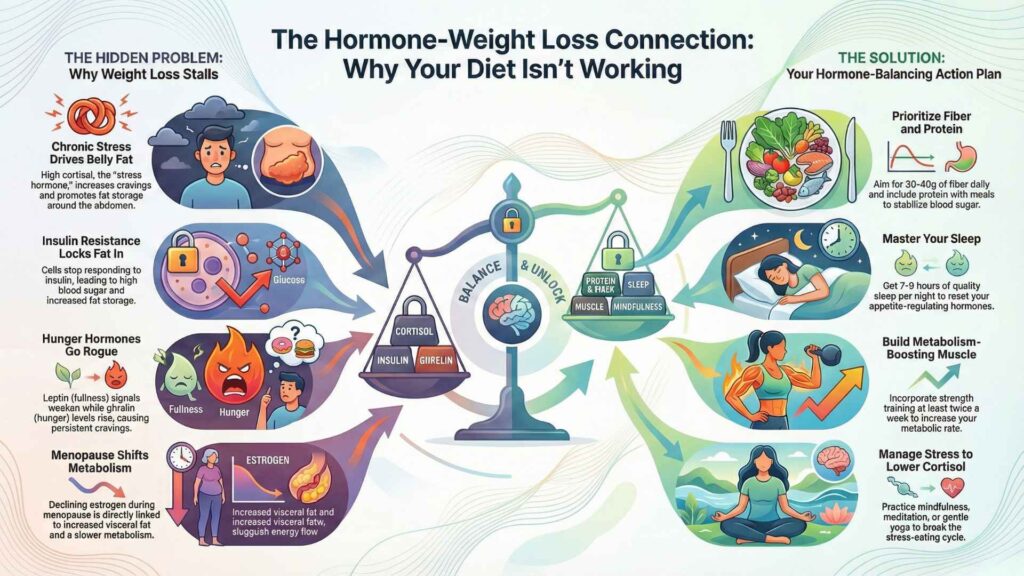
Clinical Strategies for Insulin Sensitivity
Losing weight is easier when you address the HOMA−IR (Homeostatic Model Assessment for Insulin Resistance). A study on postmenopausal women found that diet alone could improve HOMA−IR by 24% over 12 months. When you add moderate exercise, the results are even more consistent. It is not about killing yourself in the gym. It is about consistent movement that makes your muscles “hungry” for glucose without requiring massive insulin spikes.
| Study Group | 12-Month HOMA-IR Change | Restoration of Normal Glucose |
| Control Group | -2% | Baseline |
| Exercise Only | -9% | Moderate Improvement |
| Diet Only | -24% | High Success Rate |
| Diet + Exercise | -26% | Maximum Success Rate |
Cortisol and the Stress-Weight Connection
If you are carrying weight specifically around your midsection, we need to look at cortisol. Cortisol is the body’s primary stress hormone. It is designed to help you survive a temporary threat. However, in our modern world, the stress never really stops. Chronic stress leads to chronically elevated cortisol levels. This hormone has a unique affinity for visceral fat—the fat deep inside your abdomen that surrounds your organs.
Cortisol belly fat is not just an aesthetic issue. It is a metabolic one. High cortisol levels break down your lean muscle tissue to provide the liver with substrates for gluconeogenesis. This is a fancy way of saying your body eats its own muscle to create sugar. Less muscle means a lower resting metabolic rate. This makes it harder to lose weight even if you are eating very little.
The 11β-HSD1 Enzyme Mechanism
Inside your fat cells, an enzyme called 11β-hydroxysteroid dehydrogenase type 1 (11β-HSD1) acts as a local amplifier. This enzyme converts inactive cortisone back into active cortisol. In women with high stress, this enzyme is often upregulated in the abdominal region. This means even if your blood cortisol levels look okay, your belly fat is producing its own stress signals. This local “cortisol factory” makes losing waist circumference incredibly difficult without stress management.
| Hormone Combination | Physiological Result | Weight Outcome |
| High Cortisol + High Insulin | Increased Lipoprotein Lipase | Significant Visceral Fat Gain |
| High Cortisol + Low Insulin | Increased Hormone-Sensitive Lipase | Possible Muscle Wasting |
| Stable Cortisol + Stable Insulin | Balanced Fat Metabolism | Healthy Weight Maintenance |
Stress management is not just self-care; it is metabolic medicine. Practicing mindfulness meditation can reduce cortisol levels by up to 23%. This shift allows your body to exit “survival mode” and enter “repair mode.” When cortisol drops, your insulin sensitivity often improves as a secondary benefit. This double-win is the secret to getting rid of stubborn belly fat that resists traditional dieting.

Movement Without Overheating
While exercise is great, the wrong type can backfire. Doing too much high-intensity interval training (HIIT) when you are already stressed can actually spike your cortisol higher. This is why many women find that they lose more weight when they switch to walking or yoga. Low-impact activities help lower cortisol while still burning calories. For hormonal weight loss for women, the goal is to move your body without signaling to your brain that you are under attack.
Try to keep your intense workouts to 30 or 45 minutes. This window allows you to get the heart-rate benefits without the excessive cortisol rise that comes with long-duration cardio. If you feel exhausted rather than energized after a workout, your cortisol is likely too high. Listen to that signal. Sometimes, a twenty-minute nap or a slow walk in nature is more effective for weight loss than a spin class.
The Estrogen Balance: Beyond Reproduction
Estrogen is often blamed for weight gain, but the reality is more nuanced. Estrogen is actually a metabolic protector when it is in balance. It helps regulate fat storage and improves insulin sensitivity. Problems arise during two specific scenarios: estrogen dominance and the estrogen drop of menopause.
Estrogen dominance weight gain typically manifests as fat around the hips and thighs. This happens when you have too much estrogen relative to progesterone. This imbalance can be caused by stress, poor liver detoxification, or exposure to environmental chemicals. Estrogen tells your body to store fat to ensure you are fertile enough to carry a pregnancy. If your brain thinks you have “too much” estrogen, it goes into storage overdrive.
Environmental Xenoestrogens and Weight
We live in a sea of chemicals that mimic estrogen. These are called xenoestrogens. They are found in plastics (BPA), phthalates in perfumes, and pesticides on non-organic produce. These molecules bind to your estrogen receptors and send the “store fat” signal. This is a huge factor for women who are doing everything right but still seeing weight gain. Reducing your toxic load is a non-negotiable part of a natural hormone balance.
| Source of Xenoestrogens | Replacement Strategy | Hormonal Benefit |
| Plastic Water Bottles | Stainless Steel or Glass | Reduces BPA exposure |
| Synthetic Fragrances | Essential Oils or Fragrance-Free | Lowers phthalate burden |
| Pesticide-Heavy Produce | Organic (Follow Clean 15/Dirty Dozen) | Protects liver detoxification |
| Non-Stick Cookware | Cast Iron or Ceramic | Limits endocrine disruptors |
Supporting your liver is essential here. Your liver is responsible for breaking down used estrogen so it can be excreted. If your liver is sluggish due to alcohol or a high-sugar diet, that estrogen recirculates in your body. Eating cruciferous vegetables like broccoli and kale provides compounds like Indole-3-Carbinol, which help the liver process estrogen safely.
The Progesterone Protective Factor
Progesterone is the calming counterpart to estrogen. It acts as a natural diuretic and can boost your metabolism slightly. However, progesterone is often the first hormone to drop when you are stressed. The body uses the same raw materials to make cortisol that it uses to make progesterone. In a high-stress state, your body will always prioritize the stress hormone over the reproductive one. This is known as the “pregnenolone steal”. Maintaining progesterone levels is key to preventing the bloating and weight gain associated with estrogen dominance.

Decoding Hunger: Leptin and Ghrelin Resistance
Weight loss often feels like a battle of willpower, but willpower is a finite resource. Your hunger is controlled by two main hormones: leptin and ghrelin. Ghrelin is produced in the stomach and tells your brain you are hungry. Leptin is produced by your fat cells and tells your brain you are full and have enough energy.
In a healthy system, more fat should lead to more leptin, which should lead to less hunger. But in many women, this feedback loop breaks. This is called leptin resistance. Your brain becomes deaf to the “full” signal. Even if you have plenty of stored energy (fat), your brain thinks you are starving. This leads to intense cravings and a sluggish metabolism as your body tries to conserve energy.
The Inflammation-Leptin Cycle
Leptin resistance is primarily driven by inflammation and high insulin. When you eat ultra-processed foods, they trigger inflammatory markers that block leptin from reaching your brain. Here is the kicker: as you lose weight, your leptin levels naturally drop. If your brain is still leptin-resistant, it perceives this drop as a life-threatening famine. This is why many people hit a plateau and feel ravenously hungry after losing the first ten pounds.
| Hormone | Primary Function | How to Optimize |
| Leptin | Signals satiety and energy stores | Avoid processed sugar; get 8 hours of sleep |
| Ghrelin | Stimulates appetite | Eat high-protein breakfasts; stay hydrated |
| GLP-1 | Increases fullness after meals | Eat fiber; consider slow-digesting carbs |
Ghrelin hunger control is largely about meal timing and composition. Protein is the most effective macronutrient for lowering ghrelin. If you start your day with a high-protein breakfast, your ghrelin levels will stay lower for hours. Conversely, skipping meals or eating a high-sugar breakfast can cause ghrelin to spike, leading to overeating later in the day.
The Sleep-Hunger Connection
If you want to master your hunger hormones, you must master your sleep. Just a few nights of poor sleep can drop your leptin levels and spike your ghrelin. This is why you crave donuts and pasta after a late night. Your brain is looking for a quick hit of energy because it feels “starved” by the lack of restorative sleep. Aim for 7 to 9 hours of quality sleep to keep your hunger hormones in a healthy balance.

Polycystic Ovary Syndrome (PCOS) affects roughly 10% of women and is a major hurdle for weight loss. PCOS is not just an ovarian issue; it is a full-body metabolic disorder characterized by high androgens (male-type hormones) and profound insulin resistance. For women with PCOS, weight gain is often concentrated in the midsection, and losing it can feel like pushing a boulder uphill.
The high insulin levels in PCOS tell the ovaries to produce more testosterone. This testosterone then makes it harder to lose weight and can cause symptoms like thinning hair or skin breakouts. It is a biological “double whammy.” However, clinical trials show that women with PCOS can lose weight just as effectively as others when they use the right strategies.
The Power of Fiber and Protein in PCOS
For PCOS, the goal is to manage the “insulin-androgen” axis. This means prioritizing fiber-rich whole grains and lean proteins. Fiber slows down the absorption of sugar, which prevents the insulin spikes that drive testosterone production. Protein helps maintain muscle mass, which is often compromised in women with high insulin resistance.
- Whole Grains: Oats, barley, and quinoa provide the slow-burning fuel your body needs.
- Lean Protein: Chicken, fish, tofu, and legumes keep you full and stabilize blood sugar.
- Healthy Fats: Avocados and olive oil support hormone production without spiking insulin.
A 2024 meta-analysis found that high-protein diets specifically improved insulin resistance in women with PCOS, making weight loss more attainable. It is not about cutting carbs completely; it is about choosing the ones that work for you, not against you.
Exercise for PCOS Management
In the context of PCOS, exercise is a form of medicine. Strength training is particularly beneficial because it builds muscle mass, which increases the number of insulin receptors on your cells. This makes your body more efficient at processing sugar. Aim for at least 150 minutes of moderate activity per week, but make sure to include at least two days of resistance training.
| Exercise Type | Primary Benefit for PCOS | Recommended Frequency |
| Strength Training | Improves insulin sensitivity | 2-3 times per week |
| Walking (Brisk) | Lowers cortisol and burns fat | Daily (30-45 mins) |
| Yoga | Reduces stress-related androgens | 1-2 times per week |
| HIIT | Increases metabolic rate | 1-2 times per week (with caution) |

Perimenopause Weight Management: The Transition Years
As women approach their late 30s and early 40s, the hormonal landscape shifts again. Perimenopause is the long runway leading up to menopause. During this time, estrogen and progesterone levels begin to fluctuate wildly. This can lead to a slowing metabolism and a shift in fat storage toward the abdomen.
Weight loss for women over 40 requires a change in strategy. You can no longer rely on the high-intensity, low-calorie approach that may have worked in your 20s. Your body is more sensitive to stress and less efficient at burning fat. Researchers found that postmenopausal women burn about 150 to 200 fewer calories per day than they did pre-menopause. This means you have to be more intentional with your nutrition and movement.
The Role of Sarcopenia and Metabolism
One of the biggest drivers of weight gain in perimenopause is sarcopenia—the natural loss of muscle mass that occurs with aging. Muscle is metabolically expensive tissue; it burns calories even while you sleep. As you lose muscle, your basal metabolic rate drops. This makes weight gain feel inevitable.
To combat this, you need to prioritize protein and resistance training. You should aim for 25 to 30 grams of protein per meal to trigger muscle protein synthesis. This helps you hold onto your calorie-burning muscle even as your hormones shift. For personalized nutritional guidance during this phase, a consultation with a specialist at(https://dietdekho.com/form/) can help you determine your specific needs.
Heart Health and the Menopausal Shift
During perimenopause, the risk of cardiovascular disease rises sharply as estrogen levels fall. This is why perimenopause weight management is about more than just the scale; it is about protecting your heart. Estrogen helps keep your arteries flexible and your “good” HDL cholesterol high. As it drops, your blood pressure and cholesterol levels may start to climb.
| Health Marker | Menopausal Shift | Protective Strategy |
| HDL Cholesterol | Often decreases | Increase Omega-3 intake |
| Visceral Fat | Often increases | Implement fiber-rich diet |
| Bone Density | Decreases | Weight-bearing exercise |
| Sleep Quality | Often declines | Cool bedroom; limit evening screens |
Lengthening the duration of your overnight fast can also be a helpful tool. Research has shown that a longer fasting window can help increase fat burning in menopausal women, which naturally decreases during this life stage. Even a simple 12 to 14-hour fast can make a difference in how your body processes energy.

Thyroid Weight Loss: The Metabolic Thermostat
The thyroid is often called the master gland of metabolism. It produces hormones like T3 and T4 that set the pace for every cell in your body. When your thyroid is underactive (hypothyroidism), everything slows down. You feel tired, you feel cold, and you gain weight no matter how little you eat.
For women, thyroid issues are often linked to other hormonal imbalances. For example, high estrogen can increase the levels of Thyroid Binding Globulin (TBG). This “locks up” your thyroid hormone so your cells can’t use it. This means you can have normal thyroid levels on a standard blood test, but still have all the symptoms of a slow metabolism.
Nutrients for Thyroid Support
Your thyroid requires specific raw materials to function properly. Iodine, selenium, and zinc are essential for the production and conversion of thyroid hormones. If you are deficient in these, your metabolism will suffer.
- Selenium: Found in Brazil nuts, it helps convert T4 (inactive) into T3 (active).
- Iodine: Found in seaweed and iodized salt, it is the building block of thyroid hormone.
- Zinc: Found in pumpkin seeds and shellfish, it helps your cells listen to thyroid signals.
Checking your thyroid function is a necessary part of a comprehensive hormonal health assessment. If you have persistent fatigue and hair thinning alongside weight gain, it is worth asking your doctor for a full panel, including Free T3 and Reverse T3.
Medical Interventions: Peptides and HRT
Sometimes, lifestyle changes need a helping hand. We are living in a golden age of metabolic medicine, with new tools that can help reset your body’s weight-regulation mechanisms.
Peptide Therapy for Weight Loss
Peptides are short chains of amino acids that act as signaling molecules. The most famous of these are GLP-1 receptor agonists, such as Semaglutide (Wegovy) and Tirzepatide (Zepbound). These medications mimic natural hormones that tell your brain you are full and slow down your digestion.
Clinical studies have shown that these peptides can lead to a 15% to 20% reduction in body weight. They work by addressing the “internal” factors of hunger and cravings that often make traditional dieting impossible. Peptide therapy for weight loss can be a game-changer for women with significant insulin resistance or leptin resistance.
| Peptide Medication | Mechanism of Action | Avg Weight Loss (%) |
| Semaglutide | GLP-1 Mimic | ~14.9% |
| Tirzepatide | GLP-1 + GIP Mimic | ~20.9% |
| Liraglutide | Daily GLP-1 | ~8.0% |
| CJC-1295 | Growth Hormone Releasing | Metabolic Support |
Peptide therapy should always be done under medical supervision. These tools are most effective when paired with a healthy diet and regular movement. They are not “magic pills,” but they can provide the metabolic bridge many women need to see results.
Hormone Replacement Therapy (HRT)
For women in menopause, hormone replacement therapy weight loss is a valid option to consider. HRT helps restore the balance of estrogen and progesterone. This can help reverse the abdominal weight gain and metabolic slowing associated with menopause.
Studies have shown that for women who have never used HRT, losing weight after menopause can cut the risk of breast cancer in half. HRT combined with strength training and a nutritious diet is often described as a “game-changer” for weight management in your 50s and beyond. It is about finding the right dose for your unique biology.

The Metabolic Reset Protocol: Putting It All Together
A metabolic reset is not a quick fix. It is a series of intentional shifts that allow your body to function at its best. There is no health organization that “approves” a single metabolic reset program, but the principles are backed by decades of research on metabolic health.
To truly balance your hormones to lose weight, you need to address your nutrition, movement, stress, and sleep in a holistic way. This isn’t about perfection. It is about consistency. Small, daily choices add up to massive hormonal shifts over time.
The 30/30/30 Rule
A popular and effective trend for hormonal health is the 30/30/30 rule. This involves consuming 30 grams of protein within 30 minutes of waking up, followed by 30 minutes of low-intensity exercise like walking.
This strategy works because the high protein intake stabilizes your blood sugar and lowers your ghrelin (hunger) for the rest of the day. The low-intensity cardio burns fat without spiking your cortisol. It is a simple way to set your metabolic tone every morning.
Macronutrient Ratios for Balance
While calories matter, where those calories come from is even more important for your hormones. A general guideline for women looking to balance hormones is to focus on a moderate-carbohydrate, high-protein, and healthy-fat approach.
| Macronutrient | Targeted Percentage | Goal |
| Protein | 25-30% | Support muscle and satiety |
| Healthy Fats | 30-35% | Provide building blocks for hormones |
| Complex Carbs | 35-40% | Fuel thyroid and brain function |
Aim for at least 25 grams of fiber every day. Fiber is your best friend for hormonal weight loss because it helps clear excess estrogen and stabilizes insulin. You can find it in fruits, vegetables, beans, and whole grains.
Practical Steps for Long-Term Success
The journey to hormonal balance is a marathon, not a sprint. People who lose weight slowly—about 1 to 2 pounds per week—are far more successful at keeping it off in the long term. This allows your body to adjust to the new “set point” without triggering a survival-based metabolic slowdown.
Mindful Eating Practices
How you eat is as important as what you eat. Research from the NIH shows that eating in a relaxing environment can actually lead to eating less and enjoying food more. Try to put your fork down between bites and chew your food thoroughly. This gives your gut hormones time to signal to your brain that you are full.
- Eat Slower: Take at least 20 minutes for a meal.
- No Screens: Avoid eating in front of the TV to prevent mindless overconsumption.
- Listen to Cues: Stop eating when you feel satisfied, not when the plate is empty.
Rewarding Your Wins
Weight loss is hard, and our brains respond better to frequent small rewards than one big one at the end. Every time you hit a small goal—like drinking your water for a week or finishing a strength workout—reward yourself with something non-food related. Buy a new book, get a massage, or spend an afternoon in nature.
Conclusion: Reclaiming Your Metabolic Health
Hormonal weight loss for women is about understanding the delicate dance of your biology. You are not a broken machine; you are a complex ecosystem. By addressing insulin resistance, managing cortisol, and supporting your sex hormones, you can unlock the results you’ve been working so hard for.
Remember Maya? She replaced her daily five-mile runs with strength training three times a week. Along with that shift, her meals became richer in protein and fiber, and breakfast turned into a non-negotiable part of the day instead of something she skipped. Better sleep and a simple five-minute meditation habit helped her stay consistent without burning out. Within six months, her “cortisol belly” began to shrink, and she had more energy than she did in her 30s.
Your body wants to be healthy. It wants to be in balance. When you provide it with the right signals—through nutrition, movement, and rest—it will respond. You don’t have to figure this out alone. Expert guidance is just a click away to help you navigate the complexities of your unique hormonal profile.
Ready to start your journey? Let the experts at Diet Dekho create a plan that works with your hormones, not against them. Get your personalized metabolic plan here.

Frequently Asked Questions
What is the primary cause of hormonal weight gain in women over 40?
The most common cause is a combination of declining estrogen and progesterone, which shifts fat storage to the abdomen, and a loss of muscle mass (sarcopenia). These changes can lead to insulin resistance and a slower resting metabolic rate.
How can I tell if my weight gain is related to cortisol?
Cortisol-related weight gain typically concentrates in the midsection and face, while arms and legs stay relatively thin. You may also experience persistent fatigue, high sugar cravings, and trouble sleeping. Managing stress and avoiding overtraining are essential for reducing cortisol belly fat.
Can an insulin resistance diet help if I don’t have diabetes?
Yes! Insulin resistance often precedes diabetes by 10 to 15 years. Adopting a diet rich in whole grains and fiber and avoiding refined sugars can help you lose weight and prevent chronic disease before it starts.
Are there natural ways to balance leptin resistance?
Focusing on whole, unprocessed foods and avoiding added sugars is the best way to “re-sensitize” your brain to leptin. Prioritizing 7 to 9 hours of quality sleep and moving your body consistently also helps restore healthy hunger and fullness signals.
Is peptide therapy for weight loss a permanent solution?
Peptides are a powerful tool to reset your metabolic state, but long-term success depends on combining them with healthy lifestyle habits. They can help you achieve significant weight loss, which in turn improves your body’s natural hormone regulation.
BOOK YOUR APPOINTMENT

Abhinav is the Founder of Diet Dekho, helping people manage weight and lifestyle health through simple, practical nutrition and personalized diet plans.