The internal conflict between the aroma of freshly fried samosas and the discipline required for a calorie-restricted diet is a daily reality for millions of individuals. This psychological and physiological tug-of-war raises a fundamental question: How Cheat Meals Affect Weight Loss Progress when the surrounding culture revolves heavily around food, festivals, and social gatherings? For the busy professional, the homemaker managing family meals, or the NRI trying to maintain cultural roots while staying fit, understanding the biological and mental impact of these indulgences is the difference between long-term success and repeated failure.
How Cheat Meals Affect Weight Loss Progress is determined by the frequency of indulgence, the hormonal response to caloric surplus, and the psychological relationship with “forbidden” foods.A structured, high-calorie meal—when intentionally planned—can offer psychological relief and temporarily support leptin levels, which influence appetite and energy balance. But repeated episodes of eating excessively without planning can erase a week’s calorie deficit and disrupt progress during fat-loss plateaus.
Does the occasional indulgence support or stall fat loss goals?
Table of Contents
- 1 Does the occasional indulgence support or stall fat loss goals?
- 2 What happens to your body after a cheat meal?
- 3 Is there a difference between a cheat meal and a refeed day?
- 4 How do cheat meals affect weight loss progress for people with PCOS or Diabetes?
- 5 Can you have a cheat meal on a Keto diet without breaking ketosis?
- 6 Why do cheat meals often lead to a fat loss plateau?
- 7 How to eat cheat meals without gaining weight: Indian lifestyle hacks
- 8 What are the psychological benefits of planned cheat meals?
- 9 Healthy Indian cheat meal alternatives for weight loss
- 10 How to recover after a heavy cheat meal?
- 11 The 2024 ICMR-NIN Guidelines: A New Framework for Indian Health
- 12 NRI Challenges: Managing Indian food habits abroad
- 13 Social Pressure and “Log Kya Kahenge” in the Weight Loss Journey
- 14 How many cheat meals per week for weight loss?
- 15 The Impact of Cheat Meals on Metabolism: Fact vs. Fiction
- 16 Practical Guide to Mindful Cheating in an Indian Weight Loss Journey
- 17 Conclusion
The initial stages of any weight loss journey are often characterized by rigid discipline and strict caloric deficits. However, the human body is not a static machine; it is a biological system designed for survival. When calories are restricted for long periods, the body adapts through a process known as metabolic adaptation or adaptive thermogenesis. This mechanism slows down the resting metabolic rate (RMR) to preserve energy stores, making it harder to continue losing weight.
What this means for your daily routine is that the “cheat meal” is often viewed as a tool to counteract this metabolic slowdown. Proponents argue that a sudden influx of calories, particularly from carbohydrates, can signal to the brain that there is no famine, thereby temporarily increasing the metabolic rate and regulating hunger hormones like leptin. However, the reality is often more complex. While a cheat meal might offer a minor boost in energy expenditure through the thermic effect of food, this increase is rarely large enough to cancel out the massive intake of calories typically associated with such meals.
In simple terms, for healthy individuals, a single planned meal that deviates from the diet is unlikely to derail progress. The risk arises when the “meal” turns into a “cheat day” or a “cheat weekend.” For those managing conditions like diabetes or obesity, even one high-sugar meal can trigger significant blood sugar spikes and potentially reverse metabolic gains made during the week.
What happens to your body after a cheat meal?
When an individual consumes a meal significantly higher in calories, fats, and carbohydrates than their usual intake, several physiological processes are triggered. First, the blood glucose levels rise rapidly, especially if the meal is rich in refined flours like maida or added sugars. This leads to a substantial spike in insulin, the storage hormone. In a healthy body, this insulin helps shuttle glucose into the muscles and liver to replenish glycogen stores.
However, if the person is sedentary or has already hit their glycogen capacity, the excess energy is converted into triglycerides and stored in adipose (fat) tissue. Beyond fat storage, many experience significant water retention. For every gram of carbohydrate (glycogen) stored in the body, approximately 3 to 4 grams of water are held alongside it. This explains why the scale might jump by 1 or 2 kilograms the morning after a heavy dinner at an Indian wedding; it is not immediate fat gain, but rather “water weight” and undigested food volume.
The hormonal cascade and the role of leptin
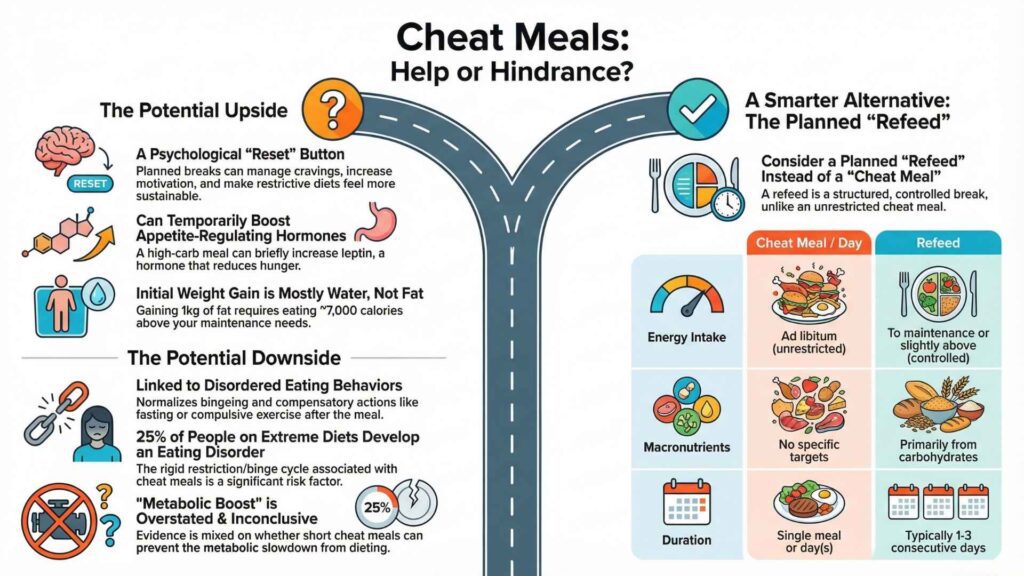
Leptin is the hormone produced by fat cells that tells the brain, “We have enough energy; stop eating.” During a prolonged diet, leptin levels drop, leading to increased hunger and decreased energy expenditure. A high-carbohydrate cheat meal can cause a temporary spike in leptin levels, sometimes by as much as 30%. This spike can temporarily reduce the feeling of deprivation and increase the dieter’s motivation to stick to their plan for the following days.
| Hormone | Response to Cheat Meal | Impact on Weight Loss Progress |
| Leptin | Acute Increase | Temporarily boosts satiety and may slightly increase metabolic rate. |
| Insulin | Sharp Spike | High spikes promote fat storage, especially in insulin-resistant individuals. |
| Ghrelin | Temporary Decrease | Suppresses hunger signals immediately after the meal. |
| Cortisol | Potential Decrease | Reducing the stress of strict dieting can lower cortisol, which helps prevent abdominal fat storage. |

Is there a difference between a cheat meal and a refeed day?
In the professional nutrition community, the terms “cheat meal” and “refeed day” are often used interchangeably, but they represent very different strategies. A cheat meal is generally an unstructured, ad libitum (unrestricted) meal where the individual eats whatever they crave without specific targets. A refeed day, on the other hand, is a planned increase in calories, focusing primarily on carbohydrates while keeping fats low.
The short answer is that refeeds are often more effective for those looking to manage a fat loss plateau. Carbs are superior to fats at increasing leptin levels and refilling muscle glycogen. By intentionally increasing carb intake while controlling total calories, a refeed day provides the metabolic benefits of a “cheat” without the uncontrolled caloric surplus that leads to fat gain.
Choosing between unstructured cheating and strategic refeeding
For a busy professional in India, a refeed might look like adding an extra portion of brown rice or sweet potato to their meals, whereas a cheat meal might be a plate of Chole Bhature or a pizza. While the latter is more psychologically satisfying, it often comes with a high fat content that can easily lead to a caloric surplus exceeding the weekly deficit.
| Feature | Cheat Meal | Refeed Day |
| Planning | Often spontaneous or emotionally driven | Strictly planned in advance. |
| Macronutrient Focus | Any (usually high fat and sugar) | High Carbohydrate, Low Fat. |
| Control | Unrestricted portions | Measured caloric increase (20-30%). |
| Purpose | Mental break / Social indulgence | Reverse metabolic adaptation / glycogen refill. |
How do cheat meals affect weight loss progress for people with PCOS or Diabetes?
For individuals managing medical conditions, the question of How Cheat Meals Affect Weight Loss Progress takes on a clinical dimension. Conditions such as Polycystic Ovary Syndrome (PCOS) and Type 2 Diabetes are fundamentally linked to insulin resistance. In these cases, the body struggles to manage blood sugar, and high-carb or high-sugar cheat meals can have detrimental effects beyond just calorie counting.
In women with PCOS, a massive insulin spike from a cheat meal can trigger the ovaries to produce excess androgens (male hormones). This hormonal imbalance can lead to irregular periods, acne, and weight gain, particularly in the abdominal area. For those with diabetes, these spikes make long-term glycemic control difficult and can lead to immediate symptoms of lethargy and “sugar crashes”.
Strategies for safe indulgence with medical conditions
Let’s simplify this: having a condition like PCOS or diabetes doesn’t mean you can never enjoy a treat, but it does mean you need a “smart” strategy. The ICMR-NIN 2024 guidelines emphasize the importance of low-glycemic index (GI) foods and high fiber intake for managing these conditions.
- Sequence your food: Start with a fiber-rich salad or protein (like paneer or chicken) before having your “cheat” item. This slows down the absorption of sugar into the bloodstream.
- Limit dairy in PCOS: Some evidence suggests that dairy contains IGF-1, which can mimic insulin and worsen PCOS symptoms. Choosing non-dairy treats might be a better option.
- Focus on small portions: Instead of a full “cheat meal,” opt for a “controlled treat”—a small portion of your favorite food as part of a balanced meal.
Can you have a cheat meal on a Keto diet without breaking ketosis?
The ketogenic (Keto) diet relies on keeping the body in a state of ketosis, where it burns fat for fuel instead of glucose. To maintain this state, most people must consume fewer than 50 grams of net carbs per day. A single Indian cheat meal, such as a serving of Biryani or even a few rotis, will easily exceed this limit and kick the body out of ketosis.
What this means for your daily routine is that “cheating” on Keto has a higher metabolic cost than on a standard balanced diet. Once out of ketosis, it can take anywhere from 24 hours to a full week for the body to return to a fat-burning state. During this period, weight loss is stalled, and the individual may experience “Keto Flu”—headaches, fatigue, and brain fog—as the body re-adjusts.
How to recover after a heavy cheat meal on Keto
If a slip-up occurs, the most effective way to re-enter ketosis is through a combination of intermittent fasting and exercise. Fasting for 16-24 hours after the cheat meal helps the body burn through the newly stored glycogen. Additionally, high-intensity interval training (HIIT) or weight training can accelerate the depletion of these sugar stores.

Why do cheat meals often lead to a fat loss plateau?
It is common to hear people complain that they “ate healthy all week but didn’t lose weight.” Often, the culprit is the weekend “cheat.” If an individual maintains a daily deficit of 500 calories (3,500 per week) but consumes 4,000 extra calories between Friday night and Sunday evening, they have effectively wiped out their entire week’s progress.
This pattern creates a fat loss plateau because the body never stays in a net caloric deficit long enough to burn stored fat. Furthermore, the high sodium levels in many Indian cheat foods—like pickles, papads, and street snacks—cause persistent water retention that masks any fat loss on the scale.
The 80/20 rule for sustainable progress
I know it’s hard to find time to track every morsel, but the 80/20 rule offers a realistic middle ground. This means eating nutritiously and staying within your calorie targets for 80% of the time, while allowing for planned flexibility for the remaining 20%. This method tends to last longer because it reduces the sense of restriction that often drives patterns of overeating. By removing the mental pressure of feeling deprived, it supports a healthier relationship with food and more consistent progress.
How to eat cheat meals without gaining weight: Indian lifestyle hacks
In the Indian context, social eating is almost mandatory. Whether it’s a family brunch or a dinner at an NRI friend’s place abroad, refusing food can be difficult. However, there are several “hacks” to minimize the impact of these meals on your weight loss progress.
The “Fiber-First” approach
Eating protein and vegetables before your carbs is a game-changer. Fiber acts like a net in your digestive system, slowing down the absorption of fats and sugars. At an Indian dinner, this might mean starting with a large bowl of Kachumber salad or a serving of dal before touching the Naan or Pulao.
Hydration as a tool
Drinking water 5 to 10 minutes before a meal can trick the brain into feeling full sooner. Additionally, staying hydrated during the cheat meal helps your kidneys flush out the excess sodium that causes post-meal bloating.
Mindful cheating
What happens to your body after a cheat meal depends on how much you eat. Using smaller plates and chewing slowly are classic but effective ways to practice portion control. If you are craving a specific sweet like Gulab Jamun, have one and savor every bite rather than eating three or four mindlessly.
What are the psychological benefits of planned cheat meals?
Weight loss is as much a mental journey as a physical one. Strict food rules are a well-known trigger for disordered eating patterns and long-term diet relapse.
19 By allowing for a planned indulgence, many individuals feel a sense of psychological relief. They no longer feel like they are “trapped” in a diet, which makes long-term adherence much easier.
Research indicates that participants permitted weekly cheat meals reported up to 23% higher adherence rates compared to those on continuously restrictive regimens. The key word here is “planned.” When the indulgence is intentional, it feels like a reward; when it is impulsive, it often leads to guilt and a feeling of having “failed,” which can trigger more overeating.
Dealing with the guilt after an indulgence
If you find yourself feeling guilty after a heavy meal, remember that one meal will not ruin months of hard work. In simple terms, fat loss is about the trend over weeks and months, not hours. The most important thing is to return to your normal routine immediately. Skipping the next meal as a form of self-penalty often backfires, increasing the chances of later excessive eating driven by hunger.

Healthy Indian cheat meal alternatives for weight loss
You don’t always have to choose between “healthy” and “tasty.” Indian cuisine is incredibly diverse and offers many options that satisfy cravings without the caloric bomb.
| If you crave… | Try this instead… | The Benefit |
| Deep-fried Samosa | Baked Samosa or Moong Dal Chilla | Much lower in saturated fats and higher in protein. |
| Butter Chicken & Naan | Tandoori Chicken & Whole Wheat Roti | Lower in refined flour and cream; high in lean protein. |
| Fried Rice/Biryani | Quinoa Pulao or Brown Rice Biryani | Higher fiber content, which prevents blood sugar spikes. |
| Gulab Jamun/Kulfi | Greek Yogurt with Honey or Fruit Chaat | Probiotics and natural sugars instead of refined syrup. |
| Maida-based Pizza | Oats or Millet Pizza Base | Complex carbohydrates that provide sustained energy. |
How to recover after a heavy cheat meal?
Waking up after an indulgent night with a “food hangover” is a common experience. Your stomach feels bloated, your energy is low, and the scale is up. Let’s simplify the recovery process with home-based solutions.
The 2.5-liter hydration rule
Drinking plenty of water is the most important step after an indulgence. It helps the body process the excess salt and sugar. Herbal teas like fennel (saunf) or ginger tea can also help soothe an irritated digestive system and reduce bloating.
Gentle movement, not intense punishment
While you might feel the urge to run for two hours to “burn off” the pizza, a simple 20-30 minute walk is often more effective for digestion and mental clarity. Over-exercising after a heavy meal can actually increase cortisol, which can further stall weight loss.
The “Skip the Scale” rule
Do not weigh yourself the day after a cheat meal. The number you see will be inflated by water weight and glycogen, which can be discouraging. Wait 48 to 72 hours for your body to stabilize before checking your progress again.
The 2024 ICMR-NIN Guidelines: A New Framework for Indian Health
The Indian Council of Medical Research (ICMR) and the National Institute of Nutrition (NIN) released updated dietary guidelines in 2024 that reflect the changing health landscape of the country. These guidelines provide a scientific backbone for How Cheat Meals Affect Weight Loss Progress in the modern Indian context.
One of the most significant shifts in the 2024 guidelines is the recommendation to limit added sugars to less than 5% of total caloric intake.2 Most traditional Indian sweets and sodas consumed during cheat meals easily exceed this daily limit in a single serving. Furthermore, the guidelines have increased the recommended vegetable intake to 400g daily to address rising rates of micronutrient deficiencies and obesity.

Addressing the dual burden of malnutrition and obesity
India currently faces a “dual burden,” where undernutrition coexists with rising rates of obesity and diabetes. The 2024 guidelines emphasize that lifestyle modifications—including diet quality, physical activity, and behavior changes—are the first-line treatment for metabolic disorders like PCOS and hypertension.
What this means for your daily routine is that the quality of your cheat meal matters as much as the quantity. Choosing home-cooked “indulgences” over ultra-processed factory-made snacks aligns with the national goal of preventing diet-related non-communicable diseases.
| Nutrient | ICMR 2024 Recommendation | Significance for Weight Loss |
| Dietary Fiber | 25–30 g/day | Essential for digestion and preventing fat loss plateaus. |
| Vegetables | 400 g/day | Provides volume and micronutrients for satiety. |
| Added Sugar | <5% of total calories | Key to preventing insulin resistance and PCOS complications. |
| Hydration | 8–12 glasses/day | Critical for metabolism and recovery from heavy meals. |
NRI Challenges: Managing Indian food habits abroad
For Non-Resident Indians (NRIs) living in Western countries, managing weight loss and cheat meals presents unique challenges. Many struggle to find a balance between the hyper-palatable, processed foods available locally and the traditional Indian meals they crave.
Often, the “cheat meal” for an NRI is simply a home-cooked Indian dinner because their daily diet has become Westernized. To manage this, nutritionists recommend adapting Indian meals smartly—for example, using local flours for rotis or incorporating high-protein options like Greek yogurt as a substitute for heavy creams in curries. Finding an Indian-expert dietitian who understands both environments can help bridge this gap and make the weight loss journey feel less like a struggle and more like a cultural integration.
Social Pressure and “Log Kya Kahenge” in the Weight Loss Journey
The psychological impact of social pressure in India cannot be ignored. Homemakers often find it difficult to stick to a diet when they are responsible for feeding the entire family. Similarly, guests are often pressured by hosts to eat “just one more piece” of barfi or another paratha.
In simple terms, learning to say “no” politely but firmly is a vital skill for weight loss. If you know you have a social event coming up, plan your cheat meal for that day. This allows you to participate in the festivities without feeling like you’ve failed your diet. Bringing a healthy dish to a potluck or choosing the roasted tikkas over the deep-fried pakoras at a wedding are practical ways to manage these situations.
How many cheat meals per week for weight loss?
The frequency of your indulgences should depend on your specific goals and your current metabolic health. For a healthy person with high activity levels, 1 to 2 cheat meals per week might be perfectly fine. However, for someone managing a significant weight loss goal or a condition like Type 2 Diabetes, once every two weeks or even once a month might be more appropriate.
The most important metric is your weekly caloric average. If your “cheat” doesn’t put you into a weekly surplus, you will continue to lose fat. Tracking your progress through photos and the fit of your clothes, rather than just the daily fluctuations on the scale, provides a more accurate picture of how these meals are affecting your body.

The Impact of Cheat Meals on Metabolism: Fact vs. Fiction
There is a widespread myth that cheat meals “rev up” the metabolism. While there is a grain of truth—eating more food does increase the thermic effect of food (TEF)—the boost is very small.7 You will not “burn off” a 1,500-calorie burger just because your metabolism worked slightly harder to digest it.
The real benefit to your metabolism is the prevention of long-term metabolic adaptation. By occasionally increasing your calories, you prevent the body from staying in “starvation mode” for too long. This helps keep your workouts energized and your non-exercise movement (NEAT) high, both of which are critical for sustained weight loss.
| Metabolic Myth | Scientific Reality |
| “Cheat meals kickstart fat burning.” | Fat loss occurs through a consistent caloric deficit; cheat meals only provide a temporary hormonal reset. |
| “You can eat anything on a cheat day.” | Excessive calories (5,000+) can undo an entire week’s deficit. |
| “Cheating helps you lose weight faster.” | Flexibility improves adherence, which leads to better long-term results, but the meal itself doesn’t cause weight loss. |
Practical Guide to Mindful Cheating in an Indian Weight Loss Journey
To wrap everything up, let’s look at a step-by-step approach to making cheat meals work for you rather than against you.
- Schedule it: Don’t let a cheat meal be an impulsive reaction to a bad day at work. Pick a day—maybe a Sunday family lunch or a Friday dinner with friends—and look forward to it.
- Earn it (Physically): Try to schedule your heaviest workout of the week on the same day as your cheat meal. This ensures that a good portion of the extra calories goes toward muscle recovery rather than fat storage.
- Protein and Fiber First: Start your meal with a protein-rich snack or a salad. This improves satiety and blunts the insulin response.
- No “Cheat Days”: Keep it to a single meal. A full day of excessive eating places more strain on the body than one isolated, indulgent meal, and recovery takes significantly longer.
- Listen to your body: Eat until you are satisfied, not until you are “stuffed.” Mindful eating allows you to enjoy the flavors without the physical discomfort of overeating.
Conclusion
The impact of How Cheat Meals Affect Weight Loss Progress is ultimately a balance of science and psychology. For the busy Indian professional or the homemaker, the goal is not to be perfect 100% of the time, but to be “good enough” most of the time. By transforming unstructured “cheats” into planned, mindful indulgences, you can navigate the complex social landscape of Indian culture while still achieving your health goals.
Remember that weight loss is a marathon. A single meal is just one step in that journey. Whether you are managing PCOS, diabetes, or simply looking to feel better in your own skin, the path to success lies in consistency, not deprivation. Be kind to yourself, plan your deviations, and always return to your healthy habits with renewed focus.
Ready to take control of your health with a plan that understands your lifestyle? Whether you are in India or abroad, our experts are here to guide you.

Frequently Asked Questions
1. How many cheat meals per week for weight loss are recommended?
Most experts suggest 1 to 2 planned cheat meals per week. This provides enough psychological relief to stay on track without significantly impacting your weekly caloric deficit.
2. Does a cheat meal break ketosis?
Yes, a high-carb cheat meal will kick your body out of ketosis. It can take 24 hours to a week to get back into a fat-burning state, depending on your activity levels and how strictly you return to the diet.
3. How to recover after a heavy cheat meal without feeling bloated?
Focus on hydration (2.5-3 liters of water), drink herbal teas like fennel or ginger, and engage in gentle movement like a 20-minute walk. Avoid the scale for a few days to let water weight stabilize.
4. Can a cheat meal trigger a fat loss plateau?
If cheat meals are too frequent or turn into “cheat days,” they can easily erase your weekly deficit, leading to a plateau. Keeping track of your weekly caloric average is the best way to ensure continued progress.6
5. What is the best cheat meal for weight loss in an Indian diet?
Opt for protein-rich options like Tandoori Chicken, Paneer Tikka, or a Ragi Dosa. These satisfy cravings while providing better nutritional value than deep-fried or sugar-heavy snacks.
Disclaimer:
This blog post was written to help you make healthier food choices altogether. So, be aware and take care. The important thing to consider is your health before starting a restrictive diet. Always seek advice from a doctor or dietitian before starting if you have any concerns.
BOOK YOUR APPOINTMENT
Dr. Ritika is a nutrition and lifestyle expert with 2+ years of experience, helping clients manage weight and health through practical, personalized diet plans.