Think about Ramesh. Ramesh is a 42-year-old software engineer in Bengaluru who just received his lab reports. Like many of us, he spent years juggling back-to-back meetings and quick office snacks. When his doctor mentioned the importance of diabetic diet, Ramesh felt overwhelmed. He wondered if he’d ever enjoy a home-cooked thali again or if his life would now be defined by deprivation.
The truth is, understanding the importance of diabetic diet is not about what you lose, but what you gain: energy, longevity, and freedom from complications.
I know it’s hard to find time for health when your calendar is full, but let’s simplify this. What this means for your daily routine is making small, manageable shifts that keep your blood sugar steady without turning your life upside down.
The primary importance of diabetic diet lies in its ability to regulate blood glucose levels, improve insulin sensitivity, and prevent long-term complications like heart disease or nerve damage. By choosing low-glycemic foods and controlling portions, you reduce the metabolic stress on your pancreas, allowing your body to process energy efficiently and maintain stable health.
The Biological Foundation of Glucose Management
Table of Contents
- 1 The Biological Foundation of Glucose Management
- 2 The Indian Perspective: A Growing Health Challenge
- 3 Essential Components of a Diabetes-Friendly Kitchen
- 4 Managing Life as a Busy Professional or Homemaker
- 5 A 7-Day Roadmap to Better Blood Sugar
- 6 Movement for the Non-Gym Audience
- 7 Avoiding the Complications of Neglected Sugar
- 8 Expert Insights: The ABCD Mantra
- 9 Frequently Asked Questions (FAQs)
- 10 Conclusion: Your Health Journey Starts Today
- 11 Contact Us
- 12 Disclaimer
To understand why we eat what we eat, we need to look at how our bodies handle fuel. Every time you eat a carbohydrate, your body breaks it down into glucose. This glucose enters your bloodstream, signaling your pancreas to release a hormone called insulin.
Think of insulin as a key. It opens the doors of your cells so glucose can enter and provide energy. In type 2 diabetes, either the locks are rusty (insulin resistance) or the body isn’t making enough keys.
When glucose can’t get into the cells, it stays in the blood. Over time, high blood sugar levels act like metabolic rust, damaging your blood vessels and organs. This is exactly why the importance of diabetic diet cannot be overstated. By choosing foods that release sugar slowly, you ensure your body isn’t flooded with more glucose than it can handle.
The Reciprocal Roles of Insulin and Glucagon
Your body has a built-in balancing act. While insulin lowers blood sugar, another hormone called glucagon raises it when you haven’t eaten for a while. In a healthy body, these two work together to keep you in a sweet spot .

When you have diabetes, this balance is fragile. Eating high-glycemic foods forces your pancreas to work overtime to produce insulin. Eventually, those insulin-producing cells can wear out. A well-planned diet acts as a support system for your pancreas, giving it the rest it needs to function for years to come.
Understanding the Glycemic Index and Glycemic Load
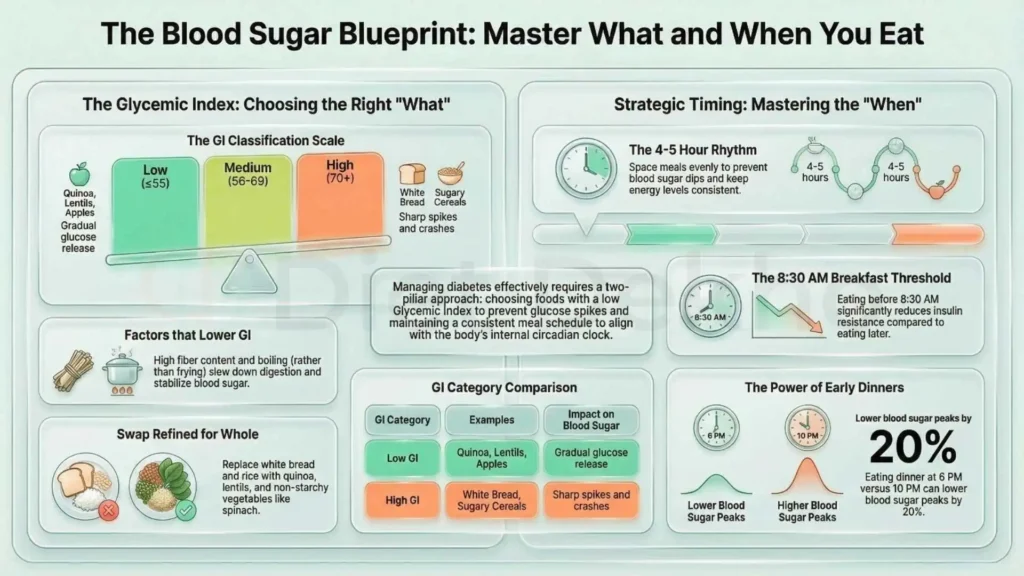
Not all carbohydrates are created equal. We measure their impact using the Glycemic Index (GI). This scale ranks how quickly a food raises your blood sugar compared to pure glucose.
| GI Category | Score Range | Effect on Blood Sugar |
| Low GI | 55 or less | Slow, steady release of energy |
| Medium GI | 56 to 69 | Moderate rise in glucose |
| High GI | 70 to 100 | Rapid spike and subsequent crash |
However, GI only tells half the story. We also look at Glycemic Load (GL). GL considers the portion size and the actual amount of carbs in a serving. For example, watermelon has a high GI, but because it’s mostly water, its GL is actually quite low.

The Indian Perspective: A Growing Health Challenge
In India, we face a unique situation. The ICMR-INDIAB study revealed that over 101 million Indians are living with diabetes, and another 135 million are in a pre-diabetic state. This means nearly one in five people with diabetes globally is in India.
I know it feels like everyone around you is struggling with this, and there’s a reason for that. Indian adults often develop type 2 diabetes a decade earlier than people in the West, and often at lower body weights.
This Asian Indian Phenotype means we tend to store more fat around the abdomen, which makes us more prone to insulin resistance. This is why the importance of diabetic diet is so personal for us. Our traditional diets are often very high in carbohydrates like white rice and refined wheat, which can make managing sugar levels even trickier.
| Indian Health Statistics | Data Point |
| Current Diabetics in India | 101 Million |
| Prediabetics in India | 135 Million |
| Patients achieving HbA1c <7% | Only 24.8% |
| Undiagnosed Rate | 43% to 50% |
The convergence of urban and rural habits means this isn’t just a city problem anymore. Whether you are in a high-rise in Mumbai or a village in Andhra Pradesh, the availability of processed snacks is changing our metabolic health.

Essential Components of a Diabetes-Friendly Kitchen
Let’s talk about your kitchen. It’s where the magic happens. I want you to view your food as nutrition therapy rather than a diet . The goal is to build a plate that satisfies your hunger while keeping your glucose curves flat.
The Power of Whole Grains and Millets
For years, white rice and maida have been staples in our homes. But if you want to see a real change in your energy, we need to look at millets. Millets like Ragi (finger millet), Jowar (sorghum), and Bajra (pearl millet) are packed with fiber and protein.
Fiber is your best friend. It acts like a speed bump, slowing down the digestion of starch into sugar. When you eat whole grains, your body has to work harder to break them down, which means sugar enters your blood slowly and steadily.
| Grain Type | Glycemic Index (Approx.) | Classification |
| White Rice | 70–80 | High |
| Brown Rice | 50–55 | Medium |
| Foxtail Millet | 45 | Low |
| Ragi (Finger Millet) | 45 | Low |
| Kodo Millet | 40–50 | Low |
I know it’s hard to give up rice entirely. If you aren’t ready to switch to millets every day, try mixing them or opting for brown or parboiled rice. Even small swaps make a big difference over time.

Protein: The Satiety Secret
Protein is essential because it doesn’t cause the same sharp spikes in blood sugar that carbs do. More importantly, it helps you feel full. If you are a vegetarian, lean on dals (lentils), chickpeas (chana), paneer, and sprouts.
For my non-vegetarian friends, skinless chicken and fish are excellent choices because they provide high-quality protein without the unhealthy fats found in red meat. Adding protein to every meal is a simple way to stabilize your levels throughout the day.
Healthy Fats and Hidden Sugars
Don’t be afraid of fats, but be choosy. Monounsaturated and polyunsaturated fats from nuts, seeds, and oils like mustard or olive are great for your heart. However, we must be careful with trans fats found in processed snacks and bakery items.
One thing I see often is the hidden sugar trap. Packaged fruit juices, sodas, and even healthy digestive biscuits can send your sugar soaring. It’s much better to eat a whole fruit like a guava or an apple, which comes with fiber, than to drink its juice.

Managing Life as a Busy Professional or Homemaker
I know your mornings are a whirlwind. Whether you’re rushing for a 9 AM meeting or getting the kids ready for school, health often takes a backseat. But the importance of diabetic diet is that it gives you the fuel to handle that stress.
Quick Breakfast Solutions
Your morning meal sets the tone for the day. Avoid sugary cereals or white bread. Instead, let’s simplify your routine with these home-based options:
- Besan Chilla: Chickpea flour is low-GI and protein-rich. Mix it with chopped veggies for a quick, filling start.
- Oats Upma: Use rolled oats instead of suji (semolina). Oats contain beta-glucan, a type of fiber that specifically helps control sugar.
- Moong Dal Sprouts: A bowl of sprouts with lemon and spices is practically zero-effort if you prepare them the night before.
The Office Tiffin and Smart Snacking
The most dangerous time for your blood sugar is 4 PM. That’s when the office samosas appear. If you aren’t prepared, it’s easy to give in.
Pack a handful of roasted chana (Bengal gram) or makhana (fox nuts). These are crunchy, satisfying, and have a very low glycemic impact. If you need a drink, skip the tea with sugar and go for a glass of spiced buttermilk (chaas). It’s hydrating and great for your gut health.
| Smart Snack Ideas | Why it Works |
| Roasted Chana | High fiber and protein |
| Roasted Makhana | Low GI and antioxidant-rich |
| Walnuts & Almonds | Healthy fats that slow sugar absorption |
| Cucumber with Hummus | High water content and low calories |
Time-Saving Prep for Homemakers
If you are managing the kitchen for the whole family, you don’t need to cook separate meals. The importance of diabetic diet principles actually benefits everyone.
- Batch Cooking: On Sundays, boil a large batch of chickpeas or lentils. These can be turned into salads, curries, or tikkis throughout the week.
- Pre-cut Veggies: Keep a box of chopped carrots, beans, and capsicum in the fridge. You’re much more likely to add them to your poha or upma if the work is already done.
- The Plate Method: When serving, fill half the plate with sabzi (vegetables like lauki, bhindi, or palak), one-quarter with protein (dal or curd), and only one-quarter with your roti or rice.

A 7-Day Roadmap to Better Blood Sugar
Let’s look at a sample week. You don’t have to follow this perfectly, but it gives you an idea of how to balance your flavors and nutrition.
| Day | Breakfast | Lunch | Dinner |
| Monday | Vegetable Oats Upma | Multigrain Roti, Moong Dal, Spinach | Vegetable Dalia with mixed veggies |
| Tuesday | Besan Chilla with Mint Chutney | Brown Rice, Rajma, Cucumber Salad | Grilled Paneer and stir-fried beans |
| Wednesday | Poha with peanuts and veggies | Whole Wheat Roti, Chole, Steamed Lauki | Quinoa Khichdi |
| Thursday | Idli with Sambar | Millet Roti, Tur Dal, Cabbage Sabzi | Vegetable Soup with Paneer cubes |
| Friday | Vegetable Upma | Brown Rice, Masoor Dal, Okra | Moong Dal Cheela with veggies |
| Saturday | Scrambled Eggs or Tofu | Multigrain Roti, Mixed Dal, Beans Poriyal | Vegetable Stew |
| Sunday | Ragi Dosa with Chutney | Vegetable Khichdi with Curd | Grilled Veggies with Paneer |
I know it might seem like a lot of change, but notice how these are all familiar Indian dishes? The importance of diabetic diet isn’t about eating foreign food; it’s about making our traditional food smarter.
Movement for the Non-Gym Audience
You don’t need a gym membership to manage your diabetes. In fact, for many people, the best exercise happens right in their living room or neighborhood park.
The Magic of the Post-Meal Walk
One of the most effective things you can do is take a 15-minute brisk walk after your largest meal. This helps your muscles soak up the sugar that just entered your bloodstream from your food.
Yoga and Stress Relief
Stress is a major hidden factor in high blood sugar. When you’re stressed, your body releases cortisol, which tells your liver to dump more sugar into your blood for energy to fight the stress.
Yoga poses like the Surya Namaskar or simple breathing exercises (Pranayama) can lower these stress hormones and improve how your body uses insulin. It’s a gentle way to care for your body and mind at the same time.
NEAT: Move While You Live
NEAT stands for Non-Exercise Activity Thermogenesis. It’s a fancy way of saying just keep moving .
- Take the stairs instead of the lift.
- Walk while you’re on a phone call.
- Do some light stretching or chair exercises while watching the evening news.

Avoiding the Complications of Neglected Sugar
I don’t say this to scare you, but rather to show you why your choices today matter so much. High blood sugar is a systemic issue. Over years, it can lead to complications that significantly impact your quality of life.
- Diabetic Retinopathy: High sugar can damage the tiny blood vessels in your eyes, leading to blurred vision or even blindness.
- Neuropathy: Have you ever felt a tingling or numbness in your feet? That’s often the first sign of nerve damage.
- Heart Health: People with diabetes are at a much higher risk for heart attacks and strokes.
By prioritizing the importance of diabetic diet, you aren’t just lowering a number on a lab report; you are protecting your sight, your mobility, and your heart.

Expert Insights: The ABCD Mantra
Dr. V. Mohan, one of India’s leading experts, suggests following the ABCD mantra for a long and healthy life with diabetes :
- A for A1c: Keeping your average blood sugar under control.
- B for Blood Pressure: Managing your salt intake to protect your heart.
- C for Cholesterol: Choosing healthy fats to keep your arteries clear.
- D for Discipline: The consistency in your diet and exercise that ties it all together.
As he says, with the right discipline, you can live a normal, healthy life even beyond 100 years.
Frequently Asked Questions (FAQs)
Q1: Can I eat white rice if I have diabetes?
Yes, but in moderation. The importance of diabetic diet lies in portion control. You can reduce the glycemic impact by mixing white rice with lots of vegetables and lentils, or by switching to brown or red rice which has more fiber.
Q2: Which fruits are safest for diabetics?
Opt for fruits with a low glycemic index like guava, apples, pears, and berries. These provide essential vitamins and fiber. Try to avoid high-sugar fruits like mangoes or grapes in large quantities.
Q3: Is it okay to use jaggery instead of white sugar?
While jaggery has some minerals, it still spikes your blood sugar almost as much as white sugar. For managing diabetes, it’s best to limit both. Natural sweeteners like Stevia can be used in moderation.
Q4: How many rotis should I eat in one meal?
Most people find that 1–2 medium-sized multigrain rotis per meal are sufficient. The key is to fill the rest of your plate with protein and fiber-rich vegetables to keep you full.
Q5: Can I reverse my diabetes with diet alone?
In the early stages of Type 2 diabetes, significant weight loss and a strict adherence to a healthy diet can lead to remission, where your sugar levels return to normal without medication. Always consult your doctor before making changes to your medicine.

Conclusion: Your Health Journey Starts Today
I know we’ve covered a lot, but I want you to remember one thing: you don’t have to be perfect. The importance of diabetic diet is about making better choices most of the time. If you have a treat at a wedding, don’t beat yourself up just get back to your balanced plate at the next meal.
Every small step choosing a millet roti, taking a walk after dinner, or swapping your afternoon biscuit for some roasted chana is a victory for your future self. You have the power to take charge of your health, starting right now in your own kitchen.
If you’re feeling a bit lost and want a plan tailored specifically to your taste and schedule, we are here to help. Let’s work together to build a routine that feels like a lifestyle, not a chore.
Ready to simplify your diabetes management?
Click here to get your personalized diet plan today!
Contact Us
We understand how overwhelming nutrition and weight loss information can feel. With so many opinions and confusing advice online, it’s easy to feel stuck or unsure about what to do next.
At Diet Dekho, you never have to figure it out alone. You can contact us anytime with any questions or concerns. Our expert dietitians are available 24/7 to guide, support, and help you stay on track. Whether your goal is weight loss or building healthier habits, we’re here to make the journey simpler and more sustainable for you.
Disclaimer
This blog is intended to help readers make healthier food choices. Your health should always be the top priority. Before starting any restrictive or special diet, especially if you have a medical condition or health concern, please consult a doctor or a qualified dietitian. Each body responds differently to food and lifestyle changes. Always choose what is safe and suitable for you.

Abhinav is the Founder of Diet Dekho, helping people manage weight and lifestyle health through simple, practical nutrition and personalized diet plans.