Meet Raj, a forty-five-year-old software engineer in Bangalore. Between back-to-back meetings and a long commute, he was shocked when a checkup showed his blood sugar hit 350 mg/dL. Like many of us, he asked a simple question: Is the keto diet for diabetics actually safe for someone with no time for the gym?
A keto diet for diabetics is generally safe and highly effective for managing Type 2 diabetes under medical supervision. This low-carb approach helps your body burn fat for energy instead of sugar. Consequently, it can significantly lower HbA1c levels. However, for Type 1 diabetics, it carries major risks like ketoacidosis and requires constant professional monitoring.
India’s Silent Health Epidemic
Table of Contents
- 1 India’s Silent Health Epidemic
- 2 What is the Keto Sugar Diet?
- 3 Safety Profile: Type 1 vs Type 2
- 4 Navigating the Indian Keto Kitchen
- 5 Meal Prep Hacks for Busy Professionals
- 6 Homemaker Strategies for Joint Families
- 7 Monitoring Progress at Home
- 8 Real Transformation Stories
- 9 Long-Term Risks to Consider
- 10 Medication and Doctor Consultation
- 11 Actionable First Week Steps
- 12 Final Expert Verdict
- 13 FAQs
- 14 Take Control of Your Health Today
- 15 Contact Us
- 16 Disclaimer
I know it feels like everyone we know is suddenly talking about sugar levels. The truth is that India is often called the diabetes capital of the world. Our rapid demographic shifts and changing economic landscape have created a perfect storm for metabolic issues. Recent data from the 2025 Diabetes Atlas shows that roughly 11.1 percent of adults worldwide live with this condition.
In India, the numbers are even more staggering. We are looking at nearly 89.8 million adults diagnosed with diabetes as of late 2024. Furthermore, about one in seven adults globally lives right here in our country. What is even more worrying is that about 43 percent of these individuals remain undiagnosed. Consequently, many people walk around with high sugar levels without even knowing it.
| Metric for India (2022–2024) | Estimated Impact |
| Diagnosed Adults (IDF 2024) | 89.8 Million |
| Total (Diagnosed + Undiagnosed) | 212 Million |
| Prevalence Rate (ICMR-INDIAB) | 11.4% |
| Population with Prediabetes | 136 Million |
| Untreated Diabetics (Lancet) | 62% |
This epidemic does not just hit the older people anymore. Instead, it spans every demographic, from busy teenagers to rural families. We often ignore early signs like fatigue or frequent thirst. By the time we acknowledge them, complications might have already started setting in.
Why Indians Face Unique Challenges
Let’s simplify why our situation is a bit different. Indian adults often develop Type 2 diabetes nearly a decade earlier than people in the West. Surprisingly, this happens at much lower body mass indices. You do not have to be higher weight to be at risk.
This trend is linked to reduced beta-cell function. Essentially, our pancreas might produce less insulin even if we are lean. Combined with higher visceral fat, this makes managing our sugar a daily battle. Therefore, we need dietary solutions that fit our unique Indian physiology and carbohydrate-heavy food culture.
What is the Keto Sugar Diet?
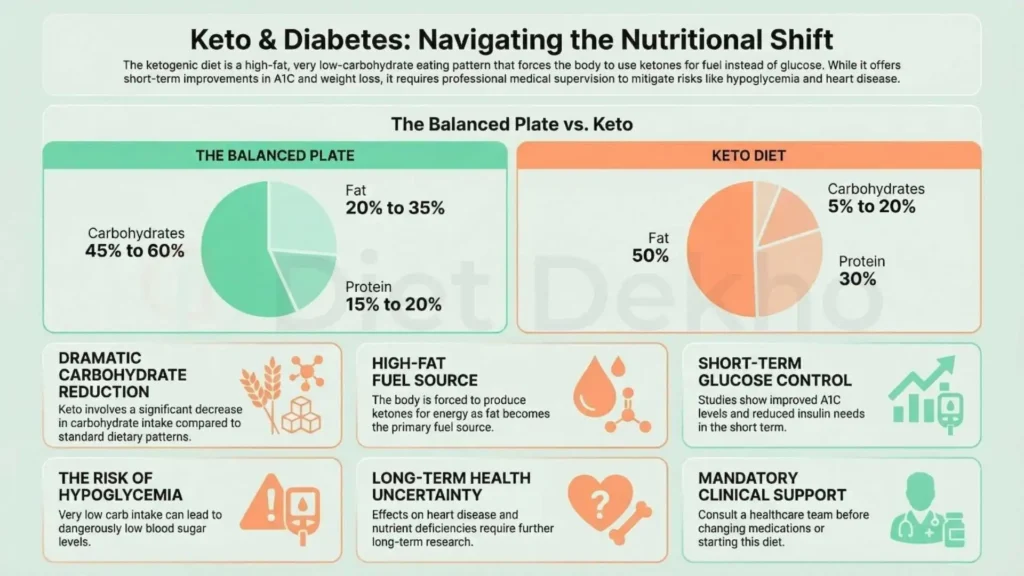
You might have heard people call it a keto sugar diet. Specifically, this is a nutritional strategy to control blood sugar by changing your body’s fuel source. Usually, our bodies prefer glucose from carbohydrates like rice and roti for energy. When you have diabetes, your body either lacks insulin or cannot use it properly.
The keto diet for diabetics flips this system upside down. By restricting carbs to less than 50 grams a day, you force a metabolic switch. Within about 48 to 72 hours, your liver runs out of stored sugar, or glycogen. Subsequently, it begins to break down fat into molecules called ketone bodies.
The Science of Nutritional Ketosis
This state is called nutritional ketosis. Your brain and muscles start using these ketones for fuel instead of glucose. Because fats do not cause the same insulin spikes as carbs, your blood sugar levels stabilize. This process is regulated by insulin; lower carb intake leads to lower insulin levels, which promotes fat burning.
For someone with Type 2 diabetes, this is like giving your pancreas a much-needed holiday. When you reduce the glucose load, you see fewer insulin spikes. Over time, this can restore insulin sensitivity and help you lose weight without feeling hungry.

Safety Profile: Type 1 vs Type 2
I always tell my clients that keto is not a one-size-fits-all plan. The safety profile depends heavily on which type of diabetes you are managing. While it can be a miracle for some, it can be dangerous for others if not handled correctly.
Is It Safe for Type 2 Diabetics?
For those with Type 2 diabetes, the clinical consensus is quite positive. The diet often leads to better glycemic control and lower cholesterol. According to research from Harvard Health, short-term metabolic changes are very beneficial. Along with weight loss, you may see improvements in high blood pressure and triglycerides.
A 2021 review even found that people with diabetes on a keto plan saw HbA1c improvements in just three weeks. Many were able to reduce or even stop their medications under a doctor’s care. However, it is hard to stick to it long-term. If you stop the diet, the weight and high sugar levels often return.
The Real Dangers for Type 1 Diabetics
If you have Type 1 diabetes, we must tread very carefully. The main concern is a life-threatening condition called diabetic ketoacidosis (DKA). In Type 1, your body does not produce insulin. Without insulin to act as a brake, your liver can overproduce ketones, making your blood dangerously acidic.
What makes this even scarier is something called euglycemic DKA. This is when your blood becomes acidic even if your sugar levels look normal or only mildly elevated. It is much harder to detect early. Because of these risks, most medical organizations do not routinely recommend ketogenic diets for Type 1 patients.
| Feature | Nutritional Ketosis | Diabetic Ketoacidosis (DKA) |
| Origin | Dietary restriction of carbs | Lack of insulin in the body |
| Ketone Levels | 0.5 to 3.0 mmol/L | Typically > 3.0 mmol/L |
| Blood Sugar | Low or stable | Often > 250 mg/dL |
| Medical Status | Controlled metabolic state | Critical medical emergency |
| Symptoms | Mild fatigue, keto breath | Nausea, vomiting, fruity breath |
I know what you are thinking. How can I do keto when my house is full of rice, dal, and roti? This is the biggest hurdle for keto diabetes India adaptations. Our traditional meals are often 70 to 75 percent carbohydrates. However, we can actually use our rich culinary heritage to our advantage.
Traditional Indian Fats to Embrace
Unlike Western keto plans that rely on heavy processed meats, we can use traditional healthy fats. Our elders were onto something with ghee and mustard oil. These have been staples in our kitchens for centuries and are perfect for a ketogenic lifestyle.
| Indian Keto-Friendly Fats | Why They Work |
| Desi Ghee | High smoke point, supports stable energy. |
| Coconut Oil | Contains MCTs that help your liver make ketones. |
| Mustard Oil | Heart-healthy unsaturated fats. |
| White Makkhan | Natural and unprocessed, great for satiety. |
| Avocado | Rich in fiber and potassium. |

The Vegetarian Protein Challenge
For my vegetarian friends, getting enough protein without the carb baggage of lentils is tricky. Traditional dals are actually too high in carbs for a strict keto diet. You have to pivot your plate toward other sources.
Paneer is your absolute best friend here. It is high in protein and very low in carbohydrates. You can also rely on tofu, soya chunks, and Greek yogurt. If you eat eggs, they are the gold standard. A three-egg masala omelet is a perfect keto breakfast that keeps you full for hours.

Meal Prep Hacks for Busy Professionals
I know it’s hard to find time to cook elaborate meals when you have a 9-to-5 job. Let’s simplify this with some hacks that I give my clients at DietDekho. You do not need to eat boring food; you just need to swap the ingredients.
The Rice and Roti Alternatives
The hardest part of a keto diet for diabetics in India is giving up the comfort of grains. But you can mimic the texture of your favorites with these swaps:
- Cauliflower Rice: Simply grate cauliflower and sauté it. It works beautifully with chicken curry or even as a base for biryani.
- Almond Flour Roti: Replace wheat flour with almond or coconut flour. These rotis won’t spike your sugar and taste delicious with palak paneer.
- Zucchini Noodles: Use a peeler to make thin strips. They are a great low-carb substitute for vermicelli or pasta.
- Lauki Sabzi: Swap out potatoes for lauki or turai. They have a very low carb count and high water content.
Weekend Planning for the Week Ahead
Success in any diet is all about the prep. If you are a busy professional, spend 40 minutes on Sunday preparing your aromatics. Peel and chop your onions, and make a large batch of ginger-garlic-chili paste.
Store these in airtight containers to eliminate daily chopping. This makes your weekday cooking 15 minutes faster. You can also batch-cook a basic keto gravy using tomatoes and spices. When you come home tired, just add paneer or chicken, and your dinner is ready in minutes.

Homemaker Strategies for Joint Families
If you are managing a joint family, I know the struggle of cooking separate meals. It is exhausting! What this means for your daily routine is that you need inclusive cooking. You do not have to cook two different dinners.
The Diabetes-Safe Kitchen Strategy
Try creating a Diabetic Zone in your pantry for things like green tea, nuts, and sprouts. Hide high-GI items like white rice or sugary biscuits from plain sight. Involve the elders in the family in chopping vegetables to build support for your new lifestyle.
You can make one base meal for everyone. For example, a rich coconut-based fish or vegetable curry. The rest of the family can eat it with rice, while you enjoy your portion with cauliflower rice or simply as a thick stew. For festivals, use sweeteners like stevia or erythritol to make kheer. This way, you celebrate without the sugar guilt.
| Non-Starchy Vegetables | Carbs per 100g | Why They Are Great |
| Spinach (Palak) | 1.4g | Iron-rich powerhouse for energy. |
| Celery | 2.9g | Perfect for snacking with a cheese dip. |
| Cabbage | 3.3g | High fiber, great for filling up sabzis. |
| Bottle Gourd (Lauki) | 3.4g | Hydrating and very easy on the stomach. |
| Cauliflower (Gobi) | 4.9g | The most versatile rice substitute. |
| Broccoli | 6.0g | Packed with Vitamin C and K. |
Monitoring Progress at Home
Managing blood sugar is a marathon, not a sprint. For a non-gym audience, tracking your progress at home is vital to see what is actually working. You do not need a medical degree to do this effectively.
The Power of the CGM
I highly recommend using a Continuous Glucose Monitor (CGM). It is a tiny patch you wear on your arm. It tells you in real-time how a specific food affects your sugar levels. This takes the guesswork out of your diet. You might find you can tolerate more carbs than you thought!
Tracking Your Ketones
If you are on a strict keto diet for diabetics, you need to know if you are actually in ketosis. There are three main ways to check:
- Blood Ketone Meters: These are the most accurate and measure beta-hydroxybutyrate (BHB) levels.
- Urine Strips: These are very cheap and easy for beginners. However, they become less accurate after a few weeks.
- Breath Analyzers: These measure acetone in your breath. They are non-invasive but usually used more for weight loss tracking.
Generally, a blood ketone reading between 0.5 and 3.0 mmol/L means you are in the safe zone. If your readings stay above 3.0 mmol/L and you feel unwell, contact your doctor immediately.

Real Transformation Stories
Sometimes we just need to hear that it’s possible. In my years at DietDekho, I have seen incredible transformations that prove age is not a barrier.
Gautam’s Two-Month Transformation
Gautam was a 29-year-old SEO manager in Delhi. He hit a low point when he could not fit into his clothes for a wedding. He adoption a strict keto plan with boiled eggs, palak paneer, and grilled chicken. In just two months, he lost 11 kilos. He did not just lose weight; he revamped his entire sleeping and water intake habits.
Asha’s 10-Year Battle Won
Mrs. Asha Ramteke from Hyderabad had been battling diabetes for ten long years. She was on three doses of metformin and insulin daily. After joining a structured program in 2025, she lost 14 kg. Most importantly, her HbA1c dropped from 7.2 to a non-diabetic 5.5. Today, she performs fifty Surya Namaskars daily.
Mr. Sanjay’s Medication-Free Journey
Mr. Sanjay started with a very dangerous HbA1c of 11.5% in early 2025. By following a low-carb protocol, he brought it down to 6.1% in just five months. The best part is he did it without a single medication.
Long-Term Risks to Consider
While short-term results are often magical, we must talk about the long-term. Research from the NIH suggests that while the keto diet is promising, it is not without potential downsides.
The Liver and Heart Connection
A major concern with a high-fat diet is its impact on your liver. A recent study in Science Advances (2025) found that long-term adherence in animals could lead to fatty liver disease. In humans, eating too much saturated fat can raise bad LDL cholesterol.
I always advise my clients to focus on quality fats. Prioritize olive oil, nuts, seeds, and fatty fish over daily processed meats. This protects your heart, which is especially important since diabetes already increases your cardiovascular risk.
The Sustainability Factor
Restrictive diets are notoriously hard to maintain. Once you return to a normal diet, many people regain the weight. This can lead to a yo-yo effect that is actually worse for your metabolism.
Think of keto as a reset button or a short-term tool to jump-start your health. After achieving your goals, the best strategy is to transition to a sustainable, balanced plate rich in colorful vegetables.
| Potential Long-Term Risk | How to Mitigate It |
| Nutrient Deficiency | Take a multivitamin; eat a wide variety of greens. |
| Constipation | Increase fiber with chia seeds and psyllium husk. |
| Kidney Stones | Stay very well hydrated; don’t overdo protein. |
| Muscle Loss | Include light resistance training or yoga daily. |
Medication and Doctor Consultation
This is the most important part of our conversation. If you are taking medication for diabetes, you must consult your endocrinologist before starting keto. As your carb intake drops, your medication often needs to be adjusted quickly.
Dangerous Drug Interactions
Certain drugs, like SGLT-2 inhibitors, carry a high risk when combined with a ketogenic diet. They can trigger that euglycemic DKA we talked about. Most doctors will advise you to stop these before starting. Metformin is usually safe to continue, but your dosage might need to be lowered as your weight drops.
If you do not adjust your insulin, your blood sugar could drop too low. This can cause dizziness, confusion, or even seizures. Therefore, always carry a source of fast-acting glucose in case of emergencies.
Actionable First Week Steps
I know it feels overwhelming, but we can break this down. Let’s simplify your first week into three manageable steps.
- The Gradual Fade: Do not cut all carbs on Monday. You will get the keto flu and feel miserable. Instead, spend the first week just halving your rice and roti portions and doubling your vegetables.
- Hydration is Key: As you lose water weight in the first few days, you also lose electrolytes. Consequently, drink plenty of water with a pinch of sea salt and lemon to prevent headaches.
- Clean the Pantry: Clear out the biscuits and sugary drinks. If they are not in the house, you won’t eat them when you’re tired after work.
Final Expert Verdict
The ketogenic diet is a powerful transformational paradigm, not just another weight loss trend. For people with Type 2 diabetes, it is a scientifically backed way to reduce HbA1c.
However, it is not a set-it-and-forget-it pattern. It requires diligence, medical oversight, and a focus on nutrient density. If you have kidney issues or Type 1 diabetes, you must approach this with extreme caution.
For the average busy Indian professional or homemaker, a low-carb approach is often more sustainable than strict keto. It gives you the benefits of blood sugar control with fewer side effects and more flexibility for family meals.

FAQs
1. Can a keto diet for diabetics reverse Type 2 diabetes?
While reversal is a strong word, many people achieve remission. This means your HbA1c is below 6.5% without medications for at least three months. Statistics show that remission rates are highest in the first year of the diet.
2. Is ghee good for diabetics on a keto plan?
Yes, ghee is an excellent source of healthy fat for Indians on keto. It provides stable energy and supports satiety without spiking insulin levels. However, portion control still matters for heart health.
3. What are the signs of DKA I should watch for?
Common warning signs include nausea, vomiting, abdominal pain, and fruity-smelling breath. If you experience these, seek medical help immediately, even if your sugar levels look normal.
4. Can I eat fruit on a keto diet?
Most fruits are too high in sugar for a strict keto plan. However, you can enjoy small portions of berries or avocado, as they are lower in net carbs. Avoid high-sugar fruits like mangoes, bananas, and grapes.
5. How many rotis can I eat on keto?
On a strict keto diet, traditional wheat rotis are usually avoided. One medium roti has about 15-20g of carbs, which is nearly your whole daily limit. Swap them for almond flour or coconut flour rotis instead.
Take Control of Your Health Today
I know how hard it is to balance your health with a busy life. But remember, every small swap you make is a step toward a healthier life. You do not have to do this perfectly; you just have to start.
If you are ready to create a personalized plan that fits your Indian lifestyle, let’s talk. We can help you navigate the complexities of your sugar levels with a plan tailored to you.
Contact Us
We understand how overwhelming nutrition and weight loss information can feel. With so many opinions and confusing advice online, it’s easy to feel stuck or unsure about what to do next.
At Diet Dekho, you never have to figure it out alone. You can contact us anytime with any questions or concerns. Our expert dietitians are available 24/7 to guide, support, and help you stay on track. Whether your goal is weight loss or building healthier habits, we’re here to make the journey simpler and more sustainable for you.
Disclaimer
This blog is intended to help readers make healthier food choices. Your health should always be the top priority. Before starting any restrictive or special diet, especially if you have a medical condition or health concern, please consult a doctor or a qualified dietitian. Each body responds differently to food and lifestyle changes. Always choose what is safe and suitable for you.

Abhinav is the Founder of Diet Dekho, helping people manage weight and lifestyle health through simple, practical nutrition and personalized diet plans.