Sunita stood in her kitchen at 8:00 PM, staring at a bottle of mango pickle. She had just returned from a long shift at the office, her feet aching and her blood pressure monitor showing a reading that made her heart sink. Like many of my clients at DietDekho, she felt trapped between the comfort of traditional flavors and the clinical necessity of a low sodium Indian diet to protect her health. I know it’s hard to find time to cook from scratch when you’re exhausted, but let’s simplify this journey together.
A low sodium Indian diet prioritizes whole foods while limiting salt intake to under 5 grams (approximately 2,000 mg of sodium) per day to manage hypertension. This is achieved by replacing table salt with natural souring agents like amchur or lemon, avoiding processed items like pickles and papads, and increasing potassium-rich foods like bananas and lentils to help the body flush out excess sodium.
The Silent Challenge: Why Our Plates Are So Salty
Table of Contents
- 1 The Silent Challenge: Why Our Plates Are So Salty
- 2 Identifying the Hidden Sodium Bombs in Your Pantry
- 3 Natural Flavor Enhancers: Cooking Without the Shaker
- 4 7-Day Low Sodium Indian Meal Plan
- 5 Pro-Tips for the Busy Professional
- 6 Addressing the Sendha Namak Myth
- 7 Conclusion: Take the First Step Today
- 8 Frequently Asked Questions
- 9 Contact Us
- 10 Disclaimer
The reality of salt consumption in India is quite staggering. While the World Health Organization (WHO) recommends a maximum of one teaspoon of salt daily, the average Indian adult consumes nearly double that amount, often reaching 11 grams per day. What this means for your daily routine is that your heart and kidneys are working overtime just to process the excess minerals.
Actually, the problem isn’t just the salt shaker on your table. In many northern states, dietary habits push consumption beyond 12 grams because of a heavy reliance on preserved condiments and salt-heavy bread. Consequently, high blood pressure has become a leading risk factor for cardiovascular diseases across the country. According to Dr. Devi Shetty, a renowned cardiac surgeon, What you are is what you eat, and he emphasizes that Indians are three times more vulnerable to heart ailments compared to Europeans, largely due to lifestyle and diet.

Understanding the Sodium-Potassium Balance
Fortunately, your body has a natural defense mechanism against salt. Potassium acts as a physiological antagonist to sodium, encouraging your kidneys to excrete the excess and helping your blood vessel walls relax. For instance, eating a banana or a bowl of spinach doesn’t just provide vitamins; it actively works to lower your numbers. Meanwhile, excessive sodium pulls water into your bloodstream, which increases blood volume and puts immense strain on your arteries.
| Nutrient | Role in the Body | Top Indian Sources |
| Sodium | Maintains fluid balance (in small amounts) | Table salt, pickles, commercial masalas |
| Potassium | Flushes out excess sodium, relaxes vessels | Bananas, coconut water, sweet potatoes |
| Magnesium | Supports heart rhythm and muscle function | Almonds, flaxseeds, leafy greens |

Identifying the Hidden Sodium Bombs in Your Pantry
I often tell my clients that the most dangerous salt is the kind you can’t taste. Many Indian foods are deeply rooted in tradition, so we consume them without realizing their sodium density. For example, a single tablespoon of mango pickle can contain up to 765 mg of sodium-that’s nearly 33% of your entire daily limit in one bite!
The Papad and Pickle Trap
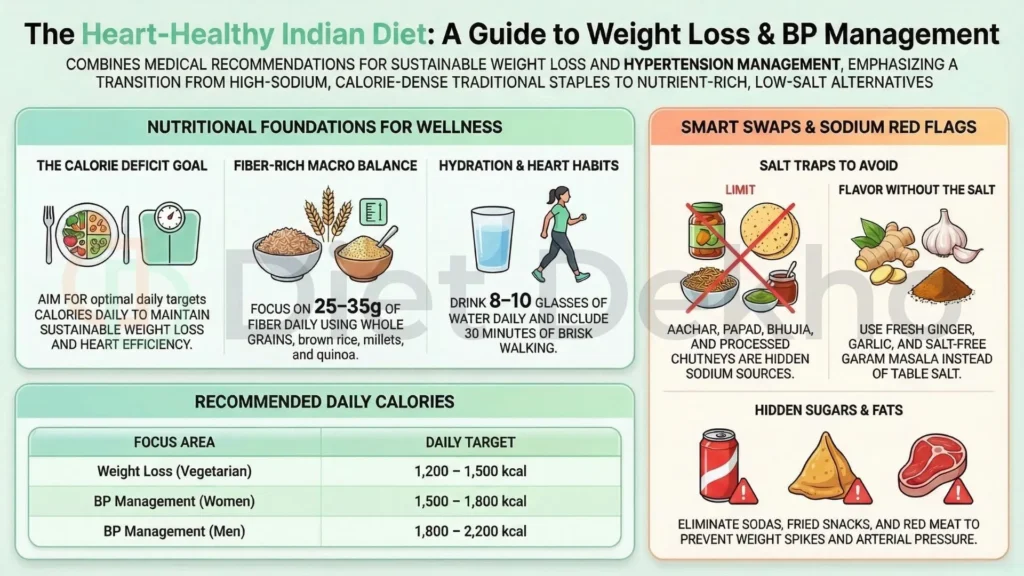
I know it’s hard to imagine a meal without that crunch, but papads are often loaded with sodium and additives. Even a small piece can contribute 150 mg to 200 mg of sodium. If you have a habit of eating two or three with every meal, you are unknowingly sabotaging your blood pressure goals. Furthermore, traditional achars (pickles) use salt as a primary preservative, making them high-risk for anyone with hypertension.
Spice Blends and Store-Bought Masalas
Surprisingly, your favorite Chaat Masala or Pav Bhaji Masala might be the culprit. These blends frequently contain added salt or black salt (kala namak) to intensify the flavor. In fact, a single teaspoon of commercial Chaat Masala can provide about 440 mg of sodium. Instead of relying on these, I suggest toasting whole spices like cumin and coriander at home to unlock their natural, earthy aromas without the salt load.
Natural Flavor Enhancers: Cooking Without the Shaker
Let’s simplify this: you don’t need salt to make food taste good. The Indian pantry is a goldmine of natural aromatics that can trick your palate into feeling satisfied. Specifically, souring agents are your best friends on a low sodium Indian diet because acidity often triggers the same flavor receptors as salt.
- Amchur (Dried Mango Powder): This is a secret weapon for brightness. A small pinch adds a tangy lift to dals and curries, making the dish feel complete without extra sodium.
- Lemon and Lime Juice: A fresh squeeze at the very end of cooking sharpens every other flavor. It’s perfect for poha, grilled veggies, or even khichdi.
- Kokum (Garcinia indica): Especially in Maharashtrian and Konkani cooking, kokum provides a fruity acidity and anti-inflammatory benefits that salt simply cannot match.
- Fresh Aromatics: Using more ginger, garlic, and green chilies provides a pungent heat that distracts the tongue from lower salt levels.

7-Day Low Sodium Indian Meal Plan
This plan is designed for the busy professional and the homemaker who needs real, home-based solutions. I have focused on regional variety to keep your palate engaged while keeping sodium levels under control.
The Fresh Start (Day 1)
- Breakfast: Oats porridge with sliced banana and a cup of unsweetened tea.
- Lunch: Brown rice served with Moong Dal (seasoned with garlic/turmeric, no salt in the dal) and a side of Bhindi Sabzi.
- Evening Snack: A handful of unsalted roasted chana.
- Dinner: Multigrain roti (no salt in the dough) with grilled paneer bhurji and sautéed spinach.
Regional Flavors (Day 2)
- Breakfast: Vegetable poha with peanuts and a small apple. Use lemon for tang instead of salt.
- Lunch: Jowar Bhakri with Pithla (gram flour curry). Season the pithla with green chili and roasted garlic instead of heavy salt.
- Evening Snack: Fresh buttermilk (chaas) without added salt or kala namak.
- Dinner: Steamed rice with Rajma (rinsed thoroughly) and stir-fried green beans.
Protein and Fiber Focus (Day 3)
- Breakfast: Besan Chilla with plenty of onions and tomatoes, served with a bowl of papaya.
- Lunch: Bajra Roti, plain curd, and Lauki (bottle gourd) curry.
- Evening Snack: Sprouts chaat with lemon and pomegranate seeds.
- Dinner: Grilled chicken or tofu with a bowl of homemade dal soup and a fresh green salad.
Heart-Healthy Fats (Day 4)
- Breakfast: Non-fat Greek yogurt with walnuts and a few berries.
- Lunch: Whole-wheat pita with hummus, avocado, and fresh cucumber slices.
- Evening Snack: A plum or a handful of unsalted almonds.
- Dinner: Stuffed sweet potato with black beans and a dash of black pepper for flavor.
The No-Cook Prep Day (Day 5)
- Breakfast: Peanut butter and banana slices on whole-grain toast.
- Lunch: Quinoa salad with roasted vegetables and a lemon-tahini dressing.
- Evening Snack: A bunch of grapes or a small bowl of papaya.
- Dinner: Chana Masala (made with fresh tomatoes and amchur) served with brown rice.
The Weekend Transition (Day 6)
- Breakfast: Paneer and spinach scramble with a whole-wheat roti.
- Lunch: Lentil soup with carrots and celery, seasoned with cumin and coriander.
- Evening Snack: Apple slices with a tiny bit of unsalted almond butter.
- Dinner: Baked salmon (or any white fish) with a rub of garlic and black pepper, served with steamed broccoli.
Wholesome Tradition (Day 7)
- Breakfast: Paneer stuffed paratha (no salt in the dough) served with plain, fresh curd.
- Lunch: Chickpea curry with onions, tomatoes, garlic, and ginger, served with brown rice.
- Evening Snack: Mixed berries with a small dollop of plain yogurt.
- Dinner: Grilled chicken with roasted carrots and beets, paired with a small portion of quinoa.
Pro-Tips for the Busy Professional
I know your schedule is packed, but batch-prepping is your greatest ally. For example, you can prepare a large batch of onion-tomato-ginger-garlic paste over the weekend without adding any salt and freeze it in single-meal portions. This base allows you to assemble a healthy curry in under 15 minutes during the work week.
Additionally, if you find yourself ordering in, remember to ask for tandoori style rather than creamy curries. Tandoori cooking uses a clay oven and minimal oil, which is inherently lower in sodium and fats. Similarly, always ask for sauces and chutneys on the side so you can control exactly how much you consume.

Addressing the Sendha Namak Myth
Many of my clients ask if Sendha Namak (rock salt) or Himalayan Pink Salt is a better choice for a low sodium Indian diet. While these salts contain trace minerals, they are still 98% sodium chloride. Therefore, switching to pink salt won’t lower your blood pressure if you use the same amount.
Instead, look for clinically tested low-sodium alternatives like Tata Salt Lite, which offers a 15% reduction, or Tata Salt SuperLite, which provides 30% less sodium. These blends replace a portion of sodium with potassium, making them more heart-smart. However, if you have any kidney issues, please consult your doctor before making this switch, as excess potassium can be tricky for some.

Conclusion: Take the First Step Today
Managing your blood pressure through a low sodium Indian diet is not about deprivation; it’s about rediscovering the true flavor of fresh ingredients. Every small change, like skipping the extra salt in your roti dough or choosing lemon over chaat masala, adds up. Ultimately, a lower-salt lifestyle can reduce your risk of stroke and heart disease by up to 30%.
Your health is a long-term investment, and I am here to help you navigate every bite. Let’s make your kitchen a place of healing, not just a habit.
Ready to personalize your heart-health plan?
Frequently Asked Questions
1. Can I completely stop using salt in my low sodium Indian diet?
While the body only needs about 500 mg of sodium daily, you shouldn’t cut it to zero without medical supervision. Natural sodium in vegetables and grains usually meets your baseline needs, but a small amount of iodized salt is often recommended for thyroid health.
2. How can I make my food taste better if I use less salt?
You should use natural tangy substitutes. Ingredients like amchur, tamarind, kokum, and lemon juice provide a flavor lift that mimics saltiness. Also, toasting whole spices like cumin and coriander helps bring out deep, nutty flavors.
3. Which Indian snacks are safe for hypertension?
Instead of salted namkeen, try roasted makhana, unsalted roasted chana, or fresh cucumber sticks with a yogurt dip. These are naturally low in sodium and high in fiber.
4. Is pink Himalayan salt better than regular salt for BP?
No, this is a common myth. Pink salt is still primarily sodium chloride. While it has a few more minerals, it won’t help your blood pressure as much as simply reducing your total salt intake would.
5. How do I order low sodium food at an Indian restaurant?
Specifically, ask the chef to go light on the salt and avoid using extra butter or cream. Choosing Tandoori or Tikka grilled items is generally safer than ordering rich gravies like Butter Chicken.
Contact Us
We understand how overwhelming nutrition and weight loss information can feel. With so many opinions and confusing advice online, it’s easy to feel stuck or unsure about what to do next.
At Diet Dekho, you never have to figure it out alone. You can contact us anytime with any questions or concerns. Our expert dietitians are available 24/7 to guide, support, and help you stay on track. Whether your goal is weight loss or building healthier habits, we’re here to make the journey simpler and more sustainable for you.
Disclaimer
This blog is intended to help readers make healthier food choices. Your health should always be the top priority. Before starting any restrictive or special diet, especially if you have a medical condition or health concern, please consult a doctor or a qualified dietitian. Each body responds differently to food and lifestyle changes. Always choose what is safe and suitable for you.

Abhinav is the Founder of Diet Dekho, helping people manage weight and lifestyle health through simple, practical nutrition and personalized diet plans.