Let’s talk about a typical Tuesday for someone like Rahul. He’s a 38-year-old marketing manager in Bangalore who works ten-hour shifts. By the time he gets home, he’s too exhausted to even look at the stove. So, he opens a delivery app and orders a healthy paneer wrap and some masala fries. Rahul doesn’t add extra salt at the table, yet his last check-up showed a surprising jump in his blood pressure. This is a common story I hear in my clinic. Many busy professionals don’t realize that restaurant foods BP triggers are often invisible, hiding behind the convenience of modern dining.
Restaurant foods increase blood pressure (BP) primarily through hidden sodium overload, often containing 2 to 3 times more salt than home-cooked meals. Key culprits include restaurant gravies (Butter Chicken, Dal Makhani), bakery items (Naan, Bread), and accompaniments like pickles and papads. Beyond table salt, restaurants use Monosodium Glutamate (MSG), baking soda, and sodium-based preservatives to enhance flavor and shelf life. For busy professionals and homemakers, managing BP requires adopting the DASH diet, choosing grilled/tandoori options over fried, and utilizing natural flavor enhancers like lemon and ginger.
The Science of Fluid Retention
Table of Contents
- 1 The Science of Fluid Retention
- 2 Why Restaurants Love Salt
- 3 Regional Dishes: The Hypertension Triggers
- 4 Navigating Zomato and Swiggy
- 5 The DASH Diet: An Indian Approach
- 6 Homemaker’s Guide: Managing the Family Budget
- 7 The Risks of AI-Generated Health Sourcing
- 8 Actionable Steps for Busy Lives
- 9 Frequently Asked Questions (FAQs)
- 10 Contact Us
- 11 Disclaimer
I know it’s hard to find time to cook, but let’s simplify why that outside meal makes your BP spike. Sodium is a mineral our bodies need for fluid balance. However, the human body evolved in a low-sodium environment. This means our systems are great at keeping salt but bad at getting rid of it.

When you eat a high-sodium restaurant meal, your body enters dilution mode. Consequently, it holds onto water to balance the salt in your bloodstream. This extra water increases the total volume of blood pushing against your artery walls. Think of it like a garden hose; if you pump more water through it, the pressure rises. This relationship is defined by:
BP = CO \SVR
Where BP is Blood Pressure, CO is Cardiac Output (blood volume), and SVR is Systemic Vascular Resistance (vessel tightness). High sodium increases both.
Why Restaurants Love Salt
What this means for your daily routine is that you are often fighting a battle against flavor engineering. Restaurant kitchens operate on tight margins. Therefore, they rely on salt because it is the cheapest way to make mediocre ingredients taste addictive.
The Flavor-Efficiency Paradox
Chefs often salt food in layers—during marination, then sautéing, and finally as a garnish. This layered approach creates a deep flavor profile but delivers a massive sodium hit. Furthermore, experts like Dr. Ramchandra Kumar note that international chains in India often have higher sodium levels than their Western counterparts. They do this to cater to the Indian preference for sharper, more intense flavors.
Hidden Sodium Sources
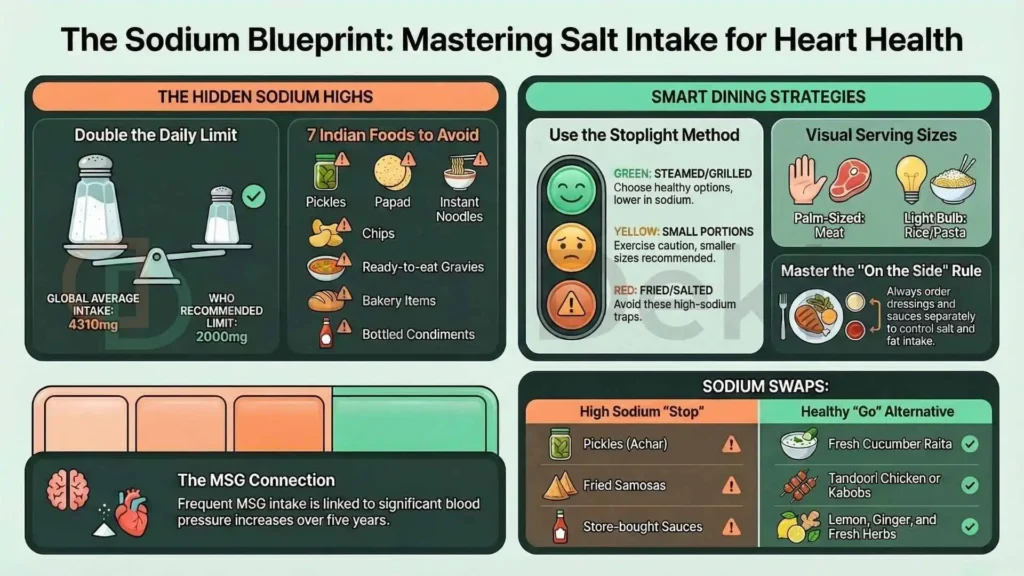
You might avoid the salt shaker, but sodium hides in chemicals you can’t even taste. For example, Monosodium Glutamate (MSG) is a staple in Indian-Chinese food and many rich gravies. While MSG has less sodium than table salt by weight, restaurants usually add it in addition to regular salt.
Similarly, baking soda (sodium bicarbonate) is the secret to fluffy naan and soft bhature. It doesn’t taste salty, but it contributes significantly to your daily limit. This is why bakery items are often listed among the Salty Six foods that drive hypertension.

Regional Dishes: The Hypertension Triggers
Let’s look at some favorites that might be sabotaging your health. If you live in Pune or Mumbai, Misal Pav and Vada Pav are likely your go-to snacks. On paper, Misal looks healthy because it uses sprouted moth beans. However, the restaurant version is a different story.
Maharashtra’s Street Food Trap
The Kat or spicy gravy is often loaded with commercial masalas and extra salt. Then, there’s the Farsan. These crunchy toppings are essentially salted flour concentrates. Finally, the Pav itself contains leavening agents like baking soda. Together, they form a sodium bomb that causes immediate water retention and morning bloating.
North Indian Gravy Secrets
Dishes like Butter Chicken or Dal Makhani are synonymous with indulgence. To balance the heavy fats of cream and butter, chefs must use aggressively high sodium. A single bowl of restaurant dal makhani can contain over 1,500 mg of sodium. This is the entire daily limit recommended for adults with high blood pressure by the American Heart Association.
Since we can’t always avoid delivery apps, let’s talk about how to use them smarter. Modern apps are finally catching up to our health needs. For instance, Zomato recently launched Healthy Mode, which uses AI to provide Healthy Scores for dishes.
Mastering the Delivery Order
When you order, look for the Add Note section. This is your most powerful tool. Specifically, you should:
- Request Less Salt: Most local restaurants cook to order and can accommodate this.
- Ask for Sauce on the Side: This allows you to control the dip rather than having your food soaked in salty liquid.
- Choose Grilled over Fried: Tandoori items are marinated in yogurt and spices, then roasted with minimal oil.
The Salty Six to Avoid
To keep your restaurant foods BP levels in check, try to limit what the American Heart Association calls the Salty Six :
- Breads: Naan, rolls, and even multigrain restaurant breads.
- Pizza: A triple threat of salty dough, salty sauce, and salty cheese.
- Sandwiches: Often use deli meats and high-sodium spreads.
- Cured Meats: Salami, sausages, and kebabs made with preservatives.
- Canned Soups: Even healthy tomato soups in restaurants are often salt-heavy.
- Tacos/Burritos: Seasoned meats and salsas add up fast.

The DASH Diet: An Indian Approach
I always tell my friends that the DASH (Dietary Approaches to Stop Hypertension) diet isn’t some Western fad. It is a simple framework that we can easily adapt to our Indian kitchens. Harvard Health and the NIH have shown it can lower blood pressure as effectively as medication.
Potassium: The Natural Antagonist
Potassium is the biological hero that helps your kidneys flush out excess sodium. Therefore, you should focus on:
- Fiber-Rich Millets: Swap white rice for Jowar, Bajra, or Ragi.
- Potassium Powerhouses: Include coconut water, bananas, and spinach (palak) in your daily routine.
- Lean Proteins: Choose moong dal or grilled fish over red meats.
Spices as Medicine
Indian spices are more than flavorings; they are heart-protective agents. For example, garlic helps relax blood vessels, which naturally reduces pressure. Turmeric contains curcumin, which fights the inflammation that damages your arteries. Using these at home allows you to reduce salt without making your food taste like cardboard.
Homemaker’s Guide: Managing the Family Budget
If you are the one managing the family’s meals, you hold the key to everyone’s heart health. Because restaurant food is a reality of social life, your at-home cooking must be the anchor.
The 20% Reduction Goal
Dr. Ramchandra Kumar suggests a clinical reduction of 20% in daily sodium. This small shift can bring down blood pressure readings within just 6 to 8 weeks. To achieve this at home, stop adding salt to your chapati dough or rice. Instead, use lemon, amchur (dried mango powder), or tamarind to provide that tang without the sodium hit.
Label Reading 101
Always check the back of the pack. I recommend avoiding any product where the sodium is more than 30% of the daily recommended limit per serving. Be especially wary of diet snacks. Many low-fat biscuits or roasted namkeens use extra salt to compensate for the lack of fat.
The Risks of AI-Generated Health Sourcing
In this digital age, many of us ask AI for restaurant suggestions. However, you must be careful. AI models can sometimes hallucinate or recommend high-sodium healthy snacks based on marketing fluff. Always cross-reference AI advice with authority sites like Harvard Health or theNational Institutes of Health (NIH). A professional dietitian who understands Indian cooking nuances is still your best bet for a safe plan.
Actionable Steps for Busy Lives
Managing your blood pressure doesn’t mean you can never eat out again. It just means being a detective with your food choices.
- The Pre-Game Snack: Eat a handful of unsalted walnuts or an apple before heading to a restaurant. This prevents ravenous ordering of salty appetizers.
- Hydrate Wisely: Drinking 2–3 liters of water helps your kidneys process excess salt.
- Audit Your Pantry: Replace store-bought masala blends with homemade ones to avoid hidden salt.
By understanding the hidden architecture of restaurant salt, you can protect your cardiovascular health without sacrificing your lifestyle.

Frequently Asked Questions (FAQs)
1. Does drinking more water help wash out the salt from a restaurant meal?
Yes, it does. Increasing your water intake helps the kidneys filter excess sodium more efficiently. Furthermore, it reduces blood thickness, which eases the strain on your heart.
2. Is Low-Sodium Salt (Potassium Chloride) safe for everyone?
Not necessarily. While it helps lower blood pressure for many, it is not suitable for people with kidney disease. Therefore, you should always consult a dietitian before making the switch.
3. Why do I feel puffy the morning after eating out?
This is a classic sign of water retention. Your body retains about 1 to 2 kilograms of water temporarily to dilute the extra sodium from your meal.
4. Are all vegetarian restaurant options low in sodium?
No, they aren’t. Many vegetarian dishes like Palak Paneer or Dal Makhani are heavily salted to create flavor. Vegetable-based soups and dry Manchurian are often the highest sodium items on the menu.
5. How much sodium is in a single piece of restaurant Naan?
A typical restaurant naan can contain 400 mg to 600 mg of sodium. This is largely due to the salt in the dough and the baking soda used for leavening.
Contact Us
We understand how overwhelming nutrition and weight loss information can feel. With so many opinions and confusing advice online, it’s easy to feel stuck or unsure about what to do next.
At Diet Dekho, you never have to figure it out alone. You can contact us anytime with any questions or concerns. Our expert dietitians are available 24/7 to guide, support, and help you stay on track. Whether your goal is weight loss or building healthier habits, we’re here to make the journey simpler and more sustainable for you.
Disclaimer
This blog is intended to help readers make healthier food choices. Your health should always be the top priority. Before starting any restrictive or special diet, especially if you have a medical condition or health concern, please consult a doctor or a qualified dietitian. Each body responds differently to food and lifestyle changes. Always choose what is safe and suitable for you.

Abhinav is the Founder of Diet Dekho, helping people manage weight and lifestyle health through simple, practical nutrition and personalized diet plans.