
DietDekho understands that for many Indians, the morning ritual of stepping onto a scale is more than just a measurement; it is an emotional event that can dictate the mood for the entire day. Whether someone is a busy professional in Bengaluru, a dedicated homemaker in Delhi, or an NRI managing health from afar, the fixation on scale weight often becomes a barrier to true progress. I know it’s hard to find time to decode complex health data, so let’s simplify this: the number you see under your feet is often the least accurate way to measure your health and body transformation.
Why Scale Weight Is Misleading? The scale weight is misleading because it measures total body mass—including water, muscle, bone, and undigested food—rather than just body fat. Daily fluctuations of 0.5kg to 2kg are normal and typically caused by sodium intake, glycogen storage, hormonal shifts, and inflammation rather than actual fat gain or loss. For sustainable health, focusing on body composition and inch loss is far more accurate than tracking shifting scale numbers.
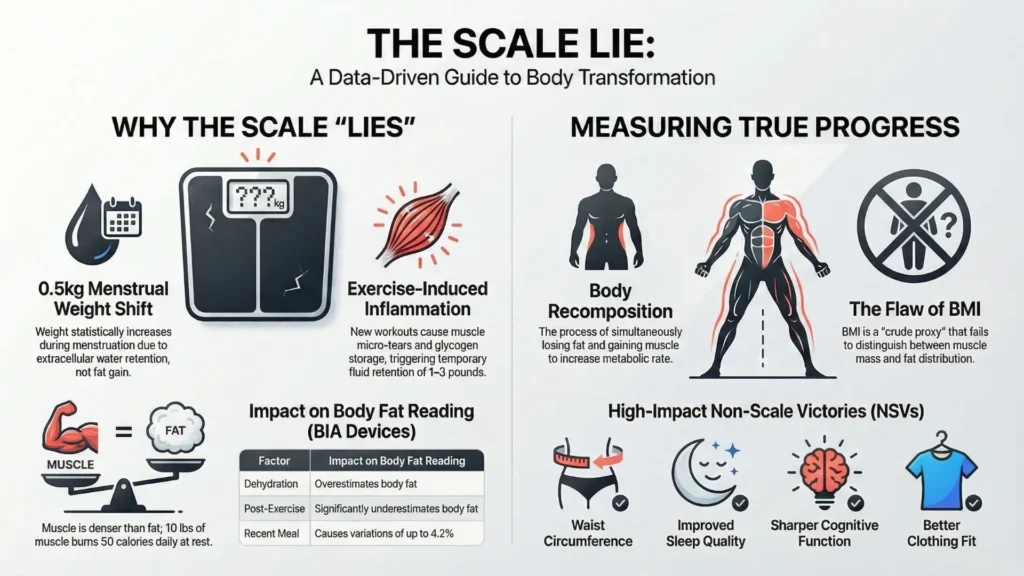
The Morning Scale Struggle: Why Does My Weight Change Every Day?
Table of Contents
- 1 The Morning Scale Struggle: Why Does My Weight Change Every Day?
- 2 Why Seeing a Higher Number After a “Good” Day Feels So Frustrating
- 3 The Myth of Overnight Fat Gain: Can You Really Gain 1kg in 24 Hours?
- 4 The Science of the Scale: Role of Sodium, Cortisol, and Glycogen in Indian Diets
- 5 Medical Realities: PCOS, Thyroid, and Diabetes
- 6 Smart Tracking: How to Use Weekly Averages and Inch Loss for Better Accuracy
- 7 Common Tracking Mistakes: Weighing at Different Times or After Heavy Meals
- 8 Trust the Process: Why Consistency Matters More Than Today’s Number
- 9 Stop Obsessing Over the Scale—Consult a Diet Dekho Expert for a Body Composition Analysis Today!
- 10 Contact Us
- 11 Disclaimer
The frustration of seeing an unstable body weight is something I hear about from clients every single day. You might have followed your meal plan perfectly, avoided the evening samosa, and completed your walk, yet the scale shows you are a kilogram heavier the next morning. It feels unfair, but from a physiological standpoint, it is perfectly normal. Our bodies are not static machines; they are dynamic, fluid-filled biological systems that respond to every bite, every hour of sleep, and every stressful meeting.
In simple terms, what you are seeing is not a failure of your diet, but the result of your body’s internal management of resources. About 60% of your body is water, and this water volume is constantly shifting. For the average adult, a daily fluctuation of 0.5kg to 2kg is standard. If you weighed yourself every three hours, you would see a different number every time. This is why fixating on a single daily measurement leads to unnecessary stress.
The Components of Total Mass
To understand why the scale is a blunt instrument, we have to look at what it is actually measuring. When you step on that machine, it provides a cumulative total of several distinct categories:
| Body Component | Percentage of Total Weight | Sensitivity to Daily Change |
| Skeletal Muscle | 30% – 55% | Low (Slow growth/loss) |
| Body Fat (Adipose) | 10% – 30%+ | Low (Slow metabolism) |
| Total Body Water | 10% – 25% | High (Instant changes) |
| Bone Mineral Content | ~15% | Very Low (Stable) |
| Organs & Tissues | 10% – 15% | Very Low (Stable) |
| Undigested Food/Waste | Variable | High (Changes per meal) |
As this table illustrates, the two things people most want to change—muscle and fat—are actually the least likely to fluctuate overnight. The daily weight changes you see are almost entirely driven by water and the physical weight of food and waste in your system.
The Role of Glycogen in Indian Diets
For the Indian population, where rice, rotis, and millets are staples, glycogen plays a massive role in weight scale fluctuations. Glycogen is the form in which your body stores carbohydrates in your muscles and liver for energy. It is a vital fuel source, but it is also a “wet” fuel. Every single gram of glycogen stored in your body binds with approximately 3 to 4 grams of water.
If you have a slightly larger portion of pulao or an extra chapati at dinner, your body stores that energy as glycogen, pulling in a significant amount of water to do so. This can easily lead to a 1kg spike on the scale the next morning. This isn’t fat; it’s simply your muscles being “topped up” with energy and the water required to hold that energy. Conversely, when people go on “crash diets” or very low-carb diets, they see a rapid drop in weight in the first few days. This is almost entirely the loss of glycogen and its associated water—not fat loss—which is why the weight often returns as soon as normal eating resumes.
Why Seeing a Higher Number After a “Good” Day Feels So Frustrating
There is a deep emotional connection between our efforts and the feedback we receive from the scale. When you feel you have been “good”—meaning you have been disciplined with your choices—and the scale doesn’t reward you, it can feel like your body is betraying you. This psychological toll is one of the biggest reasons people give up on their health journeys prematurely.
What this means for your daily routine is that you must detach your self-worth from the shifting scale numbers. The body often undergoes significant internal repairs that cause the scale to rise even when you are losing fat. For example, if you have started a new exercise routine or increased the intensity of your home workouts, your muscles will experience microscopic tears. This is a good thing; it is how you get stronger. However, the body’s response to this “micro-trauma” is inflammation and water retention to aid the healing process. You are literally getting healthier, yet the scale is telling you that you are “heavier.”
The “Nature” of Metabolic Memory
The frustration is compounded by a biological phenomenon recently highlighted in the journal Nature. Research suggests that fat cells can actually “remember” being at a higher weight. This cellular memory makes the body more efficient at regaining weight during minor dietary lapses. When you see a spike on the scale, it might trigger a stress response that leads to emotional eating, which unfortunately plays right into this biological memory.
Instead of reacting to the number, we must learn to trust the biological lag. Your body does not burn fat and show it on the scale instantly. There is often a delay between a caloric deficit and the scale reflecting that change, largely because water often fills the space in fat cells temporarily after the fat is burned—a phenomenon often called the “whoosh effect” by fitness enthusiasts, though scientifically it relates to fluid balance and cortisol regulation.

The Myth of Overnight Fat Gain: Can You Really Gain 1kg in 24 Hours?
One of the most common myths I encounter at DietDekho is the fear that a single wedding dinner or a festive meal has “ruined” everything because the scale jumped by 1kg the next day. Let’s look at the math to debunk this fear once and for all.
The Mathematics of Fat Gain
In the world of clinical nutrition, gaining actual body fat requires a significant and sustained caloric surplus. While traditional wisdom suggests that 3,500 calories equal half a kilogram of fat, the biological reality for an Indian metabolism, which may be more prone to insulin resistance, is closer to a 7,700-calorie surplus to gain one full kilogram of fat.
To put that into perspective, if your body needs 2,000 calories to maintain its weight, you would need to consume 9,700 calories in a single day to gain 1kg of fat. That is roughly equivalent to eating:
- 14-15 large burgers
- Over 40-50 samosas
- Nearly 4 kilograms of cooked biryani
Most people, even during a heavy festive meal, do not come close to this level of surplus in a single 24-hour period. Furthermore, the body has a limit on how much fat it can actually synthesize and store in a few hours. A large portion of excess calories is often burned off through increased body temperature (thermogenesis) or non-exercise activity like fidgeting.
If It’s Not Fat, What Is It?
If you see a 1kg increase after a “cheat meal,” it is almost certainly a combination of the following:
| Cause | Mechanism | Duration |
| Sodium Retention | Salt holds water in the blood and tissues | 24-48 hours |
| Glycogen Storage | Carbs stored in muscles with water | 36-72 hours |
| Digestive Bulk | The physical weight of food in the gut | Until waste is expelled |
| Inflammation | Response to high sugar or processed fats | 24-72 hours |
I know it’s hard to stay calm when the numbers jump, but understanding this math is your shield against the “all-or-nothing” mentality. One meal cannot make you fat, just as one salad cannot make you lean. Consistency over weeks and months is the only thing that changes your true body composition.
The Science of the Scale: Role of Sodium, Cortisol, and Glycogen in Indian Diets
The Indian lifestyle and dietary patterns have a unique relationship with the scale. Our food is flavorful, often involving complex masalas and preservation techniques that can wreak havoc on fluid balance.
Sodium: The Hidden Inflator
The average Indian consumes nearly 10 grams of salt daily, which is double the safe limit recommended by the World Health Organization and ICMR-NIN. This high sodium intake is a primary driver of unstable body weight. Sodium acts like a sponge, pulling water into your extracellular spaces to maintain the delicate balance of electrolytes in your blood.
Consider the traditional Indian plate. Even if you are eating “healthy” home-cooked dal-chawal, the accompaniments can spike the scale:
- Pickles (Achar): These are cured in salt. A single tablespoon can contain up to 500mg of sodium, which is 25% of your daily allowance.
- Papads: Often overlooked, these are concentrated sources of sodium used for preservation.
- Savoury Snacks (Namkeen): Even “baked” versions are often loaded with salt for taste.
When you consume excess salt, your body holds onto every drop of water it can to dilute that salt. This results in the “puffed” feeling in your face or fingers and a higher number on the scale. This is a temporary fluid shift, not a change in your body fat percentage.
Cortisol and the Busy Professional
For our busy professionals, stress is often a constant companion. Whether it is a looming deadline or the stress of a long commute in Mumbai or Bengaluru, your body responds by producing cortisol. High levels of this “stress hormone” are directly linked to water retention and bloating, particularly in the abdominal area.
Cortisol also influences how your body handles insulin. Chronic stress can lead to temporary insulin resistance, causing your body to store more sodium and water. If you are working long hours and not sleeping well, the scale might stay stuck or go up, even if you are eating very little. In fact, extreme calorie restriction is itself a stressor that can raise cortisol, creating a cycle where you eat less but the scale refuses to move.
The Role of Fiber and Digestion
A sudden increase in fiber—perhaps you’ve started eating more sabzi or switched to brown rice—can also lead to temporary shifting scale numbers. Fiber is excellent for fat loss, but it adds “bulk” to the digestive tract and can cause temporary bloating as your gut microbiome adjusts. Until your body becomes efficient at processing this new volume, the scale may reflect the physical weight of the fiber and the water it absorbs in your gut.

Medical Realities: PCOS, Thyroid, and Diabetes
At DietDekho, we specialize in helping individuals manage conditions like PCOS, hypothyroidism, and diabetes. For these groups, the scale weight is often a poor indicator of health and can even be misleading regarding the effectiveness of a treatment plan.
PCOS and the “Lean” Paradox
Polycystic Ovary Syndrome (PCOS) is a hormonal disorder that affects millions of Indian women. It is primarily driven by insulin resistance, which means the body struggles to process sugar, leading to higher insulin levels. High insulin tells the body to store fat and makes it incredibly difficult for the kidneys to flush out excess sodium.
Furthermore, up to 20% of women with PCOS fall into the “Lean PCOS” category. These women may have a “normal” scale weight but still suffer from high body fat percentages, irregular periods, and metabolic issues. If these women only tracked their weight, they might believe they are “healthy” when their internal body composition suggests otherwise. For PCOS management, focusing on weight loss vs inch loss and hormonal markers is far more important than the scale.
Hypothyroidism and Water Weight
The thyroid gland is the master controller of your metabolism. When it is underactive, every process in your body slows down, including how quickly you burn calories and how efficiently you eliminate waste and water. People with hypothyroidism often suffer from a specific type of water retention called myxedema. This is not fat; it is a buildup of complex sugars in the skin that trap water.
For a thyroid patient, the scale might show a 2kg gain in a single week. It is physically impossible to gain 2kg of fat that quickly while eating a standard diet. This is a clear indicator of a hormonal flare-up or fluid imbalance, not a failure of willpower.
Hypertension and Medication
Managing blood pressure (BP) often involves medications like diuretics or beta-blockers, which directly affect fluid balance. If you are on BP medication, your scale weight will fluctuate based on your hydration levels and the timing of your dose. In these cases, your waist-to-hip ratio and your blood pressure readings are much better indicators of your health than the scale.
Smart Tracking: How to Use Weekly Averages and Inch Loss for Better Accuracy
If the scale is misleading, how should you track your progress? Let’s simplify this by looking at more reliable metrics that reflect true body composition changes.
The 7-Day Moving Average
Instead of looking at a single day’s weight, we recommend tracking your weight daily (if it doesn’t cause anxiety) and calculating a weekly average. This “smooths out” the spikes caused by a salty dinner or a poor night’s sleep.
Example of Weekly Average Tracking:
| Day | Weight | Context |
| Monday | 70.0 kg | Post-weekend water retention |
| Tuesday | 69.5 kg | Normal routine |
| Wednesday | 69.8 kg | High-intensity workout (inflammation) |
| Thursday | 69.2 kg | Good sleep |
| Friday | 69.7 kg | Salty dinner (Pickles/Papad) |
| Saturday | 69.1 kg | Routine |
| Sunday | 68.9 kg | Rested |
| Weekly Average | 69.45 kg | The true number to compare with next week |
By comparing weekly averages rather than daily numbers, you can see the downward trend even if Friday was “heavier” than Thursday.

Why Inch Loss Is King
In the Indian context, where we often have a “thin-fat” phenotype (meaning we may look slim but have high abdominal fat), the measuring tape is a much better friend than the scale. Fat takes up about four times more space than muscle. This means you can lose a significant amount of fat and replace it with a smaller, denser amount of muscle.
The result? The scale doesn’t move, but your clothes fit differently. For a homemaker or a busy professional, the ultimate “Non-Scale Victory” (NSV) is often:
- Fitting into a saree blouse that was too tight last year.
- Needing to tighten your belt by a notch.
- Seeing more definition in your face and jawline.
- Being able to walk up three flights of stairs without getting winded.
These are signs of losing fat not weight. This distinction is critical because losing weight can sometimes mean losing precious muscle mass, which actually slows your metabolism in the long run.
Common Tracking Mistakes: Weighing at Different Times or After Heavy Meals
Many people unintentionally make the scale more misleading by not following a consistent weighing protocol. If you want the most accurate data possible, you must eliminate the variables.
The Problem with Different Scales
Every scale is calibrated differently. You might weigh 70kg on your home scale but 71.5kg on the analog scale at your gym or a friend’s house. This difference isn’t a gain; it’s just a difference in machine calibration. Always use the same scale for your tracking.
Flooring and Positioning
Digital scales are incredibly sensitive. If you place your scale on a carpet or a rug, the sensors will provide an inaccurate, often much higher, reading. Ensure your scale is on a hard, flat surface like tiles or marble. Even moving the scale a few inches can require it to “re-zero” itself. Always tap the scale to turn it on, let it hit 0.0, and then step on.
The Best Time to Weigh
Your weight will naturally increase throughout the day as you consume food and water. A single liter of water weighs exactly 1kg. If you drink a large bottle of water and step on the scale, you will be 1kg heavier instantly, but you haven’t gained any fat.
The most consistent time to weigh is:
- First thing in the morning.
- After using the washroom.
- On an empty stomach (before tea or water).
- Wearing minimal or the same type of clothing.

Trust the Process: Why Consistency Matters More Than Today’s Number
I want to remind you that your body is working for you, not against you. The biological processes of fat loss are happening deep inside your cells, and the scale is a very delayed reporter of that news. If you are eating balanced meals, moving your body, and managing your stress, you are succeeding—regardless of what the number says today.
The “Nature” study we mentioned earlier also found that while fat cells have a memory, consistent healthy habits can eventually create a new, healthier “set point”. This takes time. Most experts, including those at the ICMR, suggest that a healthy rate of weight loss is 0.5kg to 1kg per week. Expecting more leads to “yo-yo dieting,” which damages your metabolism and makes future progress harder.
The Role of Protein and Strength Training
To ensure you are losing fat not weight, you must prioritize protein and some form of resistance training. Protein has a high Thermic Effect of Food (TEF), meaning your body burns more calories just to digest it. It also helps preserve your muscle mass while you are in a caloric deficit.
At DietDekho, we don’t just advocate for “eating less.” We advocate for “eating better.” The 2024 ICMR-NIN guidelines emphasize that we should limit cereals to 45% of our plate and fill the rest with vegetables, pulses, and healthy fats. This balance ensures that your body feels safe enough to release stored fat rather than holding onto it in “survival mode.”
Stop Obsessing Over the Scale—Consult a Diet Dekho Expert for a Body Composition Analysis Today!
If you are tired of the morning scale struggle and want a plan that focuses on real results—like higher energy, better fitting clothes, and improved health markers—it’s time to move beyond the scale. Our experts use advanced body composition analysis to show you exactly how much of your weight is fat, muscle, and water. This clarity takes the guesswork out of your health journey.

Frequently Asked Questions (FAQs)
Q1: Why did my weight increase after a heavy workout yesterday?
When you exercise, you create micro-tears in your muscle fibers. Your body responds with localized inflammation and water retention to repair these tissues. Additionally, your muscles may be storing extra glycogen to prepare for your next workout, which pulls in more water. This is a sign of progress, not fat gain!
Q2: How much can weight fluctuate during a period?
Most women experience a gain of 1kg to 3kg in the week leading up to their period. This is due to hormonal changes (progesterone and estrogen) that cause the body to retain more sodium and water. This weight usually disappears a few days after the period starts.
Q3: Can I lose fat and still weigh the same on the scale?
Absolutely. This is called “Body Recomposition.” Because muscle is much denser and takes up less space than fat, you can lose several inches from your waist while the scale stays exactly the same. This is why the fit of your clothes is a much better progress marker than the scale.
Q4: Should I stop eating salt to lose weight fast?
No, salt is an essential electrolyte. However, reducing excess sodium from pickles, papads, and processed snacks will help reduce unnecessary water retention and bloating. Follow the ICMR guideline of less than 5g of salt per day for heart health and steady scale readings.
Q5: Is ghee bad for weight loss?
On the contrary, pure desi ghee contains CLA (Conjugated Linoleic Acid), which can actually help with fat metabolism. In moderation (1-2 teaspoons a day), it improves satiety and nutrient absorption, helping you stay full longer and avoid overeating.
Contact Us
We understand how overwhelming nutrition and weight loss information can feel. With so many opinions and confusing advice online, it’s easy to feel stuck or unsure about what to do next.
At Diet Dekho, you never have to figure it out alone. You can contact us anytime with any questions or concerns. Our expert dietitians are available 24/7 to guide, support, and help you stay on track. Whether your goal is weight loss or building healthier habits, we’re here to make the journey simpler and more sustainable for you.
Disclaimer
This blog is intended to help readers make healthier food choices. Your health should always be the top priority. Before starting any restrictive or special diet, especially if you have a medical condition or health concern, please consult a doctor or a qualified dietitian. Each body responds differently to food and lifestyle changes. Always choose what is safe and suitable for you.

Dr. Ritika is a nutrition and lifestyle expert with 2+ years of experience, helping clients manage weight and health through practical, personalized diet plans.