
Ever wondered how a Bollywood icon manages to stay fit while balancing a high-pressure career and a deep love for Indian food? The Sonakshi Sinha weight loss journey is not just a typical celebrity headline; it is a masterclass in metabolic patience, biological discipline, and the power of sustainable habit formation.
The short answer to how she achieved this is that Sonakshi Sinha lost 30 kg over 2.5 years by moving from a 95 kg baseline to a maintained 65 kg. Her method avoided crash diets, focusing instead on consistent Pilates, daily 90-minute yoga sessions, fasted morning cardio, and a high-protein Indian diet that strictly limited carbohydrates after 6:00 PM to align with her body’s natural circadian rhythms.
How did the Sonakshi Sinha weight loss journey begin?
Table of Contents
- 1 How did the Sonakshi Sinha weight loss journey begin?
- 2 What role did the “Salman Khan Factor” play in her motivation?
- 3 Why did Pilates become her favorite workout?
- 4 How did Yoga transform her mind and body?
- 5 Is fasted morning cardio really effective?
- 6 What exactly did her “high protein” diet look like?
- 7 Why did she stop eating carbohydrates after 6:00 PM?
- 8 How does her routine help with Thyroid and Hypertension?
- 9 What can we learn from the ICMR 2024 Dietary Guidelines?
- 10 How to manage weight like Sonakshi as a busy professional?
- 11 What are the most common FAQs about her journey?
- 12 A Reassuring Word from DietDekho.com
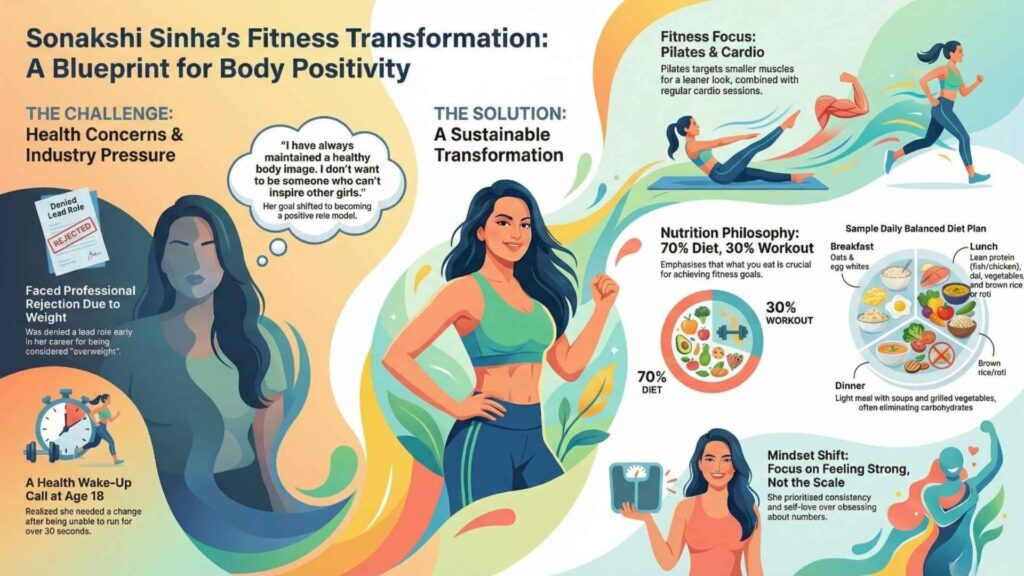
Every successful transformation starts with a “why” that goes deeper than just looking good in front of a camera. For Sonakshi, the realization came at the age of 18 when she found herself unable to run on a treadmill for more than 30 seconds. I know it is hard to hear, but being breathless after such a short burst of activity is a major sign that the heart and lungs are struggling to keep up with the body’s demands.
This moment was a wake-up call that shifted her focus from vanity to functionality. She had been higher weight since her school days, which is a common struggle for many Indian children. In simple terms, her body was carrying extra weight that made everyday movements feel like a heavy chore, and she decided she did not want to live an unhealthy life anymore.
| Baseline Metric | Pre-Transformation Value | Impact on Health |
| Initial Weight | 95 Kilograms | High risk of metabolic syndrome and breathlessness |
| Cardio Endurance | 30 Seconds on Treadmill | Extremely low cardiorespiratory fitness (VO_2 max) |
| Lifestyle Habit | Sedentary with junk food love | Chronic energy surplus and high insulin resistance |
Why is childhood obesity a growing concern in India?
The Indian Council of Medical Research (ICMR) notes that obesity is a chronic disease, not just a lifestyle choice. In India, prevalence rates for obesity have been rising rapidly, with urban populations being the most inactive. What this means for your daily routine is that the environment around us often encourages weight gain through easy access to processed snacks and a lack of open spaces for movement.
At least 30% of obesity begins in childhood, and a staggering 80% of higher-weight children go on to become higher-weight adults. Sonakshi’s journey shows that even if you have struggled with weight since you were a child, you can reprogram your metabolism with the right steps. It takes time—in her case, two and a half years—but the results are much more permanent than any “7-day detox”.
What role did the “Salman Khan Factor” play in her motivation?
While her internal drive was the engine, she credits actor Salman Khan as the spark that started the Sonakshi Sinha weight loss journey. Salman saw her potential and motivated her to lose weight specifically for her debut in the movie Dabangg. He even made sure she hit the gym every day after shooting to prevent her from becoming lethargic.
Having a support system or a mentor is vital when you are trying to change your life. Whether it is a professional trainer or a supportive friend, having someone to hold you accountable makes the difficult days easier to handle. Let’s simplify this: motivation gets you started, but the discipline Salman encouraged is what helps you cross the finish line.
How does social support influence weight loss success?
Research suggests that surrounding yourself with positive, health-conscious people can reduce stress levels, which is a major barrier to fat loss. When you feel supported, you are less likely to engage in emotional eating. Sonakshi used this encouragement to boost her willpower, eventually taking a strong stand against the “size zero” trend in Bollywood.
She chose to focus on being “fit and toned” rather than dangerously thin. This is a reassuring approach for anyone who feels pressured by industry standards. Your goal should be a body that functions perfectly, not one that fits into a specific dress size.
Why did Pilates become her favorite workout?
If you find the gym boring, you are not alone. Sonakshi openly admitted that she used to hate exercising until she discovered Pilates. She trains under celebrity instructor Namrata Purohit and found that Pilates suited her body type exceptionally well. In simple terms, Pilates is about quality of movement over quantity.
It uses specialized equipment like the Reformer or Core Stix to sculpt and tone the muscles without adding bulk. What this means for your daily routine is that you can build strength while also improving your flexibility and posture. Pilates clicked for her because the routine offered thousands of variations, so it never felt repetitive.
| Pilates Benefit | Physiological Outcome |
| Core Activation | Strengthens the deep “powerhouse” muscles of the abdomen |
| Spinal Alignment | Reduces back pain and improves overall posture |
| Muscle Toning | Uses eccentric contractions to create a lean look |
| Low Impact | Easy on the joints, making it suitable for all ages |
Can Pilates be done at home without equipment?
I know it is hard to find a specialized Pilates studio nearby, but you can still get the benefits at home. Mat Pilates uses your own body weight and gravity to create resistance. Exercises like the “Hundred,” “Glute Bridges,” and “Leg Circles” are excellent for building core strength in your living room.
For busy homemakers, even 15 to 20 minutes of these movements can help tone the waist and hips. You do not need a fancy machine; a simple yoga mat or a soft carpet will do. The key is to move slowly and with full control, focusing on your breath as you engage each muscle.
How did Yoga transform her mind and body?
Beyond the physical toning of Pilates, yoga played a massive role in the Sonakshi Sinha weight loss journey. She dedicated 1.5 hours every single day to yoga, which helped her develop not just a leaner body, but a more centered mind. Yoga is particularly effective for those dealing with stress-related weight gain or conditions like PCOS.
Her routine likely included Vinyasa flows for strength and mobility, Hatha yoga for balance, and Pranayama for relaxation. Pranayama, or controlled breathing, activates the body’s relaxation response, which helps lower blood pressure and cortisol levels. This is a very important point: you cannot build a healthy body in a stressed-out mind.
Why is yoga recommended for Indian women with PCOS?
Polycystic Ovary Syndrome (PCOS) is a hormonal issue that affects many Indian women, causing weight gain around the belly. ICMR research indicates that a multidisciplinary approach—including nutrition and stress management—is the best way to manage PCOS. Yoga helps by improving insulin sensitivity and reducing the “fight or flight” response in the body.
In simple terms, yoga helps your body process sugar better and keeps your hormones in balance. For women with PCOS or thyroid issues, starting with gentle poses like the “Child’s Pose” or “Legs-up-the-wall” can be incredibly healing. It is not just about burning calories; it is about bringing the body back into its natural rhythm.

Is fasted morning cardio really effective?
One of the “secrets” shared in the Sonakshi Sinha weight loss journey is her habit of doing cardio on an empty stomach. She typically does 30 minutes on the Stairmaster followed by 20 minutes of brisk walking. This is known as “fasted cardio.”
The logic here is that after an overnight fast, your insulin levels are low, and your body may turn to stored fat for energy more quickly. However, this needs to be done carefully. If you have diabetes, exercising on an empty stomach can sometimes cause your blood sugar to drop too low (hypoglycemia).
| Exercise Type | Recommended Duration | Benefit |
| Fasted Cardio | 30 Minutes | Potential for higher fat oxidation |
| Brisk Walking | 20-30 Minutes | Excellent for heart health and blood sugar |
| Stairmaster | 20-30 Minutes | Intense calorie burn and lower body toning |
How can beginners safely start a cardio routine?
If you are just starting, do not feel pressured to jump on a Stairmaster immediately. Brisk walking for 30 minutes daily is one of the most powerful tools for weight loss. It helps lower blood sugar and can even reduce high blood pressure naturally.
For those with knee pain or limited time, walking after meals is a great way to prevent blood sugar spikes. I suggest starting with a 10-minute walk in the morning sunlight to help set your body’s natural clock and absorb Vitamin D, which is vital for insulin operation.
What exactly did her “high protein” diet look like?
Diet is often 70% of the battle, and Sonakshi’s approach was very structured. Her trainer, Yasmin Karachiwala, put her on a high-protein, low-carb plan. In simple terms, she swapped heavy rotis and rice for lean proteins and plenty of vegetables.
A high-protein diet is effective because protein takes more energy to digest than fats or carbs. It also keeps you feeling full for a longer time, which prevents you from reaching for those mid-day biscuits. According to Harvard Health, choosing healthier proteins like fish, beans, or nuts over processed meats is better for both your heart and your waistline .
How to structure an Indian high-protein meal plan?
Let’s simplify this for an Indian kitchen. You do not need expensive imported foods to follow the Sonakshi Sinha weight loss journey diet plan. Indian staples are naturally rich in what you need.
- Proteins: Dal, chickpeas (chana), kidney beans (rajma), paneer, eggs, and chicken.
- Carbs: Replace white rice with brown rice, quinoa, or local millets like ragi, bajra, and jowar.
- Fats: Use healthy oils like mustard or cold-pressed coconut oil in moderation.
One of her “golden rules” was eating every 2 to 3 hours in small quantities. This keeps your metabolism ticking and prevents you from getting so hungry that you overeat during your next meal.

Why did she stop eating carbohydrates after 6:00 PM?
A very important part of her transformation was the 6:00 PM carbohydrate cutoff. For dinner, she typically had lean protein like fish, chicken, or egg whites with a bowl of mixed vegetables or soup.
Our bodies are less efficient at processing sugar and carbs as the sun goes down. This is linked to our “circadian rhythm”—the internal clock that tells us when to sleep and eat. By keeping dinner light and protein-focused, you give your digestive system a rest and encourage your body to burn fat while you sleep.
| Meal Timing | Food Selection | Rationale |
| Early Morning | Warm lemon water | Flushes toxins and aids digestion |
| Breakfast | Muesli/Oats with egg whites | Complex carbs for energy |
| Lunch | Dal, Sabzi, and 2 Rotis | Balanced fiber and protein |
| Dinner | Grilled chicken/fish or soup | Lean protein for muscle repair |
What if you feel hungry late at night?
I know it is hard to resist late-night cravings, especially if you are working late. If you must snack after dinner, reach for a few almonds, walnuts, or a small cup of warm milk. These provide satiety without the heavy blood sugar spike that comes from bread or sweets.
Hydration is also key. Often, our brain confuses thirst with hunger. Drinking a glass of water or a cup of green tea can help settle the stomach. Sonakshi made sure to keep herself hydrated at all times to maintain her energy levels.
How does her routine help with Thyroid and Hypertension?
If you are managing thyroid issues or high blood pressure (BP), weight loss can feel like an uphill battle. However, the Sonakshi Sinha weight loss journey incorporates elements that are medically sound for these conditions. For thyroid management, it is important to focus on nutrient-dense foods that support metabolic function.
For hypertension, the ICMR suggests restricting salt intake and focusing on potassium-rich foods like fruits and vegetables. The “DASH” eating plan, which is often recommended by health authorities like the NIH, emphasizes exactly what Sonakshi followed: more vegetables, fruits, whole grains, and lean proteins (https://www.nih.gov/health-information/weight-management).
Tips for exercising with High Blood Pressure
If you have high BP, avoid very intense lifting or sudden bursts of speed. Instead, follow Sonakshi’s lead with yoga and walking.
- Deep Breathing: 5 minutes of mindful breathing can lower blood pressure naturally.
- Slow Yoga: Poses like Shavasana (corpse pose) are “quiet healers” for the heart.
- Swimming: If you have access to a pool, swimming is excellent as it is light on the joints and very calming for the nervous system.
Always remember to consult your doctor before starting any new routine, especially if your BP is not yet under control with medication.

What can we learn from the ICMR 2024 Dietary Guidelines?
In May 2024, the Indian Council of Medical Research (ICMR) released updated dietary guidelines that perfectly explain why Sonakshi’s “Ghar ka Khana” approach works. The new guidelines suggest a 33% increase in vegetable intake—up to 400 grams a day!.
They also emphasize getting protein from natural sources rather than powders. Sonakshi’s diet of dal, paneer, and eggs aligns with this “natural first” approach. The ICMR warns that excessive protein supplements, if not balanced with enough carbs and fats, can put a strain on your kidneys.
The 17 ICMR Guidelines for a healthier India
Let’s simplify the most relevant points for your weight loss journey :
- Eat a variety of foods to ensure a balanced diet.
- Eat plenty of vegetables and legumes (dals).
- Restrict salt intake to less than 5g a day.
- Minimize the consumption of “HFSS” (High Fat, Sugar, and Salt) foods.
- Maintain a healthy lifestyle to prevent abdominal obesity.
What this means for your daily routine is that you do not need “fancy” diets. Simple, home-cooked Indian food, when eaten in the right portions and at the right time, is your best tool for long-term health.
How to manage weight like Sonakshi as a busy professional?
I know it is hard to find time for 90 minutes of yoga when you have meetings or a household to run. But the Sonakshi Sinha weight loss journey taught us that “balance” is more important than perfection. You can still see results by making small, smart swaps throughout your day.
| Busy Life Situation | The “Sonakshi” Style Swap | Benefit |
| Eating Out | Swap Naan for Tandoori Roti/Chapatti | Saves ~430 calories and adds fiber |
| Snack Break | Swap Biscuits for a handful of Almonds | Provides protein and healthy fats |
| Beverages | Swap Soda for Coconut Water or Green Tea | Hydrates without hidden sugars |
| In the Office | Take the stairs instead of the elevator | Increases daily “NEAT” (non-exercise activity) |
Efficient meal strategies for the modern NRI
For our NRI friends, maintaining an Indian diet can be tricky. I suggest focusing on “one-pot” meals like vegetable khichdi made with brown rice or millets. You can also prep your dals and stir-fries for the week during the weekend to avoid the temptation of ordering fast food.
Even if you cannot do a full yoga session, a quick 10-minute deep breathing exercise before bed can help lower your stress levels after a long workday. Consistency beats complexity every single time.

What are the most common FAQs about her journey?
How did Sonakshi Sinha lose 30 kg?
She lost weight over 2.5 years through a combination of high-protein eating, a strict no-carb-after-6-PM rule, and a workout routine that blended Pilates, yoga, and fasted morning cardio.
What is the best protein source for Indian vegetarians?
According to ICMR and nutrition experts, the best sources are a variety of dals (lentils), chickpeas, kidney beans (rajma), paneer (cottage cheese), and curd. Combining cereals with pulses in a 3:1 ratio (like Khichdi) improves the quality of protein you get from your meal.
Can I lose weight without going to the gym like Sonakshi?
Yes! While she used a gym for some of her cardio, she also heavily relied on yoga and Pilates, both of which can be done at home with just a mat. Walking briskly for 30 minutes every day is another highly effective “non-gym” exercise.
What should I eat if I have a sweet tooth?
Luckily, Sonakshi does not have much of a sweet tooth, but she used fruits like bananas or a few nuts as her go-to snacks when she felt hungry. If you crave sweets, try a small piece of dark chocolate or a few dates instead of refined sugar treats.
Is it necessary to do 1.5 hours of yoga every day?
While Sonakshi did 1.5 hours, even 30 to 45 minutes of yoga three times a week has been shown to produce better blood pressure results than medication alone for some people with mild hypertension. The goal is to be consistent with whatever time you can spare.
A Reassuring Word from DietDekho.com
The most important takeaway from the Sonakshi Sinha weight loss journey is that transformation is a mental game as much as a physical one. She stopped chasing thinness and started choosing wellness. She stopped comparing herself to others and focused on her own growth.
In simple terms, you have to be kind to yourself. There will be days when you miss a workout or eat a slice of pizza—and that is okay. What matters is that you get back to your routine the next day. Health is a lifelong commitment, not a short-term destination.
I know it feels overwhelming right now, but you do not have to do it alone. Start by making one small change today—maybe a 10-minute walk or swapping your evening biscuit for a few almonds. You have the potential to feel lighter, stronger, and more confident, just like Sonakshi did.
Ready to start your own transformation? Let us help you design a plan that fits your busy life:
Disclaimer: This blog post was written to help you make healthier food choices altogether. So, be aware and take care. The important thing to consider is your health before starting a restrictive diet. Always seek advice from a doctor or dietitian before starting if you have any concerns.
BOOK YOUR APPOINTMENT
Dr. Ritika is a nutrition and lifestyle expert with 2+ years of experience, helping clients manage weight and health through practical, personalized diet plans.