Have you ever found yourself standing in your kitchen at 7:00 AM, looking at a bowl of fermented rice batter and feeling a sense of quiet dread rather than the usual morning comfort? For so many of my friends and clients in Chennai, Bengaluru, or Kochi, a diagnosis of Type 2 diabetes feels like a sudden wall between you and the foods that define your childhood.
I know it is hard to find time to research every grain when you are juggling back-to-back meetings or managing a household, but the truth is that you do not have to give up your culture to save your health. Specifically, by simply adjusting your south indian diabetic diet chart to favor ancient grains and smarter eating sequences, you can enjoy your favorite flavors while keeping your blood sugar stable and your energy levels high.
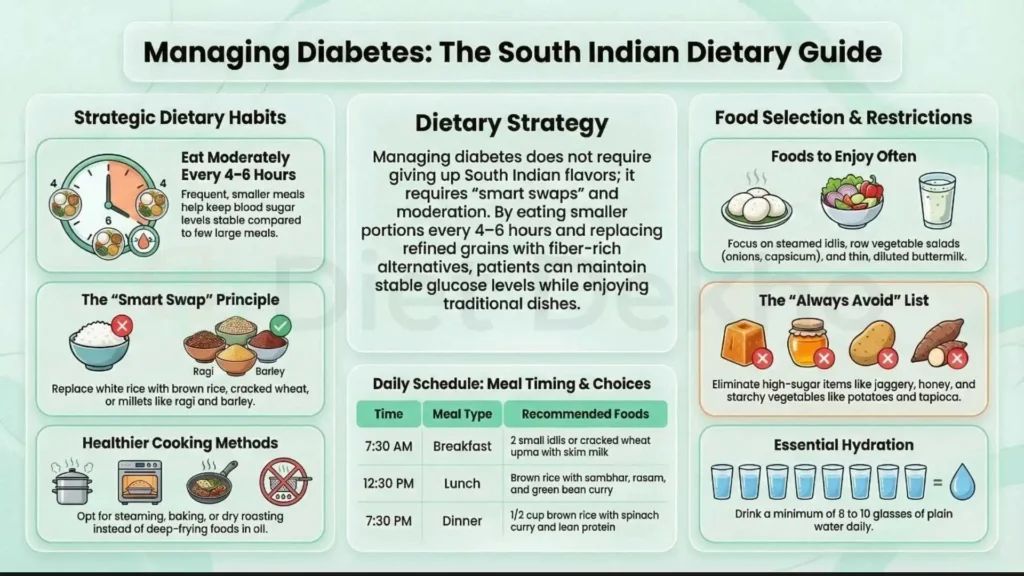
A south indian diabetic diet chart focuses on replacing polished white rice with low-glycemic alternatives like ragi, barnyard millet, and brown rice to prevent glucose spikes. It prioritizes fiber-rich vegetables, lean proteins like pulses or egg whites, and strategic meal sequencing eating fiber and protein before carbohydrates to maintain stable HbA1c levels while respecting traditional regional culinary preferences.
Understanding the Metabolic Landscape of South India
Table of Contents
- 1 Understanding the Metabolic Landscape of South India
- 2 The Science of the Glycemic Index in the South Indian Kitchen
- 3 Reclaiming the Grains: The Millet and Ragi Revolution
- 4 Regional Deep Dive: Tamil Nadu and the Art of the Tiffin
- 5 Kerala: Navigating Red Rice and Coconut Wisdom
- 6 Andhra Pradesh and Telangana: Balancing Heat and Health
- 7 Karnataka: The Power of Ragi and the Plate Method
- 8 The Plate Method and the Science of Meal Sequencing
- 9 Survival Guide for Busy Professionals and Homemakers
- 10 Clinical Foundations: The ICMR-NIN 2024 Guidelines
- 11 A Detailed 7-Day South Indian Diabetic Diet Chart
- 12 Frequently Asked Questions
- 13 Conclusion: Your Journey to Wellness Starts Today
- 14 Contact Us
- 15 Disclaimer
What this means for your daily routine is that we need to look closely at why our bodies react differently to a traditional meal than they might have a generation ago. We live in a region that is often called the diabetes capital of the world, and there is a specific metabolic reason for this that has nothing to do with a lack of willpower. Specifically, researchers have identified a unique body composition in South Asians often described as the Thin-Outside-Fat-Inside (TOFI) phenotype, where we tend to carry more visceral fat around our internal organs even if our weight on the scale looks normal.

The Impact of the Nutrition Transition
Furthermore, this deep belly fat is biologically active and directly increases insulin resistance, making it much harder for our cells to absorb glucose from the blood. The statistics are quite sobering when we look at them closely. Currently, over 101 million adults in India are living with diabetes, and the prevalence is significantly higher in southern states like Kerala and Tamil Nadu compared to the national average. This is largely because we have shifted from a lifestyle of physical labor and diverse grains to one of long sitting hours and a diet dominated by highly polished white rice.
| Region/Metric | Estimated Prevalence (%) | Primary Dietary Driver |
| Tamil Nadu | 13.5 – 14.3 | High reliance on polished white rice staples |
| Kerala | 14.2 – 20.0 | High intake of saturated fats and refined carbs |
| Andhra Pradesh | 12.5 | Heavy salt and spice with rice-centric meals |
| Karnataka | 11.5 | Increased urban consumption of processed snacks |
| National Average | 11.4 | Sedentary lifestyle and refined grain intake |
Consequently, I want you to realize that this is not your fault, but it is your responsibility to manage it. When we talk about a south indian diabetic diet chart, we are looking at a way to outsmart this genetic predisposition. Instead of the sharp, exhausting spikes and crashes that come from a plate of white rice, we want a slow, steady release of energy.

The Science of the Glycemic Index in the South Indian Kitchen
Let’s simplify one of the most confusing parts of diabetes management: the Glycemic Index (GI). Think of the GI as a speed limit for how fast a food turns into sugar in your blood. High-GI foods are like a sports car speeding onto a highway; they hit your system fast and cause a massive spike. On the other hand, low-GI foods are more like a steady walker; they release energy slowly and keep things under control. For those of us in the South, our traditional staples like idli and dosa are often made with white rice, which pushes them into the high-speed category.
Comparing Common Breakfast Items
Recent studies conducted in Chennai and Bengaluru have tested 23 varieties of common breakfast foods to see exactly how they affect us. Specifically, the results were fascinating. While we often think of an onion dosa as a healthy choice because of the vegetables, it actually recorded one of the highest GI values because of the refined rice batter. Conversely, the humble vada sambar performed much better because the lentils (urad dal) provide protein and fiber that act as a natural brake on sugar absorption.
| Breakfast Item | Glycemic Index (GI) | Glycemic Load (GL) | Metabolic Impact |
| Vada Sambar | 36.89 | 18.44 | Low/Stable |
| Pesarattu (Moong) | 60.69 | 33.70 | Medium/Manageable |
| Chapati (Whole Wheat) | 62.43 | 28.37 | Medium/Steady |
| Idli Sambar | 68.69 | 34.34 | Medium-High |
| Plain Dosa | 79.39 | 39.69 | High/Spiking |
| Onion Dosa | 79.69 | 39.84 | High/Spiking |
| Lemon Rice | 79.30 | 39.65 | High/Spiking |
However, we cannot just look at the GI. We also have to consider the Glycemic Load (GL), which accounts for the portion size you actually eat. If you have a tiny piece of a high-GI food, the impact might be low. But if you eat three large dosas, the cumulative load becomes dangerous. What this means for your daily routine is that we can actually eat some of the foods we love as long as we control the portion size and pair them with the right fiber and protein bodyguards .

Reclaiming the Grains: The Millet and Ragi Revolution
I know it’s hard to imagine a meal without rice, but let’s look at the incredible alternatives that were once the backbone of our regional agriculture. Millets, or nutri-cereals, are essentially superfoods that have been hidden in plain sight. They are naturally gluten-free, packed with fiber, and have a much lower impact on your blood sugar than any polished grain. When you incorporate these into your south indian diabetic diet chart, you aren’t just managing sugar; you’re also getting a massive boost of calcium, iron, and magnesium.
Identifying the Best Millet for Your Plate
Each millet has its own unique personality and health benefits. Specifically, barnyard millet has one of the lowest GI values of any grain, making it the perfect direct substitute for rice in a curd rice or a pulao. Foxtail millet is rich in protein and helps reduce bad cholesterol, while Ragi (finger millet) is famous for its high calcium content.
| Grain Type | Tamil Name | Kannada Name | Glycemic Index | Key Benefit |
| Barnyard Millet | Kuthiraivali | Oodalu | 42.3 | Lowest GI, High Fiber |
| Foxtail Millet | Thinai | Navane | 54.5 | High Protein, Heart Health |
| Finger Millet | Ragi | Ragi | 54.0 | Calcium, Iron, Satiety |
| Little Millet | Samai | Saame | 52.7 | Antioxidants, Easy Digest |
| Brown Rice | Sigappu Arisi | Rajamudi | 50.0 | Whole Grain, B Vitamins |
| White Rice | Pachari | Sona Masoori | 89.0 | High Spike, Refined |
In addition, I often tell my friends that if you want to start small, try replacing just half of your white rice with barnyard or kodo millet. The texture is surprisingly similar, and after a few days, your palate will actually start to prefer the nuttier flavor of the ancient grains. For the ragi lovers, remember that the way you prepare it matters. Specifically, coarsely ground ragi flour has a lower GI than very fine powder because the larger particles take longer for your body to break down.
Regional Deep Dive: Tamil Nadu and the Art of the Tiffin
In Tamil Nadu, the ritual of the tiffin is sacred. Whether it’s breakfast or a light evening meal, the combination of idli, dosa, and sambar is everywhere. But if we want to manage blood sugar effectively, we need to perform a little culinary surgery on these classics. The traditional ratio of four parts rice to one part urad dal is unfortunately a recipe for a sugar spike.
Smart Swaps for Tamil Favorites
However, shifting that ratio to include more lentils or substituting the rice with millets can transform your metabolic health. For example, an Oats Idli or a Ragi Dosa provides a much steadier release of energy. When you pair these with a sambar that is overflowing with vegetables like drumsticks, okra, and pumpkin, you are creating a meal that is both satisfying and safe.
One of the best kept secrets in a south indian diabetic diet chart for Tamil Nadu is the use of Sundal or steamed legumes as a snack. Whether it is green gram or chickpeas, these are protein powerhouses that keep your hunger at bay. What this means for your daily routine is that instead of reaching for a biscuit, a small bowl of sundal with a squeeze of lime can be a life-changing habit.
Kerala presents a unique challenge and opportunity. The state has some of the highest rates of diabetes in the country, partly due to the high consumption of polished rice. However, the traditional use of parboiled red rice (Matta rice) is a fantastic starting point. Matta rice retains its outer bran layer, which contains the fiber and nutrients that white rice lacks.
Balancing Traditional Fats
While coconut is often debated, it is a foundational part of Kerala’s culinary soul. The key is balance. Specifically, using fresh coconut in a poriyal or an avial provides healthy medium-chain triglycerides that can help with satiety. However, we must be careful with the quantity of coconut oil if there is an underlying heart condition. For breakfast, the transition from white rice puttu to ragi or oats puttu is one of the most effective moves you can make.

Andhra Pradesh and Telangana: Balancing Heat and Health
The bold, spicy flavors of Andhra and Telangana are legendary, but the traditional emphasis on large mounds of white rice can be tough on a diabetic system. The key here is to embrace the region’s love for lentils and non-starchy vegetables. Specifically, the Pesarattu, or green moong dal dosa, is perhaps one of the most clinically sound breakfast choices available.
Adding Fiber to Spicy Curries
Moreover, moong dal has a very low GI of around 38 and is packed with protein. When you make your daily Pappu (dal), try adding fiber-rich vegetables directly into the pot. A ridge gourd (Beerkaya) pappu or a leafy green (Akukoora) pappu increases the bulk of the meal and slows down the absorption of sugar.
| Nutrient (per portion) | Beerkaya Pappu | Traditional Plain Dal | Impact |
| Calories | 152 | 180 | Lower Calorie |
| Protein (g) | 6.0 | 5.5 | Sustained Fullness |
| Fiber (g) | 5.0 | 1.5 | Better Sugar Control |
| Carbs (g) | 16.7 | 25.0 | Reduced Spiking |
In this region, the use of souring agents like tamarind or lemon is also beneficial. Specifically, studies have shown that adding acidity to a meal can actually lower the glycemic response of the entire dish.

Karnataka: The Power of Ragi and the Plate Method
Karnataka is the home of the Superfood ragi, and if you live here, you have a massive advantage. The traditional Ragi Mudde is an exceptional tool for blood sugar management, but we need to be careful about the portion size. Specifically, a tennis ball sized mudde is more than enough for a main meal. When you pair it with a Soppu Saaru (greens-based sambar), you are following a diet plan that is almost perfectly aligned with modern guidelines.
Smart Swaps for Local Staples
One of the common traps in Karnataka is the Bisibelebhath made with high-GI Sona Masoori rice. Consequently, I suggest making your own version at home using broken wheat (Dalia) or Foxtail millet. If you are a fan of Akki Roti, try substituting half the rice flour with Jowar (sorghum) or Bajra (pearl millet) flour. Karnataka’s tradition of Kosambari or raw lentil salad is another brilliant habit to keep, as eating it first creates a fiber net in your stomach.
The Plate Method and the Science of Meal Sequencing
I want to share a technique with you that is so simple it feels like a magic trick, yet it is backed by serious research from institutions like Harvard and the NIH. It’s called Carbohydrate-Last eating. What this means for your daily routine is that the order in which you eat your food is just as important as what you eat.
Visualizing Your New Diabetic-Friendly Plate
When you sit down for a South Indian meal, your plate usually has a mound of rice, some dal, and a vegetable poriyal. Instead of mixing them all together, I want you to try this specific sequence:
- First: Eat your salad or your vegetable poriyal. This provides the fiber that lines your stomach.
- Second: Eat your protein, whether it’s the thick dal, a piece of grilled fish, or paneer.
- Third: Finally, eat your rice or roti.
| Meal Component | Standard Thali | Diabetic-Friendly Thali |
| Half the Plate | Rice/Roti | Non-starchy Vegetables |
| Quarter Plate | Dal/Protein | Dal, Sprouts, or Lean Meat |
| Quarter Plate | Extra Rice | Millets or Whole Grain |
| Accompaniment | Sweet/Pickle | Buttermilk or Salad |
Furthermore, this Plate Method ensures you are getting at least 400 grams of vegetables a day, which is the current gold standard recommended by the ICMR-NIN 2024 guidelines.

Survival Guide for Busy Professionals and Homemakers
I know it is hard to find time to cook elaborate meals when your schedule is packed. For my professional friends in the city, the Biscuit Trap is the most dangerous part of the day. Instead, keep a stash of roasted chickpeas (Chana), peanuts, or makhana in your desk drawer. These are crunchy and provide the protein that stabilizes your blood sugar.
Motivation and consistency
For the homemakers who are the health CEOs of their families, remember that you set the metabolic tone for the whole house. You can sneak nutrition into traditional batters by grating some carrots or finely chopping spinach into your idli batter. In addition, using a non-stick tawa can help you reduce fat intake without sacrificing texture. Consistency is far more important than perfection.

Clinical Foundations: The ICMR-NIN 2024 Guidelines
It’s important to know that these recommendations are based on the latest scientific consensus. In May 2024, the Indian Council of Medical Research (ICMR) and the National Institute of Nutrition (NIN) released updated dietary guidelines. The most significant shift is the Cereal Cap, which recommends that grains should contribute no more than 45% of your total daily energy.
| Guideline Aspect | 2011 Recommendation | 2024 Recommendation |
| Total Vegetable Intake | 300g / day | 400g / day |
| Green Leafy Veg | 50g / day | 100g / day |
| Added Sugar Limit | General Restriction | < 5% of Total Calories |
| Salt Intake | < 5g / day | < 5g / day (Strictly) |
| Fiber Target | General | 25g – 30g / day |
What this means for your daily routine is that we need to stop thinking of rice as the hero of the plate.

A Detailed 7-Day South Indian Diabetic Diet Chart
I have put together this weekly plan to show you that eating for diabetes can be incredibly varied and delicious.
| Day | Breakfast | Lunch | Evening Snack | Dinner |
| Mon | 2 Ragi Idlis + Tomato Chutney | Brown Rice (1/2 cup) + Veg Sambar | Roasted Chana & Green Tea | 2 Multigrain Rotis + Veg Curry |
| Tue | Veg Oats Upma | Foxtail Millet + Kootu + Curd | Sprouted Moong Salad | Veg Dal Khichdi + Raita |
| Wed | Pesarattu + Ginger Chutney | 2 Jowar Rotis + Palak Paneer | Roasted Makhana | Broken Wheat Upma |
| Thu | 2 Adai + light Avial | Kodo Millet + Sambar + Buttermilk | 1 Guava & 5 Almonds | 2 Besan Chillas + Tomato Soup |
| Fri | Ragi Porridge | Brown Rice + Grilled Chicken | Walnuts & Seeds | 2 Multigrain Rotis + Dal |
| Sat | 2 Moong Chillas | Barnyard Millet + Mixed Veg Kootu | Buttermilk + Roasted Cumin | Veg Soup + Ragi Mudde |
| Sun | 2 Oats Idlis + Sambar | Brown Rice + Rajma Masala | Sundal (Green Gram) | Veg Soup + Grilled Paneer |
Pro Tip: For your morning drink, try warm water with 1 teaspoon of soaked fenugreek (methi) seeds.
Frequently Asked Questions
Is idli dosa for diabetes really that bad?
Traditional rice-based idli and dosa have a high glycemic index. However, you can switch to ragi, oats, or millet-based batters to make them much safer.
Can I ever eat white rice again?
You don’t have to ban it, but it should be a rare treat. When you do eat it, keep the portion small and follow the Plate Method by eating your vegetables first.
What about fruits like mango and banana?
These are high in natural sugars and can cause rapid spikes. Instead, stick to low-GI fruits like guava, apple, and pear.
How often should I test my blood sugar?
Specifically, it is good discipline to maintain ‘before food’ sugar levels between 100-110 mg/dL and ‘after food’ levels below 160 mg/dL.

Conclusion: Your Journey to Wellness Starts Today
Reclaiming your health is not about losing your culture. Specifically, it’s about honoring the wisdom of our ancestors who thrived on millets and diverse vegetables. I know it’s hard to change lifetime habits, but let’s simplify this: start by replacing one meal a day with a millet-based alternative and see how much better you feel. Your energy will be more stable, and your doctor will be delighted with your next results.
Ready to personalize your path to health?
Contact Us
We understand how overwhelming nutrition and weight loss information can feel. With so many opinions and confusing advice online, it’s easy to feel stuck or unsure about what to do next.
At Diet Dekho, you never have to figure it out alone. You can contact us anytime with any questions or concerns. Our expert dietitians are available 24/7 to guide, support, and help you stay on track. Whether your goal is weight loss or building healthier habits, we’re here to make the journey simpler and more sustainable for you.
Disclaimer
This blog is intended to help readers make healthier food choices. Your health should always be the top priority. Before starting any restrictive or special diet, especially if you have a medical condition or health concern, please consult a doctor or a qualified dietitian. Each body responds differently to food and lifestyle changes. Always choose what is safe and suitable for you.

Abhinav is the Founder of Diet Dekho, helping people manage weight and lifestyle health through simple, practical nutrition and personalized diet plans.