Ever wondered why you feel like taking a long nap right after a comforting meal of aloo-poori or heavy potato curry? I know it’s hard to find time for a post-lunch stroll when you’re a busy professional or managing a household, but that heavy, sleepy feeling isn’t just food coma it’s your blood sugar acting like a roller coaster. Sweet potato benefits include a much lower glycemic index and higher fiber content compared to regular white potatoes. This ensures a slow release of energy, preventing the insulin spikes that lead to weight gain and fatigue. For those following an Indian diet for weight loss, they offer superior Vitamin A and heart-healthy minerals.
The Mid-Day Energy Slump: Why Your Regular Aloo Might Be Making You Tired?
Table of Contents
- 1 The Mid-Day Energy Slump: Why Your Regular Aloo Might Be Making You Tired?
- 2 Sweet Potato vs. White Potato: How Do These Sweet Potato Benefits Compare?
- 3 Scientific Reasons Sweet Potato Benefits Support Weight Loss and Digestion
- 4 Why Sweet Potato Benefits Matter for PCOS and Diabetes Management
- 5 Practical Indian Kitchen Swaps: From Shakarkandi Chaat to Healthy Tikkis
- 6 Common Cooking Mistakes That Drain These Sweet Potato Benefits
- 7 Take the Next Step Get a Personalized Indian Nutrition Plan from DietDekho
- 8 Frequently Asked Questions
- 9 Contact Us
- 10 Disclaimer
In simple terms, regular white potatoes are fast carbs. They break down quickly into glucose, giving you a sudden rush of energy followed by a crashing low. When your blood sugar drops, you feel tired, irritable, and hungry again within two hours.
If you are managing PCOS or diabetes, these spikes are particularly dangerous. What this means for your daily routine is that your body has to work overtime to manage that sugar, often storing it as belly fat. By focusing on sweet potato benefits, you give your body slow-release fuel.

Sweet Potato vs. White Potato: How Do These Sweet Potato Benefits Compare?
Let’s simplify this debate. While both are root vegetables, they come from completely different plant families. White potatoes are part of the nightshade family, while sweet potatoes belong to the morning glory family .
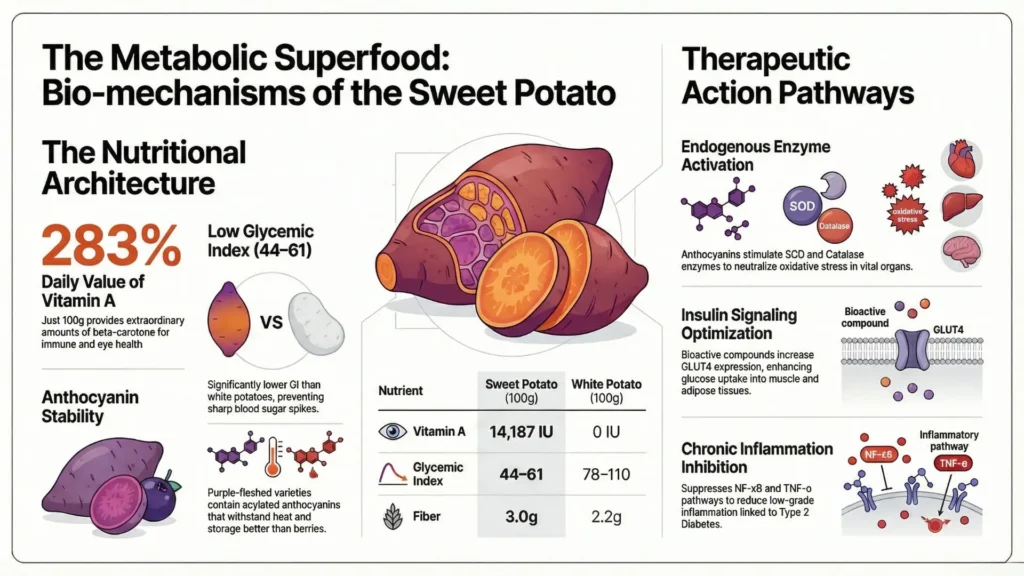
| Nutrient (per 100g) | White Potato | Sweet Potato |
| Fiber | 2.1g | 3.3g |
| Vitamin A (% DV) | 0.1% | 107% |
| Glycemic Index | 80+ (High) | 44-55 (Low-Med) |
| Potassium | 17% DV | 10% DV |
While the regular potato has more potassium, it lacks the massive dose of Vitamin A (beta-carotene) found in sweet potatoes. This vitamin is essential for eye health and supports your immune system. If you’re looking for weight management foods in India, the higher fiber in sweet potatoes is a clear winner.

Scientific Reasons Sweet Potato Benefits Support Weight Loss and Digestion
If you are following an Indian diet for weight loss, satiety (feeling full) is your best friend. Sweet potatoes are rich in resistant starch. This type of starch doesn’t digest in the small intestine; instead, it travels to your colon and feeds healthy gut bacteria.
Recent data from the Indian Council of Medical Research (ICMR) suggests that focusing on fiber-rich tubers can help manage the growing obesity epidemic in India .
How it helps you lose weight:
- Reduced Cravings: The slow digestion means you won’t reach for a biscuit or chai at 4:00 PM.
- Calorie Efficiency: A medium-boiled sweet potato has roughly 90–100 calories but keeps you full significantly longer than white rice or a white potato .
- Metabolic Support: The magnesium and Vitamin B6 in sweet potatoes help your body convert food into energy more efficiently .
At DietDekho, we often integrate these into our 3-3-3 rule for weight loss because they satisfy the balanced meal requirement perfectly.

Why Sweet Potato Benefits Matter for PCOS and Diabetes Management
In India, we are facing a silent crisis. Over 10.1 crore Indians are now living with diabetes, according to the ICMR-INDIAB study. Another 31.5 crore people struggle with high blood pressure .
For Diabetics: Boiled sweet potatoes have a GI as low as 44 . Clinical studies published by the National Institutes of Health (NIH) show that specific preparations of sweet potato can even improve HbA1c levels by 0.3% over five months . You can read more about Harvard’s findings on glycemic loads of root vegetables to see how they compare.
For PCOS & Thyroid: Women with PCOS often have lower magnesium levels. Sweet potatoes help bridge this gap. For thyroid health, the Vitamin A in these tubers helps control TSH levels and prevents gland enlargement. If you have thyroid or hormonal concerns, you might want to look at our(https://dietdekho.com/services/).

Practical Indian Kitchen Swaps: From Shakarkandi Chaat to Healthy Tikkis
I know it’s hard to give up your favorite comfort foods. Let’s simplify this with healthy Indian meal swaps that use sweet potato benefits without sacrificing taste:
- The Tikki Swap: Instead of deep-fried aloo tikkis, make Shakarkandi Tikkis. Mash boiled sweet potatoes with roasted besan (gram flour) or atta, add green chilies, and shallow fry with minimal ghee.
- The Chaat Swap: Winter in India is incomplete without street-side shakarkandi. At home, toss steamed cubes with lemon juice, black salt, and roasted cumin. It’s a fiber-rich snack that beats a bag of chips any day.
- The Roti Swap: Grate raw sweet potato into your whole wheat dough. It makes the rotis softer and adds a boost of fiber to your lunch.
- The Dessert Swap: Use mashed sweet potato and jaggery to make a nutrient-dense halwa instead of refined sugar versions.
Common Cooking Mistakes That Drain These Sweet Potato Benefits
Your shakarkandi is only as healthy as the way you cook it. Many Indian households make one major mistake: peeling the skin.
What this means for your nutrition is a loss of nearly 40% of the antioxidants. The skin contains ten times the antioxidants of the flesh and half the total fiber.
The Best Cooking Methods:
- Boiling/Steaming: This is the gold standard for diabetics. It keeps the GI low.
- Microwaving: Believe it or not, microwaving a whole sweet potato (with skin) preserves more nutrients than baking.
- Avoid Deep Frying: This turns a superfood into a calorie bomb and creates harmful compounds that damage heart health.

Take the Next Step Get a Personalized Indian Nutrition Plan from DietDekho
Switching to sweet potatoes is a fantastic start, but every body is different. Whether you are managing PCOD, trying to lower your blood pressure, or just wanting to lose that stubborn belly fat, a generic plan won’t cut it.
At DietDekho, we help you bridge the gap between knowing what’s healthy and actually doing it in your busy Indian life.
Frequently Asked Questions
Are sweet potato benefits safe for diabetics to eat every day?
The short answer is yes, but portion control is key. A recommended size is about half a cup of boiled sweet potato twice a week. Pairing it with a protein like curd or paneer helps keep your sugar even more stable.
Can I eat sweet potatoes if I have a thyroid condition?
Yes. In fact, they are highly recommended. They are rich in Vitamin A and prebiotics that support gut health, which is vital for thyroid function. Just ensure they are cooked (boiled or roasted) to neutralize any minor goitrogens.
Why are sweet potatoes better than regular potatoes for weight loss?
It comes down to fiber and satiety. Sweet potatoes keep you full for 3 – 4 hours, whereas white potatoes often lead to hunger pangs shortly after eating due to the insulin spike.
Do I have to eat the skin to get the sweet potato benefits?
Ideally, yes. Scrub the skin well to remove dirt. The skin holds the majority of the fiber and antioxidants that protect your heart and pancreas.
Contact Us
We understand how overwhelming nutrition and weight loss information can feel. With so many opinions and confusing advice online, it’s easy to feel stuck or unsure about what to do next.
At Diet Dekho, you never have to figure it out alone. You can contact us anytime with any questions or concerns. Our expert dietitians are available 24/7 to guide, support, and help you stay on track. Whether your goal is weight loss or building healthier habits, we’re here to make the journey simpler and more sustainable for you.
Disclaimer
This blog is intended to help readers make healthier food choices. Your health should always be the top priority. Before starting any restrictive or special diet, especially if you have a medical condition or health concern, please consult a doctor or a qualified dietitian. Each body responds differently to food and lifestyle changes. Always choose what is safe and suitable for you.

Dr. Ritika is a nutrition and lifestyle expert with 2+ years of experience, helping clients manage weight and health through practical, personalized diet plans.