Sunita, a 34-year-old software engineer and mother of two in Bengaluru, used to feel that every meal was a gamble with her health. After her diagnosis, she found it exhausting to balance office meetings, her children’s school schedules, and her insulin injections. Learning how to navigate a type 1 diabetes diet chart finally gave her the confidence to eat without fear. What this means for your daily routine is that you do not have to give up your favorite Indian flavors to stay healthy.
A type 1 diabetes diet chart for the Indian context focuses on low-glycemic index foods such as millets, pulses, and non-starchy vegetables to prevent blood sugar spikes. It recommends a macronutrient balance of 55-60% complex carbohydrates, 15-20% lean protein, and 25-30% healthy fats. By emphasizing portion control and consistent meal timing, this chart helps maintain stable glucose levels and supports long-term metabolic health for insulin-dependent individuals.
Understanding the New Landscape of Diabetes in India
Table of Contents
- 1 Understanding the New Landscape of Diabetes in India
- 2 Why Nutrition is Your Most Powerful Ally
- 3 The Magic of the Glycemic Index in Indian Kitchens
- 4 Embracing the Millet Revolution for Better Control
- 5 Mastering Carbohydrate Counting for Indian Meals
- 6 The Role of Protein and Healthy Fats
- 7 Flexible Indian Meal Sequences for Your Week
- 8 Navigating Social Situations and Cravings
- 9 Advice for Busy Professionals and Homemakers
- 10 The Impact of Stress and Sleep on Your Sugars
- 11 Conclusion: You Are in the Driver’s Seat
- 12 Frequently Asked Questions (FAQs)
- 13 Contact Us
- 14 Disclaimer
I know it feels like the numbers are stacked against us sometimes, but understanding the scale of the challenge is the first step toward mastery. Actually, recent findings from the ICMR–INDIAB study indicate that the prevalence of diabetes in India has surged to 10.5% of the adult population. Even more startling is the fact that India now leads the world in the number of Type 1 diabetes cases among children and adolescents .
| Metric | Current Status in India | Global Context |
| Total Diabetes Cases (Adults) | 89.8 Million | 2nd Highest Worldwide |
| Undiagnosed Cases | 43% | Major Public Health Gap |
| Type 1 Cases (Under 20) | 307,000 | Highest Globally |
| Projected Cases by 2050 | 156.7 Million | 75% Increase Expected |
Consequently, the peak incidence for Type 1 diabetes usually occurs between 10 and 14 years of age, though it can affect you at any stage of life . Unlike Type 2, which is often linked to insulin resistance, Type 1 involves the destruction of insulin-producing beta cells in the pancreas . Therefore, your body requires external insulin to survive, making your food choices the most critical tool in your management kit .

Why Nutrition is Your Most Powerful Ally
Let’s simplify this: every time you eat, your body breaks down carbohydrates into glucose. In a body without Type 1 diabetes, the pancreas releases just the right amount of insulin to move that sugar into your cells. Since your body isn’t making that insulin anymore, we have to do the math ourselves. In light of this, the goal of a professional type 1 diabetes diet chart is to make that math easier and more predictable .
Research shows that following a structured nutritional plan can reduce your HbA1c levels by 1.0% to 1.9%. Furthermore, this isn’t about deprivation; it’s about stability. When we choose foods that digest slowly, we avoid the rollercoaster effect of high and low sugars that leaves you feeling drained . As experts note, a consistent menu plan helps regulate glucose levels and prevents those intense cravings that often lead to overeating.

The Magic of the Glycemic Index in Indian Kitchens
I know it’s hard to find time to research every ingredient, so I want to introduce you to a simple tool: the Glycemic Index (GI). Think of GI as a speedometer for how fast food turns into sugar in your blood. For instance, high-GI foods like white rice or maida are like sports cars they hit top speed instantly. Conversely, low-GI foods like dal and millets are like a steady walk through a park; they give you energy without the crash.
| GI Category | Score Range | Indian Food Examples |
| Low GI | 55 or less | Most pulses, millets, green leafy vegetables |
| Medium GI | 56 – 69 | Whole wheat, brown rice, sweet potato |
| High GI | 70 or more | White bread, white rice, sweetened cornflakes |
What this means for your daily routine is that you should prioritize unprocessed carbohydrates. These foods are high in fiber, which acts like a biological brake, slowing down the release of sugar into your bloodstream. According to the National Institutes of Health (NIH), focusing on these low-GI options is the gold standard for intensive glycemic control .

Embracing the Millet Revolution for Better Control
You might have heard your grandparents talk about jowar, bajra, and ragi. These ancient grains are making a massive comeback for a very good reason. Specifically, millets are nutritional powerhouses. They are naturally gluten-free and packed with magnesium, which helps your body use its own insulin more effectively . If you are looking for a simple swap, start by replacing your white rice with foxtail millet once a week .
| Millet Name | Glycemic Index | Best Used For |
| Barnyard Millet (Oodalu) | 41 | Lowest GI; perfect for replacing rice |
| Browntop Millet (Korle) | 45 | Highest fiber and protein; great for satiety |
| Foxtail Millet (Navane) | 50 | Tastes closest to rice; excellent for pulaos |
| Little Millet (Saame) | 52 | Highest iron; great for energy levels |
| Finger Millet (Ragi) | Moderate | Highest calcium; ideal for bone health |
I’ve seen many clients struggle with the transition, but let’s simplify this: foxtail millet works perfectly in biryani or lemon rice . Meanwhile, ragi is fantastic for making dosas or a warm morning porridge . These small shifts in your type 1 diabetes diet chart can lead to a significant reduction in your post-meal sugar spikes, which means less stress for you and your family.

Mastering Carbohydrate Counting for Indian Meals
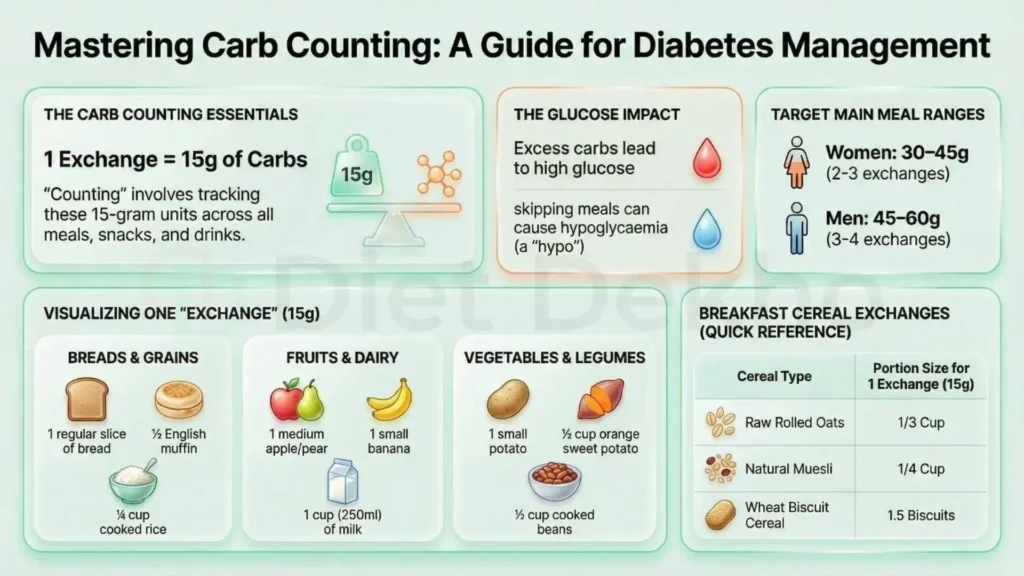
One of the most empowering skills you can learn is carbohydrate counting. It sounds technical, but it’s actually quite simple. In the world of diabetes management, we talk about carb choices. Essentially, one carb choice is a serving of food that contains roughly 15 grams of carbohydrates. Understanding this allows you to have variety and flexibility in your diet without losing control of your numbers.
| Indian Staple | Serving Size | Carb Count (Approx.) |
| Chapati/Phulka (6 inch) | 1 piece | 15g |
| Idli (3 inch) | 1 small | 15g |
| Dosa (10 inch) | 1 piece | 15g |
| Cooked Rice | 1/3 cup | 15g |
| Cooked Dal | 1/2 cup | 15g |
| Cooked Poha/Upma | 1/2 cup | 15g |
If you’re a woman, you generally need about 3–4 carb choices (45–60g) per meal. For men, the range is often 4–5 carb choices (60–75g) per meal. I know it’s hard to measure everything when you’re busy, but using a standard katori or a small bowl (about the size of your fist) can act as a reliable guide for your portions at home. This simple visual cue makes following your type 1 diabetes diet chart much more manageable in a hectic household.

The Role of Protein and Healthy Fats
While carbohydrates have the most immediate effect on your blood sugar, protein and fat play a supporting role that is just as important. In addition, lean proteins like lentils, beans, paneer, and eggs help you feel full and satisfied . They also slow down the digestion of any carbs you eat in the same meal, which further stabilizes your glucose levels.
When it comes to fats, quality matters more than quantity. Specifically, focus on heart-healthy fats from nuts, seeds, and oils like mustard or olive oil . A small handful of almonds (about 23 nuts) provides nearly 20% of your daily magnesium requirement, a mineral that is essential for blood sugar balance . Therefore, avoid deep-fried snacks like samosas or pakoras, as they are high in saturated fats and can lead to delayed sugar spikes.

Flexible Indian Meal Sequences for Your Week
Rather than following a rigid calendar, think of these meal sequences as balanced options you can rotate. This approach allows you to adapt to your schedule while ensuring your blood sugars stay within the target range.
One: The Fiber-First Approach
- The Early Start: Wake up with warm water, 1 tsp soaked methi seeds, and 5 soaked almonds.
- For Breakfast: Enjoy 2 Moong Dal Chillas stuffed with fresh vegetables and a small bowl of low-fat curd.
- A Light Snack: Have 1 medium apple or a fresh guava mid-morning .
- Main Lunch: Prepare 2 whole wheat rotis with 1 cup Masoor Dal, 1 cup Lauki (bottle gourd) sabzi, and cucumber salad.
- Tea Time: Sip on green tea (no sugar) with 1/4 cup roasted chana.
- Final Dinner: End with 1 cup vegetable Dalia khichdi and 100g grilled paneer or tofu.
Two: The Traditional Grain Mix
- The Early Start: Begin with cinnamon water and 2 walnuts .
- For Breakfast: Try 1 cup vegetable Oats Upma with a boiled egg .
- A Light Snack: A small bowl of papaya works perfectly for mid-morning.
- Main Lunch: Serve 1 cup Brown rice with 1 cup Rajma and a side of sautéed spinach .
- Tea Time: Enjoy a glass of unsweetened buttermilk with roasted cumin.
- Final Dinner: Have 2 Jowar rotis with 1 cup Soya Chunk curry and mixed greens .
Three: South Indian Flavor Profile
- The Early Start: Sip warm water with lemon and 5 almonds .
- For Breakfast: Prepare 2 small Idlis with vegetable Sambar and mint chutney.
- A Light Snack: Enjoy 1 medium pear mid-morning.
- Main Lunch: 2 Bajra rotis served with 1 cup Tur Dal and cabbage-carrot sabzi .
- Tea Time: A fresh sprouts salad with onions and tomatoes .
- Final Dinner: Warm vegetable soup with paneer cubes and 1 small roti.
Four: Protein-Rich Variations
- The Early Start: Start with Jeera water and 2 walnuts .
- For Breakfast: Scrambled eggs or tofu with 1 slice whole wheat toast.
- A Light Snack: A small bowl of watermelon or fresh berries .
- Main Lunch: 2 Multigrain rotis with mixed vegetable curry and 1/2 cup curd.
- Tea Time: A small handful of unsalted peanuts or roasted makhana.
- Final Dinner: 100g grilled fish, chicken, or tofu with stir-fried beans.

I know it’s hard when you’re at a wedding or a family dinner and everyone is enjoying halwa or gulab jamun. It’s okay to feel that way. Instead of completely restricting yourself, try the bite-sized approach. If you really want a sweet, have a very small portion (about 15g of carbs) and adjust your insulin bolus accordingly.
What this means for your daily routine is that you don’t have to be perfect. If you have a high sugar reading after an event, don’t beat yourself up. Use it as data to understand how that specific food affects you. Moreover, make a note in your blood glucose diary; this helps you and your dietitian understand your patterns better. According to Harvard Health, developing a healthy eating pattern is more effective than sticking to rigid rules .

Advice for Busy Professionals and Homemakers
If you’re a busy professional, I know it’s hard to find time to cook. Try meal prepping your dals and sabzis over the weekend. Keeping healthy snacks like roasted makhana or nuts in your office drawer can prevent you from reaching for cafeteria biscuits . If you have a desk job, set an alarm to take a 5-minute movement break every hour.
For homemakers, the kitchen can be a place of temptation. I often see clients tasting while cooking, which adds up to many extra carbs. Instead, try sipping on water while you cook to avoid unplanned snacking. Make the type 1 diabetes diet chart a family affair healthy, low-GI eating is good for everyone in the house.
The Impact of Stress and Sleep on Your Sugars
Actually, you could follow the perfect type 1 diabetes diet chart and still see high numbers if you’re stressed or sleep-deprived. When you’re stressed, your body releases cortisol, a hormone that tells your liver to dump extra sugar into your blood. Similarly, poor sleep makes your cells more resistant to insulin.
Let’s simplify this: aim for 7–8 hours of consistent sleep every night. Try to wind down 30 minutes before bed by putting away your phone. This isn’t just wellness talk; it’s a critical part of managing your medical condition. Consequently, these steps help keep your hormones in balance and make your insulin work much more predictably.
Conclusion: You Are in the Driver’s Seat
Managing Type 1 diabetes is a marathon, not a sprint. While the diagnosis might feel like a heavy burden, remember that with a structured type 1 diabetes diet chart and the right lifestyle habits, you can live a full, vibrant life. You have the power to protect your heart, kidneys, and eyes by making smart choices every single day.
Every meal is a new opportunity to give your body what it needs. Don’t let a single high reading discourage you. You are doing something incredibly difficult, and every small win like choosing ragi over white rice is a victory worth celebrating. If you ever feel overwhelmed, reach out for support. You don’t have to do this alone.
Ready to take control of your health today? Our expert dietitians are here to help you create a personalized plan that fits your life and your favorite foods.
Frequently Asked Questions (FAQs)
What is the best type 1 diabetes diet chart for Indian vegetarians?
A great vegetarian chart focuses on low-GI complex carbs like millets (jowar, ragi) and brown rice, balanced with high-protein dals, legumes (rajma, chana), and green leafy vegetables. This combination ensures steady energy and prevents the sharp sugar spikes often seen with high-carb vegetarian diets.
How many carbohydrates should I eat per meal with Type 1 diabetes?
As a general rule, most women need about 3–4 carbohydrate choices (45–60g) per meal, while men often need 4–5 carbohydrate choices (60–75g). However, this depends on your activity level and insulin-to-carb ratio, so it’s best to work with a dietitian to find your perfect number.
Is rice allowed in a type 1 diabetes diet chart?
Yes, you can eat rice! The key is to choose brown rice or parboiled (Basmati) rice and keep the portion size to about 1/3 to 1/2 cup cooked. Pairing your rice with a large serving of dal and fiber-rich vegetables further slows down the sugar absorption.
What are some low-GI snacks suitable for Indians?
Excellent low-GI Indian snacks include roasted chana, roasted makhana, sprouts salad, unsweetened buttermilk (chaas), and raw nuts like almonds or walnuts. These snacks provide satiety without causing significant fluctuations in your blood glucose levels .
Can I reverse Type 1 diabetes with a diet chart?
Currently, there is no cure for Type 1 diabetes because it is an autoimmune condition that destroys the insulin-producing cells. However, a well-structured diet chart can significantly reduce your insulin requirements, lower your risk of complications, and help you live a long and healthy life.
Contact Us
We understand how overwhelming nutrition and weight loss information can feel. With so many opinions and confusing advice online, it’s easy to feel stuck or unsure about what to do next.
At Diet Dekho, you never have to figure it out alone. You can contact us anytime with any questions or concerns. Our expert dietitians are available 24/7 to guide, support, and help you stay on track. Whether your goal is weight loss or building healthier habits, we’re here to make the journey simpler and more sustainable for you.
Disclaimer
This blog is intended to help readers make healthier food choices. Your health should always be the top priority. Before starting any restrictive or special diet, especially if you have a medical condition or health concern, please consult a doctor or a qualified dietitian. Each body responds differently to food and lifestyle changes. Always choose what is safe and suitable for you.

Abhinav is the Founder of Diet Dekho, helping people manage weight and lifestyle health through simple, practical nutrition and personalized diet plans.