Imagine you are rushing to pack tiffins while checking work emails, only to remember the weight of your recent doctor’s visit. I know it is hard to find time for your health when life feels so busy, but managing your condition doesn’t mean giving up the food you love. By using a tailored type 2 diabetes diet chart, you can stabilize your energy and feel like yourself again starting today. Let’s simplify this journey so you can focus on living your life, not just managing a diagnosis.
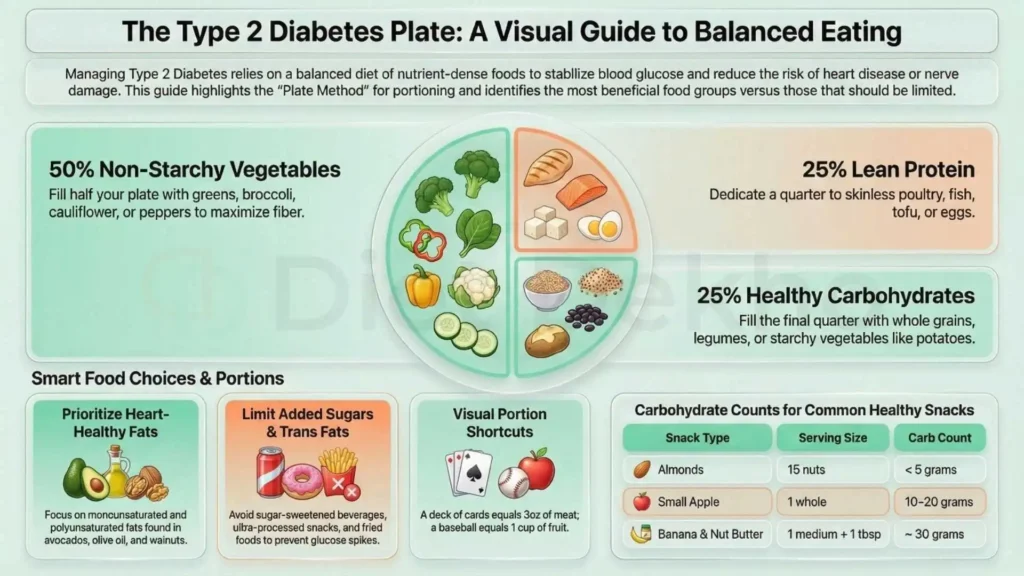
An effective type 2 diabetes diet chart focuses on low-glycemic index (GI) staples like millets (jowar, bajra) and pulses (moong dal) to maintain steady blood sugar. Specifically, you should replace refined grains with fiber-rich alternatives. In addition, I recommend the Plate Method : fill half your plate with non-starchy vegetables, one-quarter with lean protein, and one-quarter with complex carbohydrates for metabolic health.
The National Landscape of Diabetes in India
Table of Contents
- 1 The National Landscape of Diabetes in India
- 2 Understanding Glycemic Index and Glycemic Load
- 3 The Science of Satiety: Fiber, Protein, and Healthy Fats
- 4 Traditional Grains: The Heart of Your T2 Diabetic Chart
- 5 Non-Starchy Vegetables: Your Foundation
- 6 The Plate Method : Visual Portion Control
- 7 7-Day Type 2 Diabetes Diet Chart: A Practical Guide
- 8 Behavioral Strategies for Long-Term Success
- 9 Expert Insights: The Importance of Mental Well-being
- 10 Frequently Asked Questions
- 11 Strategic Conclusion
- 12 Contact Us
- 13 Disclaimer
The prevalence of diabetes in India has reached a critical stage that we simply cannot ignore. According to the ICMR INDIAB study, over 10.1 crore individuals are now living with this metabolic condition. Furthermore, research suggests that approximately 57% of adults with diabetes in our country remain undiagnosed.
What this means for your daily routine is that small, consistent changes are your best defense. Since 1990, diabetes has risen from the 35th to the 13th leading cause of disability in India. Because of this shift, adopting a type 2 diabetes food chart is no longer optional for long-term vitality. By choosing better ingredients today, you are protecting your heart, eyes, and kidneys for the future.
| Epidemiological Statistic | Data Point/Projection | Source |
| Current Prevalence (2024) | 10.1 Crore People | |
| Undiagnosed Population | 57% of Adults | |
| Projected Cases (2045) | 134.2 Million | |
| Global Rank | 2nd (after China) | |
| Leading Cause of DALYs | 13th (up from 35th) |
Understanding Glycemic Index and Glycemic Load
The foundation of a good type 2 diabetic eating chart is the Glycemic Index (GI). This system ranks carbohydrates based on how quickly they convert into blood sugar. Low-GI foods (55 or less) provide a slow, steady release of energy. Conversely, high-GI foods (70 or more) cause rapid spikes that can leave you feeling exhausted.
However, we must also consider the Glycemic Load (GL). This metric is more practical because it accounts for the actual portion size you eat. For instance, watermelon has a high GI but a very low GL because it is mostly water. Therefore, you can occasionally enjoy a small slice without worry. On the other hand, boiled potatoes have a moderate GI but a high GL, meaning they have a much larger impact on your HbA1c levels.
The Science of Satiety: Fiber, Protein, and Healthy Fats
A successful plan is about adding the right nutrients rather than just taking things away. Specifically, combining fiber, protein, and healthy fats is the secret to staying full.
The Essential Role of Dietary Fiber
Fiber acts like a natural brake for your digestion. Soluble fiber, found in oats and beans, slows down the absorption of sugar into your bloodstream. Consequently, your energy stays stable for hours. Most experts recommend aiming for 25 to 35 grams of fiber every day. In your kitchen, focus on legumes like rajma and traditional vegetables like okra (bhindi).
Protein for Metabolic Stability
Protein has almost no direct impact on your blood sugar levels. Moreover, it helps build muscle and keeps you satisfied between meals. For vegetarians, moong dal and low-fat paneer are excellent staples. If you enjoy non-vegetarian food, please prioritize skinless chicken or fish over red meats.
Choosing Heart-Healthy Fats
We now know that certain fats actually improve your heart health. Monounsaturated fats found in nuts and seeds can increase your insulin sensitivity. Similarly, using mustard oil or groundnut oil in small amounts is a healthy choice for Indian cooking. However, please avoid trans fats found in packaged snacks, as they increase inflammation.

Traditional Grains: The Heart of Your T2 Diabetic Chart
Grains are the soul of the Indian plate. Therefore, switching from refined flour to whole options is the most powerful change you can make today.
The Resurgence of Millets
Millets like bajra, jowar, and ragi are traditional superfoods that our ancestors relied on. These grains are naturally low in GI and packed with essential minerals. Recently, Dr. Pramod Tripathi, a Pune-based physician, highlighted that grains like barley (jau) are incredible for weight control. Because barley has a GI of only 25-30, it helps you feel full longer and prevents mid-day cravings.
| Traditional Grain | Glycemic Index (Approx.) | Key Benefit |
| Barley (Jau) | 25–30 | High in magnesium |
| Foxtail Millet | 30–35 | Slow-release energy |
| Ragi (Finger Millet) | 54 | Rich in calcium |
| Bajra (Pearl Millet) | 54 | High in protein |
| Khapli Wheat | 40–45 | Ancient wheat variety |
Smart Grain Swaps in Your Kitchen
You do not need to quit rice to be healthy. Instead, try switching white rice for brown rice or quinoa. When making rotis, use a type 2 diabetes aahar chart strategy by mixing whole wheat with millet flour. If you strongly prefer white rice, simply dilute your portion. This means mixing a small amount of rice with a large serving of dal and vegetables to lower the total glycemic impact.

Non-Starchy Vegetables: Your Foundation
Vegetables are the best way to fill your stomach without raising your sugar. Because they are low in calories, you can eat them in generous portions.
Non-Starchy vs. Starchy
It is vital to know which vegetables to prioritize. Non-starchy options like spinach (palak), bottle gourd (lauki), and bitter gourd (karela) have almost no impact on your sugar levels. In contrast, you should limit starchy vegetables like potatoes, yams, and corn. While sweet potatoes are more nutritious than white potatoes, they still require careful portion control.
| Vegetable | Clinical Significance | Usage Idea |
| Bitter Gourd (Karela) | Mimics insulin action | Sautéed or as juice |
| Okra (Bhindi) | High in soluble fiber | Dry sautéed sabzi |
| Spinach (Palak) | Rich in magnesium | Raita or stir-fry |
| Bottle Gourd (Lauki) | Low calorie and hydrating | Steamed stew |
The Plate Method : Visual Portion Control
I know that counting calories is stressful and time-consuming. Instead, let’s use the simple Plate Method based on a 9-inch dinner plate.
- Fill Half the Plate: Use non-starchy vegetables like a fresh salad or cooked green sabzi.
- One-Quarter Plate: Add a lean protein source like dal, paneer, or grilled chicken.
- One-Quarter Plate: Place your complex carbohydrate here, such as one jowar roti or a small scoop of brown rice.
- On the Side: You may add a small bowl of curd or one piece of whole fruit to complete your meal.

7-Day Type 2 Diabetes Diet Chart: A Practical Guide
This plan uses familiar Indian ingredients that are easy to find. Consequently, you can start today without any specialized shopping.
On the First Day: Fiber Foundation
- Early Morning: Soaked methi seeds and 5 almonds.
- Breakfast: Two moong dal chillas with mint chutney.
- Mid-Morning: One medium guava.
- Lunch: One multigrain roti, mixed dal, and bhindi sabzi.
- Evening: Roasted chana and green tea.
- Dinner: Grilled paneer with stir-fried beans.
Following this, Day 2: Ancient Grains
- Early Morning: Cinnamon water and 2 walnuts.
- Breakfast: Vegetable oats upma with plenty of peas.
- Mid-Morning: A small bowl of papaya cubes.
- Lunch: 1/2 cup brown rice, rajma curry, and cucumber salad.
- Evening: Unsweetened buttermilk (chhachh).
- Dinner: One bajra roti with lauki sabzi.
For Your Third Day: Protein Focus
- Early Morning: Warm lemon water and 5 almonds.
- Breakfast: Vegetable poha with peanuts and a side of curd.
- Mid-Morning: One pear or a few berries.
- Lunch: Two whole wheat rotis, chole curry, and steamed palak.
- Evening: Roasted makhana and herbal tea.
- Dinner: Quinoa or daliya khichdi with mixed vegetables.
Next, Day 4: Traditional Staples
- Early Morning: Ginger-tulsi tea without sugar.
- Breakfast: Two ragi dosas with sambar and chutney.
- Mid-Morning: One small orange.
- Lunch: One jowar roti, masoor dal, and cabbage sabzi.
- Evening: One boiled egg or a bowl of sprouts salad.
- Dinner: Stir-fried tofu with bell peppers and a small serving of barley.
Moving to Day 5: Green Goodness
- Early Morning: Plain warm water and 4-5 soaked almonds.
- Breakfast: Besan chilla with spinach and black coffee.
- Mid-Morning: One medium apple.
- Lunch: Two multigrain rotis and beans poriyal.
- Evening: Fresh coconut slices and green tea.
- Dinner: Grilled fish or chicken with vegetable stew.
Then, Day 6: Balanced Choices
- Early Morning: Jeera water and 2 walnuts.
- Breakfast: Paneer bhurji with one slice of whole-grain toast.
- Mid-Morning: A small bowl of muskmelon.
- Lunch: One bajra roti, mixed veg curry, and dal.
- Evening: Unsalted peanuts and herbal tea.
- Dinner: Thick lentil soup with leafy greens and a small salad.
Finally, Day 7: Weekend Maintenance
- Early Morning: Warm water with lemon.
- Breakfast: Two idlis with sambar.
- Mid-Morning: One pear.
- Lunch: Vegetable khichdi made with dal and brown rice.
- Evening: A handful of roasted chana.
- Dinner: One multigrain roti and baked paneer tikka.

Behavioral Strategies for Long-Term Success
Consistency is more important than perfection. For instance, try to eat your meals at the same time every day to prevent sugar fluctuations. In addition, I recommend carrying healthy snacks like roasted chana to avoid office biscuits.
If you are dining out, simply ask for an extra side of vegetables. Furthermore, you can ask the server to pack half your meal before you even start eating. This small trick helps you stay in control while still enjoying a meal with friends.
Expert Insights: The Importance of Mental Well-being
Managing diabetes is a psychological journey as much as a physical one. Research shows that 33% of Indian patients experience Diabetes Distress . I want you to know that it is okay to feel overwhelmed sometimes. However, having a structured type 2 diabetes diet chart reduces decision fatigue and makes your day easier. Moreover, losing just 5% to 7% of your body weight can drastically improve your insulin resistance.

Frequently Asked Questions
What are the best low-GI grains for a Type 2 sugar diet list?
The best grains for an Indian diet include barley (jau), which has an exceptionally low GI of 25-30, and millets like jowar, bajra, and ragi. These grains release energy slowly, which prevents the sugar spikes caused by white rice.
Can I eat rice on a Type 2 diabetic eating chart?
Yes, but you should choose brown rice or basmati rice. In addition, please keep the portion small and pair it with a bowl of dal and high-fiber vegetables to lower the meal’s total impact.
What snacks are safe for people with type 2 diabetes?
Safe Indian snacks include roasted chana, sprouts salad, roasted makhana, and unsalted nuts like almonds. These options provide protein and fiber without causing a sugar crash later.
Is fruit allowed in a type 2 diabetes diet chart?
Absolutely! Whole fruits like guava, apple, and papaya are excellent in small portions. However, please avoid fruit juices, as they lack fiber and cause sugar to spike rapidly.
How does fiber help in managing sugar levels?
Fiber slows down the digestion of carbohydrates. Consequently, it leads to a more gradual rise in blood glucose. Furthermore, it keeps you full, which helps with weight management.
Strategic Conclusion
Taking control of your health is a brave and vital step. By following this type 2 diabetes diet chart, you are choosing energy, clarity, and long-term vitality. Remember that small swaps like switching your grains or adding more greens can lead to massive results over time. You don’t have to do this alone; I am here to guide you every step of the way.
For a plan tailored specifically to your medical history and lifestyle, we invite you to connect with our experts today. Access your personalized dietary solution here
Contact Us
We understand how overwhelming nutrition and weight loss information can feel. With so many opinions and confusing advice online, it’s easy to feel stuck or unsure about what to do next.
At Diet Dekho, you never have to figure it out alone. You can contact us anytime with any questions or concerns. Our expert dietitians are available 24/7 to guide, support, and help you stay on track. Whether your goal is weight loss or building healthier habits, we’re here to make the journey simpler and more sustainable for you.
Disclaimer
This blog is intended to help readers make healthier food choices. Your health should always be the top priority. Before starting any restrictive or special diet, especially if you have a medical condition or health concern, please consult a doctor or a qualified dietitian. Each body responds differently to food and lifestyle changes. Always choose what is safe and suitable for you.

Abhinav is the Founder of Diet Dekho, helping people manage weight and lifestyle health through simple, practical nutrition and personalized diet plans.