Do you ever find yourself sitting at your desk or finishing a long day of household chores, only to feel a strange, dull throb at your temples or a sudden sense of fatigue that just doesn’t fit the day’s work? I once sat with a client, a dedicated school teacher from Dehradun, who discovered her hypertension entirely by accident during a routine school health camp. She was worried that a vegetarian diet plan for BP would mean giving up the flavors of her home, but I assured her that our traditional kitchens actually hold the keys to her recovery.
A successful vegetarian diet plan for BP leverages the DASH (Dietary Approaches to Stop Hypertension) framework, prioritizing high-potassium foods like spinach, lentils, and bananas to offset sodium’s effects. By integrating magnesium-rich nuts, calcium-dense low-fat dairy, and fiber-heavy whole grains while strictly limiting pickles and processed snacks, individuals can achieve significant blood pressure reduction and improved cardiovascular health naturally.
The Rising Tide of Hypertension in the Indian Landscape
Table of Contents
- 1 The Rising Tide of Hypertension in the Indian Landscape
- 2 The Physiological Blueprint: How Plants Lower Blood Pressure
- 3 Decoding the DASH Diet for the Indian Kitchen
- 4 The Sodium Trap: Pickles, Papads, and Hidden Salt
- 5 The Superfoods of India: Nature’s Own BP Medication
- 6 Oil Wars: Mustard vs. Sunflower in the Indian Context
- 7 A Practical 7-Day Indian Vegetarian Diet Plan for BP
- 8 Meal Prep Hacks for Busy Indian Professionals and Homemakers
- 9 Clinical Proof: Why Plant-Based Diets Win the Fight Against BP
- 10 FAQs
- 11 Reclaiming Your Health: A Final Reassurance
- 12 Contact Us
- 13 Disclaimer
The state of cardiovascular health in India has shifted dramatically over the last few decades. Hypertension has transitioned from a concern primarily for older people to a silent crisis affecting the young and the working class. Recent data from the fifth National Family Health Survey (NFHS-5) highlights a staggering reality: hypertension prevalence is increasing linearly with age, but a significant and concerning rise is now observed as early as the 35-39 years age group. For the busy professional or the homemaker, this means the window for preventive action is shrinking, and the need for a structured nutritional intervention is more urgent than ever.
Understanding the Economic and Social Burden
The economic implications are just as heavy as the health risks. Between 2011 and 2025, cardiovascular diseases, fueled largely by uncontrolled blood pressure, are expected to cost low- and middle-income countries like India approximately US 3.7 trillion. This represents nearly 2% of their combined GDP, a figure that highlights how personal health is inextricably linked to national productivity. When we talk about a vegetarian diet plan for BP, we are not just talking about a meal chart; we are discussing a strategy to protect the economic and physical future of millions of households.
The challenge in India is unique because our diet is often rich in complex carbohydrates but also laden with hidden sodium and saturated fats from traditional preparations. For example, a study conducted in Kerala revealed that the hypertension control rate in some regions is as low as 23.04%, despite high awareness. This suggests that knowing you have high blood pressure is not enough; the barrier is often the practical application of a heart-healthy diet in a culture that treats pickles, papads, and fried snacks as daily staples.
| Hypertension Statistic | Data Point/Impact |
| Global Prevalence | 1.4 Billion People |
| India Control Rate | 23.04% |
| Projected Economic Cost (CVD) | 3.7 Trillion by 2025 |
| Prevalence in Adults 45+ | 28.60% |
| Recommended Screening Age | 35 Years |
What this means for your daily routine is that the standard avoid salt advice is no longer sufficient. We need to look deeper at the physiological triggers of blood pressure and how a plant-based diet can intervene at a cellular level. The global nutrition transition has led many Indians toward processed, carbohydrate-heavy foods that exacerbate insulin resistance and hypertension. Reversing this trend requires a return to whole, minimally processed foods that our ancestors once relied on, but with the added precision of modern clinical guidelines like the DASH diet. According to Harvard Health, a low-sodium version of the DASH diet can be as effective as first-line medication.

The Physiological Blueprint: How Plants Lower Blood Pressure
To understand why a vegetarian diet plan for BP works, we have to look at the big three minerals: potassium, magnesium, and calcium. These aren’t just entries on a nutrition label; they are the electrical regulators of your heart and blood vessels. When your blood pressure is high, it often means your blood vessels are constricted or your body is holding onto too much fluid.
Potassium: The Natural Sodium Antagonist
Potassium is perhaps the most critical player in this drama. It acts as a natural antagonist to sodium. While sodium pulls water into your bloodstream, increasing the volume and pressure, potassium promotes the excretion of sodium through urine and helps relax the walls of your blood vessels. In the Indian context, where salt is used liberally in everything from dal to dough, increasing potassium through foods like sweet potatoes and bananas is essential.
Magnesium and Calcium for Vascular Health
Magnesium functions differently but just as effectively. It acts as a natural calcium channel blocker. In medical terms, this means it prevents too much calcium from entering the heart and blood vessel cells, which allows the vessels to relax and dilate. This process, known as vasodilation, is what allows blood to flow more freely, reducing the strain on the heart. You can find this natural medication in local seeds, nuts, and leafy greens like palak (spinach).
| Mineral | Physiological Role in BP Control | Top Indian Food Sources |
| Potassium | Promotes sodium excretion; vasodilation | Bananas, Potatoes, Coconut Water, Lentils |
| Magnesium | Natural calcium channel blocker; relaxant | Almonds, Pumpkin Seeds, Spinach, Whole Grains |
| Calcium | Regulates vascular smooth muscle contraction | Low-fat Curd, Paneer, Ragi, Broccoli |
| Nitrates | Convert to nitric oxide for vessel dilation | Beets, Spinach, Fenugreek (Methi) |
I know it’s hard to find time to track every mineral, but what this means for your daily routine is that by simply swapping your morning biscuit for a handful of almonds or a banana, you are giving your blood vessels the tools they need to stay flexible. This isn’t just theory; landmark trials like the DASH and DASH-Sodium studies have proven that these dietary shifts can lower blood pressure within weeks, sometimes as effectively as first-line medications.

Decoding the DASH Diet for the Indian Kitchen
The Dietary Approaches to Stop Hypertension (DASH) eating plan is the gold standard for managing BP through nutrition. It was originally developed by the National Institutes of Health (NIH) and has been endorsed by major organizations like the American Heart Association (AHA). The beauty of the DASH plan is that it doesn’t require special foods; it’s about the balance of everyday ingredients.
For an average Indian adult requiring about 2,000 calories, the DASH plan provides clear serving goals. However, I often find that my clients struggle to translate servings into katoris or rotis. Let’s simplify this. A serving of grains is one roti or half a cup of rice. A serving of vegetables is half a cup of cooked sabzi or a full cup of raw salad. When you look at it this way, reaching the goal of 4-5 servings of vegetables a day becomes much more realistic.
Why Quality Matters More Than Calorie Counting
One of the most powerful insights from the DASH research is that the benefits are observed regardless of weight loss. This is encouraging for those who aren’t looking to hit the gym or follow a restrictive calorie-counting regimen. Simply changing the quality of what you eat can protect your heart. For the non-gym audience, this is the most practical step you can take. You don’t need to run a marathon; you just need to change your grocery list.
Detailed DASH Serving Guidelines (2,000 Calorie Plan)
| Food Group | Daily Servings | Example (Indian Context) |
| Whole Grains | 6–8 | 3 Rotis + 1 cup Brown Rice + 1 cup Oats |
| Vegetables | 4–5 | 1 cup Palak + 1 cup Lauki + 1 cup Salad + 1/2 cup Beans |
| Fruits | 4–5 | 1 Banana + 1 Apple + 1 Guava + 1/2 cup Papaya |
| Low-fat Dairy | 2–3 | 1 cup Skim Milk + 1 bowl Curd + 30g Low-fat Paneer |
| Legumes/Nuts/Seeds | 4–5 per week | 1 bowl Dal daily + handful of Walnuts/Almonds |
| Fats and Oils | 2–3 | 2 tsp Mustard/Olive Oil + 1 tsp Ghee |
| Sweets | < 5 per week | 1 small piece of Jaggery or 1 tsp Honey |
Moreover, it feels like a lot of food, especially the fruits and vegetables. But if you think about it, a simple vegetable pulao made with brown rice can easily tick off two servings of grains and two servings of vegetables in one go. The goal is integration, not complication.

The Sodium Trap: Pickles, Papads, and Hidden Salt
In every Indian home, the dining table is rarely complete without a jar of achar (pickle) or a stack of crisp papads. I hate to be the bearer of bad news, but if you are struggling with your blood pressure, these are the first things we need to address. Sodium is the silent partner in the hypertension crisis. In India, we don’t just get our salt from the shaker; it’s embedded in our cultural habits.
A single tablespoon of commercial mango pickle can contain over 300 mg of sodium. If you have two papads with lunch, you’ve added another 400-500 mg. When the daily recommended limit for someone with hypertension is often as low as 1,500 mg, these small additions consume nearly half your allowance before you’ve even counted the main meal.
| High Sodium Source | Sodium Content (Approx) | Why It’s Dangerous |
| 1 tbsp Achar (Pickle) | 300 mg | Salt acts as the primary preservative |
| 1 Roasted Papad | 200–300 mg | Contains added alkaline salts and preservatives |
| Salted Namkeen (1 bowl) | 600–800 mg | Deep-fried and heavily seasoned with chaat masala |
| Instant Noodles | 1,000+ mg | The tastemaker is mostly salt and MSG |
| Store-bought Bread | 150 mg per slice | Salt is used for texture and shelf-life |
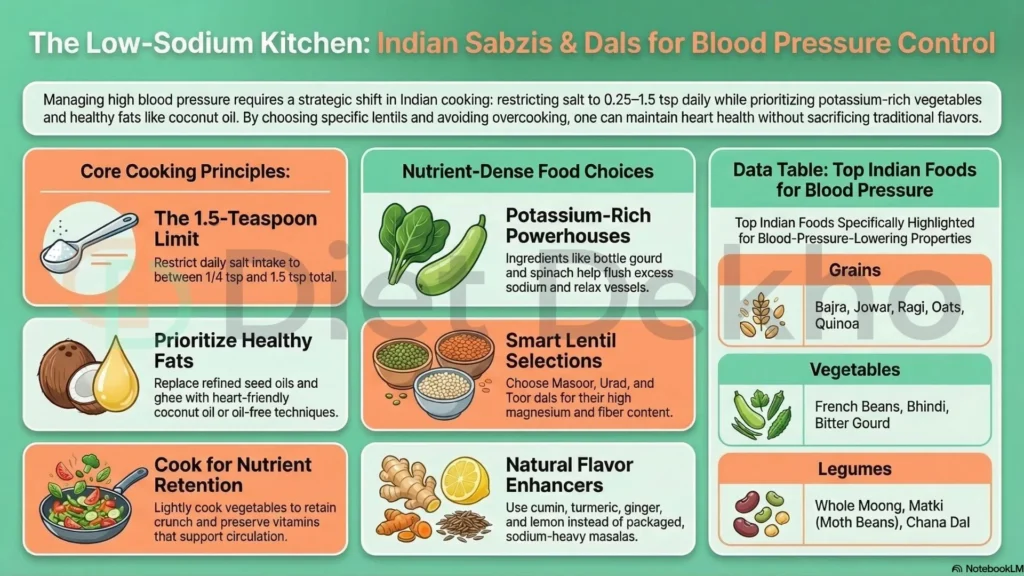
What this means for your daily routine is that we need to find flavor replacements. Instead of salt-heavy pickles, try fresh chutneys made with mint, coriander, green chilies, and a squeeze of lemon. Lemon juice and tamarind are fantastic souring agents that can trick your palate into not missing the salt. I always tell my clients, Don’t just cut the salt; add the soul. Spices like cumin (jeera), black pepper (kali mirch), and fennel (saunf) provide the aromatic depth that salt often masks.

The Superfoods of India: Nature’s Own BP Medication
When people ask for a vegetarian diet plan for BP, they are often looking for a magic pill. While no single food can fix everything, there are five Indian staples that act remarkably like natural medicine for your arteries.
Palak (Spinach): The Nitrate Powerhouse
Spinach is a staple in almost every Indian kitchen, and for good reason. It is incredibly rich in inorganic nitrates, which the body converts into nitric oxide. Nitric oxide is a gas that tells your blood vessels to relax and widen. Clinical trials have shown that daily consumption of spinach juice can dramatically lower both systolic and diastolic blood pressure. Whether you make a simple palak-paneer (with low-fat paneer) or add it to your dal, you are giving your heart a massive boost.
Garlic (Lehsun): The Allicin Effect
Ayurveda has heralded garlic as a top food for high blood pressure for centuries, and modern science finally agrees. When you crush or chop raw garlic, a bioactive compound called allicin is created. Allicin has been shown to be as effective at reducing blood pressure as some pharmaceutical drugs. I suggest my clients swallow one small clove of crushed raw garlic with water in the morning, or add it as a fresh garnish to their dal just before serving.
Bananas: The Potassium Shield
The humble banana is the ultimate convenience food for a busy professional. With 422 mg of potassium in a medium-sized fruit, it helps eliminate excess sodium and soothes the walls of the blood vessels. If you find yourself reaching for a biscuit at 4 PM, have a banana instead. It’s a simple switch that yields huge results.
Flaxseeds (Alsi) and Groundnuts
Flaxseeds are rich in alpha-linolenic acid, an omega-3 fatty acid that reduces inflammation and prevents arteries from narrowing. They also contain lignans, which have antioxidant properties. A tablespoon of roasted, ground flaxseed powder sprinkled on your curd or oats can significantly enhance your vascular function. Similarly, coconut water is rich in potassium and magnesium-acting as a natural electrolyte balance that can replace carbonated drinks or sugary juices.

Oil Wars: Mustard vs. Sunflower in the Indian Context
One of the most frequent debates I have with clients is about cooking oil. For years, we were told to avoid traditional oils and use refined vegetable oils. However, recent Indian studies are shedding new light on this. Mustard oil (sarson ka tel) is increasingly seen as a cardioprotective choice.
Mustard oil has a very favorable ratio of omega-3 to omega-6 fatty acids (about 6:5). It is high in monounsaturated fats (MUFA) and contains alpha-linolenic acid, which helps lower blood pressure and inflammation. In contrast, many refined sunflower or safflower oils are extremely high in omega-6 fatty acids. While we need some omega-6, an excess can lead to systemic inflammation-the very thing we want to avoid with hypertension.
| Feature | Mustard Oil (Sarson) | Sunflower Oil (Refined) |
| Primary Fat Type | Monounsaturated (MUFA) | Polyunsaturated (PUFA) |
| Omega-3 Content | High (Alpha-linolenic acid) | Very Low |
| Anti-inflammatory | Yes, due to N3 fatty acids | Can be pro-inflammatory if excessive |
| CHD Risk Reduction | Up to 71% in some studies | Variable results |
| Best Usage | Traditional Indian cooking | High-heat frying (but releases aldehydes) |
Notably, you can confidently go back to using cold-pressed mustard oil for your subzis. It’s stable at high temperatures and carries those essential fatty acids your heart craves. Just remember that even the healthiest oil is calorie-dense, so stick to 2-3 teaspoons a day.
The Benefits of Farm-Fresh Harvests
Freshly harvested pumpkins, sweet potatoes, and leafy greens from local farms can contain up to 40% more vitamins than their supermarket counterparts. If you live near Jansath, look for local seed dealers who provide traditional varieties of grains like bajra or jowar. These ancient grains have a lower glycemic index and higher fiber content than modern hybrid wheat, making them perfect for a vegetarian diet plan for BP.

A Practical 7-Day Indian Vegetarian Diet Plan for BP
Let’s put all this research into a practical, 7-day schedule. This plan is designed for a busy professional or homemaker who doesn’t have hours to spend on gourmet health food. It uses standard Indian ingredients but prepares them with a heart-healthy twist.
The Energizing Start : Day 1
- Kick off your day with: 1 glass warm water with 1 clove of crushed garlic.
- For your morning meal, try: Vegetable Upma (made with Rava or Oats) with plenty of carrots and beans. 1 cup low-fat curd.
- Once it’s mid-morning, reach for: 1 medium Banana.
- Your lunch consists of: 2 Whole Wheat Rotis, 1 bowl Moong Dal Tadka (use Mustard Oil), 1 bowl Lauki Sabzi, and a large Cucumber-Tomato Salad.
- When evening hunger strikes: 1 small bowl of roasted, unsalted Makhana.
- Dinner is a light: 1 bowl Vegetable Khichdi (Brown Rice and Moong Dal) with a side of steamed spinach.
The Protein Focus : Day 2
- Start the morning with: 5-6 soaked Almonds and 2 Walnuts.
- Breakfast option: Moong Dal Chilla with Mint Chutney (No salt).
- Mid-morning snack: 1 Guava or Pear.
- Main lunch meal: 1 cup Brown Rice, 1 bowl Rajma (prepared with fresh tomatoes, not canned), and 1 bowl Beetroot Raita.
- Evening hydration: 1 glass fresh Coconut Water.
- Ending the day with: 2 Multigrain Rotis (Mix of Wheat, Jowar, and Bajra) with a bowl of Palak Paneer (use low-fat paneer).
The Fiber Boost: Day 3
- Early ritual: 1 tsp Methi (Fenugreek) seeds soaked overnight.
- Breakfast bowl: Oats Porridge with Skim Milk, topped with sliced Apple and 1 tsp Flaxseed powder.
- Mid-morning fruit: 1 bowl Papaya.
- Lunch time: 2 Rotis, 1 bowl Masoor Dal, 1 bowl Mixed Veg (Carrots, Peas, Beans), and a bowl of salad.
- Evening munch: A handful of roasted Chana (Unsalted).
- Supper serving: 1 bowl Dalia Upma with plenty of green peas and carrots.
The Mediterranean-Indian Fusion: Day 4
- Wake-up drink: 1 glass Lemon water (No salt or sugar).
- Morning tiffin: 2 Idlis with Sambar (No coconut chutney, use Tomato-Garlic chutney instead).
- Mid-morning energy: 1 small bowl of Pomegranate seeds.
- Balanced lunch: 2 Rotis, 1 bowl Chole (Chickpeas), and 1 bowl Sautéed Bhindi.
- Evening nutrition: 1 cup Sprouts Salad with chopped onions and lemon.
- Modern dinner: Grilled Tofu with stir-fried Broccoli and Bell Peppers. 1 Roti.
The Potassium Power Day: Day 5
- Daily start: 1 clove of crushed garlic with water.
- Morning favorite: Vegetable Poha with roasted peanuts and a dash of turmeric.
- Citrus snack: 1 Orange or Sweet Lime (Mausambi).
- Midday meal: 1 cup Brown Rice, 1 bowl Toor Dal, 1 bowl Baingan Bharta, and a bowl of curd.
- Hydrating evening: 1 bowl Watermelon or Musk Melon.
- Soy-rich dinner: 2 Rotis, 1 bowl Tofu or Soya Chunk Curry, and a fresh salad.
The Traditional Whole Grain Day: Day 6
- First thing: 5-6 soaked Almonds.
- Ancient grain breakfast: Ragi Dosa or Ragi Porridge (No sugar).
- Morning fruit: 1 medium Apple.
- Hearty lunch: 2 Jowar Rotis, 1 bowl Moong Dal, 1 bowl Cabbage-Matar sabzi, and salad.
- Cool evening: 1 glass Buttermilk with roasted cumin powder.
- Evening pulao: Vegetable Pulao with plenty of cauliflower and beans. 1 bowl Cucumber Raita.
The Satisfying End: Day 7
- Morning cleanse: 1 glass warm water with honey and a pinch of cinnamon.
- Homestyle breakfast: 1 Paneer Paratha (No butter/ghee on top) with a bowl of curd.
- Crunchy snack: Handful of Sunflower or Pumpkin seeds.
- Leafy lunch: 1 cup Brown Rice, 1 bowl Kadhi (Low-fat), and 1 bowl of Sautéed Spinach.
- Veggie evening: Carrot sticks with homemade Hummus (use less salt).
- Final dinner: 2 Rotis, 1 bowl Mixed Dal, and 1 bowl Lauki Sabzi.
Dietitian’s Tip: I know it’s tempting to cheat on Sundays, but what this means for your daily routine is that consistency is what heals the arteries. If you must have a treat, keep the portion small and avoid deep-fried options.

Meal Prep Hacks for Busy Indian Professionals and Homemakers
The biggest obstacle to a vegetarian diet plan for BP isn’t the food-it’s the time. If you’re a professional in a city like Noida or a homemaker in Jansath, your morning is a race. Consequently, we need to simplify the logistics.
The Batter and Gravy Strategy
Most South Indian breakfasts like Idli and Dosa are heart-healthy if you make the batter at home and control the salt. Homemakers can grind a large batch of batter on the weekend. Furthermore, you can prepare and freeze base gravies like bhuna masala or makhani (without the cream) to save time during the week. This makes a healthy breakfast a 10-minute task rather than a 45-minute chore.
Office Lunch Box and Smart Snacking
If you work in an office, canteen food is likely your biggest sodium source. I know it’s hard to find time, but packing a simple box of 2 rotis and a dry sabzi (like beans or carrots) with a small container of curd can save your heart. Moreover, keeping fruit boxes or roasted chana at your desk avoids the temptation of ordering burgers or pizza.
The Non-Gym Exercise for Busy Days
The non-gym audience often feels guilty about not doing hard workouts. But for blood pressure, the insidious damage is done by long periods of sitting. My advice? Take a 10-minute walk after every meal. Research shows that walking post-meal can help manage both blood sugar and blood pressure more effectively than a single long session at the gym. For a homemaker, this could be a few brisk rounds of the house while the tea is brewing.
Clinical Proof: Why Plant-Based Diets Win the Fight Against BP
The evidence for a plant-based approach to hypertension is overwhelming. A systematic review of randomized controlled trials demonstrated that vegetarian diets significantly lower both systolic and diastolic blood pressure compared to omnivorous diets. Specifically, the pooled results showed a significant reduction in systolic blood pressure (WMD, -2.66 mmHg) and diastolic BP (WMD, -1.69 mmHg).
The Vegan vs. Lacto-Vegetarian Impact
Interestingly, the vegan version of the diet-avoiding all animal products including dairy-showed an even greater reduction in systolic blood pressure (-3.12 mmHg) compared to a lacto-ovo-vegetarian diet (-1.75 mmHg). However, for most Indians, giving up curd and milk is difficult. Therefore, the Lacto-vegetarian DASH approach remains the most practical and effective clinical recommendation.
| Study/Trial Type | Key Finding | Clinical Significance |
| DASH Trial (NIH) | 5.5/3.0 mmHg reduction | Effective within 2 weeks |
| Vegan Meta-analysis | -3.12 mmHg SBP | Greatest reduction recorded |
| Epic-Oxford Study | Vegans had lowest BP | Meat-eaters had highest risk |
| Mustard Oil Study (Rastogi) | 71% reduction in CHD risk | Compared to sunflower oil users |
| 2025 AHA Guidelines | DASH lowers SBP by up to 13 mmHg | Rivals medication efficacy |
In summary, adopting a diet rich in plant-based foods, whole grains, and low-fat dairy products has proven effective in managing hypertension. This is particularly true for older adults and those with early-onset hypertension who receive regular dietary guidance.
FAQs
What is the best vegetarian diet plan for BP management?
The best vegetarian diet plan for BP is the DASH diet. It focuses on eating 4-5 servings of vegetables, 4-5 servings of fruits, and 2-3 servings of low-fat dairy daily. It emphasizes whole grains like brown rice and ragi while limiting sodium to less than 1,500 mg per day to naturally lower blood pressure levels.
Can Indians eat potatoes with high blood pressure?
Yes, Indians can eat potatoes if they are boiled or baked with the skin on. A medium potato contains about 900 mg of potassium, which is more than double the amount in a banana. Potassium helps flush out excess sodium and relaxes blood vessel walls, supporting a healthy vegetarian diet plan for BP.
Which Indian superfoods help control high blood pressure naturally?
Five Indian superfoods that help control BP naturally are:
- Garlic: Contains allicin to relax blood vessels.
- Spinach (Palak): High in nitrates for improved circulation.
- Flaxseeds: Rich in Omega-3 to prevent artery narrowing.
- Bananas: High potassium to balance sodium.
- Coconut Water: Provides essential electrolytes to flush out excess salt.
Is jaggery better than sugar for high blood pressure?
Jaggery is a healthier alternative to refined sugar in a vegetarian diet plan for BP because it contains potassium and magnesium, which help regulate blood pressure and muscle function. However, it should be consumed in moderation as it is still a sugar and can affect blood glucose if taken in excess.
What are the hidden sodium sources in an Indian diet?
The main sources of hidden sodium are pickles (achar), papads, salted namkeen (bhujia/sev), and store-bought bread. A single tablespoon of pickle can contain 300 mg of sodium. Reducing these accompaniments is a key step in any vegetarian diet plan for BP.
Reclaiming Your Health: A Final Reassurance
I know it’s hard to find time to change everything at once. If you feel overwhelmed, don’t try to implement all seven days of the meal plan tomorrow. Start with one thing: remove the salt-shaker and the pickle jar from your table. That one act alone can reduce your daily sodium intake by 20-30%.
Next, add one superfood to your routine. Maybe it’s a banana as a snack or a clove of garlic in the morning. These small, punchy changes are more realistic than shifting your entire lifestyle overnight. What this means for your daily routine is that health is a series of choices, not a single destination.
You don’t have to navigate this alone. Hypertension is a silent killer, but it is also a highly treatable and preventable condition. With the right vegetarian diet plan for BP, you are not just managing a number on a machine; you are investing in more years with your family, more energy for your work, and a heart that beats with strength and ease.
Take the first step toward a heart-healthy future. Let our team at DietDekho.com craft a plan that fits your life, your taste, and your goals.
Contact Us
We understand how overwhelming nutrition and weight loss information can feel. With so many opinions and confusing advice online, it’s easy to feel stuck or unsure about what to do next.
At Diet Dekho, you never have to figure it out alone. You can contact us anytime with any questions or concerns. Our expert dietitians are available 24/7 to guide, support, and help you stay on track. Whether your goal is weight loss or building healthier habits, we’re here to make the journey simpler and more sustainable for you.
Disclaimer
This blog is intended to help readers make healthier food choices. Your health should always be the top priority. Before starting any restrictive or special diet, especially if you have a medical condition or health concern, please consult a doctor or a qualified dietitian. Each body responds differently to food and lifestyle changes. Always choose what is safe and suitable for you.

Abhinav is the Founder of Diet Dekho, helping people manage weight and lifestyle health through simple, practical nutrition and personalized diet plans.