At DietDekho, we often see clients who feel perpetually exhausted despite having a clean diet and adequate sleep. If you find yourself struggling with persistent back pain, sudden mood shifts, or hair loss that just won’t stop, the culprit might be simpler than you think. Consequently, despite living in a sun-drenched nation, most of us are missing out on the “sunshine vitamin,” making the search for Vitamin D rich foods a top priority for modern Indian households.
The short answer to optimizing your levels is a combination of 15–30 minutes of mid-day sun exposure and a diet featuring Vitamin D rich foods like sun-dried mushrooms, egg yolks, and fatty fish. For vegetarians, FSSAI-fortified milk, yogurt, and cooking oils are essential staples to bridge the gap in an Indian context.
Why are so many Indians struggling with Vitamin D deficiency?
Table of Contents
- 1 Why are so many Indians struggling with Vitamin D deficiency?
- 2 Understanding the silent signs: How your body tells you it’s low on Vitamin D
- 3 The Indian Vitamin D Food List: Best vegetarian and non-vegetarian sources
- 4 Common myths about sunlight and diet-based Vitamin D absorption
- 5 Practical daily habits and meal swaps to maintain optimal Vitamin D levels
- 6 When to stop DIY and consult a clinical nutritionist for a personalized plan
- 7 Conclusion: A Supportive Path Forward
- 8 Frequently Asked Questions (FAQs)
- 9 Contact Us
- 10 Disclaimer
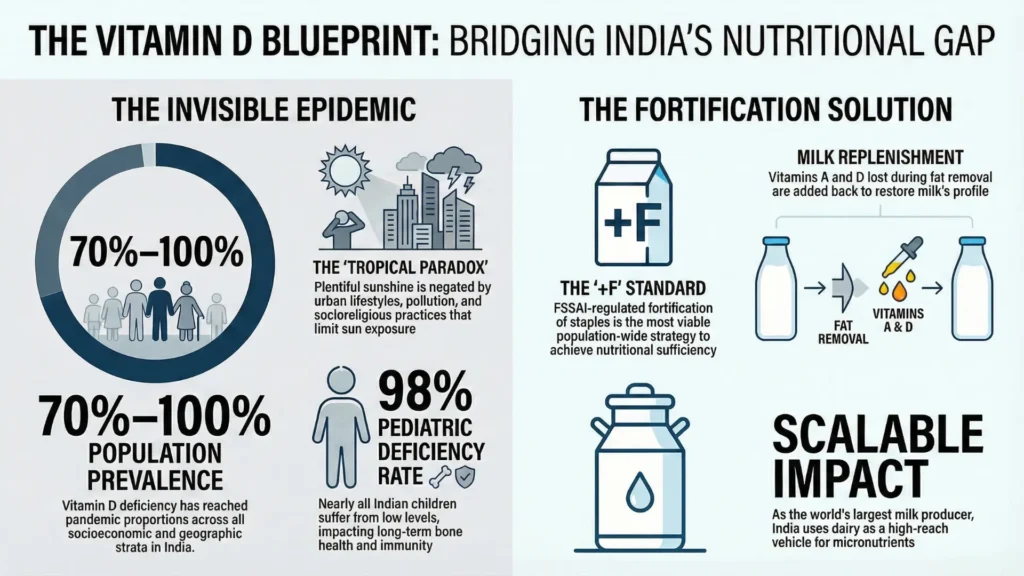
It sounds like a contradiction: how can a country located between the equator and the Tropic of Cancer, receiving nearly 3,000 hours of sunlight a year, have a Vitamin D deficiency rate of 70% to 100%? I know it’s hard to find time to step outside during your busy workday, but the reasons behind this epidemic are a mix of biology, environment, and our changing urban habits.
The Science of Melanin and Skin Pigmentation
In simple terms, the very thing that protects our skin—melanin—is also what blocks Vitamin D production. Melanin acts as a natural shade, reducing the skin’s ability to synthesize Vitamin D from ultraviolet B (UVB) rays. While this prevents skin damage from the harsh tropical sun, it means that an average Indian person needs significantly more time in the sun than someone with lighter skin to produce the same amount of Vitamin D. Specifically, research shows that while a light-skinned person might only need 15 minutes, those with darker skin tones may require 30 to 45 minutes of direct exposure to achieve sufficient levels.
Urbanization and the Glass Barrier
Moreover, our modern life has moved almost entirely indoors. Busy professionals and homemakers alike spend the peak UVB hours—typically between 10:00 AM and 3:00 PM—inside air-conditioned offices or homes. What this means for your daily routine is that even if your desk is next to a large, sunlit window, you aren’t getting your Vitamin D. In fact, glass windows block almost 100% of UVB rays, which are the specific wavelengths needed for the body to convert cholesterol in the skin into Vitamin D3.
Environmental Factors and Air Pollution
Furthermore, for those living in major metros like Delhi, Mumbai, or Bengaluru, the air we breathe also blocks the nutrients we need. High levels of atmospheric pollution, particularly suspended particulate matter and aerosols, scatter and absorb UVB radiation before it can reach the ground. As a result, this “pollution screen” makes it even harder for urban dwellers to maintain healthy levels, forcing a greater reliance on Vitamin D rich foods.
Socio-Cultural Practices and Dress Codes
Additionally, cultural and religious practices play a significant role. Many Indians prefer to stay indoors during peak heat to avoid tanning, and our traditional clothing—which often covers a large percentage of the body—limits the skin’s surface area available for UV absorption. Similarly, even the common use of sunscreen, which is vital for preventing skin aging, can reduce the body’s Vitamin D production by over 95% if applied correctly.
| Factor | Description of Impact | Prevalence in India |
| Melanin | High melanin levels act as a filter for UVB rays. | Very High (Majority of Population) |
| Pollution | Particulates in the air prevent UVB from reaching the skin. | High (Major Urban Hubs) |
| Indoor Lifestyle | Peak sun hours are spent in offices/homes. | High (Urban Professionals) |
| Glass Windows | Block the specific UVB wavelengths needed for D3. | Universal in modern buildings |
| Traditional Dress | Extensive body coverage limits skin-to-sun contact. | High (Across various states) |

Understanding the silent signs: How your body tells you it’s low on Vitamin D
Vitamin D isn’t just a vitamin; it’s actually a hormone that receptors in almost every cell of your body are looking for. When your levels are low, the body doesn’t just “shut down”; it starts sending subtle, persistent signals. Recognizing these Vitamin D deficiency symptoms early can save you from chronic health issues down the line.
The Bone and Muscle Connection
Because Vitamin D is the primary key that unlocks calcium absorption in your gut, your bones are usually the first to suffer when it’s missing. Without it, the body can only absorb a small fraction of the calcium you eat. Consequently, the body “steals” calcium from your skeleton to maintain critical blood functions.
- Persistent Bone Pain: This is often described as a deep, dull ache in the shins, thighs, or lower back. It doesn’t go away with rest and can feel like it’s coming from the “inside” of the bone.
- Muscle Weakness: If you find it difficult to climb stairs or feel a sense of “heaviness” in your legs, it could be a sign of low Vitamin D. In fact, the vitamin plays a direct role in muscle fiber preservation and strength.
- Osteomalacia vs. Osteoporosis: In adults, severe deficiency leads to osteomalacia (softening of the bones). Over time, long-term insufficiency contributes to osteoporosis (brittle bones), significantly increasing the risk of fractures.
Immune Health and Recovery
I know it’s hard to stay productive when you’re constantly falling ill. Essentially, Vitamin D is vital for the activation of your immune system’s “killer T cells,” which hunt down viruses and bacteria.
- Frequent Infections: If you find yourself catching every cold or flu that goes around the office, it’s time to check your levels. Low Vitamin D is strongly linked to respiratory tract infections and a weakened immune response.
- Slow Wound Healing: Have you noticed that a small cut or scrape takes weeks to heal? Vitamin D is involved in the inflammatory and remodeling phases of skin repair.
Mental Health and Energy Levels
The “winter blues” isn’t just a seasonal phrase; it’s a biological reality. Vitamin D receptors are concentrated in the areas of the brain that produce serotonin, the “happiness hormone”.
- Low Mood and Depression: Many clinical studies have shown a direct correlation between low serum levels and symptoms of depression. In simple terms, your brain needs sunlight—or Vitamin D rich foods—to maintain a balanced mood.
- Unexplained Fatigue: This isn’t just “feeling tired” after a long day. Rather, it is a persistent exhaustion that makes everyday tasks feel overwhelming, often acting as a primary sign of insufficiency in women and busy professionals.
Specific Risks for the DietDekho Community
If you are managing conditions like PCOS, Diabetes, or Thyroid issues, Vitamin D isn’t just an “add-on”—it’s a central part of your management plan.
- PCOS and Insulin Resistance: In Indian people with PCOS, Vitamin D deficiency is nearly universal. Specifically, low levels are linked to worsened insulin resistance, higher testosterone levels, and irregular periods. In fact, deficiency can cause “follicular arrest,” where the ovaries struggle to release eggs properly.
- Thyroid Disorders: There is a strong inverse relationship between Vitamin D and thyroid autoantibodies. For instance, if you have Hashimoto’s, low Vitamin D can cause your TSH levels to fluctuate and increase the autoimmune attack on your thyroid gland.
- Diabetes and Hypertension: Vitamin D helps the pancreas produce insulin. As a result, research indicates that maintaining healthy levels can reduce the risk of progressing from prediabetes to Type 2 diabetes.

The Indian Vitamin D Food List: Best vegetarian and non-vegetarian sources
When sunlight isn’t enough, we turn to the kitchen. While few foods are naturally high in this nutrient, the Indian food landscape has evolved to include Vitamin D rich foods through natural synthesis and fortification.
The Power of Mushrooms (Vegetarian Superstar)
Mushrooms are the only plant-based food that can naturally synthesize Vitamin D when exposed to the sun, just like humans.
- Sun-Drying Technique: If you buy button or shiitake mushrooms from the market, don’t cook them immediately. Instead, place them gills-up in direct sunlight for 30–60 minutes. This simple habit can increase their Vitamin D content from negligible amounts to over 400–2000 IU per 100g.
- Cooking Tip: Sauté them in a little ghee. Since Vitamin D is fat-soluble, the healthy fats in ghee help your body absorb the vitamin more efficiently.
FSSAI Fortified Staples (The Foundation)
Because the Indian diet is largely vegetarian and natural sources are scarce, the Food Safety and Standards Authority of India (FSSAI) has implemented a massive fortification program. Consequently, you should look for the +F logo on packaging.
- Fortified Milk: One glass of fortified milk typically provides about 100–120 IU of Vitamin D. This is a simple way for homemakers and busy professionals to get a baseline dose daily.
- Fortified Cooking Oils: Oils like Fortune or Dhara are fortified with Vitamins A and D. Since we use oil for tempering (tadka) every day, it provides a consistent, low-level source that reaches every member of the family.
- Dahi and Paneer: Fresh curd and paneer are excellent sources of calcium and protein. When made from fortified milk, they contribute significantly to your goals for an Indian diet high in Vitamin D.
Non-Vegetarian Powerhouses (D3 Sources)
Non-vegetarian foods provide Vitamin D3 (cholecalciferol), which is more effective at raising and maintaining blood levels than the D2 found in plants.
- Indian Fatty Fish: You don’t need expensive imported salmon. On the contrary, local Indian fish like Bangda (Mackerel), Hilsa (Ilish), and Sardines (Tarli) are incredibly rich in Vitamin D. For example, a 100g serving of grilled Mackerel can provide up to 500 IU.
- Whole Eggs: Don’t throw away the yolk! The Vitamin D is found exclusively in the yellow part of the egg. One large egg provides roughly 40–44 IU. For those on a weight loss journey, 1–2 whole eggs a day is a safe and nutrient-dense choice.
- Cod Liver Oil: This is the “heavy hitter” of the supplement world. One tablespoon contains 1,360 IU—more than double the daily requirement for an average adult. This is especially useful for people older than 70 or those living in colder climates with limited sun exposure.
| Food Category | Specific Example | IU per Serving (Approx.) |
| Supplements | Cod Liver Oil (1 tbsp) | 1,360 IU |
| Seafood | Mackerel / Bangda (100g) | 360–500 IU |
| Seafood | Sardines (2 small) | 46 IU |
| Fungi | Sun-dried Mushrooms (100g) | 400–2,000 IU |
| Dairy (Fortified) | Milk (1 cup) | 100–120 IU |
| Dairy (Fortified) | Paneer (100g) | 212 IU |
| Poultry | Egg Yolk (1 large) | 40–44 IU |
| Plant Milk (Fortified) | Soy / Almond Milk (1 cup) | 100–140 IU |

Common myths about sunlight and diet-based Vitamin D absorption
Let’s simplify this: there is a lot of “WhatsApp University” advice out there that can actually be harmful. As a senior dietitian, I want to clear up the most common misconceptions I hear at DietDekho.
Myth 1: Sunlight through the car or office window is enough
In contrast to popular belief, what this means for your daily routine is that you are getting zero Vitamin D through glass. While the light feels warm, the glass filters out the UVB rays needed for synthesis. Therefore, you need direct, skin-to-sun contact.
Myth 2: Early morning sun (Sunrise) is the best for Vitamin D
Actually, the short answer is no. To produce Vitamin D, the sun must be at a specific angle where the UVB rays can penetrate the atmosphere. In India, this is typically between 10:00 AM and 3:00 PM. Although early morning rays are great for your mood, they are too weak to trigger Vitamin D production.
Myth 3: You can get all your Vitamin D from a vegetarian diet
In simple terms, it is nearly impossible for a vegetarian to meet the 600–800 IU daily requirement through “natural” unfortified food alone. You would need to eat massive quantities of mushrooms or eggs. This is why fortification and sensible sun exposure are not optional—they are essential.
Myth 4: Supplements are better than sunlight and food
I know it’s hard to find time to sit in the sun, but sunlight-generated Vitamin D lasts twice as long in your blood as the kind you get from a pill. Additionally, your body has a built-in “cutoff switch” for sunlight. Consequently, you can never get Vitamin D toxicity from the sun, but you can get it from over-supplementing.
Practical daily habits and meal swaps to maintain optimal Vitamin D levels
Improving your Vitamin D status doesn’t require a lifestyle overhaul. Rather, it’s about making smarter choices with the Vitamin D rich foods you are already eating.
The 15-Minute “D-Break”
Try to step outside for 15 minutes during your lunch break (between 11:00 AM and 1:00 PM). Expose your arms and face. If you’re worried about the heat, even a short duration is helpful. This “snackable” sun exposure is much better than trying to spend hours in the sun only on weekends.
Smart Meal Swaps for the Indian Kitchen
- Breakfast: Swap plain paratha for a Mushroom and Egg Bhurji. Specifically, use fortified oil for the sauté. This gives you a double hit of Vitamin D from the eggs and mushrooms.
- Lunch: If you’re a vegetarian, ensure your Palak Paneer or Dal Tadka is made with fortified oil and a teaspoon of ghee. The fat in the ghee ensures the Vitamin D in your staples is actually absorbed.
- Evening: Instead of tea and biscuits, try a bowl of Fortified Dahi (Yogurt) with a few walnuts. The probiotics in the dahi support gut health, which is where Vitamin D absorption begins.
- Dinner: For non-vegetarians, aim for a Fish Curry (using Mackerel or Rohu) twice a week. Moreover, steam or grill the fish rather than deep-frying to preserve the delicate D3 and Omega-3 fats.

The Role of Magnesium and Vitamin K2
Vitamin D doesn’t work alone. For instance, it needs Magnesium to be “activated” in your liver and kidneys. You should include magnesium-rich foods like pumpkin seeds and almonds in your diet. Additionally, Vitamin K2 helps ensure the calcium that Vitamin D absorbs goes into your bones and not your arteries.
| Time of Day | Simple Habit / Meal | Why it Works |
| 11:00 AM | 15-min walk in the sun | Direct UVB exposure for D3 synthesis. |
| Breakfast | Fortified Milk + Whole Egg | Baseline dose + healthy fats for absorption. |
| Lunch | Mushroom Masala (Sun-dried) | High D2 content from UV-exposed fungi. |
| Snack | Handful of Almonds | Provides Magnesium to activate Vitamin D. |
| Dinner | Grilled Bangda (Mackerel) | Potent natural source of D3 and Omega-3. |
When to stop DIY and consult a clinical nutritionist for a personalized plan
I know it’s hard to know when a supplement is necessary. While Vitamin D rich foods are great for maintenance, a severe deficiency often requires a clinical approach.
The Warning Signs for Medical Consultation
If you are experiencing any of the following, “eating more fish” might not be enough:
- Bone density issues: For example, if you’ve been diagnosed with osteopenia or osteoporosis.
- Chronic medical conditions: If you are actively managing PCOS, Type 2 diabetes, or an autoimmune thyroid condition. Your requirements are much higher than the standard RDA.
- Pregnancy or Breastfeeding: Vitamin D is critical for fetal skeletal development and preventing preeclampsia. Current guidelines recommend empirical supplementation for all pregnant people.
- Persistent Fatigue: If your energy levels haven’t improved after 4 weeks of dietary changes and sun exposure.
Understanding Your Blood Test (25-OH Vitamin D)
In simple terms, here is how to read your reports according to the Indian Expert Consensus :
- Deficient: Below 20 ng/mL. This usually requires clinical-grade supplementation prescribed by a doctor.
- Insufficient: 20–30 ng/mL. You can likely correct this with a combination of Vitamin D rich foods and better sun habits.
- Sufficient: 30–60 ng/mL. This is the “Goldilocks zone” for optimal health.
- Toxic: Above 100 ng/mL. This is dangerous and usually only happens from taking excessive high-dose supplements.
At DietDekho, we don’t believe in a one-size-fits-all approach. Every person’s ability to use Vitamin D is different, based on their genetics and body weight. Therefore, personalized guidance is key.
Get a Personalized Macro-Balanced Plan with a Diet Dekho Expert
Start Your Journey to Holistic Health with a Diet Dekho Consultant

Conclusion: A Supportive Path Forward
Correcting a Vitamin D deficiency is one of the most rewarding changes you can make for your health. Within just a few weeks of increasing your intake of Vitamin D rich foods and getting a bit of sun, you’ll likely notice your energy returning and your mood stabilizing. Remember, it’s not about perfection; rather, it’s about persistence. Start by sun-drying your mushrooms this weekend or swapping your regular oil for a fortified one. You’ve got this, and our team at DietDekho is always here to guide you.
Frequently Asked Questions (FAQs)
1. Can I get Vitamin D from vegetarian foods like spinach or bananas?
The short answer is no. Spinach, bananas, and other green vegetables do not naturally contain Vitamin D. However, they are rich in magnesium, which is crucial for activating the Vitamin D you get from the sun or fortified foods. To get the vitamin itself, vegetarians should focus on sun-exposed mushrooms and fortified dairy.
2. Is it safe to take 60,000 IU Vitamin D every week?
This is a high medical dose used to treat clinical deficiency. While common in India, it should only be taken for a specific duration as prescribed by a doctor. Consequently, taking this dose indefinitely can lead to Vitamin D toxicity, causing kidney stones and high blood calcium.
3. Does sunscreen completely block Vitamin D?
In simple terms, yes. A sunscreen with SPF 30 or higher blocks about 95% to 98% of the UVB rays needed to make Vitamin D. To balance skin protection with nutrient needs, try getting 10–15 minutes of sun exposure before applying your sunscreen.
4. Why is Vitamin D important for PCOS?
Vitamin D acts more like a hormone that regulates insulin and reproductive health. For people with PCOS, healthy Vitamin D levels help improve insulin sensitivity and support more regular ovulation.
5. How do I know if my milk or oil is fortified?
Look for the “+F” logo on the packet, which is the official FSSAI mark for fortified foods in India. It will usually state “Fortified with Vitamin A and Vitamin D” near the nutritional label.

Contact Us
We understand how overwhelming nutrition and weight loss information can feel. With so many opinions and confusing advice online, it’s easy to feel stuck or unsure about what to do next.
At Diet Dekho, you never have to figure it out alone. You can contact us anytime with any questions or concerns. Our expert dietitians are available 24/7 to guide, support, and help you stay on track. Whether your goal is weight loss or building healthier habits, we’re here to make the journey simpler and more sustainable for you.
Disclaimer
This blog is intended to help readers make healthier food choices. Your health should always be the top priority. Before starting any restrictive or special diet, especially if you have a medical condition or health concern, please consult a doctor or a qualified dietitian. Each body responds differently to food and lifestyle changes. Always choose what is safe and suitable for you.

Dr. Ritika is a nutrition and lifestyle expert with 2+ years of experience, helping clients manage weight and health through practical, personalized diet plans.