At DietDekho, we understand that your journey toward a healthier body is personal. Moreover, it is a challenging endeavor. This is especially true for those who feel invisible in a culture obsessed with weight loss. Finding the right weight gain foods list is not just about a scale. Instead, it is about building strength and long-term vitality. Many busy Indian professionals and NRIs struggle with this. Specifically, a high metabolism or conditions like PCOS can make it hard to gain mass.
Choosing an effective weight gain foods list involves creating a caloric surplus. For instance, you should consume 300–500 extra calories daily. Focus on nutrient-dense items like buffalo milk, paneer, and desi ghee. This ensures you gain muscle rather than just fat. Additionally, prioritize complex carbs like brown rice and potatoes.
Struggling to Bulk Up? Why Eating More Isn’t Always the Answer
Table of Contents
- 1 Struggling to Bulk Up? Why Eating More Isn’t Always the Answer
- 2 The Frustration of Being Underweight: When Your Metabolism Works Too Fast?
- 3 Myth Buster: Do You Really Need Junk Food and Ghee to Gain Weight?
- 4 What is the Science of Healthy Mass Gain?
- 5 Which are the Top 10 Indian Weight Gain Foods?
- 6 What Does a Sample Indian Weight Gain Diet Plan Look Like?
- 7 Managing Medical Conditions: A Safety-First Approach?
- 8 What are the Common Mistakes That Stall Progress?
- 9 How to Stay Consistent Over a Long Period?
- 10 Take Control of Your Health: Book a Personalized Consultation with Diet Dekho Experts
- 11 FAQs
- 12 Contact Us
- 13 Disclaimer
I know it’s hard to find time for nutrition. However, simply eating more food is not always the solution. The biological mechanism of weight gain is complex. Specifically, it is governed by energy homeostasis. Consequently, your body seeks to maintain its current weight. For hardgainers, the resting metabolic rate is very high. As a result, the body burns fuel too quickly to store it. This is why large, low-calorie meals often cause bloating instead of weight gain.
What this means for your daily routine is that you must change your focus. Specifically, shift from food quantity to caloric density. Data shows that 64.8% of Indians face under-nourishment. The traditional reliance on low-calorie staples is often a barrier. Therefore, DietDekho emphasizes choosing weight gain foods that provide high energy in a small volume. This allows you to hit your targets without feeling uncomfortably full.
Let’s simplify this. Your body needs an energy surplus to build tissue. If you only eat more low-energy foods, your body stays in maintenance mode. Alternatively, you can integrate Indian superfoods like desi ghee. This provides over 100 calories per tablespoon. Because of its density, you can bypass the fullness signals that stall your progress.
Why is Your Metabolism a Barrier?
Non-Exercise Activity Thermogenesis (NEAT) is the energy you burn during daily tasks. Many thin people have very high NEAT levels. For example, they may fidget more or have high muscle tone. When these individuals eat more, their bodies burn the extra calories through NEAT.
In contrast, a good diet plan must be a strategic intervention. ICMR-NIN guidelines suggest a balanced diet. Specifically, it should provide no more than 45% of calories from cereals. You need more protein and fat for tissue growth. For the average Indian, this requires a change from carb-heavy plates. Therefore, you must adopt a more macro-balanced approach.
The Frustration of Being Underweight: When Your Metabolism Works Too Fast?
Being underweight is often dismissed as a lucky problem. However, it carries serious health risks. Data from the NFHS-5 shows that 18.7% of Indian women are underweight. This condition is often linked to anemia. Furthermore, it causes poor immune function. It also leads to low bone density. For a busy parent, it manifests as chronic fatigue. Consequently, it is hard to keep up with daily demands.
The short answer is that a fast metabolism is a double-edged sword. It prevents fat but also stops muscle growth. A BMI below 16.0 is associated with poor physical performance. Your body may break down muscle for fuel during a deficit. Specifically, it does this to power breathing and heart regulation.
What are the Health Risks of a Low BMI?
| BMI Range | Classification | Health Implications |
| < 16.0 | Severe Thinness | High risk of immune collapse and organ stress. |
| 16.0 – 16.9 | Moderate Thinness | Susceptibility to infections and slow recovery. |
| 17.0 – 18.4 | Mild Thinness | Warning sign for nutrient deficiencies. |
| 18.5 – 24.9 | Normal Weight | Optimal range for cardiovascular health. |
What this means for your daily routine is that weight gain is healthcare. Approximately 3–5% of people are naturally thin. However, most need more nutritional support. In older adults, a higher BMI can be protective. This is because fat stores act as a buffer during illness.

Myth Buster: Do You Really Need Junk Food and Ghee to Gain Weight?
There is a persistent myth about weight gain. Many believe you must indulge in dirty bulking. This means eating fried snacks and sugary desserts. While these are high in calories, they cause visceral fat. As a result, fat settles around internal organs. This skinny fat condition is dangerous.
In simple terms, ghee is a healthy fat. However, it must be used as a catalyst. ICMR-NIN guidelines suggest limiting saturated fats. Ghee provides essential fatty acids and vitamins. But relying on it exclusively can lead to inflammation. Therefore, you must balance it with fiber and protein.
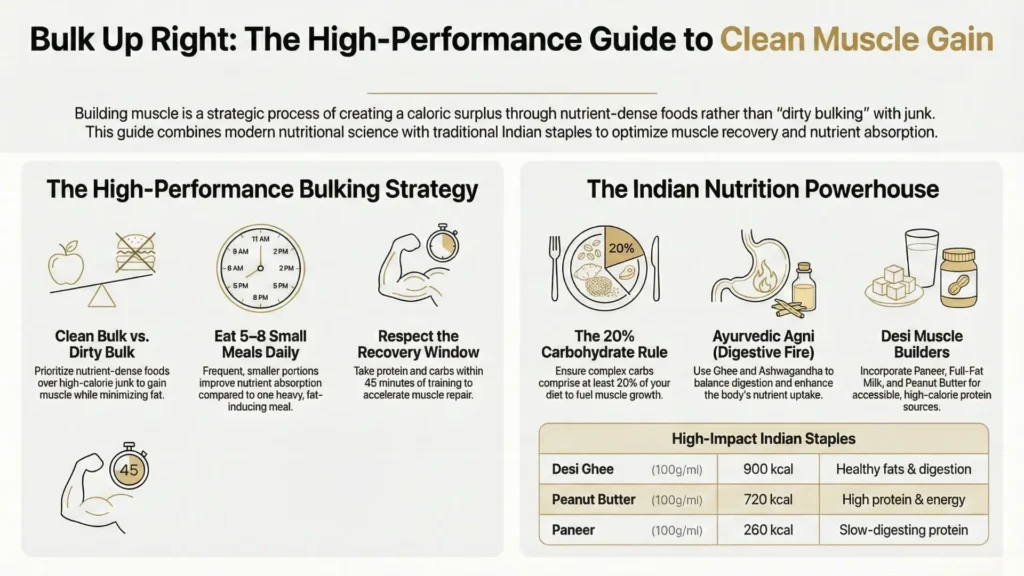
Clean Bulking vs. Dirty Bulking?
- Clean Bulking: This involves eating nutrient-dense weight gain foods list. Examples include paneer, legumes, and nuts. This approach promotes muscle growth.
- Dirty Bulking: This relies on processed carbs and trans fats. For example, samosas and sodas. This leads to rapid fat gain and sluggishness.
Ultimately, a clean bulk features better digestion. It focuses on high-fiber foods. For Indians, this means choosing homemade laddoos over biscuits. By making these swaps, you can gain 0.5–1 kg per week. Moreover, you can do this without hurting your heart.
What is the Science of Healthy Mass Gain?
To understand weight gain, we must look at macronutrients. The AMDR provides a framework for a balanced diet.
Recommended Macronutrient Distribution for Adults
| Macronutrient | % of Total Calories | Role in Weight Gain |
| Carbohydrates | 45% – 65% | Primary fuel for energy storage. |
| Proteins | 10% – 35% | Building blocks for muscle growth. |
| Fats | 20% – 35% | Hormonal support and high calories. |
I know it’s hard to track numbers. Let’s simplify this. You need a caloric surplus to gain weight. A 60 kg person may need 2,400 to 3,000 calories daily. This surplus should come from complex carbs and quality proteins. For instance, 100 grams of paneer provides 300 calories. Consequently, it is an efficient choice in the Indian diet.
Why are Micronutrients Important?
Calories drive the scale, but micronutrients drive the process. Zinc and Selenium are vital for thyroid function. Furthermore, Magnesium and Vitamin D are essential for muscles. You can find these in local foods like pumpkin seeds and eggs.

Which are the Top 10 Indian Weight Gain Foods?
When selecting the best weight gain foods list, we look for accessible items. These ten items are the gold standard for healthy mass gain.
1. High-Fat Buffalo Milk
Milk is a nutritional powerhouse. It contains whey and casein proteins for muscle recovery. Buffalo milk is very calorie-dense. For example, it provides 320 calories per cup.
- Routine Tip: Add milk powder to your glass. This increases protein without adding bulk.
2. Fresh Paneer (Cottage Cheese)
Paneer is a vegetarian essential. It is high in protein and fat. Because it digests slowly, it provides steady amino acids.
- Preparation: Grill it or make Paneer Bhurji. Specifically, a 150g serving provides 25g of protein.
3. Bananas and Mangoes
Bananas are indispensable for energy. They are high in carbohydrates and potassium. Mangoes are also energy-dense favorites. For instance, one fruit provides 180 calories.
- Routine Tip: Blend them into a smoothie with yogurt and nuts.
4. Desi Ghee
Ghee is a traditional fat source. It increases caloric intake without causing early fullness. One tablespoon adds 120 calories.
- Safety Note: Use it to top rotis or dal. However, continue eating vegetables for digestion.
5. Whole Wheat and Rice
Rice is an affordable staple. One cup of cooked rice provides 200 calories. Millets like Ragi are also excellent high-calorie alternatives.
- Preparation: Opt for Rajma Chawal cooked with ghee.
6. Cashews and Almonds
Nuts are incredibly energy-dense. For example, 10 almonds provide 85 calories. Dates and figs provide quick energy and fiber.
- Routine Tip: Carry a small container of trail mix for snacks.
7. Whole Eggs
Eggs provide complete protein and healthy fats. Two whole eggs offer about 160 calories. Furthermore, the yolk contains essential Vitamin D.
- Safety Note: 2–3 eggs daily is safe for most people.
8. Potatoes and Sweet Potatoes
These tubers provide complex carbohydrates. They fuel your daily activities and store energy as glycogen. For instance, a medium potato has 160 calories.
- Preparation: Mash them with butter to increase the load.
9. Natural Peanut Butter
Peanut butter is a calorie bomb. A single spoonful provides plant-based protein.
- Routine Tip: Spread it on whole-wheat toast. Always choose unsweetened varieties.
10. Legumes (Rajma and Chole)
Lentils are vital for meeting protein targets. Dals like Dal Makhani provide a significant caloric boost.
- Preparation: Combine them with rice for a complete amino acid profile.

What Does a Sample Indian Weight Gain Diet Plan Look Like?
What this means for your daily routine is that structure is key. Breaking your intake into 6 smaller meals ensures consistent calories.
The 2800 Calorie Clean Gain Chart
| Time | Meal | Suggested Food Items |
| 7:00 AM | Morning | 1 glass milk + 5 almonds + 2 dates. |
| 8:30 AM | Breakfast | 2 Paneer Parathas + 1 tbsp ghee + curd. |
| 11:00 AM | Mid-Morning | 1 Banana shake + peanut butter. |
| 1:30 PM | Lunch | Rice + Rajma + Sabzi + ghee. |
| 4:30 PM | Snack | 2 Boiled eggs + tea with milk. |
| 8:30 PM | Dinner | 2 Rotis + Dal Makhani + Palak Paneer. |
| 10:30 PM | Bedtime | Warm milk + honey. |
This weight gain diet chart is realistic for busy professionals. For NRIs, ingredients like paneer are easily replaced by Greek yogurt.
Managing Medical Conditions: A Safety-First Approach?
Weight gain is not one-size-fits-all. This is especially true for conditions like PCOS or diabetes. Specifically, your selection of weight gain foods list must protect your clinical markers.
Weight Gain for PCOS
Many women with PCOS have insulin resistance.
- The Strategy: Focus on low-GI weight gain foods list. Specifically, choose millets like Ragi or Jowar.
- Safety Tip: Use anti-inflammatory spices like turmeric to reduce swelling.
Weight Gain for Diabetes
Diabetics must avoid blood sugar spikes.
- The Strategy: Prioritize proteins and fats over sugars. Nuts and full-fat yogurt are excellent.
- Safety Tip: Always pair carbs with protein. For example, eat walnuts with your banana.
Weight Gain for Hypertension (BP)
Sodium control is paramount for high blood pressure.
- The Strategy: Use high-potassium weight gain foods list like spinach and sweet potatoes.
- Safety Tip: Avoid processed snacks and biscuits. These are often loaded with hidden salt.

What are the Common Mistakes That Stall Progress?
I know it’s frustrating when the scale doesn’t move. Let’s simplify this by looking at five frequent missteps.
- Too Much Cardio: Intensive cardio burns the calories you need. Shift your focus to strength training instead.
- Too Much Protein: Protein makes you feel full very quickly. Consequently, you won’t have room for high-calorie fats.
- Filling Up on Watery Veggies: Cucumbers and lettuce take up space without providing energy.
- Lack of Consistency: Skipping your snacks can drop you out of a surplus.
- Unrealistic Goals: Trying to gain 10 kg in a month is unhealthy. Aim for a steady 0.5 kg per week instead.
How to Stay Consistent Over a Long Period?
The journey to a healthier version of yourself takes patience. For many Indians, pressure leads to stress. Consequently, this spikes cortisol which breaks down muscle.
What this means for your daily routine is that sleep is vital. Your muscles grow while you are asleep. Therefore, aim for 7–8 hours of quality rest.
Home-Based Solutions
You don’t need a gym to see results. Simple movements like squats at home can stimulate growth. For NRIs, batch-cooking on weekends ensures you have high-calorie options ready.
The Secret of Liquid Calories
For a busy professional, liquid calories are a game-changer. For instance, a homemade smoothie provides 600 calories. This is portable and easy to drink during meetings.
Take Control of Your Health: Book a Personalized Consultation with Diet Dekho Experts
At DietDekho, we believe everybody is different. We offer personalized plans that consider your blood markers and lifestyle. Gaining weight healthily is a holistic transformation. Our dietitians are here to guide you through the maze of weight gain foods list. Build a body that is stronger and more resilient.

FAQs
Q1: Which Indian food is best for rapid weight gain?
The most effective Indian weight gain foods list include buffalo milk, paneer, and desi ghee. Furthermore, bananas and nuts like cashews are excellent. These provide high calories and proteins for muscle growth.
Q2: How can I gain weight if I have a small appetite?
If you have a small appetite, focus on liquid calories like smoothies. Additionally, eat 5-6 smaller meals per day. Avoid drinking water before meals to save space for weight gain foods list.
Q3: Is ghee good for weight gain?
Yes, desi ghee is an excellent addition. It provides 120 calories per tablespoon. Specifically, it offers healthy fats that aid digestion and energy without adding bulk.
Q4: Can I gain weight while managing PCOS or Diabetes?
Yes, you can gain weight by choosing a low-GI weight gain foods list. Specifically, focus on paneer, eggs, and millets. This ensures healthy gain without causing hormonal spikes.
Q5: How many calories do I need to gain 1 kg per week?
To gain 1 kg per week, you need a daily surplus of 500–1000 calories. This usually brings your total intake to 2,500–3,200 calories.
Contact Us
We understand how overwhelming nutrition and weight loss information can feel. With so many opinions and confusing advice online, it’s easy to feel stuck or unsure about what to do next.
At Diet Dekho, you never have to figure it out alone. You can contact us anytime with any questions or concerns. Our expert dietitians are available 24/7 to guide, support, and help you stay on track. Whether your goal is weight loss or building healthier habits, we’re here to make the journey simpler and more sustainable for you.
Disclaimer
This blog is intended to help readers make healthier food choices. Your health should always be the top priority. Before starting any restrictive or special diet, especially if you have a medical condition or health concern, please consult a doctor or a qualified dietitian. Each body responds differently to food and lifestyle changes. Always choose what is safe and suitable for you.

Dr. Ritika is a nutrition and lifestyle expert with 2+ years of experience, helping clients manage weight and health through practical, personalized diet plans.