Have you ever felt like you are doing everything right—counting every grain of rice and walking until your feet ache—yet the scale refuses to budge? It is incredibly frustrating to find reliable thyroid weight loss tips when your own body feels like it is working against you. Many Indians struggle with this metabolic lock, but a well-structured weight loss diet for thyroid can be the key to harmonizing your hormones and finally seeing the results you deserve while managing weight with thyroid issues.
The ideal weight-loss diet for thyroid focuses on nutrient-dense Indian whole foods that provide iodine, selenium, and zinc to support hormone synthesis. For Indian women, a daily intake of 1200–1500 calories, emphasizing high-fiber millets and lean proteins, helps overcome metabolic sluggishness. Consistent medication timing and a 5-meal structure are essential for energy regulation.
Why is it so hard to follow a weight-loss diet for thyroid patients in India?
Table of Contents
- 1 Why is it so hard to follow a weight-loss diet for thyroid patients in India?
- 2 The frustration of invisible weight gain: Managing weight with thyroid issues
- 3 Thyroid weight loss tips: Why starving yourself is the worst thing for your health
- 4 How metabolism affects your diet for thyroid and weight loss
- 5 Best Indian superfoods to include in a hypothyroidism weight loss diet chart
- 6 What is the ideal daily calorie count for a weight loss diet for the thyroid?
- 7 A simple 5-meal Indian thyroid weight loss meal plan
- 8 Thyroid weight loss tips: Common mistakes to avoid
- 9 Essential thyroid weight loss tips for PCOD and metabolic health
- 10 Practical lifestyle habits for managing weight with thyroid issues
- 11 FAQs
- 12 Ready to balance your hormones?
- 13 Contact Us
- 14 Disclaimer
I know it’s hard to stay motivated when the results don’t match your effort. In India, the prevalence of thyroid disorders is exceptionally high, with nearly 42 million people affected. When your thyroid gland is underactive—a condition known as hypothyroidism—it produces fewer hormones, such as thyroxine (T4) and triiodothyronine (T3). These are the managers of your metabolism; they tell your cells how fast to burn energy. When these levels drop, your Basal Metabolic Rate (BMR) slows, making it more challenging to implement a weight-loss diet for the thyroid.
What this means for your daily routine is that even a standard healthy diet might provide more energy than your slowed metabolism can handle. In the Indian context, this is further complicated by our heavy reliance on refined carbohydrates like white rice, which can cause insulin spikes that, in turn, encourage fat storage. Data shows urban variations, with Kolkata reporting a prevalence of up to 21.67%, making local thyroid weight-loss tips and dietary adjustments vital for residents.
The Regional Metabolic Profile of India
The metabolic challenges faced by an Indian woman in a coastal city like Mumbai often differ from those in inland regions like Delhi. Research indicates that inland regions report a higher prevalence of hypothyroidism (11.73%) compared to coastal areas (9.45%). This might be linked to the availability of iodine-rich seafood. For those living inland, ensuring that a weight-loss diet for thyroid includes iodized salt and other iodine sources is a non-negotiable step in metabolic repair.
| City / Region | Prevalence of Hypothyroidism (%) | Key Metabolic Observations |
| Kolkata | 21.67% | Highest urban prevalence; often linked to diet. |
| Delhi | 11.07% | Higher correlation with sedentary lifestyle. |
| Bangalore | 10.50% | High prevalence among young professionals. |
| Hyderabad | 8.88% | Link between thyroid and metabolic syndrome. |
| Coastal regions | 9.45% | Slightly lower prevalence due to iodine access. |

The frustration of invisible weight gain: Managing weight with thyroid issues
Let’s simplify this: have you ever been told it’s all in your head? For many Indian homemakers, this advice is scientifically inaccurate. When you have hypothyroidism, your body’s set point changes. You might gain 5 to 7 kilograms quickly, even if your habits haven’t changed. This is the emotional weight of the condition—the feeling of losing control over your own physical form. Effective thyroid weight loss tips must start with acknowledging this physiological reality.
This frustration is compounded by the double burden where thyroid issues overlap with PCOD/PCOS or early-stage diabetes. In these cases, your ability to manage insulin is compromised. When you eat a high-carb Indian meal, your blood sugar spikes, but because your metabolism is slow, that sugar isn’t used for energy. Instead, it is shuttled into fat cells, leaving you tired and hungry again. This cycle is why a thyroid-friendly weight loss guide emphasizes blood sugar stability.
The Role of Water Retention and Bloating
A significant portion of the weight gain seen in thyroid patients is actually myxedema—a specific type of swelling caused by the accumulation of complex sugars in the skin tissues, which trap water. This is why your weight might fluctuate by 1-2 kilograms in a single day. A successful weight-loss diet for the thyroid must address this by including natural diuretics such as Lauki (bottle gourd) and cucumber to help flush out excess fluid.
| Symptom | Relation to Thyroid Weight | Indian Home Solution |
| Face/Ankle Puffiness | Water retention due to slowed drainage. | Lauki juice; reducing salt at night. |
| Chronic Constipation | Slowed gut motility. | High-fiber millets (Ragi, Bajra). |
| Mid-day Sluggishness | Poor glucose utilization. | Small, frequent meals; no sugar in tea. |
| Cold Extremities | Low internal heat production. | Warming spices like ginger and cinnamon. |
Thyroid weight loss tips: Why starving yourself is the worst thing for your health
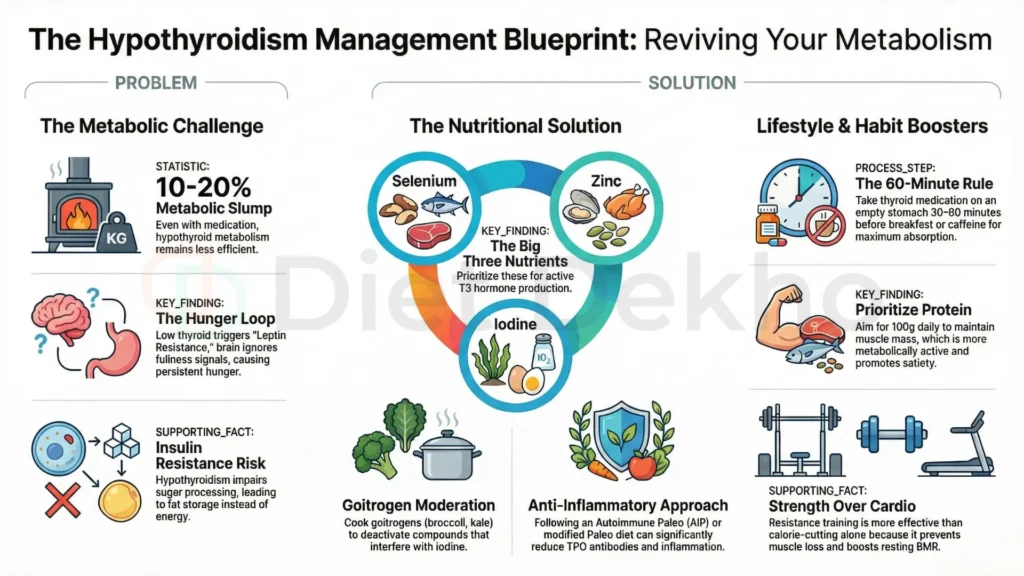
I know it’s tempting to think that if your metabolism is slow, you should just eat as little as possible. However, in simple terms, your thyroid is like a thermostat. When you drastically cut calories, your thyroid senses a famine and further suppresses the production of active $T_3$ hormones to save your life. This is why many people who follow crash diets see an initial drop followed by months of total stagnation.
Severely restricting food intake also leads to the loss of lean muscle mass. Muscle is metabolically active; it burns calories even while you are sleeping. If you lose muscle, your BMR drops even further, making it harder to sustain the results from your Indian thyroid weight-loss meal plan. Instead of a starvation mindset, we need a nourishment mindset to give the thyroid what it needs to turn the metabolism back up.
The Science of T4 to T3 Conversion
The thyroid gland primarily releases T4, the inactive form of the hormone. Your liver must convert this into T3, the active form that actually burns fat. This process is extremely sensitive to calories. If you are undereating:
- The conversion of T4 to T3 decreases significantly.
- The body produces more reverse T3 (rT3), which acts like a block on your cells.
- Cortisol (stress hormone) rises, promoting belly fat storage.

How metabolism affects your diet for thyroid and weight loss
What this means for your daily routine is that your fuel tank is never quite full. Even after 8 hours of sleep, you wake up unrefreshed because your cells aren’t effectively converting food into energy. For a busy professional, this manifests as brain fog. Because your body is trying to conserve energy, it discourages you from moving, creating a cycle in which you move less and burn fewer calories. Breaking this requires thyroid weight loss tips that target mitochondrial health.
The Insulin Resistance Connection
In India, the high prevalence of diabetes means thyroid patients often deal with hyperinsulinemia—too much insulin in the blood. Insulin is a storage hormone; when it is high, fat burning is physically impossible. Hypothyroidism makes cells less sensitive to insulin, so your body produces more to manage a simple meal of dal-chawal. This is why a weight loss diet for thyroid must also be blood-sugar-friendly.
| Metric | Healthy Range | Hypothyroid Impact |
| Basal Metabolic Rate (BMR) | Standard for Age | Reduced by 15-40%. |
| Body Temperature | ~98.6°F | Often lower (cold intolerance). |
| Digestion Time | 24-48 hours | Can slow significantly (bloating). |
| Insulin Sensitivity | High | Often low (higher storage risk). |
Best Indian superfoods to include in a hypothyroidism weight loss diet chart
Let’s simplify this: the Indian kitchen is a pharmacy for thyroid health. We don’t need expensive imports when we have ancestral grains that provide exactly what the thyroid needs: Iodine, selenium, zinc, and iron.
1. Fiber-Rich Millets (The Low-GI Powerhouses)
Millets like Jowar, Bajra, and Ragi provide sustained energy. Ragi is rich in calcium and iron, while jowar is excellent for those with gluten sensitivity. The high fiber content of millets also helps clear the digestive tract, addressing chronic constipation.
2. Selenium-Packed Nuts (The Conversion Switch)
Selenium is the on-switch for the enzyme that converts $T_4$ to $T_3$. While Brazil nuts are the best source, sunflower seeds and local fish like mackerel are also good Indian alternatives.
3. Zinc-Rich Legumes (The Production Support)
Lentils like moong dal and chickpeas (chana) are packed with zinc, which is used to manufacture hormones. Moong dal is especially recommended because it is the easiest to digest.
| Indian Superfood | Key Nutrient | Benefit for Thyroid |
| Ragi (Finger Millet) | Iron & Calcium | Combats fatigue and bone issues. |
| Pumpkin Seeds | Zinc | Helps in synthesis of hormones. |
| Curd (Dahi) | Iodine & Probiotics | Essential for production and gut. |
| Lauki (Bottle Gourd) | Fiber & Water | Reduces bloating and puffiness. |
What is the ideal daily calorie count for a weight loss diet for the thyroid?
The short answer is it depends, but for most Indian women, a range of 1200 to 1500 calories is the sweet spot. If you go too low (under 1000 calories), you risk further damaging your metabolism. According to ICMR-NIN 2024 guidelines, the focus should be on the quality of those calories. For a weight loss diet for thyroid, your plate should ideally be 50% vegetables, 25% lean protein, and 25% high-fiber cereals.
Understanding your BMR
An adult sedentary Indian woman requires roughly 1660 calories for maintenance. However, thyroid dysfunction can reduce this by 15-20%. This means your maintenance might actually be 1350 calories. Therefore, to lose weight, a slight 1200-calorie deficit is often necessary, but it must be achieved with high-quality foods to prevent nutrient gaps.

A simple 5-meal Indian thyroid weight loss meal plan
Planning a weight loss diet for the thyroid doesn’t have to be complicated. The goal is to keep your blood sugar stable throughout the day. Here is a practical daily routine for the Indian kitchen.
1. The Early Morning Ritual (6:30 AM – 7:30 AM)
- Hydration: Warm water or Dhania Pani (coriander seed water).
- Medication: Take your thyroid pill on an empty stomach with water.
- Wait: You must wait 60 minutes before having tea or breakfast.
2. Breakfast: The Protein Foundation (8:30 AM – 9:00 AM)
- Two Moong Dal Cheelas with grated carrots or a bowl of vegetable Poha with roasted peanuts.
3. Mid-Morning: The Micronutrient Boost (11:00 AM)
- One seasonal fruit (apple or guava) OR a handful of roasted pumpkin seeds.
4. Lunch: The Balanced Thali (1:30 PM – 2:00 PM)
- 1 small Jowar roti, 1 bowl of thick Dal, a large serving of Sabzi (Lauki or Palak), and fresh Curd.
5. Evening Snack & Dinner (5:00 PM & 8:00 PM)
- Snack: Green tea with roasted Makhana.
- Dinner: A light bowl of vegetable millet khichdi or grilled paneer with sautéed vegetables.
Thyroid weight loss tips: Common mistakes to avoid
One of the biggest pitfalls is the pill-and-forget approach. Medication replaces the hormone, but it doesn’t fix the nutritional deficiencies or insulin resistance.
- Caffeine Interference: Having tea within an hour of your medication can reduce absorption by 30%.
- Overconsumption of Soy: Soy contains isoflavones that can interfere with the thyroid’s ability to use iodine.
- Skipping Meals: This signals your body to slow down even further to conserve energy.
- Raw Cruciferous Veggies: While healthy, Gobi or Cabbage should be cooked to neutralize goitrogens.
Essential thyroid weight loss tips for PCOD and metabolic health
If you are managing weight with thyroid and PCOS, weight loss can feel twice as difficult. Both are linked to systemic inflammation and insulin resistance. Your body is in a state of constant internal stress. For this group, a weight loss diet for the thyroid must be anti-inflammatory. Focus on omega-3 fats (walnuts, flaxseeds) and spices like turmeric and ginger to calm internal inflammation and improve insulin sensitivity.
Strategic Timing for PCOS
When you have both conditions, the order of your food matters. Eating fiber (salad) first, then protein (dal), and finally carbohydrates (roti) can significantly reduce the insulin spike. This is one of the most effective thyroid weight loss tips for those with hormonal imbalances.
Practical lifestyle habits for managing weight with thyroid issues
Losing weight with a thyroid condition is about consistency in small habits.
- Yoga: Poses like Sarvangasana or Bhujangasana are believed to stimulate the thyroid area.
- NEAT: Calories burned during non-exercise activities (walking while talking, taking stairs) add up to more fat burning than a 30-minute jog.
- Sleep: Lack of sleep increases hunger hormones and decreases satiety, causing you to crave sugar.

FAQs
What is the best weight loss diet for thyroid patients?
There is no single best diet for thyroid patients. A thyroid-friendly weight loss diet focuses on balanced meals with adequate protein, fiber, complex carbohydrates, healthy fats, and sufficient micronutrients like iodine, selenium, and iron, while maintaining a moderate calorie deficit.
Can people with thyroid problems lose weight safely?
Yes, people with thyroid disorders can lose weight safely once thyroid hormone levels are properly managed. Weight loss may be slower, but it is achievable with consistent nutrition, medical treatment, and lifestyle support.
Which foods should be avoided in a thyroid weight loss diet?
Thyroid patients should limit ultra-processed foods, excess sugar, refined carbohydrates, and excessive intake of raw goitrogenic foods like raw cabbage or cauliflower. These foods can interfere with metabolism or nutrient balance when consumed in large amounts.
How does hypothyroidism affect weight loss?
Hypothyroidism slows metabolism, increases fatigue, and can cause fluid retention, making weight loss more difficult. Proper thyroid medication helps normalize metabolism, but lifestyle changes are still required for fat loss.
Is exercise necessary for weight loss with thyroid issues?
Exercise is not mandatory for weight loss, but it is strongly recommended. Physical activity helps preserve muscle mass, improves insulin sensitivity, reduces fatigue, and supports long-term weight maintenance in thyroid patients.
Can a thyroid patient follow a low-carb or keto diet?
Low-carb or keto diets may lead to short-term weight loss, but they are not suitable for all thyroid patients. Very low-carbohydrate diets may worsen fatigue or hormonal balance in some individuals and should only be followed under medical supervision.
How long does it take to see weight loss results with a thyroid-friendly diet?
Once thyroid levels are stabilized, most people notice gradual weight changes within 4 to 8 weeks. Meaningful fat loss typically occurs over several months with consistent dietary and lifestyle habits.
Ready to balance your hormones?
Losing weight with a thyroid condition requires patience and the right thyroid weight loss tips. By focusing on Indian superfoods, adjusting your medication regimen, and following a consistent thyroid-friendly weight-loss diet, you can break the metabolic lock. Whether you are a busy professional or a homemaker, the power to reclaim your energy is in your hands, one meal at a time.
Contact Us
We understand how overwhelming nutrition and weight loss information can feel. With so many opinions and confusing advice online, it’s easy to feel stuck or unsure about what to do next.
At Diet Dekho, you never have to figure it out alone. You can contact us anytime with any questions or concerns. Our expert dietitians are available 24/7 to guide, support, and help you stay on track. Whether your goal is weight loss or building healthier habits, we’re here to make the journey simpler and more sustainable for you.
Disclaimer
This blog is intended to help readers make healthier food choices. Your health should always be the top priority. Before starting any restrictive or special diet, especially if you have a medical condition or health concern, please consult a doctor or a qualified dietitian. Each body responds differently to food and lifestyle changes. Always choose what is safe and suitable for you.

Dr. Ritika is a nutrition and lifestyle expert with 2+ years of experience, helping clients manage weight and health through practical, personalized diet plans.