Anjali often sat at her desk in New Jersey, staring at the steam rising from her third cup of tea, feeling a familiar, dull throb at her temples. Between back-to-back Zoom calls and the evening rush to prep a traditional dinner for her family, her own health had become a secondary thought. When her doctor mentioned that her blood pressure was creeping into the 150/95 range, the news felt like a heavy weight. She knew she needed to lose weight, but the thought of a restrictive diet or an hour at the gym felt impossible.
Like many busy professionals and homemakers, Anjali felt trapped between her cultural love for flavor and the clinical necessity of a low sodium diet. What Anjali didn’t realize is that managing hypertension with diet doesn’t have to mean eating bland, uninspired food; it means understanding how specific nutrients can actually help her heart work less while her body feels more energized. This report explores how a tailored weight loss diet for people with high blood pressure can integrate into a busy life, providing a roadmap that honors both health and heritage.
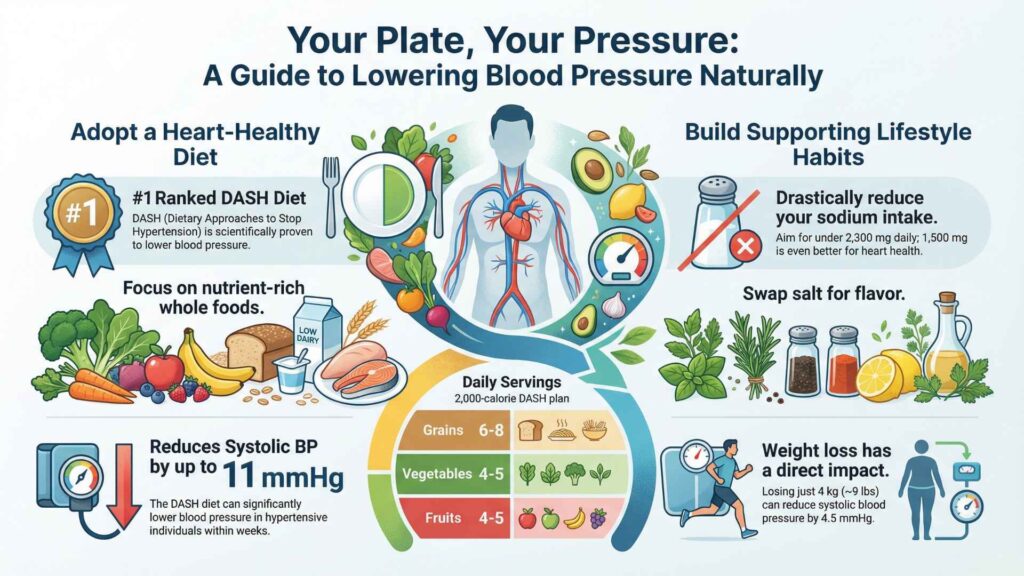
Table of Contents
- 1 The Physiological Intersection of Weight and Vascular Pressure
- 2 Understanding the Clinical Design of the DASH Diet
- 3 The Sodium Crisis: Understanding Hidden Salt and Fluid Retention
- 4 Managing Comorbidities: PCOS, Diabetes, and Thyroid Realities
- 5 The NRI and Global Indian Perspective: Navigating Tradition and Health
- 6 Non-Gym Exercise Hacks for the Time-Poor Homemaker and Professional
- 7 Kitchen Wisdom: Salt-Free Flavor and Grocery Strategies
- 8 The Emotional Side of the Weight Loss Journey
- 9 FAQs for Weight Loss and Hypertension
- 10 Final Thoughts and Action Steps
The Physiological Intersection of Weight and Vascular Pressure
The relationship between body mass and blood pressure is governed by complex hemodynamics and metabolic signaling. When a person carries excess weight, the heart must work significantly harder to pump blood through a larger network of vessels, often leading to structural changes in the heart muscle itself. This process is exacerbated by visceral adiposity, which secretes pro-inflammatory cytokines that directly damage the lining of the arteries. For every extra pound of fat, the body must produce miles of additional capillaries, increasing the total peripheral resistance the heart must overcome.
I know it’s hard to find time to focus on biology when you’re just trying to get through the day, but what this means for your daily routine is that even small changes have a massive payoff. Clinical research has documented that losing just 10 pounds can produce a measurable decrease in blood pressure readings. This happens because a reduction in fat mass lowers the metabolic demand on the heart and reduces the chronic activation of the sympathetic nervous system. When we talk about heart healthy weight loss, we aren’t just looking at the scale; we are looking at reducing the mechanical and chemical stress on your entire vascular system.
| Physiological Parameter | Impact of Weight Loss on Hypertension | Clinical Significance |
| Stroke Volume | Decreased demand on the left ventricle | Reduces risk of heart failure |
| Endothelial Function | Improved vessel dilation and elasticity | Lowers arterial stiffness |
| Insulin Sensitivity | Reduced hyperinsulinemia | Decreases renal sodium retention |
| Inflammatory Markers | Lower levels of CRP and cytokines | Protects artery walls |
Understanding the Clinical Design of the DASH Diet
The Dietary Approaches to Stop Hypertension, or the dash diet plan, is not a temporary fix but a clinically validated architecture for eating. Developed in the 1990s through funding from the National Institutes of Health (NIH), the DASH trials were designed to test if a specific combination of nutrients could mirror the effects of blood pressure medication. The results were groundbreaking: participants saw significant drops in pressure without the use of drugs, often within just two weeks of starting the plan.
Let’s simplify this approach. The core of DASH isn’t about what you take away, but what you add. The diet is rich in potassium, magnesium, and calcium—minerals that naturally signal your blood vessels to relax and help your kidneys flush out excess salt. Unlike the standard American or urban Indian diet, which is heavy on refined grains and processed meats, DASH prioritizes fruits, vegetables, and low-fat dairy.
| Food Group | Servings (2,000 kcal/day) | Example Serving Size | Key Nutrients |
| Whole Grains | 6–8 servings | 1 slice bread or 1/2 cup rice | Fiber, B-Vitamins |
| Vegetables | 4–5 servings | 1 cup raw leafy greens | Potassium, Magnesium |
| Fruits | 4–5 servings | 1 medium fruit | Fiber, Antioxidants |
| Low-fat Dairy | 2–3 servings | 1 cup milk or yogurt | Calcium, Protein |
| Lean Protein | 6 oz or less | 1 oz cooked meat or 1 egg | Essential Amino Acids |
| Nuts/Seeds/Legumes | 4–5 per week | 1/3 cup nuts or 1/2 cup beans | Healthy Fats, Magnesium |
| Fats and Oils | 2–3 servings | 1 tsp oil or 1 tbsp mayo | Monounsaturated Fats |
According to researchers at Harvard Health, the DASH diet has been shown to lower blood pressure even without a reduction in sodium, though the benefits are vastly amplified when salt intake is also addressed. What this means for your kitchen is that you have multiple “levers” to pull to improve your health. You can start by adding a salad to your lunch and a piece of fruit to your breakfast before you even worry about the salt shaker.

The Sodium Crisis: Understanding Hidden Salt and Fluid Retention
Sodium is an essential mineral, but our modern food environment has turned it into a silent predator. For many NRIs and urban residents, the primary source of sodium isn’t the salt added at the table, but the “hidden” salt used in processing and preservation. High salt intake disrupts the delicate osmotic balance in the blood, forcing the body to retain water to dilute the excess sodium. This increased fluid volume raises the pressure within the arteries, much like turning up a garden hose increases the pressure against the rubber walls.
I know it’s hard to keep track of numbers when you’re grocery shopping, but the difference between 2,300 mg and 1,500 mg of sodium is significant. While 2,300 mg is the standard upper limit, aiming for 1,500 mg can lead to an even more dramatic reduction in blood pressure, especially if you are middle-aged or have already been diagnosed with hypertension.
| Common Indian Food | Hidden Sodium Source | Estimated Sodium (mg) |
| Pickle (Achar) | Salt used for preservation | 300 mg per tbsp |
| Papad | Added salt and baking soda | 200–300 mg per piece |
| White Bread | Dough conditioners | 150–200 mg per slice |
| Instant Noodles | Flavoring tastemaker packet | 1,000+ mg per serving |
| Ready-to-eat Gravy | Preservatives and additives | 800+ mg per cup |
| Store-bought Masala | Salt as a filler/enhancer | Varies |
Reducing salt intake isn’t just about avoiding the shaker; it’s about reclaiming control over your ingredients. When you use salt free seasoning, you are training your taste buds to enjoy the actual flavor of the food. In the(https://www.nhlbi.nih.gov/files/docs/public/heart/new_dash.pdf), researchers found that participants who moved from a high-sodium diet to a low-sodium DASH plan saw the most significant drops in systolic pressure—sometimes comparable to the effect of a single-drug therapy.
Managing Comorbidities: PCOS, Diabetes, and Thyroid Realities
For many women, hypertension doesn’t come alone; it often brings along friends like Polycystic Ovary Syndrome (PCOS), insulin resistance, or thyroid imbalances. This is where a standard hypertension meal plan needs a bit of fine-tuning. PCOS, for instance, is characterized by chronic inflammation and insulin spikes, which can make weight loss feel like an uphill battle.
If you’re dealing with PCOS and hypertension, your body is essentially in a state of high alert. Every time you eat high-GI carbs like white rice or sugary snacks, your insulin spikes, which tells your kidneys to hold onto even more sodium. By switching to a mediterranean diet for hypertension that also focuses on low-glycemic foods, you tackle both the inflammation and the blood pressure simultaneously.
| Condition | Dietary Priority for Weight Loss | Key Food Swaps |
| PCOS | Insulin stabilization and anti-inflammation | Tofu instead of paneer; berries instead of sweets |
| Diabetes | Glucose control and heart health | Quinoa/Oats instead of white rice; fiber-rich lentils |
| Thyroid | Metabolism support and iodine balance | Selenium-rich Brazil nuts; cooked instead of raw kale |
| Hypertension | Sodium reduction and mineral density | Potassium rich foods; herbs instead of salt |
What this means for your daily routine is that your choice of breakfast matters more than you think. A bowl of oats with almonds provides the magnesium needed for your heart and the fiber needed for your insulin levels. If you have thyroid issues, remember that while cruciferous vegetables like broccoli are great for DASH, they should be cooked to neutralize goitrogens that can interfere with your thyroid hormone production.
For the NRI audience, the struggle is often found in the “convenience” of shelf-stable Indian brands. Products from brands like Patak’s or Mother’s Recipe are lifesavers on a busy Tuesday, but they are often mines of hidden sodium. Even “healthy” frozen meals can pack up to 1,000 mg of sodium per serving, which is nearly your entire daily allowance in one sitting.
I know it’s hard to cook everything from scratch when you’re working 50 hours a week, but let’s look at how we can hack this. You don’t have to give up your flavors. If you use a store-bought simmer sauce, try using only half the jar and “padding” the meal with fresh tomatoes, ginger, and garlic to maintain the volume and flavor without the extra salt. This is a practical step for a busy person that doesn’t require hours of extra work.
Cultural habits also mean we love our bold, layered spices. The good news is that most traditional Indian spices like turmeric, cumin, and coriander are actually your allies in this weight loss with high blood pressure journey. Turmeric contains curcumin, a natural anti-inflammatory that helps blood vessels dilate, and fenugreek (methi) has been shown to help with sodium retention issues.

Non-Gym Exercise Hacks for the Time-Poor Homemaker and Professional
If the word “gym” makes you want to hide under the covers, you’re not alone. The reality for busy professionals and homemakers is that a 60-minute workout is often a luxury they can’t afford. However, the biology of blood pressure is surprisingly forgiving. Exercise lowers pressure by reducing vessel stiffness, and these effects are most powerful immediately after a workout.
Recent research suggests that adding just five extra minutes of moderate movement to your day can have a measurable impact on your heart health. You don’t need a treadmill; you need a few clever hacks.
- The “Ten-Minute Triple”: Instead of one 30-minute walk, try three 10-minute brisk walks throughout the day. Studies show this is more effective at preventing blood pressure spikes.
- Housework as Cardio: Mopping floors, vigorous dusting, or gardening are all valid ways to get your heart rate up and blood moving.
- The Desk Trick: If you’re stuck in meetings, try calf raises or chair squats. Even standing up once every hour can help manage blood sugar levels and obesity risk.
- Isometric Squeezes: Using a soft ball to perform handgrip exercises for five minutes a day has been shown to improve blood vessel elasticity.
What this means for your daily routine is that you can “sneak” in your fitness. Park a little further away, take the stairs, or dance in the kitchen while the dal is simmering. These small efforts accumulate, keeping your heart and blood vessels in good condition without ever stepping foot in a gym.
Kitchen Wisdom: Salt-Free Flavor and Grocery Strategies
Training your palate to enjoy low salt foods is a process of “retraining your taste buds”. Within a few weeks of reducing salt, your tongue actually becomes more sensitive to the natural flavors of vegetables and grains. To make this transition easier, we look to the power of aromatics.
Instead of salt, use “brightness” and “depth.” Lemon juice, amchur (dry mango powder), and tamarind provide that tangy “kick” we often mistake for a need for salt. For depth, roasted cumin powder and garlic provide a savory note that satisfies the palate.
| Category | Low Sodium Grocery Staples | Why They Work |
| Grains | Brown rice, bajra, jowar, oats | High fiber for weight loss and potassium for BP |
| Pulses | Moong dal, chickpeas, lentils | Plant protein that keeps you full longer |
| Dairy | Toned milk, low-fat curd | Calcium source without the saturated fat |
| Snacks | Roasted makhana, unsalted nuts | Crunch without the sodium spike |
| Aromatics | Fresh ginger, garlic, green chilies | Natural flavor enhancers and vasodilators |
A practical dash diet grocery list should be focused on the “perimeter” of the store—the fresh produce and the bulk bins. Avoid the “inner aisles” where the processed, canned, and packaged foods live. If you must use canned beans, always rinse them thoroughly under cold water; this single act can remove up to 40% of the added sodium.
The Emotional Side of the Weight Loss Journey
I know it’s hard when your family is eating samosas and you’re reaching for a bowl of roasted chana. There is an emotional component to heart healthy weight loss that textbooks often ignore. Food is love, food is culture, and food is comfort. If you feel like you’re failing because you had a salty meal at a wedding, stop right there. The DASH diet is about “guidelines, not rules”.
If you have a slip-up, the best thing you can do for your blood pressure is to stay hydrated. Drinking plenty of water helps your kidneys flush out the excess sodium from that one-off meal. Move forward with your next meal by filling half your plate with vegetables. This “reset” mindset prevents the stress-induced cortisol spikes that can further raise your blood pressure.

FAQs for Weight Loss and Hypertension
Q: Can I follow a dash diet plan if I am a strict vegetarian?
Absolutely. The DASH diet is actually one of the most vegetarian-friendly plans because it focuses so heavily on plant-based minerals. You can replace meat with lentils, beans, tofu, and nuts to get all the protein you need for weight loss.
Q: Is “rock salt” or “sea salt” better for my blood pressure?
This is a common myth. While they may have different textures or trace minerals, they all contain the same amount of sodium. It is the sodium that impacts your blood pressure, so whether it’s pink, sea, or table salt, the limit remains the same.
Q: How can I manage high blood pressure while working a 9-to-5 job?
Preparation is your best friend. Bringing a home-cooked lunch allows you to control the salt. If you must eat out, ask the chef for “no added salt” and choose grilled chicken or fish over breaded or sauced options.
Q: Does weight loss with high blood pressure require high-intensity exercise?
No. In fact, for people with very high blood pressure, moderate exercise like brisk walking is safer and often more sustainable. High-intensity bursts can cause temporary spikes in pressure that might be risky if not monitored by a doctor.
Q: What are some low sodium snacks I can keep at my desk?
Think of things that are naturally low in salt: fresh fruit like an apple or banana, unsalted almonds, or homemade roasted makhana (fox nuts) seasoned with turmeric and black pepper.
Final Thoughts and Action Steps
Taking charge of your blood pressure is one of the best decisions you’ll ever make for your future self. By combining a low sodium diet with mineral-rich foods, you aren’t just losing weight; you are giving your heart a well-deserved break. Remember, you don’t have to change everything overnight. Start with one meal, one five-minute walk, and one less sprinkle of salt. Over time, these small shifts create a new reality where you have more energy, less stress, and a heart that beats strong for years to come.
If you’re ready to stop guessing and start feeling better, let’s create a plan that fits your life.
Disclaimer: This blog post was written to help you make healthier food choices altogether. So, be aware and take care. The important thing to consider is your health before starting a restrictive diet. Always seek advice from a doctor/dietitian before starting if you have any concerns.
BOOK YOUR APPOINTMENT
Abhinav is the Founder of Diet Dekho, helping people manage weight and lifestyle health through simple, practical nutrition and personalized diet plans.