Have you ever stood in front of the bathroom mirror, tugging at the waist of jeans that fit perfectly just two years ago, and wondered where the time and energy went? For Sarah, a thirty-five-year-old professional with a desk-bound routine, that moment didn’t happen at the gym. It happened in a grocery store parking lot, when pushing a full cart to her car left her unexpectedly breathless.
Here’s the thing many health-conscious people overlook. A weight-loss journey isn’t about punishing the body for change or loss of control. It’s about giving the body the biological and psychological support it needs to function efficiently again.
What this really means is that lasting transformation has very little to do with chasing a single diet. Instead, it comes from a structural shift in how you move, eat, and design your daily environment to support healthier choices.
This report serves as an exhaustive guide for beginners, health-conscious individuals, and anyone seeking a simple weight loss strategy that actually sticks. Consequently, by weaving together clinical data from the National Institutes of Health (NIH), metabolic research from Harvard Health, and the decade of localized expertise from Diet Dekho, we will break down the mechanics of the human body to ensure your progress is both sustainable and scientifically sound.
Decoding the Biological Engine: How to Start a Weight Loss Journey
Table of Contents
- 1 Decoding the Biological Engine: How to Start a Weight Loss Journey
- 2 The Nutritional Architecture: Sustainable Weight Loss for All Individuals
- 3 Psychological Hurdles: Beyond the Weight Loss Journey Blog
- 4 Movement and Metabolism: The Beginner Workout Plan
- 5 Navigating the Postpartum Weight Loss Journey
- 6 Breaking Through the Weight Loss Plateau
- 7 Healthy Meal Prep Ideas and Strategies for Success
- 8 The Truth About Weight Loss Supplements
- 9 Tracking Your Progress: More Than Just the Scale
- 10 Diet Dekho: Your Expert Partner in Health
- 11 FAQs for Your Weight Loss Journey
- 12 Take the First Step Today
- 13 The Future of Weight Management: A Conclusion
Starting is often the hardest part because the modern world is designed to keep us sedentary and overfed. To understand how to start a weight loss journey, we first have to look at the body as a biological engine that burns fuel to move mass across a distance. In other words, the fundamental rule of weight management is the energy balance equation. To lose weight, you must create a caloric deficit, meaning you burn more energy than you consume.
Experts traditionally cited Wishnofsky’s Rule, which suggested that a cumulative deficit of 3,500 calories leads to one pound of fat loss. However, modern research from the NIH and Harvard suggests this is a static view of a very dynamic system. Your body is remarkably smart; therefore, as you lose weight, your metabolism shifts to become more efficient, requiring fewer calories to function. What this really means is that a calorie deficit calculator is a vital tool, but it must be used as a moving target that adjusts as your body changes.
The Dynamic Nature of Energy Expenditure
When we talk about burning calories, we are looking at Total Daily Energy Expenditure (TDEE). This is comprised of your Basal Metabolic Rate (BMR), the Thermic Effect of Food (TEF), and Physical Activity.
| Component of TDEE | Percentage of Daily Burn | Relevance to Weight Loss |
| Basal Metabolic Rate (BMR) | 60% – 75% | Energy used for breathing, circulation, and cell production at rest. |
| Thermic Effect of Food (TEF) | 10% | Energy used to digest and process nutrients; protein has the highest TEF. |
| Non-Exercise Activity Thermogenesis (NEAT) | 15% – 30% | Calories burned during daily tasks like walking, cleaning, or fidgeting. |
| Exercise Activity Thermogenesis (EAT) | 5% – 10% | Calories burned during intentional workouts. |
As a result, what this means for a beginner is that while the gym is important, the calories you burn just by staying active throughout the day (NEAT) are often more significant for a long-term weight loss transformation. Furthermore, focusing on movement outside of structured exercise can prevent the metabolic slow-down often seen in restrictive phases.
The Nutritional Architecture: Sustainable Weight Loss for All Individuals
Food is not just fuel; it is information for your cells. When you eat, you are sending signals to your body to either store fat or burn it. In addition, a successful weight loss diet for women and people of all genders must prioritize satiety and muscle preservation. This prevents the “skinny-fat” outcome where weight is lost but metabolic health remains poor.
The Satiety Power of Protein and Fiber
Protein is arguably the single most important macronutrient in your weight loss journey. High protein intake stimulates the release of Peptide YY (PYY) and Glucagon-like peptide-1 (GLP-1), which are hormones that tell your brain you are full. Furthermore, protein helps you retain lean muscle mass during a deficit, which keeps your BMR from crashing.
Clinical guidelines from Harvard doctors recommend aiming for 1.5 to 2 grams of protein per kilogram of body weight daily. Consequently, for a 70 kg individual, this translates to roughly 112 to 140 grams of protein.
In a similar vein, fiber acts as a weight-loss “cheat code.” In a study cited by the Harvard T.H. Chan School of Public Health, participants who increased their fiber intake by 14 grams per day saw a 10% decrease in caloric intake without making any other changes. Ultimately, fiber slows down gastric emptying. This means the food stays in your stomach longer, preventing the “sugar highs” and subsequent crashes that lead to excessive consumption later in the day.
The Science of the Keto Diet Plan
For some, a keto diet plan offers a structured way to manage hunger. By shifting the body from burning glucose to burning ketones (derived from fat), many people experience a significant reduction in appetite. A typical ketogenic distribution includes 55% to 60% fat, 30% to 35% protein, and only 5% to 10% carbohydrates.
While the initial drop on a keto diet is often rapid—up to 10 pounds in the first two weeks—this is primarily water weight released as the body burns through its glycogen stores. Nevertheless, for long-term success, the “Keto 2.0” trend of 2026 focuses on whole-food fats and cycling carbohydrates to ensure sustainability and gut health.

Psychological Hurdles: Beyond the Weight Loss Journey Blog
Here’s the thing: you can have the perfect diet, but if your mindset is not aligned, the results will be temporary. Most individuals fail not because they don’t know what to eat, but because they don’t know how to handle their emotions around food.
Overcoming Emotional Eating and Cues
We often eat not out of physical hunger, but as a response to environmental triggers or emotional stress. Chronic stress elevates cortisol, which has a direct causal relationship with the storage of visceral fat—the dangerous fat around your organs often referred to as “belly fat”.
Instead of succumbing to these triggers, psychological hacks for weight loss include mindful eating. This is the practice of removing all distractions—TV, phones, work—during meals. By focusing on the flavor and texture of your food, you allow your brain to register satiety signals that typically take 20 minutes to travel from the gut to the hypothalamus. What this really means is that you stop eating when you are truly satisfied, rather than when you reach a point of over-indulgence.
Visualization and Affirmations
Negative self-belief is a silent killer of progress. Shifting your internal narrative from “I can’t lose weight” to “I make healthy choices for my body” is not just “woo-woo” science; on the contrary, it is about rewiring the neural pathways that govern habit formation. Visualizing your goal for just five minutes a day can activate the brain’s motivation centers. As a result, it becomes much easier to stick to your beginner workout plan when you’re tired.
Movement and Metabolism: The Beginner Workout Plan
Exercise is a powerful supplement to a good diet, but it is not a replacement for one. As the saying goes, “You can’t out-exercise a bad diet”. However, physical activity is essential for cardiovascular health, mood regulation, and maintaining the muscle that drives your metabolism.
The 3km Walk: The Foundation of Fat Loss
For a beginner, the most effective tool is often the simplest: walking. Research has shown that a brisk 3km walk can yield double the fat oxidation of a high-intensity run for some individuals because it keeps the heart rate in the “fat-burning zone” without triggering a massive stress response.
Walking also lowers cortisol levels. Consequently, this helps reduce the physiological drive for exercise for belly fat storage. At Diet Dekho, we recommend starting with a 10-minute daily walk and gradually increasing the duration by 10% each week to allow your joints and ligaments to adapt.
Resistance Training: The Metabolic Engine Upgrade
If walking is the fuel, strength training is the engine upgrade. In addition to burning calories during the session, adding muscle mass increases the number of calories your body burns at rest. For individuals just starting out, compound movements—exercises that work multiple joints at once—provide the most “bang for your buck”.
| Exercise Category | Specific Movements | Beginner Tip |
| Lower Body | Squats, Lunges, Deadlifts | Keep your back straight and focus on form over weight. |
| Upper Body | Push-ups, Rows, Overhead Press | Use knee-push-ups if full push-ups are too difficult. |
| Core | Planks, Bicycle Crunches, Mountain Climbers | Avoid “crunching” your neck; pull from the abs. |

The postpartum weight loss tips sector is often filled with pressure to “bounce back” quickly, which can be physically dangerous. Your body takes nearly 10 months to grow a human; therefore, it is unrealistic—and often unhealthy—to expect it to return to its pre-pregnancy state in 10 weeks.
Safety First: The 6-Week Rule
Medical experts at the Mayo Clinic and NIH recommend waiting at least six weeks, or until your postpartum checkup, before starting any formal exercise program. If you had a C-section, this timeline might be longer. Initial movements should focus on the pelvic floor and gentle walking.
Breastfeeding and Nutrition
If you are breastfeeding, your body requires an extra 330 to 500 calories per day to produce milk. Consequently, dropping your calories too low can significantly impact your milk supply and leave you feeling lethargic. A safe pace for postpartum weight loss while breastfeeding is about 1.5 pounds per week, provided you are meeting your nutritional needs.
| Postpartum Stage | Movement Focus | Nutritional Goal |
| 0-6 Weeks | Pelvic floor, easy walking | Focus on healing and hydration. |
| 6-12 Weeks | Build to 150 mins/week cardio | Moderate 300-500 kcal deficit. |
| 3-6 Months | Introduce light resistance training | High protein and fiber for energy. |
Breaking Through the Weight Loss Plateau
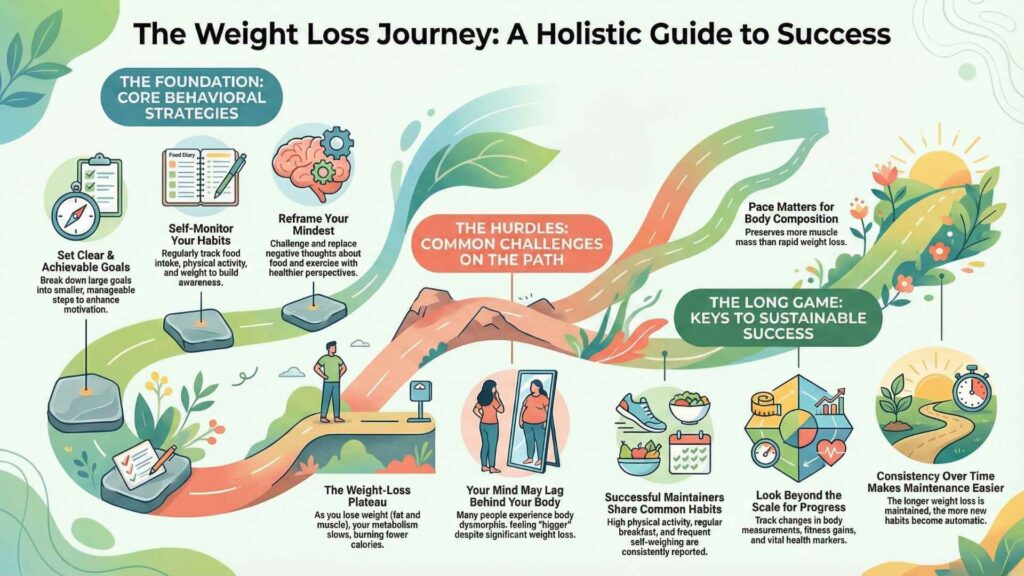
The weight loss plateau is the single biggest cause of plan abandonment. It is the moment when the scale stops moving, despite your continued efforts. Understanding why this happens is key to pushing through it.
Why Progress Stalls
As you lose weight, your body requires less energy to move. Therefore, if you continue eating the same amount of calories that helped you lose the first 10 pounds, you may eventually reach “energy equilibrium,” where the calories you burn equal the calories you eat. Additionally, your body’s adaptive thermogenesis slows down metabolic processes to “defend” your current weight.
Strategic Fixes for Plateaus
- Reassess Your Habits: Are you experiencing “calorie creep”? Use a weight loss tracker to ensure your portions haven’t slowly increased.
- Increase Protein: Higher protein intake can boost metabolism and preserve muscle, helping to “shock” the system back into fat loss.
- Vary Your Intensity: If you always walk at the same pace, your body becomes efficient at it. In other words, introduce short bursts of speed (HIIT) to increase caloric burn.
- Prioritize Sleep: Lack of sleep disrupts leptin and ghrelin. Consequently, this makes you hungrier and more likely to hold onto fat.

Healthy Meal Prep Ideas and Strategies for Success
Success in a weight loss journey is often found in the kitchen on a Sunday afternoon. Healthy meal prep ideas reduce the “decision fatigue” that leads to ordering fast food on a busy Tuesday night.
Batch Cooking for Beginners
You don’t need to be a chef to meal prep. Focus on preparing three main components:
- Proteins: Grill a week’s worth of chicken, boil eggs, or prepare a batch of lentils.
- Grains: Cook a large pot of brown rice, quinoa, or steel-cut oats.
- Vegetables: Roast a tray of broccoli, carrots, and bell peppers, or wash your leafy greens so they are ready to grab.
The Grab-and-Go Snack List
Having low-calorie, high-protein snacks prevents the “starvation mode” that leads to excessive eating during dinner.
- Apple slices with a tablespoon of peanut butter.
- Greek yogurt with a handful of berries.
- Hummus with carrot sticks or bell peppers.
- A handful of almonds (approx. 15 nuts).
The Truth About Weight Loss Supplements
The market is flooded with the “best weight loss supplements,” but the scientific reality—as reported by the NIH Office of Dietary Supplements—is much more modest.
What Actually Works?
- Caffeine: Can slightly increase metabolic rate and fat breakdown, but effects diminish as you build a tolerance.
- Green Tea Extract: May help you lose a small amount of weight by increasing energy expenditure.
- Fiber (Glucomannan): Absorbs water in the gut to help you feel fuller.
- Protein Powder: Useful for meeting daily protein targets if whole foods are not enough.
What to Avoid?
Supplements like Garcinia Cambogia and Chitosan have “little to no effect on weight loss” in clinical studies. Furthermore, some “fat burners” can cause increased blood pressure and heart palpitations. Therefore, always prioritize a keto diet plan or a balanced whole-food diet over pills.

Tracking Your Progress: More Than Just the Scale
One of the biggest psychological traps is becoming obsessed with the number on the scale. Your weight can fluctuate by 2-5 pounds in a single day due to water retention or hormonal cycles.
Better Metrics for Success
- Body Measurements: Use a tape measure to track inches lost around the waist, hips, and arms.
- Clothing Fit: How your favorite pair of jeans feel is often a more accurate measure of fat loss than the scale.
- Energy Levels: Are you sleeping better? Do you have more energy at 3:00 PM? These are signs of metabolic improvement.
- Strength Gains: Being able to lift more weight or walk further without being winded is a sign of building lean muscle mass.
Diet Dekho: Your Expert Partner in Health
At Diet Dekho, we believe that dieting shouldn’t be a chore—it should be a lifestyle upgrade. Our success stories speak for themselves. From a student losing 19 kilos by making Indian meals “fun” again, to professionals managing PCOD through structured nutrition, our focus is on sustainable, expert-led guidance.
We provide:
- Customized Diet Plans: Tailored to your favorite home-cooked meals.
- Expert Coaches: Dietitians who understand the biological and emotional hurdles of weight loss.
- Integrated Fitness: Live yoga and cardio sessions to complement your nutrition.
- Disease Management: Specialized plans for Diabetes, Thyroid, and PCOS.

FAQs for Your Weight Loss Journey
How do I start a weight loss journey as a beginner?
The best way to start is by calculating your daily calorie needs and aiming for a 500-calorie deficit. Combine this with a 30-minute daily walk and prioritize protein at every meal to keep your metabolism active.
What is a realistic weight loss transformation timeline?
Expert consensus from the NIH suggests aiming for 1–2 pounds of weight loss per week. This ensures the loss is primarily fat, not muscle, and is more likely to be maintained long-term.
How do I handle a weight loss plateau?
When progress stalls, try increasing your protein intake, changing your workout intensity, and ensuring you are getting 7–9 hours of sleep. Sometimes, your body simply needs time to adjust to its new weight before continuing the loss.
Is exercise for belly fat effective?
You cannot “spot-reduce” fat from one specific area. However, a combination of a calorie deficit, high-intensity intervals (HIIT), and strength training will reduce your overall body fat percentage, eventually revealing a flatter midsection.
Can I follow a keto diet plan long-term?
While effective for rapid weight loss and hunger control, long-term keto requires careful management. Many individuals find success by using keto to kickstart their journey and then transitioning to a balanced whole-food diet.
Take the First Step Today
Your weight loss journey is uniquely yours, but you don’t have to walk it alone. Whether you are struggling with a weight loss plateau, looking for postpartum weight loss tips, or simply need a beginner workout plan, the expert team at Diet Dekho is here to guide you every step of the way.
Let’s turn your “one day” into “Day One.”
The Future of Weight Management: A Conclusion
As we move through 2026, the weight loss landscape will continue to be reshaped by AI-driven personalization and a deeper understanding of metabolic health. What remains constant is the biological necessity of movement, the physiological requirement for nutrient-dense food, and the psychological need for a supportive community.
Success is not found in the perfect pill or the most extreme diet; instead, it is found in the small, consistent choices made every day. By understanding the “why” behind the “how,” you empower yourself to take control of your health. Ultimately, your weight loss journey is not a destination—it is a lifelong commitment to the only body you will ever have. What this really means is that every meal, every walk, and every hour of sleep is an investment in your future self.
Let’s break it down one final time: eat your protein, move your body, and be kind to your mind. The rest will follow.
For more personalized strategies and professional guidance, join the Diet Dekho family today.
BOOK YOUR APPOINTMENT
Abhinav is the Founder of Diet Dekho, helping people manage weight and lifestyle health through simple, practical nutrition and personalized diet plans.