Have you noticed your periods becoming unpredictable, or are you suddenly struggling with stubborn weight around your middle that refuses to budge? Many Indian women face these same challenges, often feeling confused by conflicting medical advice. Consequently, the first step to reclaiming your health is understanding exactly what is PCOS.
What is PCOS? Polycystic Ovary Syndrome (PCOS) is a complex hormonal and metabolic condition where the ovaries produce an abnormal amount of androgens (male hormones). This imbalance disrupts regular ovulation, leading to irregular periods, small fluid-filled follicles on the ovaries, and physical symptoms like persistent acne, weight gain, and unwanted hair growth.
Why is this metabolic disorder reaching crisis levels in India?
Table of Contents
- 1 Why is this metabolic disorder reaching crisis levels in India?
- 2 Understanding the medical definition and diagnostic criteria
- 3 Identifying the core triggers of your hormonal imbalance
- 4 Recognizing the most common symptoms in women and teens
- 5 How does the syndrome differ from PCOD?
- 6 Managing insulin resistance through your daily meals
- 7 Building a PCOS-friendly Indian diet plan
- 8 Quick and healthy snacks for busy professionals
- 9 Home-based exercise routines for fat loss
- 10 Natural therapies and Ayurvedic herbs for support
- 11 Navigating fertility and reproductive health
- 12 Frequently Asked Questions
- 13 Conclusion: Taking control of your health
In the Indian context, the prevalence of this condition is reaching critical levels. Recent epidemiological surveys indicate that the frequency of the syndrome is significantly higher in urban settings compared to rural areas, often linked to rapid urbanization and lifestyle shifts. Furthermore, according to the ICMR PCOS Task Force data released through 2025, an estimated 44 million women in India are currently affected by this syndrome.
I know it’s hard to find time to stay active in a busy city, but these environmental factors are major triggers for hormonal disruption. Below is a breakdown of how the syndrome manifests across different regions:
| Region or Study Group | Prevalence Rate | Diagnostic Criteria Used |
| National Average (India) | 19.6% | Rotterdam 2003 |
| Delhi NCR (College Women) | 17.4% | Rotterdam 2003 |
| Mumbai (Adolescents) | 22.5% | Rotterdam 2003 |
| Southern India & Maharashtra | 9.13% | Region-Specific Study |
| Global Prevalence | 8% – 13% | WHO General Estimate |
Specifically, the ICMR study found that central and northern India recorded the highest prevalence, while the northeast reported the lowest. This highlights that the condition is a significant public health problem that requires culturally sensitive solutions.

Understanding the medical definition and diagnostic criteria
Polycystic ovary syndrome is a multifaceted endocrine and metabolic disorder that impacts far more than just the reproductive system. For many women, the journey begins with a missed period or a sudden breakout of adult acne, but the underlying mechanisms involve a deep-seated hormonal imbalance.
In simple terms, PCOS is a condition where the body’s messengers—the hormones—get their signals crossed. Consequently, the ovaries may fail to release an egg regularly, a process known as anovulation. What this means for your daily routine is that your cycle might become erratic, and you may notice physical changes that affect your confidence.
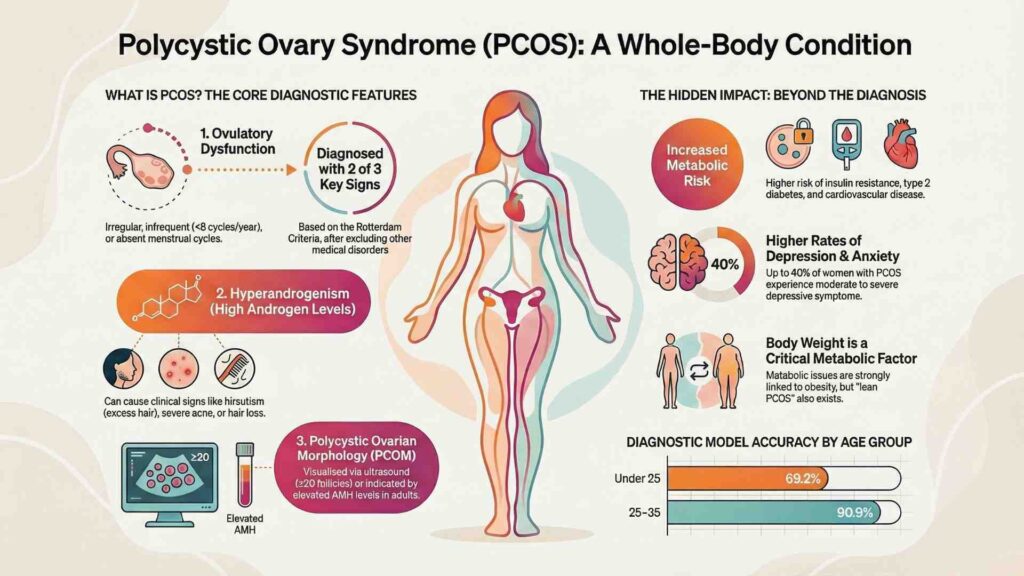
Furthermore, medical professionals typically categorize it as a chronic condition, meaning it requires long-term management rather than a quick fix. It is generally characterized by three main features: irregular periods, excess androgen levels, and the presence of polycystic ovaries. If a woman meets at least two of these three criteria, she is typically diagnosed with the syndrome.
Identifying the core triggers of your hormonal imbalance
The exact cause remains unknown, but researchers have identified several factors that contribute to its development. Specifically, one of the most significant causes is insulin resistance. In simple terms, insulin resistance happens when your body’s cells do not respond properly to the hormone insulin, which is responsible for managing blood sugar.
When your cells resist insulin, your pancreas produces even more to keep blood sugar stable. Consequently, these high levels of insulin can cause your ovaries to produce excess amounts of the male hormone, androgen. Therefore, this hormonal shift is what interferes with ovulation.
| Factor Type | Mechanism | Resulting Impact |
| Metabolic | Insulin Resistance | Triggers excess androgen production |
| Biological | Low-grade Inflammation | Stimulates ovaries to produce testosterone |
| Genetic | Family History | Polygenic inheritance increases risk |
| Environmental | Diet and Pollutants | Disrupts endocrine function |
| Gut Health | Gut Dysbiosis | Imbalance in gut bacteria affects metabolism |

Recognizing the most common symptoms in women and teens
Clinical signs vary greatly from person to person. Some may have very mild signs, while others experience severe disruptions to their daily lives. Let’s simplify this by looking at the most frequent clinical manifestations.
Irregular periods are the hallmark sign. Specifically, this might mean having fewer than nine periods a year, cycles that are longer than 35 days, or periods that are unusually heavy and prolonged. Similarly, for some women, periods may stop altogether, a condition known as amenorrhea.
Hormonal imbalance symptoms in females also manifest physically. High androgen levels lead to hirsutism, which is the growth of dark, coarse hair on the face, chin, chest, or abdomen. Conversely, some women experience thinning hair on the top of their head, similar to male-pattern baldness. In addition, skin issues are common, including persistent acne that often resists standard treatments and dark, velvety patches of skin around the neck or armpits.
How does the syndrome differ from PCOD?
It is very common for people to confuse these two conditions. However, the difference lies in the severity and the systems involved. PCOD (Polycystic Ovarian Disease) is generally considered a condition where the ovaries release many immature or partially mature eggs that turn into small cysts.
In contrast, PCOS is a more serious metabolic and endocrine disorder. While PCOD affects about one-third of menstruating women globally and can often be managed with simple lifestyle corrections, the syndrome impacts the entire body and increases the risk of long-term complications like diabetes and heart disease.
| Feature | PCOD (Disease) | PCOS (Syndrome) |
| Severity | Milder and more common | More severe metabolic disorder |
| Fertility Impact | Conception is usually possible | Significant challenge to fertility |
| Management | Often managed by lifestyle alone | Requires medical + lifestyle approach |
| Hormonal Impact | Slight increase in androgens | High levels of androgens and insulin |

Managing insulin resistance through your daily meals
The relationship between what you eat and your hormones is incredibly strong. Consequently, an insulin resistance and pcos diet focuses on stabilizing blood sugar to prevent insulin spikes. When your blood sugar is stable, your body produces less insulin, which in turn reduces the production of androgens in your ovaries.
What this means for your daily routine is prioritizing foods that are digested slowly. In simple terms, you should look for “low-GI” or low glycemic index foods. For example, these foods release energy gradually, helping you avoid the “sugar crashes” that trigger hunger and hormonal flare-ups.
Building a PCOS-friendly Indian diet plan
Creating an indian diet plan for pcos does not mean you have to stop eating your favorite traditional meals. Instead, it is about making smarter swaps. Specifically, focus on whole grains and millets that have been part of the Indian diet for centuries.
- Millets over Maida: Use ragi, bajra, and jowar for your rotis. These are high in fiber and help control insulin spikes.
- ** Protein Power:** Include plenty of moong dal, chana, rajma, and paneer. Protein helps you feel full and supports muscle repair.
- High-Fiber Vegetables: Focus on sabzis made from palak (spinach), lauki (bottle gourd), methi (fenugreek), and karela (bitter gourd).
- Healthy Fats: Use moderate amounts of mustard oil or ghee. In addition, include a few walnuts and almonds daily for hormone support.

Quick and healthy snacks for busy professionals
If you are a busy professional or an NRI managing a hectic schedule, snacking is often where diets fail. However, having pcos friendly snacks india ready to grab can prevent you from reaching for unhealthy biscuits.
Some easy, home-based snack ideas include:
- Roasted Makhana: A low-calorie, high-fiber alternative to chips.
- Boiled Sprouts: Mix sprouted moong with cucumber and lime for a quick nutrient boost.
- Roasted Chana: Perfect for keeping in your bag for mid-afternoon hunger.
- Buttermilk (Chaas): A probiotic drink that aids digestion and keeps you hydrated.
- Walnuts and Flaxseeds: These provide essential Omega-3 fatty acids that fight inflammation.
Home-based exercise routines for fat loss
Exercise is just as important as diet when it comes to managing hormones. Specifically, the most effective pcos exercises for belly fat are those that improve insulin sensitivity and reduce cortisol. You don’t need a gym; many of these can be done at home.
- Brisk Walking: Walking for 30–45 minutes daily is one of the easiest ways to lower blood sugar without stressing your body.
- Strength Training: Using your own body weight for squats, lunges, and planks helps build lean muscle. Consequently, muscle tissue burns more energy than fat, helping with long-term weight management.
- Yoga: Poses like the “Butterfly Stretch” and “Cobra Pose” can help stimulate ovarian function and reduce stress.
- HIIT: For those with higher fitness levels, short bursts of intense activity like jumping jacks can effectively burn fat in a short amount of time.
Natural therapies and Ayurvedic herbs for support
India’s traditional medicine system offers several natural solutions. Specifically, using ayurvedic herbs for pcos management can complement your dietary changes by addressing the root cause of hormonal imbalance.
- Shatavari: Known as a female reproductive tonic, it supports hormonal balance and regular cycles.
- Ashwagandha: An adaptogen that helps the body manage stress and lower cortisol, which is often high in this condition.
- Cinnamon (Dalchini): Studies show it can improve insulin receptor function and help regulate periods.
- Fenugreek (Methi): Soaking methi seeds overnight and drinking the water is a common Indian home remedy to help manage insulin resistance.

A major concern for many is what is PCOS and how it affects fertility. Because the syndrome prevents regular ovulation, it is the most common cause of female infertility worldwide. When an egg is not released every month, getting pregnant naturally becomes more challenging.
However, the good news is that with the right management, most women can still conceive. Lifestyle changes that reduce insulin levels often help restore natural ovulation. For those who need extra help, doctors may prescribe medications like Letrozole or Clomiphene to stimulate the ovaries. Therefore, understanding your cycle through tracking is an essential step toward motherhood.
BOOK YOUR APPOINTMENTFrequently Asked Questions
Can PCOS be cured permanently? Technically, it is a chronic condition, so there is no one-time “cure.” However, through lifestyle changes, many women reach a point where they are symptom-free and their hormones are balanced.
Does every woman with the syndrome have cysts on her ovaries? No. Despite the name, you can have the condition without having visible cysts on an ultrasound, provided you meet the other diagnostic criteria.
Is rice bad for my condition? White rice can spike insulin. Therefore, it’s better to choose brown rice, red rice, or millets. If you do eat white rice, pair it with plenty of fiber and protein to slow down sugar absorption.
How long does it take to see results from diet changes? Most women start to see improvements in energy and skin within 4–6 weeks, while it may take 3–6 months for menstrual cycles to become regular.

Conclusion: Taking control of your health
I know that dealing with this condition can feel like an uphill battle, but you have the power to change your health outcomes. Ultimately, by understanding what is PCOS and how it affects your body, you have already taken the most important first step. Focus on making sustainable, Indian-friendly lifestyle choices that nourish your body rather than restrict it.
Whether it’s swapping your morning toast for a ragi dosa or finding 20 minutes to walk in your local park, every small action counts. You are not alone on this journey, and with patience and consistency, you can achieve the hormonal harmony you deserve.
Take the Next Step Toward Your Health Goals Are you ready to create a personalized plan that fits your busy Indian lifestyle? Our expert dietitians are here to help you navigate your journey with ease. Book
BOOK YOUR APPOINTMENTDisclaimer: This blog post was written to help you make healthier food choices altogether. So, be aware and take care. The important thing to consider is your health before starting a restrictive diet. Always seek advice from a doctor or dietitian before starting if you have any concerns.

Abhinav is the Founder of Diet Dekho, helping people manage weight and lifestyle health through simple, practical nutrition and personalized diet plans.