
Imagine this: It is Monday morning. You wake up feeling lighter, more energetic, and ready to take on the world. For the last six weeks, you have been remarkably consistent. You’ve traded your morning sugary cereal for a protein-rich moong dal chilla. You’ve started taking the stairs at your office in London or Dubai, and you have even resisted the late-night snacks that usually follow a stressful day of work. The scale has been your best friend, rewarding your efforts with a steady downward trend. But today, something is different. You step on the scale, and the number is exactly the same as it was last Monday. In fact, it is the same as it was three weeks ago.
You feel a sinking sensation in your stomach. You start questioning everything. Is the calorie deficit not working anymore? Is it your PCOS or your thyroid acting up again? You are doing everything “right,” yet the scale refuses to budge. This frustrating wall is what we call a weight loss plateau, and if you are feeling discouraged, I want you to take a deep breath. I have seen thousands of people hit this exact spot. It isn’t a sign that you’ve failed; it is actually a sign that your body is working perfectly. It’s just being a little too good at its job of protecting you.
In this deep dive, we are going to simplify the complex science behind why weight loss stops. We will look at how metabolic adaptation, hormone changes, and even your busy NRI lifestyle play a role. Most importantly, I will give you the practical, home-based tools to break through that stall without ever needing to step foot in a gym. Let’s get your journey back on track.
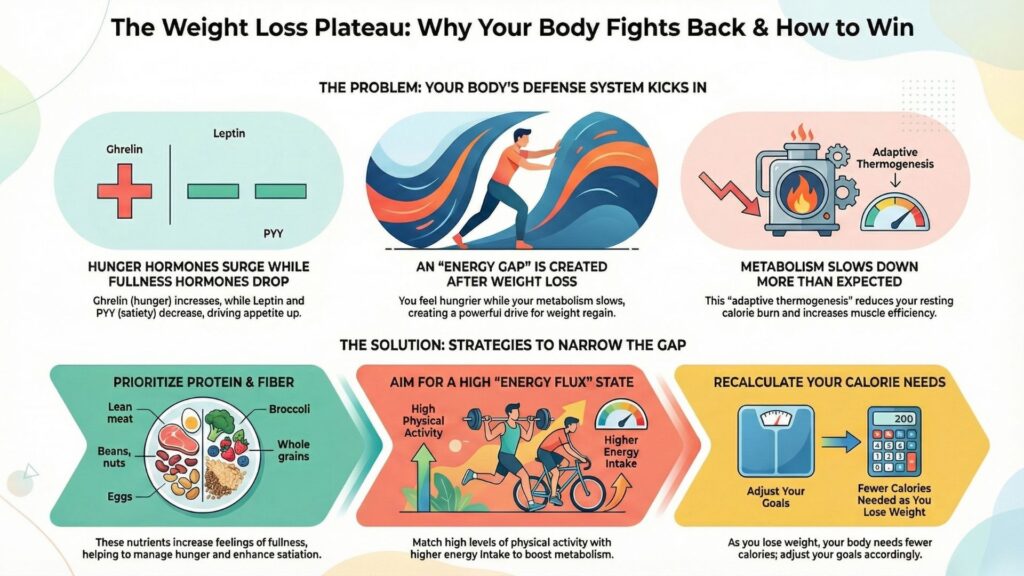
Understanding the “Wall”: What is a Weight Loss Plateau?
Table of Contents
- 1 Understanding the “Wall”: What is a Weight Loss Plateau?
- 2 Metabolic Adaptation: Your Body’s Survival Shield
- 3 The Set-Point Theory: Your Internal Thermostat
- 4 Hormone Changes During Weight Loss: The Silent Saboteurs
- 5 Muscle Loss: The Metabolism’s Hidden Leak
- 6 Medical Condition #1: The PCOS and PCOD Struggle
- 7 Medical Condition #2: Thyroid and the Slow-Motion Metabolism
- 8 Medical Condition #3: Diabetes and Hypertension Interplay
- 9 The NRI Dilemma: Cultural Diets and Life Abroad
- 10 The Sedentary Trap: Busy Professionals and Homemakers
- 11 NEAT Activities: The Non-Gym Secret to Fat Loss
- 12 Desk Exercises and Office Hacks for Busy Pros
- 13 Home-Based Workout Routines for Homemakers
- 14 The Protein Fix: Why You Might Need to Eat More
- 15 Traditional Indian Protein Sources for Every Diet
- 16 Fiber: The Volume Filler for Satiety
- 17 Tracking Calories Accurately: Avoiding “Calorie Amnesia”
- 18 Stress and Cortisol: The Belly Fat Driver
- 19 Sleep: The Most Underestimated Weight Loss Tool
- 20 Debunking Myths: Is “Starvation Mode” Real?
- 21 Water Weight: The Deceptive Number on the Scale
- 22 Weight Loss Medications: Why Ozempic Stops Working
- 23 Non-Scale Victories: Celebrating the Invisible Wins
- 24 The Roadmap to Break Your Weight Loss Plateau
- 25 Conclusion
A weight loss plateau is a period where your body weight stops changing, despite you continuing your diet and exercise routine. It is incredibly common, affecting about 85% of people at some point in their journey. Usually, this stall happens after an initial period of rapid success. In those first few weeks, the drop is often dramatic because your body is releasing glycogen—a form of stored energy in your muscles and liver that is mostly made of water. As that water weight leaves, the scale moves fast. But once that initial “flush” is over, fat loss becomes a slower, more deliberate biological process.
A true plateau is generally defined as seeing no change in your weight or body measurements for at least two to four consecutive weeks. If the scale doesn’t move for three days, that is just normal daily fluctuation. But if it’s been a month, your body has likely reached a state of energy equilibrium. This means the calories you are eating now exactly match the calories your body is burning in its new, smaller state.
I know it’s hard to stay motivated when the scale stops “talking” to you, but we need to remember that weight loss is rarely a straight line. It’s a series of steps and landings. Think of a plateau as your body’s way of catching its breath and adjusting to its “new normal” before it feels safe enough to let go of more energy stores.
| Sign of a Real Plateau | What it Actually Means |
| No weight change for 3+ weeks | You’ve reached energy equilibrium. |
| Measurements (waist/hips) are the same | Fat loss has likely stalled. |
| Hunger levels are spiking | Your hormones are fighting back. |
| Energy levels are dipping | Your metabolism is slowing to save power. |
Metabolic Adaptation: Your Body’s Survival Shield
Why does weight loss stop after some time? The biggest culprit is a process called metabolic adaptation, also known as adaptive thermogenesis. This isn’t a “broken” metabolism; it is an evolutionary survival mechanism. Thousands of years ago, if our ancestors suddenly started losing weight, it usually meant a famine was coming. To prevent them from starving to death, the human body evolved to become incredibly efficient at using energy.
When you lose weight, you have less body mass to move around. A 70kg person naturally burns fewer calories than a 90kg person just by existing. But metabolic adaptation goes deeper. Your body actually slows down your resting metabolic rate (RMR) more aggressively than the weight loss alone would suggest. According to researchers, this adaptation is a “proportional, but incomplete, response to efforts to reduce body weight”.
In a famous study of participants from “The Biggest Loser,” researchers found that six years after their massive weight loss, their metabolisms were still burning about 500 calories fewer per day than expected for their size. This is why the “eat less, move more” advice often fails over the long term. If you keep eating the same 1,500 calories that helped you lose the first 10kg, your body eventually learns how to survive on exactly 1,500 calories, and the weight loss stops.
The Set-Point Theory: Your Internal Thermostat
Let’s simplify this further. Think of your body as having an internal weight thermostat, known as the “set point”. Your DNA and your environment work together to determine a weight range where your body feels most comfortable and functions optimally. When you try to push your weight below this range, your brain’s hypothalamus gets “alarmed”.
The brain then coordinates a counter-attack. It increases your hunger hormones so you seek out food and decreases your metabolic rate to protect your fat reserves. According to some experts, your body can defend a set-point range of about 5-10% of your total weight without much resistance. But once you go past that, the biological battle begins in earnest.
This is why many of my clients hit a wall after losing their first 5-8kg. Your body is trying to stay in its “comfort zone.” The good news? You can reset your thermostat. By going slowly and incorporating maintenance phases—periods where you focus on staying at your current weight rather than losing more—you give your body time to accept the new weight as its new set point.

Hormone Changes During Weight Loss: The Silent Saboteurs
When you are in a calorie deficit, it’s not just your “willpower” that changes; it’s your blood chemistry. Two main hormones act as the gas and the brake for your appetite: Leptin and Ghrelin. Understanding them is the key to managing your cravings during a weight loss stall.
Leptin is produced by your fat cells and tells your brain, “We have plenty of energy, you can stop eating and burn more fuel”. As you lose fat, your leptin levels drop. Your brain suddenly thinks you are in a state of energy depletion, which triggers intense hunger and a slower metabolism. At the same time, Ghrelin—the “hunger hormone” produced in the stomach—increases. This hormone’s job is to make you look for food.
This hormonal shift can last for a long time. Research published by the National Institutes of Health (NIH) shows that these hormonal adaptations can continue for at least a year after you finish your diet. This is why you might feel hungrier now than when you were 10kg heavier. It’s not that you have lost your discipline; it’s that your hormones are literally screaming at you to eat.
The Hormonal Balance Sheet
| Hormone | What Happens During Weight Loss | The Result for You |
| Leptin | Decreases significantly. | You feel less full and more “starved”. |
| Ghrelin | Increases significantly. | You have intense cravings and food noise. |
| Insulin | Sensitivity improves (which is good). | Can lower blood sugar, sometimes causing hunger. |
| Cortisol | Increases due to stress/low calories. | Your body holds onto belly fat. |
| Thyroid (T3) | Decreases to conserve energy. | You feel cold, tired, and sluggish. |
Muscle Loss: The Metabolism’s Hidden Leak
One of the most common weight loss stall reasons is the loss of muscle tissue. When you are in a calorie deficit, your body doesn’t just burn fat for energy; it can also break down your muscles. This is a major problem because muscle is much more metabolically active than fat.
While fat tissue burns only about 4.5 kcal per kilogram per day, muscle tissue burns approximately 19 kcal per kilogram just by existing. If your weight loss is too fast or if you aren’t eating enough protein, you might be losing muscle. This effectively “shrinks your engine,” meaning you burn fewer calories every single hour, even while you sleep.
If you notice that your weight has plateaued but you feel “squishier” or weaker, you may have lost muscle mass. This is why I always tell my busy professionals and homemakers: stop focusing on being “thin” and start focusing on being “strong.” Preserving your muscle is the single best way to keep your metabolism humming while you lose fat.
Medical Condition #1: The PCOS and PCOD Struggle
For my friends dealing with PCOS (Polycystic Ovary Syndrome), weight loss can feel like a mountain that keeps getting taller. It is not just about calories; it is about a profound hormonal imbalance called insulin resistance. When you have PCOS, your cells don’t respond properly to insulin, the hormone that helps you use sugar for energy.
As a result, your pancreas pumps out even more insulin. This is a double-edged sword: high insulin levels prevent your body from breaking down fat and instead signal it to store fat, particularly in the abdomen. Furthermore, high insulin triggers the production of androgens (male hormones), which further disrupts your metabolism and can cause cravings for high-sugar, high-fat foods.
If you have PCOS and your weight loss has stopped, it might be that your insulin levels are too high. I know it’s hard when the standard advice doesn’t work for you, but the secret here is often a low-glycemic diet and strength training to improve how your muscles use sugar. You can still lose weight, but we have to manage the insulin first.
Medical Condition #2: Thyroid and the Slow-Motion Metabolism
The thyroid is the master regulator of your metabolism. If you have hypothyroidism (an underactive thyroid), your gland isn’t producing enough hormones to keep your body’s systems running at full speed. It’s like trying to drive a car with the parking brake on. Your heart rate, digestion, and calorie-burning processes all slow down.
Even if you are taking medication like levothyroxine, you might still hit plateaus. Standard treatments sometimes normalize your blood tests but don’t fully restore your body’s ability to burn carbohydrates or manage energy. Additionally, the stress of dieting can further suppress thyroid function by reducing the conversion of T4 to the active T3 hormone.
If you find yourself feeling cold all the time, losing hair, or feeling chronically fatigued while your weight stays stuck, it’s worth talking to your doctor about your dosage. For thyroid warriors, “eating less” is rarely the answer. In fact, cutting calories too low can make your thyroid shut down even further to protect you.
Medical Condition #3: Diabetes and Hypertension Interplay
If you are managing Diabetes (Type 2) and High Blood Pressure (Hypertension), you are dealing with a complex metabolic environment. Obesity-related hypertension often involves an overactive sympathetic nervous system and the activation of the RAAS (renin-angiotensin-aldosterone system), which causes your body to retain salt and water.
This fluid retention can completely mask fat loss on the scale. You might be losing half a kilogram of actual fat, but if your body is holding onto an extra kilogram of water due to high salt intake or medication side effects, the scale will show a gain. Furthermore, some diabetes medications can make weight loss more difficult by increasing insulin levels or causing hunger.
However, the “healthy silver lining” is that even if the weight doesn’t shift, your efforts are making a massive difference. According to Harvard Health Publishing, nearly one-third of people who follow a healthy diet don’t lose any weight but still see significant improvements in their cholesterol, blood pressure, and liver fat. Your health is improving under the surface, even if the scale is being stubborn.

The NRI Dilemma: Cultural Diets and Life Abroad
I work with many NRIs in the US, UK, and Canada, and I know the unique struggles you face. When you move abroad, your health often takes a hit. NBC News once noted that “immigrants to the US arrive thin, get fat”. This happens because we often trade our traditional, high-fiber Indian meals for a “white-washed” Western diet of processed snacks, large portions, and hidden sugars.
You might replace your home-cooked dal and roti with quinoa or oats, thinking they are healthier, but if they are highly processed or if you are missing the spices that help with digestion, your metabolism might stall. Living abroad often means higher stress, less sunlight, and more desk-bound work, all of which contribute to insulin resistance and weight gain.
Let’s simplify this: you don’t have to eat like a Westerner to be healthy. Reconnecting with traditional Indian wisdom—like using turmeric, ginger, and cumin—can actually boost your metabolism. A study showed that some migrant groups increase their processed food intake by 30% within a decade of moving. Breaking the plateau for an NRI often means returning to the roots of a diverse, plant-based Indian diet.
The Sedentary Trap: Busy Professionals and Homemakers
Whether you are a professional sitting in meetings for eight hours or a homemaker managing a never-ending list of chores, the “sitting disease” is a major barrier to weight loss. Research shows that sitting for more than seven hours a day increases the risk of heart disease and diabetes, even if you exercise later.
The problem is that our total amount of daily activity matters far more than a 30-minute workout. When you are busy, your body subconsciously tries to save energy. You might notice you’ve stopped fidgeting, or you take the elevator without thinking. This reduction in “background movement” can burn 200-500 fewer calories per day than when you first started your diet.
I know it’s hard to find time, but we have to rethink our approach. Your entire day is your weight loss battlefield, not just the time you spend in a gym. Small, consistent changes in how you move while working or doing housework can be the spark that reignites your fat loss.
NEAT Activities: The Non-Gym Secret to Fat Loss
If you hate the gym, I have great news. The most powerful tool for breaking a plateau is something called NEAT (Non-Exercise Activity Thermogenesis). NEAT is simply all the calories you burn doing anything that isn’t sleeping, eating, or sports-like exercise.
For example, a 145 lb (65kg) person burns about 102 calories an hour while sitting at a desk. If they perform those same duties while standing, they burn 174 calories an hour. Over a year, as little as 100 extra NEAT calories a day can lead to a 10lb (4.5kg) weight loss without breaking a sweat.
Easy NEAT Hacks for Your Daily Routine
| Activity | Instead of… | Do this… |
| Phone Calls | Sitting on the couch | Pace around the room |
| At the Office | Emailing a colleague | Walk to their desk |
| Housework | Using the dishwasher | Hand-wash the dishes |
| Commuting | Parking near the door | Park 5 minutes away and walk |
| Television | Constant sitting | Stretch or do squats during ads |

Desk Exercises and Office Hacks for Busy Pros
I know it feels impossible to stay active when you have deadlines looming. But you can turn your workspace into a mini-studio with “invisible” exercises. These movements don’t just burn calories; they help your muscles stay sensitive to insulin, which is crucial for those with PCOS or Diabetes.
- Seated Leg Lifts: While you are typing or in a Zoom meeting, straighten one leg under your desk and hold it for 5-10 seconds. Switch legs. This engages your core and quads.
- Desk Push-ups: When you get up to get water, place your hands on the edge of your sturdy desk, step back, and do 10 push-ups. This works your chest and arms.
- Shoulder Rolls and Neck Stretches: Every hour, take 30 seconds to roll your shoulders. This reduces the cortisol-spiking stress of a long workday.
- The Standing Meeting: If you are on a call where you don’t need to type, stand up. Standing engage the large muscles in your legs and helps stabilize your blood sugar.
Remember, small changes lead to big results. You don’t need a marathon; you just need to stop sitting perfectly still.
Home-Based Workout Routines for Homemakers
Managing a home is a marathon in itself. But if the weight has stopped moving, we need to add a little more intention to our movements. You can use everyday household items to perform strength-building exercises that rev up your metabolism.
- The Laundry Squat: Every time you pick up a piece of clothing from the basket to hang it, do one full squat. If you have a big load, that’s 30-40 squats right there!
- Water Bottle Curls: Use two 1-liter water bottles as weights. While you are waiting for the tea to boil or the cooker to whistle, do 15 bicep curls.
- The Kitchen Counter Plank: While waiting for your food to cook, place your forearms on the kitchen counter and hold a plank for 30 seconds. This is great for core strength.
- Stair Intervals: If you have stairs at home, carry your grocery bags up one by one. Carrying heavy loads up stairs is considered a vigorous workout that significantly boosts your heart health.
The Protein Fix: Why You Might Need to Eat More
If you are following all the rules and yet the scale refuses to budge, you might be making one common mistake: you are cutting the wrong things. Dr. Saurabh Sethi, a gastroenterologist trained at Harvard, suggests that many people focus so much on cutting calories that they don’t eat enough protein.
When you don’t eat enough protein, your body starts burning its own muscle for fuel instead of fat. Less muscle means a slower metabolism. Protein also has a “magic” effect on your hunger. It suppresses ghrelin (your hunger hormone) and stimulates hormones that make you feel full.
A Harvard doctor’s “proven protein fix” to break a plateau is to aim for 1.5 to 2 grams of protein per kilogram of your body weight every day. For a 70kg person, that’s about 110-140 grams of protein. Try to get 25-35 grams in every single meal. When you eat protein at breakfast, your cravings for sugary snacks later in the day will naturally disappear.
Traditional Indian Protein Sources for Every Diet
| Food Item | Protein Content (Approx.) | Why it’s Great for Plateaus |
| Paneer (Low-fat) | 18-20g per 100g | High in protein and calcium; very filling. |
| Moong Dal | 7-9g per bowl | High in fiber; stabilizes blood sugar. |
| Soya Chunks | 15g per 1/2 cup | A vegetarian protein “bomb” for muscle preservation. |
| Greek Yogurt / Curd | 10-12g per cup | Natural probiotics for gut health and satiety. |
| Chickpeas (Chana) | 15g per bowl | High in fiber; great for managing PCOS cravings. |
| Eggs | 6-7g per egg | High bioavailability; perfect for busy morning professionals. |
Fiber: The Volume Filler for Satiety
If protein is the “brick” that builds your metabolism, fiber is the “foam” that fills your stomach. When you hit a plateau, you often feel hungrier because of those shifting hormones we discussed earlier. Fiber-rich foods like vegetables, lentils, and whole grains help you feel full on fewer calories.
Cruciferous vegetables like broccoli, cauliflower, and cabbage are gut health champions. They aid digestion and promote a healthy microbiome, which research shows is critical for weight management. Try to fill half your plate with colorful, non-starchy vegetables. This “volume eating” trick allows you to eat a large amount of food while still staying in a calorie deficit.
For my NRI friends, try swapping white rice for brown rice, millets (like ragi, bajra, or jowar), or quinoa. These whole grains provide sustained energy and won’t spike your insulin as much as refined white bread or pasta.

Tracking Calories Accurately: Avoiding “Calorie Amnesia”
Let’s be honest: tracking calories is a chore. Many of my clients start strong, but over time, they stop measuring. This leads to “calorie creep,” where your portion sizes slowly get bigger without you noticing. One study observed that 37% of adults in higher-weight bodies substantially underestimated or underreported their actual food intake.
I call this “calorie amnesia”—the bites of your child’s leftover food, the extra tablespoon of peanut butter in your smoothie (which is 100 calories!), or the cream in your third cup of coffee. These “sneaky” calories can easily add up to 300-500 extra a day, which is enough to completely stop your weight loss.
If you are stuck, I want you to try being “meticulous” for just one week. Use a kitchen scale and a tracking app to log every single bite. You will likely be shocked at where the hidden calories are coming from. This isn’t about being obsessed; it’s about having accurate data so we can make adjustments.
Stress and Cortisol: The Belly Fat Driver
Stress is a psychological barrier that has very real physical consequences for your weight. When you are stressed—whether it’s from a project at work or managing the household—your body releases a hormone called cortisol.
Cortisol is like a signal to your body to store energy for a “threat.” It raises your blood sugar and prompts your body to store fat, specifically around your midsection and organs. Chronic stress also kills your self-control, making you gravitate toward high-carbohydrate, high-fat “comfort foods” like cakes, pasta, and cookies.
I know life is hectic, but managing stress is non-negotiable for weight loss. Simple techniques like taking five deep breaths, journaling for five minutes, or going for a short walk in natural light can lower your cortisol levels and help your body let go of stubborn fat.
Sleep: The Most Underestimated Weight Loss Tool
If you are getting everything else right but only sleeping five hours a night, you will likely hit a weight loss plateau. Sleep deprivation is a metabolic disaster. It raises ghrelin (making you ravenous) and lowers leptin (so you never feel full).
A study by Kaiser Permanente found that people who slept 6 to 8 hours a night and reported lower stress levels were twice as likely to reach their weight loss goals as those who were sleep-deprived. When you are tired, your brain’s reward center lights up more for junk food, and you lack the energy to make healthy choices.
Let’s simplify your bedtime routine. Challenge yourself to turn off your phone 30 minutes before bed. Make your room cool and dark. Aiming for 7-9 hours of quality sleep is not a luxury; it is a core part of your weight loss plan.
Debunking Myths: Is “Starvation Mode” Real?
You’ve probably heard people say, “You aren’t losing weight because you aren’t eating enough, and your body is in starvation mode.” Let’s clear this up. While the body does slow its metabolism during calorie restriction (metabolic adaptation), it will not stop fat loss or cause you to gain weight if a true deficit is present.
The term “starvation mode” is a bit of an exaggeration. True starvation mode only happens when an individual has lost almost all their body fat and their body is shutting down to prevent death. For most people, a stall is caused by a combination of a slower metabolism and “habit drift”.
However, starving yourself is a bad idea. If daily calories are reduced excessively, particularly below 1,200 for most women, the body may respond with fatigue and loss of lean muscle. Over time, unmanaged hunger signals can intensify, often leading to episodes of eating far beyond satiety. Slow and steady is the only way to keep the weight off for good.

Water Weight: The Deceptive Number on the Scale
Sometimes the scale stops moving not because you aren’t losing fat, but because you are gaining water. Water makes up about 65% of your weight, and it can fluctuate wildly.
Why might you be retaining water?
- New Exercise: If you’ve started a new home workout, your muscles may be sore. Your body responds by “bathing” those sore muscles in water to help them repair.
- High Salt Intake: If you had a salty meal last night, your body will hold onto extra water to balance the sodium.
- Hormonal Shifts: Women often retain several pounds of water during their menstrual cycle.
- Carb Refills: Remember, every 1 gram of glycogen (carbs) holds 3 grams of water. If you had a higher-carb day, the scale will jump.
This is why I tell my clients: don’t let the scale be your only judge. Use body measurements, progress photos, and how your clothes fit to track your true progress.
Weight Loss Medications: Why Ozempic Stops Working
Many people are now using GLP-1 medications like Wegovy or Ozempic. While these are powerful tools, they are not magic. Almost everyone on these medications will eventually reach a “medication plateau”.101
This typically happens around the one-year mark (60 weeks). It happens because your body eventually finds a new set point and adjusts its metabolism to the lower calorie intake. If you hit a stall while on medication, it’s a sign that you need to refocus on the “lifestyle” side—increasing protein and strength training—to keep your metabolism active.
Non-Scale Victories: Celebrating the Invisible Wins
The scale is a blunt tool. It doesn’t tell you that you’ve gained 2kg of muscle and lost 2kg of fat. It doesn’t tell you that your liver fat is gone or that your heart is stronger. When you are in a plateau, these non-scale victories (NSVs) are your fuel.
Take a moment to look back. Are you fitting into an old pair of jeans? Do you have more energy to play with your kids? Are you sleeping better? These are deep metabolic shifts that have real consequences for your long-term health. Success isn’t just a number; it’s a feeling of vitality and confidence.
The Roadmap to Break Your Weight Loss Plateau
If you’ve been stuck for more than 4 weeks, here is your 5-step battle plan to restart the progress:
- Tighten Your Awareness: Track your food and movement meticulously for 7 days. Find the “hidden” calories.
- Recalculate Your Needs: As you lose weight, your body needs less. Use a TDEE (Total Daily Energy Expenditure) calculator to find your new maintenance calories, then subtract a modest 200-300 calories.
- Shock Your System: If you’ve been doing the same 20-minute walk, try a 15-minute HIIT session or add some bodyweight squats. Change the intensity to wake up your metabolism.
- Prioritize the “Metabolic Trio”: Increase protein, increase fiber, and get 8 hours of sleep. This manages your hunger hormones and protects your muscle.
- Be Patient and Kind: Your body isn’t a machine; it’s a biological system. Sometimes it just needs a few weeks to trust you before it lets go of more weight.
Conclusion
Breaking a weight loss plateau is as much about your mindset as it is about your metabolism. It is a sign that your body has adapted, and now it is time for you to adapt. Whether you are managing PCOS, navigating life as an NRI, or just trying to balance a career and home, remember that weight loss is a marathon, not a sprint.
Don’t let a temporary stall on the scale erase all the incredible progress you’ve made for your health. Celebrate your energy, your strength, and your resilience. If you feel like you need a personalized plan to navigate these hurdles, we are here to support you. Let’s make your health a priority together.
Take the first step toward your customized breakthrough today:(https://dietdekho.com/form/)
Disclaimer: This blog post was written to help you make healthier food choices altogether. So, be aware and take care. The important thing to consider is your health before starting a restrictive diet. Always seek advice from a doctor/dietitian before starting if you have any concerns.

Frequently Asked Questions (FAQs)
Why does my weight loss stop after some time even though I am still dieting?
This happens primarily because of metabolic adaptation. As you lose weight, your body requires fewer calories to function. Your metabolism also slows down more than expected as a survival mechanism to “defend” your energy stores. Eventually, the calories you are eating match the calories you are burning, and weight loss stops.
How can I break a weight loss plateau without going to the gym?
The most effective way is to increase your NEAT (Non-Exercise Activity Thermogenesis). This means moving more throughout your daily life—pacing while on the phone, taking the stairs, or doing household chores with more intensity. Additionally, increasing your protein intake and ensuring you get 7-9 hours of sleep can help restart your metabolism.
Does PCOS make a weight loss plateau more likely?
Yes. PCOS is often linked to insulin resistance, which promotes fat storage and increases hunger. This hormonal environment makes your body more resistant to fat loss, meaning you may experience more frequent or stubborn plateaus that require managing your insulin through diet and movement.
What is the “whoosh” effect in weight loss?
The “whoosh” effect refers to a period where fat cells lose fat but temporarily fill with water, causing a plateau. Eventually, the body releases this water all at once, leading to a sudden drop on the scale. This explains why your weight might stay the same for two weeks and then suddenly drop 1kg overnight.
How do stress and cortisol affect a weight loss stall?
When you are under chronic stress, your body produces cortisol, which encourages fat storage in the belly area and increases cravings for sugary foods. High cortisol can essentially “lock” your fat stores and make it very difficult to break through a plateau until your stress is managed.
BOOK YOUR APPOINTMENT
Abhinav is the Founder of Diet Dekho, helping people manage weight and lifestyle health through simple, practical nutrition and personalized diet plans.