
Have you ever stood on the scale and felt a sudden pang of anxiety at the number staring back at you? You aren’t alone. Determining the ideal body weight for women in India is about much more than a single number; it’s about understanding how your height, genetics, and lifestyle shape your personal health.
Direct Answer: The ideal body weight for women in India is generally defined by a Body Mass Index (BMI) between 18.5 and 22.9kg/m2 and a waist circumference below 80cm. For an average height of 5’0″ to 5’3″, a healthy range typically falls between 43 and 58kg, depending on your specific bone structure and muscle mass.
The Weight Dilemma: Is 70 kg Truly “Heavy” for an Indian Girl?
Table of Contents
- 1 The Weight Dilemma: Is 70 kg Truly “Heavy” for an Indian Girl?
- 2 The Mirror vs. The Scale: Why Your Weight Doesn’t Tell the Whole Story
- 3 Busting the “One-Size-Fits-All” Weight Myth
- 4 Height, Health, and Hormones: The Real Reasons Your Weight Might be High
- 5 Diet Dekho’s Healthy Plate: Simple Swaps to Reach Your Natural Balance
- 6 From Morning Tea to Dinner: A Realistic Daily Routine for Sustainable Health
- 7 Common Pitfalls: Why “Weight Loss” Often Fails in the Long Run
- 8 Progress is Not Just a Number: Embracing Your Journey
- 9 Take Charge of Your Health: Your Personalized Path to Wellness
I know it’s hard to see 70 kg on the scale without feeling like you need to start a crash diet immediately. However, the short answer is: it depends. Whether 70 kg is “heavy” is entirely relative to your height and body composition.
In simple terms, a woman who is 5’9″ (175 cm) weighing 70 kg is within a very healthy range, with a BMI of approximately 22.86kg/m2. Consequently, for her, this weight is perfect. On the other hand, for a woman who is 5’0″ (152 cm), that same 70 kg would place her in a higher-weight category with a BMI of 30.3kg/m2, which indicates a higher risk for metabolic issues.
What this means for your daily routine is that we need to stop comparing ourselves to our friends and start looking at our own average female weight in kg relative to our height. Moreover, the “panic point” of 70 kg is often more psychological than clinical, driven by social media standards rather than your actual health needs.
The Mirror vs. The Scale: Why Your Weight Doesn’t Tell the Whole Story
Let’s simplify this: the scale measures everything—your bones, water, muscle, and fat. But it doesn’t tell you where that weight is. Many Indian women fall into the “thin-fat” phenotype, where the scale looks normal, but they carry hidden fat around their internal organs.
Understanding the height weight ratio for women
Because Indian genetics predispose us to store fat around the abdomen, your height weight ratio for women is a much better health predictor than total weight. If you have a higher weight but it’s mostly muscle from being active, you are likely metabolically healthier than a sedentary person who weighs less.
Furthermore, the latest research from Harvard suggests that your waist size is just as important as your BMI. For Indian ladies, keeping your waist under 80cm (31.5 inches) is the gold standard for preventing heart disease and diabetes.
Busting the “One-Size-Fits-All” Weight Myth
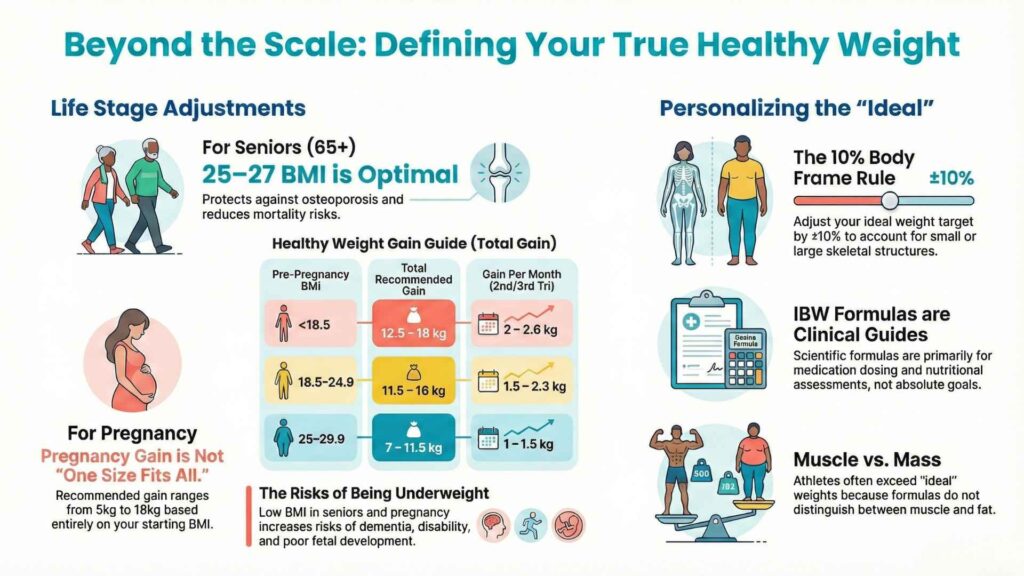
We’ve all heard it: “Every girl should weigh 50 kg.” This is a myth that needs to be retired. A healthy weight for Indian females varies significantly based on your frame size—whether you are small-boned or have a larger, sturdier build.
What is the healthy weight for Indian females?
In the past, we used Western tables that didn’t account for our unique physiology. Today, the Indian Council of Medical Research (ICMR) and the World Health Organization have clarified that Indian populations require lower BMI cut-offs to better identify people at higher health risk.
| Height (ft’in” / cm) | Normal Weight Range (kg) | BMI Range (kg/m2) |
| 5’0″ / 152 cm | 43.1 – 53.0 | 18.5 – 22.9 |
| 5’2″ / 157 cm | 45.8 – 56.5 | 18.5 – 22.9 |
| 5’4″ / 163 cm | 49.2 – 60.8 | 18.5 – 22.9 |
| 5’6″ / 168 cm | 52.2 – 64.6 | 18.5 – 22.9 |
In simple terms, a woman in a higher-weight body who is tall shouldn’t aim for the same “50 kg” goal as her shorter counterparts. Your ideal body weight for women is the one where your energy is high, your periods are regular, and your blood sugar is stable.

Height, Health, and Hormones: The Real Reasons Your Weight Might be High
If you feel like you’re eating “nothing” but still gaining, it’s likely not your fault. For many of my clients at Diet Dekho, especially busy professionals and homemakers, hormonal imbalances are the silent culprit behind a higher weight.
Using a weight chart for Indian ladies to understand risk
When we look at a weight chart for Indian ladies, we often see that those with PCOS (Polycystic Ovary Syndrome) or Thyroid issues struggle to stay in the “normal” box. In fact, PCOS affects up to 20% of Indian women, causing the body to store fat instead of using it for energy due to insulin resistance.
Additionally, hypothyroidism slows down your basal metabolic rate (BMR). This means your body burns fewer calories while resting, making the journey to an ideal body weight for women feel like an uphill battle. If you are managing these conditions, focusing on “hormone harmony” is more important than just cutting calories.
How Hormones Impact Your average female weight in kg
Moreover, stress plays a massive role. High cortisol levels from a hectic work-life balance tell your body to “hold onto” fat, particularly around the belly. Consequently, a heavier person isn’t necessarily “lazy”—they might just be dealing with a complex internal environment that needs specialized nutritional support.
Diet Dekho’s Healthy Plate: Simple Swaps to Reach Your Natural Balance
I know you’re busy, so let’s talk about practical Indian kitchen solutions. You don’t need fancy avocados or expensive kale to reach the ideal body weight for women. You just need to balance your traditional thali.
The(https://www.nin.res.in/dietaryguidelines/index.html) suggest a “Balanced Plate” rule that is perfect for our lifestyle:
- Fill 50% of your plate with vegetables: Think of seasonal sabzis like tinda, lauki, or spinach.
- 25% should be high-quality protein: This is vital for muscle. Use dal, paneer, curd, or eggs.
- 25% complex carbohydrates: Switch from white rice to “Shree Anna” (millets) like Ragi, Jowar, or Bajra.
In simple terms, swapping your morning white bread for a Moong Dal Chilla or a Ragi Dosa can stabilize your blood sugar and stop those 4 PM samosa cravings. These small tweaks are what lead to a sustainable healthy weight for Indian females.
From Morning Tea to Dinner: A Realistic Daily Routine for Sustainable Health
Let’s simplify this into a daily flow that fits into your life. Achieving an ideal body weight for women doesn’t require a 2-hour gym session.
- 7:00 AM: Start with warm water and soaked almonds to kickstart your metabolism.
- 8:30 AM: A protein-rich breakfast like Paneer Paratha (using multigrain atta) or a sprout salad.
- 1:00 PM: A balanced thali with one roti, a big bowl of dal, and plenty of salad.
- 4:30 PM: Instead of biscuits, have a handful of roasted makhana or a fruit.
- 7:30 PM: A light dinner like Daliya Khichdi or vegetable soup with tofu.
Moreover, try to squeeze in a 40-minute brisk walk. If you can’t go out, a simple at-home HIIT circuit—like jumping jacks and squats—can do wonders for insulin sensitivity in PCOS. What this means for your daily routine is that consistency is your superpower.

Common Pitfalls: Why “Weight Loss” Often Fails in the Long Run
I know it’s tempting to try a “7-day detox” or skip breakfast to save calories. However, these are the exact reasons why many women find themselves gaining the weight back.
- Obsessing over the “target number”: If you only focus on the average female weight in kg, you miss the fact that you might be losing inches and gaining health.
- Crash dieting: This destroys your metabolism and is especially dangerous for those with thyroid issues.
- The “All or Nothing” mindset: One “cheat meal” doesn’t ruin your progress. Aim for 80% consistency, not 100% perfection.
In simple terms, weight management is a marathon, not a sprint. People in higher-weight bodies often succeed when they make peace with food rather than fighting it.
Progress is Not Just a Number: Embracing Your Journey
Let’s focus on “Non-Scale Victories.” While we use the ideal body weight for women as a guide, your body shows healing in other ways:
- Stable Energy: You no longer feel like napping every afternoon.
- Regular Cycles: Your periods are becoming more predictable—a huge win for PCOS.
- Glowing Skin: Reduced acne and clearer skin often mean your hormones are balancing out.
- Better Mood: You feel less anxious and more confident in your clothes.
What this means is that even if the scale is slow to move, your body is changing on the inside. Every healthy meal is a win.
Take Charge of Your Health: Your Personalized Path to Wellness
I know it can feel overwhelming to navigate all this on your own. But you don’t have to. Whether you are managing PCOD, a thyroid disorder, or just want to feel like yourself again, a customized plan makes all the difference.
Get a Personalized Macro-Balanced Plan with a Diet Dekho Expert Start Your Journey to Holistic Health with a Diet Dekho Consultant
Ready to find your natural balance? Fill out our Consultation Form today, and let’s build a version of you that is healthy, happy, and thriving.

Frequently Asked Questions
1.Is 70 kg high for a girl who is 5’3″? For a height of 5’3″ (160 cm), a weight of 70 kg gives a BMI of 27.34 kg/m², which falls into the higher weight category according to revised Indian standards. The ideal body weight for women at this height is typically 47 to 58kg.
2. What is the healthy weight for Indian females according to the 2024 guidelines? The current guidelines suggest maintaining a BMI between 18.5 and 22.9kg/m2. Moreover, your waist circumference should ideally stay below 80cm to minimize metabolic risk.
3. Why is it so hard to reach my ideal weight with PCOS? PCOS often causes insulin resistance, which means your body stores sugar as fat rather than burning it for energy. Consequently, weight loss requires a specific balance of high fiber and lean protein to manage these insulin spikes.
4. Can I lose weight without going to the gym? Absolutely. Many of my clients reach their goals through simple Indian kitchen swaps and 40 minutes of daily walking or home-based HIIT. Consistent daily movement is more effective for long-term health than occasional intense workouts.
Disclaimer: This blog post was written to help you make healthier food choices altogether. So, be aware and take care. The important thing to consider is your health before starting a restrictive diet. Always seek advice from a doctor or dietitian before starting if you have any concerns.
BOOK YOUR APPOINTMENT
Dr. Ritika is a nutrition and lifestyle expert with 2+ years of experience, helping clients manage weight and health through practical, personalized diet plans.