
I still remember the look on my friend Priya’s face when she called me after her 24-week glucose screening. She was a busy architect, already juggling a toddler and a high-stakes project, and the diagnosis of GDM felt like a heavy weight she hadn’t prepared for. Like many of you, her first question wasn’t about the medicine, but about her kitchen. Specifically, she needed a clear, supportive, and effective Indian diet plan for gestational diabetes that wouldn’t feel like a punishment or a second full-time job. This guide is built for the Priyas of the world, the busy professionals and dedicated homemakers who need to protect their babies while keeping their own energy levels steady.
An effective Indian diet plan for gestational diabetes focuses on stabilizing blood sugar by choosing low-glycemic index (GI) foods like whole grains, dals, and non-starchy vegetables. Consequently, you should aim for three balanced meals and two to three fiber-rich snacks daily. Specifically, this approach prevents glucose spikes while ensuring your baby receives vital nutrients for healthy growth.
Understanding the Landscape of GDM in India
Before we look at the recipes, we need to understand why this metabolic shift is happening. India is often referred to as the diabetes capital of the world, and this extends to pregnancy as well. Specifically, recent research from the ICMR-INDIAB national study shows that nearly one in four pregnant people in India about 22.4% develop gestational diabetes. These numbers aren’t just statistics; instead, they represent a significant shift in how our bodies handle modern lifestyles and traditional diets.
Prevalence varies across the country, which means your regional background might play a role. In urban areas, the rate is slightly higher at 24.2%, while rural areas follow closely at 21.6%. Furthermore, what is even more interesting is the regional divide. Specifically, Central India currently shows the highest prevalence at 32.9%, whereas West India reports the lowest at 16%. Therefore, this suggests that our regional cooking styles and activity levels play a massive role in how our bodies manage sugar during pregnancy.
I know it’s hard to find time to research all of this while you’re preparing for a baby, but understanding the Indian Phenotype is vital. Many of us are skinny fat, meaning we might have a normal weight but a higher percentage of body fat, especially around the middle. Consequently, this baseline insulin resistance makes us more susceptible to GDM when pregnancy hormones like cortisol and placental lactogen kick in.

National Prevalence of GDM by Demographic
| Category | Prevalence (%) | Context/Source |
| National Average | 22.4% | ICMR-INDIAB Weighted Estimate |
| Urban Residents | 24.2% | Linked to sedentary professional roles |
| Rural Residents | 21.6% | Increasing due to dietary transitions |
| Early GDM (<20 weeks) | 19.2% | Often linked to pre-existing resistance |
| Late GDM (>20 weeks) | 23.4% | Triggered by peak placental hormones |
What this means for your daily routine is that we can’t just follow a generic Western diet plan. Instead, we need a solution that respects our love for rotis, dals, and spices while making them work for our health.

The Science of Stability: Glucose Targets and Testing
You might be feeling a bit like a pincushion with all the finger-pricking lately, but those numbers are your most powerful tool. Specifically, they tell us exactly how that bowl of poha or that extra roti affected your system. Therefore, organizations like the National Institutes of Health (NIH) suggest very specific targets to keep you and the baby safe.
When you use your glucose meter, look for these numbers:
- Fasting (first thing in the morning): le 95 { mg/dL}
- One hour after a meal: le 140 { mg/dL}
- Two hours after a meal: le 120 { mg/dL}
If your numbers are higher than these targets, please don’t panic. Instead, treat it as information. For example, it might mean we need to adjust the portion of rice or add more protein to that specific meal. I always tell my clients to keep a food diary alongside these numbers. Specifically, this is because it helps us see patterns like how your body might handle a whole wheat roti better than a white rice-based idli.

Why These Targets Matter
When blood sugar stays high, the extra glucose crosses the placenta to the baby. Consequently, the baby’s pancreas then has to work overtime to produce insulin, which acts as a growth hormone. This can lead to macrosomia, where the baby grows larger than 9 pounds (4kg), potentially making delivery difficult and increasing the chance of a C-section.
Long-term, babies born to mothers with unmanaged GDM have a higher risk of childhood obesity and developing Type 2 diabetes themselves. By following a solid indian diet plan for gestational diabetes, you aren’t just managing a nine-month condition. Instead, you are literally setting up your child’s metabolic health for life.

The Pillars of the Indian GDM Plate
Let’s simplify the way you look at your plate. We use something called the Plate Method, and it’s a lifesaver for busy homemakers and professionals who don’t have time to weigh every gram of food.
Imagine your dinner plate divided into sections:
- Half the plate: Fill this with non-starchy vegetables like palak, bhindi, lauki, tori, or cucumber.
- One-quarter of the plate: Reserve this for lean protein such as dal, paneer, sprouts, eggs, or chicken.
- One-quarter of the plate: Add your complex carbohydrates here, like a small roti or a small bowl of brown rice.
Understanding the Glycemic Index (GI)
The Glycemic Index is just a fancy way of saying how fast a food turns into sugar in your blood. For an effective indian diet plan for gestational diabetes, we want to choose slow burners. Specifically, foods with a low GI value release glucose more slowly, which helps to manage your blood glucose levels during pregnancy.
| Food Category | Low GI (Choose Often) | High GI (Limit Strictly) |
| Grains | Barley (Jau), Quinoa, Steel-cut oats | White rice, Maida, Cornflakes |
| Millets | Jowar, Bajra, Barnyard millet | Puffed rice (Murmura) |
| Dals | Moong, Masoor, Rajma, Chana | Sweetened dal preparations |
| Vegetables | Bitter gourd (Karela), Spinach, Okra | Potatoes, Pumpkin, Yam |
| Fruits | Apples, Guava, Pears, Cherries | Watermelon, Overripe mangoes |

The Rice and Potato Hack for Busy Professionals
I know many of you love rice and find it hard to cut out entirely. What this means for your daily routine is that we need to use a bit of science to our advantage. Specifically, there is a process called starch retrogradation. If you cook your rice or potatoes a day in advance and let them cool in the fridge for 16 to 24 hours, the structure of the starch changes. Consequently, it becomes resistant to starch, which your body can’t digest as easily.
This simple trick can reduce the glycemic impact of your rice by 30% to 40%. You can reheat it the next day for lunch, and it will still have that lower glycemic load. Furthermore, this is perfect for meal-prepping on a Sunday night for the busy work week ahead.

A Supportive 7-Day Indian Diet Plan for Gestational Diabetes
This plan is designed to be relatable and easy to follow. We focus on home-based solutions that don’t require expensive superfoods.
One : The Power of Moong
- Early Morning (7:00 AM): Start with 5-6 soaked almonds and warm water to buffer morning cortisol spikes.
- Breakfast (8:30 AM): After your nuts, enjoy a Moong Dal Chilla filled with grated carrots.
- Mid-Morning Snack (11:00 AM): Have one small apple or guava for steady energy.
- Lunch (1:00 PM): For your main meal, pair two small rotis with mixed vegetable sabzi and yellow dal.
- Evening Snack (4:00 PM): Enjoy a handful of roasted chana and plain buttermilk.
- Dinner (8:00 PM): Finally, have stir-fried paneer with capsicum and a bowl of clear vegetable soup.
Two : Embracing Millets
- Early Morning: Begin with warm water and a teaspoon of soaked methi seeds to improve sensitivity.
- Breakfast: Try multigrain toast with a side of paneer bhurji.
- Mid-Morning Snack: Snack on a small bowl of papaya or a fresh pear.
- Lunch: Serve one small bowl of brown rice with lauki sabzi and thick curd.
- Evening Snack: Have sprouts chaat with lemon, which further helps lower the glycemic response.
- Dinner: Conclude with moong dal khichdi made with more vegetables than rice.
Three : Calcium and Strength
- Early Morning: Eat 2 walnuts with warm water for the baby’s brain development.
- Breakfast: Prepare two small Ragi Dosas served with vegetable-heavy sambar.
- Mid-Morning Snack: Enjoy a small orange or a handful of berries.
- Lunch: Pair two small Jowar rotis with bhindi masala and arhar dal.
- Evening Snack: Munch on roasted makhana, as these are low in calories.
- Dinner: Have a vegetable stir-fry with tofu or paneer for a light protein boost.
Four : Hearty Legumes
- Early Morning: Drink warm water with a pinch of flaxseed powder.
- Breakfast: Enjoy vegetable poha loaded with extra peas and peanuts.
- Mid-Morning Snack: Have one fresh apple.
- Lunch: Serve brown rice with Rajma and a large cucumber salad.
- Evening Snack: Sip on buttermilk accompanied by roasted makhana.
- Dinner: End the day with a large bowl of clear vegetable soup and one small roti.
Five : Greens for Glucose Control
- Early Morning: Start with 5 soaked almonds.
- Breakfast: Have one vegetable paratha cooked with minimal oil and served with curd.
- Mid-Morning Snack: Enjoy a fiber-rich guava.
- Lunch: Pair two whole wheat rotis with palak paneer and a fresh green salad.
- Evening Snack: Have a portion of roasted chana.
- Dinner: Opt for steamed vegetables like broccoli and carrots with a bowl of dal.
Six : Traditional Flavors
- Early Morning: Drink warm water with soaked chia seeds.
- Breakfast: Serve two small Idlis with vegetable-heavy sambar.
- Mid-Morning Snack: Have a slice of fresh papaya.
- Lunch: Enjoy two rotis with tinda sabzi and yellow moong dal.
- Evening Snack: Try a cup of unsweetened yogurt with a few berries.
- Dinner: Have a bowl of vegetable daliya, which is much lower in GI than white rice.
Seven : Weekend Balance
- Early Morning: Eat a mix of soaked walnuts and almonds.
- Breakfast: Try a Besan Chilla filled with shredded paneer and capsicum.
- Mid-Morning Snack: Snack on a small pear.
- Lunch: Serve brown rice with Chole and a vinegar-based salad.
- Evening Snack: Enjoy roasted makhana again for a crunch.
- Dinner: Conclude with a light vegetable curry and one small roti.

Essential Portion Guide for the Indian Kitchen
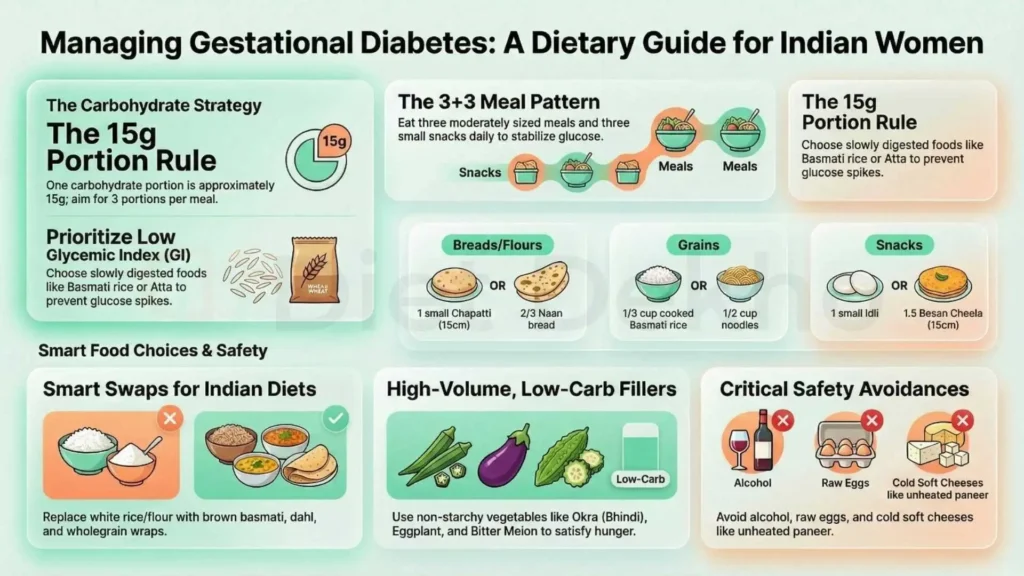
I know it’s hard to find time to measure food when you’re running a household, but keeping an eye on portions is the secret sauce of an indian diet plan for gestational diabetes. One portion of carbohydrates is roughly 15 grams. Specifically, women should aim for three portions (45g) at main meals and one to two portions (15-30g) at snacks.
| Food Item | What counts as one portion? | How much should you eat? |
| Chapatti/Roti | One small roti (15cm diameter) | Aim for 2 rotis per meal |
| Cooked Rice | One-third cup of rice | Limit to 1 portion if having roti |
| Dals/Lentils | Half a cup of thick dal | Can have 1-2 portions freely |
| Idli | One small steamed idli | Max 2 per breakfast |
| Milk/Curd | One small cup (200ml) | 1 portion with meals |

Traditional Indian Remedies: Methi and Beyond
Many of our grandmothers suggest methi (fenugreek) for sugar control, and for once, modern science completely agrees. Specifically, methi seeds are rich in a fiber called galactomannan, which physically slows down the rate at which your intestines absorb sugar.
How to Prepare Methi Water Correctly
- Soak: First, put one teaspoon of methi seeds in a glass of water before you go to bed.
- Drink: In the morning, drink the water on an empty stomach for maximum effect.
- Chew: Additionally, chew the soaked seeds if you can handle the bitterness for concentrated fiber.
If methi is too bitter for you, don’t force it. Similarly, you can dry-roast the seeds, grind them into a powder, and add a pinch to your yogurt or salads.
Expert Insights and Statistics
India’s leading experts emphasize the need for systemic support. Dr. V. Mohan, Director of the Madras Diabetes Research Foundation, stated in a press meet: India has highest rates of women with GDM. If the government extends support to implement the program, we will be able to help more than 5 million women affected with GDM in the country.
Furthermore, statistics show the long-term importance of follow-ups. In one study, about 60% of women with GDM developed Type 2 diabetes within 5-10 years after delivery. Therefore, sticking to your indian diet plan for gestational diabetes even after pregnancy is a vital investment in your future health.

I know you often reach for healthy biscuits or packaged yogurt when you’re busy, but we need to be careful. Specifically, many of these products are quietly packed with hidden sugars under names like maltodextrin, dextrose, or fruit juice concentrate.
What this means for your daily routine is that you should always flip the pack over. Specifically, look at the first three ingredients. If any form of sugar or refined flour (maida) is listed there, the product is likely a high-sugar food in disguise. Instead, try to choose whole, less-processed snacks like roasted chana or peanuts.
Lifestyle Tips for the Non-Gym Audience
I know you likely don’t have the energy or time for the gym right now. Let’s simplify this. You don’t need a treadmill to manage GDM. Instead, what you need is the 10-Minute Rule.
After every major meal breakfast, lunch, and dinner commit to a 10-minute walk. This does not have to be power-walking; just a gentle stroll around your living room will do. Specifically, this muscle activation helps your body pull glucose out of your bloodstream and into your muscles without needing as much insulin. Consequently, it is one of the most effective ways to lower your post-meal glucose numbers. For more on healthy patterns, you can refer to guidelines from Harvard Health.
Frequently Asked Questions (FAQs)
1. Can I eat white rice in an indian diet plan for gestational diabetes?
While white rice is high in GI and can cause sugar spikes, you can manage it by using the cooling hack or switching to Basmati or parboiled rice, which have lower GI values. Furthermore, always pair rice with plenty of fiber-rich dals.
2. Are Indian sweets completely off-limits?
During pregnancy, it is best to avoid traditional sweets like Gulab Jamun, Jalebi, and Kheer made with sugar. If you have a craving, try a small piece of low-GI fruit or a tiny portion of a sugar-free alternative instead.
3. Is it safe to take Methi water every day?
Yes, for most women, methi water is a safe and natural way to help regulate blood sugar levels first thing in the morning. However, you should always inform your doctor before adding any concentrated supplement to your routine.
4. What are some quick snacks for busy professionals with GDM?
Roasted chana, makhana, walnuts, almonds, and sprouts chaat are excellent portable snacks that won’t spike your sugar. Avoid sugar-free biscuits as they are often made with maida which still raises blood glucose.
5. Does gestational diabetes mean I will definitely have Type 2 diabetes later?
No, but it does increase your risk significantly. Specifically, about 50-60% of women with GDM may develop Type 2 diabetes within 5-10 years if they don’t maintain healthy habits like following a balanced diet and staying active.
Conclusion: Your Next Steps
Managing gestational diabetes is a marathon, not a sprint. I know it’s hard to find time to change everything at once, so start with one small thing today. Specifically, maybe it’s soaking the methi seeds tonight, or committing to that 10-minute walk after lunch tomorrow. Every small choice you make is a win for you and your baby.
If you’re feeling lost or need a more personalized approach tailored to your specific taste and schedule, we are here to help. At DietDekho, we specialize in creating stress-free, culturally relevant plans that fit your life.
Ready to simplify your GDM journey?
Contact Us
We understand how overwhelming nutrition and weight loss information can feel. With so many opinions and confusing advice online, it’s easy to feel stuck or unsure about what to do next.
At Diet Dekho, you never have to figure it out alone. You can contact us anytime with any questions or concerns. Our expert dietitians are available 24/7 to guide, support, and help you stay on track. Whether your goal is weight loss or building healthier habits, we’re here to make the journey simpler and more sustainable for you.
Disclaimer
This blog is intended to help readers make healthier food choices. Your health should always be the top priority. Before starting any restrictive or special diet, especially if you have a medical condition or health concern, please consult a doctor or a qualified dietitian. Each body responds differently to food and lifestyle changes. Always choose what is safe and suitable for you.

Abhinav is the Founder of Diet Dekho, helping people manage weight and lifestyle health through simple, practical nutrition and personalized diet plans.