Meet Anjali, a software engineer in Bangalore who balances a high-pressure job with a busy home life. She loves her morning chai and whole-wheat parathas, but lately, her stomach feels like a balloon ready to pop by midday. If you have ever felt that sharp, painful bloating or found yourself rushing to the bathroom at the most inconvenient times, starting a low fodmap diet might be the simple, evidence-based relief you need to start following today.
The low fodmap diet is a structured three-phase eating plan designed to identify specific fermentable carbohydrates that trigger digestive distress. By temporarily removing high-trigger foods like onions, garlic, and wheat, and replacing them with gut-friendly alternatives like rice and certain gourds, up to 75% of people with Irritable Bowel Syndrome experience significant relief from pain, bloating, and gas.
Understanding the Science of Fermentable Carbohydrates
What this means for your daily routine is that the foods you think are healthy might actually be the ones causing your discomfort. The acronym FODMAP stands for Fermentable Oligosaccharides, Disaccharides, Monosaccharides, and Polyols. These are types of short-chain carbohydrates that the small intestine does not absorb well. Because they are small and active, they behave in two specific ways that cause your stomach to revolt.
First, these sugars are osmotically active, which is a scientific way of saying they draw water into your intestines. Imagine your bowel filling up with extra fluid; this causes the walls of your gut to stretch and expand. For most people, this is a minor event. But if you have a sensitive gut, that stretching feels like intense pressure and pain.
Second, once these undigested sugars reach your large intestine, they become a feast for your gut bacteria. These bacteria ferment the sugars rapidly, producing gas as a byproduct. This combination of extra water and rapid gas production is the perfect recipe for the bloating and unpredictable bowel movements that have likely been making your life difficult.

The Role of Visceral Hypersensitivity
I know it is hard to understand why your friend can eat a bowl of rajma without a single issue while you feel miserable after just a few bites. The difference often lies in something called visceral hypersensitivity. People with Irritable Bowel Syndrome (IBS) often have nerves in their gut that are much more sensitive than the average person. While the gas and water production happen in everyone, your body perceives that stretching as a major signal of distress or pain.
Breaking Down the Acronym
Let us simplify the different groups of FODMAPs so you can recognize them in your local grocery store or your pantry.
| Category | Acronym Component | Where You Find It in India | Mechanism of Distress |
| Fermentable | N/A | All groups below | Gut bacteria turn these into gas |
| Oligosaccharides | Fructans & GOS | Wheat, onions, garlic, kidney beans (rajma) | These are never fully absorbed by humans |
| Disaccharides | Lactose | Milk, soft yogurt, fresh paneer | Requires the enzyme lactase to break down |
| Monosaccharides | Fructose (Excess) | Mangoes, honey, apples, agave | Absorbed slowly in the small intestine |
| Polyols | Sorbitol & Mannitol | Cauliflower, mushrooms, sugar-free gum | Draw water into the bowel through osmosis |
The Growing Gut Health Crisis in India
What this means for our community is that we are seeing a significant rise in digestive issues as our lifestyles change. While earlier studies suggested that IBS affected only about 4% to 5% of the Indian population, newer data from urban centers like Mumbai and Pune show that nearly 7.5% of people are struggling with these symptoms.
Why Urban Living Impacts Your Digestion
If you live in a bustling city, the pressure of a fast-paced life and high levels of stress can actually worsen your gut health. Stress impacts the gut-brain axis, making your digestive system even more reactive to high-FODMAP foods. Interestingly, women in India report these symptoms more frequently than men, with a prevalence of about 4.8% compared to 3.2% in certain communities.
| Region/Group | Prevalence of IBS | Most Common Subtype | Reference |
| North Indian Rural | 4% | Mixed (IBS-M) | |
| Mumbai Urban | 7.5% | Variable | |
| Global Average | 11.2% | Mixed/Diarrhea | |
| Indian Medical Interns | 73% (perception) | Underreported |

The Three-Phase Journey to a Happier Gut
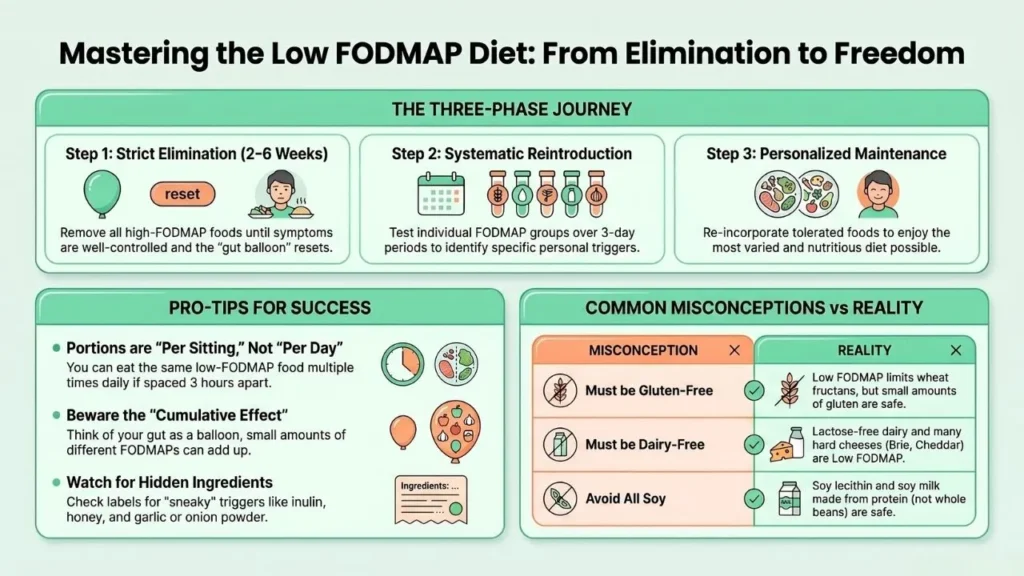
I want to be very clear: this is not a forever diet. It is a short-term discovery process to help you find your personal triggers. Think of it like a reset button for your digestive system. There are three distinct steps we will take together.
Phase 1: The Elimination Phase
During this step, which usually lasts two to six weeks, you will replace all high-FODMAP foods with safe alternatives. The goal is to get your symptoms under control so you can finally feel what a quiet gut feels like. Most people notice a huge difference within the first two weeks.
Phase 2: The Reintroduction Phase
Once you are feeling better, we do not just stay on the restricted list. That would be boring and could lead to nutritional gaps. Instead, we systematically test one food group at a time. For example, you might eat a small amount of garlic for three days and watch how your body reacts. This phase helps you learn exactly which sugars are your enemies and which ones are your friends.
Phase 3: The Personalization Phase
This is the long-term goal. You take everything you learned in the first two phases and create a balanced diet that works for you. You might find you can handle a little bit of onion in a curry but need to stay far away from milk. This phase is about freedom and ensuring you get a wide variety of nutrients for your long-term health.

I know it feels impossible to cook Indian food without onions and garlic. They are the foundation of almost every dish we make. However, we can use some clever tricks to keep the flavor without the pain.
The Secret of Garlic-Infused Oil
FODMAPs are water-soluble, meaning they dissolve in water but not in oil. If you sauté garlic in oil and then remove the garlic pieces, the flavor stays in the oil, but the trigger sugars stay out. This is a game-changer for your daily tadka.
The Magic of Hing (Asafoetida)
If you are missing that pungent, savory base that onions provide, a pinch of high-quality hing in hot oil can replicate that umami flavor beautifully. It is a traditional Indian solution that fits perfectly into the low fodmap diet.
Managing Dals and Legumes
Most dals are high in GOS, which causes gas. However, yellow moong dal is generally the easiest to digest. If you soak your dal overnight and change the water several times before cooking, you can reduce some of the fermentable sugars, but during the elimination phase, it is best to stick to small portions of moong dal or switch to firm tofu and eggs for protein.
| Indian Food Category | High FODMAP (The Trigger) | Low FODMAP (The Safe Swap) |
| Grains | Wheat (Atta), Maida, Suji, Barley | Rice, Poha, Jowar, Ragi, Quinoa |
| Vegetables | Onion, Garlic, Cauliflower, Cabbage | Lauki, Tori, Pumpkin, Spinach, Carrots |
| Fruits | Mango, Apple, Watermelon, Chikoo | Papaya, Pineapple, Oranges, Strawberries |
| Proteins | Rajma, Chole, Soya Chunks, Toor Dal | Eggs, Chicken, Fish, Firm Tofu, Moong Dal |
| Dairy | Full-fat Milk, Dahi, Condensed Milk | Lactose-free Milk, Almond Milk, Hard Cheese |
Managing Diabetes and Gut Health Together
If you are managing diabetes, you might have been told to eat lots of beans and whole wheat for fiber. I know this is confusing because those are exactly the foods that trigger IBS symptoms. What this means for your daily routine is that we need to find low-glycemic index (GI) foods that are also low in FODMAPs.
Choosing the Right Grains
Instead of wheat rotis, try making rotis from Jowar (Sorghum) or Ragi (Finger Millet). These are traditional Indian grains that have a lower glycemic index, meaning they do not spike your blood sugar, and they are generally much gentler on the gut.
Safe Fruits for Diabetics
Fruits like papaya and oranges are excellent choices because they provide fiber and vitamins without the high fructose load found in mangoes or apples.
| Food Item | Glycemic Index (GI) | FODMAP Status | Recommended for Both? |
| Brown Rice | 55 (Medium) | Low | Yes |
| Chickpeas | 28 (Low) | High | No (Avoid in Phase 1) |
| Wheat Atta | 54 (Medium) | High | No (Use Millets instead) |
| Moong Dal | 38 (Low) | Low (Moderate) | Yes (Safest dal) |
| Bitter Gourd | 13 (Low) | Low | Yes (Excellent) |

Meal Planning for the Busy Professional
Let’s simplify this. You don’t need to spend hours in the kitchen every day. With a bit of weekend prep, you can have a week of gut-friendly meals ready to go.
The Power of Batch Cooking
I know it’s hard to find time, but cooking a large pot of rice or a big batch of moong dal on Sunday can save your week. You can turn that rice into lemon rice, curd rice (using lactose-free curd), or a simple vegetable pulao with carrots and beans throughout the week.
The Jain Option for Eating Out
When you are at a work lunch or a family gathering, look for Jain options on the menu. Jain cuisine naturally excludes onions and garlic, which removes two of the biggest hurdles of the low fodmap diet instantly. It is a built-in safety net for our Indian culture.
A Simple 7-Day Indian Meal Plan
| Day | Breakfast | Lunch | Dinner |
| 1 | Poha with peanuts and curry leaves | Rice with Lauki curry and Moong Dal | 2 Jowar rotis with Egg Bhurji |
| 2 | 2 Idlis with coconut chutney (no garlic) | Rice with Tori (Ridge Gourd) sabzi | Grilled chicken with sautéed spinach |
| 3 | Ragi porridge with lactose-free milk | Quinoa pulao with carrots and beans | Rice with Pumpkin (Kaddu) sabzi |
| 4 | 2 Besan Chillas (no onion) | Rice with tomato-based chicken curry | Rice with Baingan Bharta (Jain style) |
| 5 | Sabudana Khichdi with peanuts | Rice with Spinach (Palak) and Paneer (40g) | Fish curry with coconut milk and rice |
| 6 | Scrambled eggs with tomatoes and toast | Rice with Moong Dal and carrot salad | 2 Ragi rotis with Bhindi (Okra) sabzi |
| 7 | Oats upma with beans and carrots | Rice with egg curry (tomato base) | Rice with sautéed zucchini and bell peppers |
Potential Challenges and How to Overcome Them
I know it feels like you are losing your favorite foods, but think of this as a temporary investment in your long-term health. One common concern is getting enough fiber. When we remove wheat and beans, your fiber intake might drop. To prevent constipation, make sure you are eating plenty of safe vegetables like spinach and carrots, and drink at least 8 to 10 glasses of water every day.
The Importance of Portions
What this means for your daily routine is that low FODMAP does not always mean unlimited. Some foods, like paneer or certain nuts, are safe only in small amounts. For instance, having 40 grams of paneer is fine, but eating a whole plate of it might bring back your symptoms.
The Risk of Staying Restricted Too Long
If you stay in the elimination phase for months, it can actually hurt your gut microbiome. Your good bacteria need a variety of fibers to thrive. This is why I always encourage my clients to move into the reintroduction phase as soon as they feel stable. We want a gut that is both quiet and diverse.

Practical Steps to Start Today
I know you are busy, so let us focus on three things you can do right now to feel better.
- Clear your pantry: Move the wheat, onions, garlic, and honey to a different shelf so you aren’t tempted to use them by habit.
- Buy your basics: Stock up on rice, jowar flour, eggs, moong dal, and gut-friendly veggies like lauki and carrots.
- Find your flavor: Invest in some good hing and make a small jar of garlic-infused oil to use for your daily cooking.
Expert Quotes and Support
Dr. Hazel Galon Veloso, a gastroenterologist at Johns Hopkins, notes that the low fodmap diet is a temporary eating plan, a short discovery process to determine what foods are troublesome for you. It is not meant to be a permanent sentence. Most importantly, research published by Monash University shows that 3 out of 4 people find relief. You are very likely to be one of them.

Frequently Asked Questions
Can I follow the low fodmap diet if I am a vegetarian?
Yes, you certainly can. In India, we have many vegetarian options like moong dal, tofu, peanuts, and various millets that are safe. Just be careful with large portions of heavy lentils like rajma and chole during the first few weeks.
Is the low fodmap diet the same as a gluten-free diet?
Not exactly. Gluten is a protein found in wheat, while FODMAPs are carbohydrates. Some gluten-free foods are low in FODMAPs, but many are not. For example, some gluten-free breads use honey or agave, which are high-FODMAP triggers.
How long does it take to see results on a low fodmap diet?
Most people start feeling a reduction in bloating and pain within two to four weeks of strict elimination. If you don’t feel better after six weeks, it’s possible that your symptoms are being caused by something other than FODMAPs.
Can I drink tea or coffee on this diet?
Yes, but you should stick to black coffee or use lactose-free milk or almond milk. Avoid adding honey or high-fructose corn syrup. Also, limit yourself to about two to three cups a day, as caffeine can sometimes irritate a sensitive gut regardless of FODMAPs.
What happens if I accidentally eat something high in FODMAPs?
Do not worry; it happens to everyone. You might feel some bloating or discomfort for a day or two, but it does not mean you have to start the whole process over. Just go back to your safe, low-FODMAP meals for your next few sittings and let your gut settle down.
Contact Us
We understand how overwhelming nutrition and weight loss information can feel. With so many opinions and confusing advice online, it’s easy to feel stuck or unsure about what to do next.
At Diet Dekho, you never have to figure it out alone. You can contact us anytime with any questions or concerns. Our expert dietitians are available 24/7 to guide, support, and help you stay on track. Whether your goal is weight loss or building healthier habits, we’re here to make the journey simpler and more sustainable for you.
Disclaimer
This blog is intended to help readers make healthier food choices. Your health should always be the top priority. Before starting any restrictive or special diet, especially if you have a medical condition or health concern, please consult a doctor or a qualified dietitian. Each body responds differently to food and lifestyle changes. Always choose what is safe and suitable for you.

Abhinav is the Founder of Diet Dekho, helping people manage weight and lifestyle health through simple, practical nutrition and personalized diet plans.