Imagine Anjali, a 38-year-old homemaker in Bangalore, who starts her day at 6:00 AM. She manages the kitchen, gets her kids ready for school, and then sits by her large, sun-drenched window to finish her work. Despite the bright light, she feels a lingering exhaustion and persistent bone pain. She often wonders why her energy levels are so low when she lives in a country where the sun is always shining. This is the reality of vitamin d sunlight india-a paradox where we are surrounded by light but internally starving for nutrients.
To maintain healthy levels, Indians need 15–30 minutes of direct midday sun exposure (10 AM–3 PM) at least three times a week, as window glass and early morning light do not provide enough UVB rays. Since biological factors and pollution block synthesis, incorporating fatty fish, sun-exposed mushrooms, and fortified dairy is essential for bone health and managing diabetes.
The Great Indian Sunshine Paradox
It feels almost impossible to believe that in a country like ours, where the sun feels like a constant companion, nearly 90% of us are running low on the very vitamin it provides. I know it is hard to find time for yourself between office meetings or managing the household, but we need to talk about why being in a sunny room is not the same as getting actual sunlight. Doctors are now calling this one of the biggest health challenges of our time in India. We are living an indoor life, shielded by glass walls and air conditioning, which quietly cuts us off from nature’s easiest medicine.

Recent research shows that this deficiency is not just a minor issue; it is a nationwide crisis. From the busy streets of Mumbai to the quiet towns of the North, the numbers are staggering. Most studies conducted across the country show that 80% to 90% of Indians are deficient in Vitamin D. This means that almost everyone you know-your neighbor, your colleague, and perhaps even you-might be struggling with low levels without even realizing it.
The problem is that our modern routines have turned us into indoor dwellers. We commute in covered cars, work in cabins, and spend our evenings in malls. Even when we think we are getting sun, we often aren’t. Let’s look at how this deficiency actually breaks down across different parts of our country.
Regional Trends in Vitamin D Deficiency
A massive study analyzed over 22 lakh test results across India to understand how our location affects our health. What this means for your daily routine is that your geographical location might be working against you more than you think.
| Region | Deficiency Rate | Primary Drivers |
| South India | 51.6% | Rapid urbanization and high-density indoor workspaces. |
| Central India | 48.1% | Industrial pollution and dietary shifts. |
| North India | 44.9% | Seasonal variations and high atmospheric dust. |
| West India | 42.9% | Slightly better due to coastal outdoor activities. |
| Northeast India | 36.9% | More outdoor lifestyles and diverse local diets. |
It is particularly worrying to see that South India, despite its tropical weather, has the highest deficiency rates. This happens because the more we move toward urban lifestyles, the less we interact with the sun in a way that matters for our biology.
Age and Gender: Who is Most at Risk?
I often see parents worrying about their children’s grades, but we must also worry about their bone health. Teenagers between the ages of 13 and 18 are the most deficient group in India, with a shocking 66.9% rate. This is likely because they spend their peak sunlight hours inside classrooms or tuitions.
For a long time, we thought women were more at risk due to being indoors more often. However, the gap is closing. Today, 46.9% of women and 45.8% of men are found to be deficient. This tells us that the lifestyle of a busy professional is just as sun-starved as that of a homemaker. No matter who you are, if you aren’t making a conscious effort to step outside, your body is likely paying the price.

Why Your Morning Walk Might Not Be Enough
I often hear my clients say, But I go for a walk every morning at 7:00 AM! While a morning walk is wonderful for your mood and heart, it does almost nothing for your Vitamin D levels. Let’s simplify this: the specific rays your skin needs to make Vitamin D are called UVB rays. In the early morning or late evening, these rays are so weak that they can’t trigger the production process in your skin.
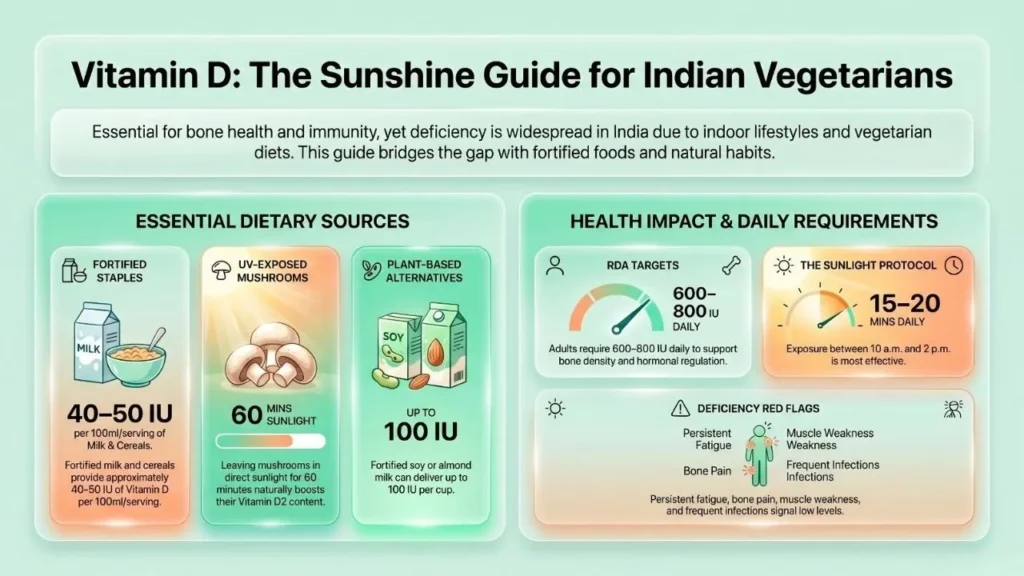
For the majority of experts, the golden window is between 10:00 AM and 3:00 PM. This is when the sun is directly overhead and the UVB radiation is at its strongest. I know it is the hottest part of the day, and nobody wants to be sweaty, but even 15 to 20 minutes during this time is three times more effective than an hour spent at 8:00 AM.
The Role of the UV Index
Think of the UV Index as a measure of the sun’s power. To start making Vitamin D, the UV Index needs to be at least 3. You can check this easily on your phone’s weather app. If the number is below 3, you are getting the warmth of the sun but none of the vitamins.
| UV Index Level | Strength | Time Needed for Vitamin D (Midday) |
| 3 to 5 | Moderate | 20 to 30 minutes. |
| 6 to 10 | High | 10 to 15 minutes. |
| 11+ | Very High | 5 to 7 minutes. |
In most Indian cities, the index hits 3 around 10:00 AM and stays there until 3:00 PM. If you can just step out onto your balcony or take a quick walk to the local market during this time, you are doing your body a massive favor.

The Science of Our Skin: The Melanin Factor
One thing that makes the vitamin d sunlight india conversation so unique is our skin tone. We are blessed with melanin, which protects us from skin cancer and the harsh effects of the sun. However, this same melanin acts like a natural sunscreen. It filters out the UVB rays, which means that the darker your skin, the longer you need to stay in the sun to produce the same amount of Vitamin D as someone with lighter skin.
For my friends with deeper brown or dusky skin tones, you might need 30 to 45 minutes of exposure, whereas someone with a fair tone might only need 10 to 15 minutes. This is not a flaw in our biology; it is just how our bodies adapted to a tropical environment. But in today’s world where we stay indoors, we have to account for this melanin filter and give ourselves those extra few minutes outside.

Hidden Barriers: Glass, Pollution, and Sunscreen
You might think that sitting by a sunny window in your office is helping, but I have to tell you the truth: glass blocks almost 100% of the UVB rays you need. Even if you feel the heat, the glass is absorbing the very light that helps your body heal. If you want the benefit, the window must be open.
The Problem with Air Pollution
This is a reality for those of us living in cities like Delhi, Mumbai, or Bangalore. Air pollution, specifically small particles called PM 2.5, can block or scatter up to 60% of the UVB rays before they even reach your skin. So even if it looks like a sunny day, the quality of that sun might be poor. This is why we can’t rely on sunlight alone and must look at our plates too.
The Sunscreen Dilemma
We are told to wear sunscreen to protect our skin, and that is important advice for preventing aging and damage. But even an SPF 30 sunscreen can block about 95% of Vitamin D production. A practical step for a busy person is to spend the first 10 to 15 minutes in the sun without sunscreen, and then apply it if you plan to stay out longer. This gives your skin a chance to do its job without increasing your risk of sunburn.
Why Every Indian with Diabetes Must Care
If you are managing diabetes or have been told you are pre-diabetic, Vitamin D is your best friend. There is a deep, biological link between this vitamin and how your body handles sugar. Research from Harvard Health and local Indian studies shows that people with low Vitamin D are much more likely to have insulin resistance.
How it Works in Your Body
Think of your beta cells in the pancreas as a factory that produces insulin. Vitamin D receptors are found right on these cells. When your Vitamin D levels are high enough, these cells can work efficiently. Vitamin D also helps lower inflammation, which is a major cause of insulin resistance in type 2 diabetes.
| Group | Average Vitamin D Level | Prevalence of Deficiency |
| Normal Glucose Levels | 21 ng/ml | 51%. |
| Pre-Diabetes | 19 ng/ml | 58%. |
| Type 2 Diabetes | 18 ng/ml | 63%. |
I know it’s hard to change your entire diet, but simply fixing your Vitamin D levels could help your body use insulin more effectively, leading to better blood sugar control.

Eating Your Way to Better Levels
Since we can’t always get enough sun, we must look at what is in our kitchen. Very few foods have Vitamin D naturally, but in the Indian con, we have some great options that fit right into our traditional meals.
The Mushroom Trick for Vegetarians
If you are a vegetarian, mushrooms are a miracle food for you. They are the only plant source that can make Vitamin D just like human skin does. Here is a simple dietitian’s hack: when you buy fresh button or shiitake mushrooms, leave them in the direct midday sun for about 30 to 60 minutes before you cook them. This sun-bathing for mushrooms can boost their Vitamin D content by hundreds of units.
Non-Vegetarian Superfoods: Local Indian Fish
For those who eat fish, you have a major advantage. Fatty fish are packed with Vitamin D3, the form our body loves most. Adding fish to your diet twice a week can raise your levels significantly.
| Fish Name | Local Names | Why It’s Good |
| Indian Mackerel | Bangda | Budget-friendly and widely available. |
| Indian Salmon | Rawas | High in D3 and heart-healthy Omega-3s. |
| Hilsa | Ilish | A nutritional powerhouse rich in good fats. |
| Sardines | Mathi / Tarli | Low in mercury and excellent for bone health. |
| Rohu | Rui | A staple in many households with decent Vitamin D. |
Everyday Staples: Dairy and Eggs
- Eggs: One large egg yolk gives you about 40 IU of Vitamin D. I always tell my clients-don’t throw away the yolk! That’s where all the Vitamin D lives.
- Fortified Milk: Many Indian milk brands are now fortified with Vitamin D. A glass of fortified milk daily can provide about 20% of your daily needs.
- Ghee and Butter: Traditional cow ghee contains small traces of Vitamin D. While it won’t fix a deficiency on its own, it helps your body absorb the vitamin because Vitamin D needs fat to work.

New Guidelines: How Much Do You Actually Need?
The Indian Council of Medical Research (ICMR) and the National Institute of Nutrition (NIN) recently updated their guidelines for 2024 to help us navigate this crisis.
| Age Group | Daily Requirement (RDA) | Why It Matters |
| Infants (0-12 months) | 400 IU (10 mcg) | Essential for growing bones. |
| Children & Adults (1-70 years) | 600 IU (15 mcg) | Supports immunity and muscle function. |
| Elders (Over 70 years) | 800 IU (20 mcg) | Helps prevent fractures and falls. |
| Pregnant & Lactating | 600 IU (15 mcg) | Vital for both mother and baby. |
These are the amounts needed to maintain health. If you are already deficient, your doctor might prescribe much higher doses for a short time to bring your levels back to normal.

Practical Steps for a Busy Life
I know your schedule is packed, but let’s simplify this. You don’t need to spend hours in the sun. Here is how you can fit vitamin d sunlight india into your day:
- The 15-Minute Rule: During your lunch break, step outside. If you are a homemaker, hang the clothes or sit in the balcony while the sun is high. Even 15 minutes of direct sun on your arms and face makes a difference.
- Open the Windows: If you are working from home, don’t sit behind closed glass. Open the window and let the direct rays hit your skin for a few minutes while you check your emails.
- Choose Fortified: When you go grocery shopping, check the labels. Pick the milk, oil, and cereals that say +F or Fortified with Vitamin D.
- Pair with Fat: Vitamin D is fat-soluble. If you take a supplement or eat a D-rich meal, make sure there is a little healthy fat (like nuts or ghee) to help your body absorb it.
- Get a Test: Once a year, get a 25(OH)D blood test. It is the only way to know if your efforts are working.
Recognizing the Signs of Deficiency
Sometimes our body speaks to us in whispers. If you find yourself constantly tired, experiencing all-over body aches, or falling sick with every change in weather, your Vitamin D might be low. In teenagers and adults, it can cause a condition called osteomalacia, which feels like deep bone pain and muscle weakness.
For people with diabetes, low levels can make blood sugar harder to manage. If your numbers aren’t coming down despite a good diet, check your Vitamin D. It could be the missing piece of the puzzle.

FAQ
Can I get enough Vitamin D from just my diet?
Honestly, it is very difficult. Most of our Indian vegetarian food is low in natural Vitamin D. You would need to eat a massive amount of eggs or fortified milk to meet your daily goal. That’s why a little bit of sunlight and sometimes a supplement are necessary.
Is sunlight through a window helpful?
I wish it were, but no. Glass blocks the UVB rays that create Vitamin D. You’ll get the warmth and the light, but your body won’t produce the nutrient. The sun has to touch your skin directly.
Does air pollution really stop Vitamin D?
Yes, it does. In very polluted cities, the haze can block over half of the UVB rays. On very smoggy days, you might need to rely more on your diet and supplements than the sun.
Should I take a supplement every day?
You should only take high-dose supplements under a doctor’s guidance. While Vitamin D is essential, taking too much can cause calcium to build up in your blood, which can lead to kidney stones. A simple daily maintenance dose of 600-1000 IU is generally safe for most healthy adults.

Conclusion: A Small Step for a Healthier You
I know it feels like there is always one more thing to worry about when it comes to your health. But think of Vitamin D as a foundation. When your levels are right, your bones are stronger, your mood is better, and your body can handle sugar more effectively. It doesn’t take a transformative journey-it just takes 15 minutes of sun and a few smart choices at the dinner table.
Start today. Spend a few minutes in the midday sun, look for fortified foods, and don’t be afraid to ask for help if you’re feeling sluggish. Your body has an incredible ability to heal when you give it what it needs.
If you’re feeling overwhelmed by all the conflicting health advice out there, let’s simplify it together. We can create a plan that fits your busy life and your specific health goals.
Contact Us
We understand how overwhelming nutrition and weight loss information can feel. With so many opinions and confusing advice online, it’s easy to feel stuck or unsure about what to do next.
At Diet Dekho, you never have to figure it out alone. You can contact us anytime with any questions or concerns. Our expert dietitians are available 24/7 to guide, support, and help you stay on track. Whether your goal is weight loss or building healthier habits, we’re here to make the journey simpler and more sustainable for you.
Disclaimer
This blog is intended to help readers make healthier food choices. Your health should always be the top priority. Before starting any restrictive or special diet, especially if you have a medical condition or health concern, please consult a doctor or a qualified dietitian. Each body responds differently to food and lifestyle changes. Always choose what is safe and suitable for you.

Abhinav is the Founder of Diet Dekho, helping people manage weight and lifestyle health through simple, practical nutrition and personalized diet plans.